


Benefit Type Selection
EI Economic Region
Average Insurable Weekly Earnings
Insurable Hours in Your Qualifying Period
Basic Eligibility Screening
Your EI maternity and parental benefits
Sample scenario shown - Use your own numbers to get started!
Select a benefit type and fill in your details, then click Calculate Benefits to see your estimate.
- This is an estimate only. EI benefits are taxable; amounts shown are before tax.
- There is typically a one-week unpaid waiting period before payments begin.
- This is an estimate only. EI benefits are taxable; amounts shown are before tax.
- There is typically a one-week unpaid waiting period before payments begin.
- This is an estimate only. EI benefits are taxable; amounts shown are before tax.
- There is typically a one-week unpaid waiting period before payments begin.
- This is an estimate only. EI benefits are taxable; amounts shown are before tax.
- There is typically a one-week unpaid waiting period before payments begin.
- This is an estimate only. EI benefits are taxable; amounts shown are before tax.
- There is typically a one-week unpaid waiting period before payments begin.
Estimated breakdown of your EI maternity and parental benefits
Estimated breakdown of your EI maternity and parental benefits
| Regional unemployment rate | Toronto - 6.8% |
|---|---|
| Required insured hours | 600 hours in the last 52 weeks |
| Number of best weeks | 21 weeks |
| Weekly EI maternity benefit amount | |
| Weekly EI standard parental benefit amount | |
| Weekly EI extended parental benefit amount | |
| Maximum number of payable weeks | 50 weeks |
| Estimated total (gross) | $27,500.00 |
Data sources: Regional unemployment rates and best-weeks divisors are based on Service Canada’s current EI Program Characteristics table. A notice of violation from a previous EI claim can increase the number of hours required. This calculator uses rules for claims beginning in 2026 and the EI regional data period shown below. It should not be used to recalculate an earlier claim. EI regional data period: September 6, 2026 to October 10, 2026. Last verified by EBSource: September 7, 2026.
EBSource’s EI Maternity and Parental Benefits Calculator requires four inputs: the benefit you want to claim, your economic region, your average weekly earnings, and your insurable hours. For parental benefits, it can also show an estimated gross total based on the maximum individual weeks available under the option you choose.
To be eligible, you generally need at least 600 hours of insurable employment during your qualifying period, although a previous EI violation can increase the requirement and result in a drop of over 40% in your usual weekly earnings for at least one week. These are based on your own work record, meaning a partner’s hours cannot compensate for any shortfall.
Once you qualify, you can choose between standard parental benefits or extended parental benefits. Compare both options based on the weeks you expect to use and the weekly income your household will need.
How Does EBSource’s EI Maternity and Parental Benefits Calculator Work?
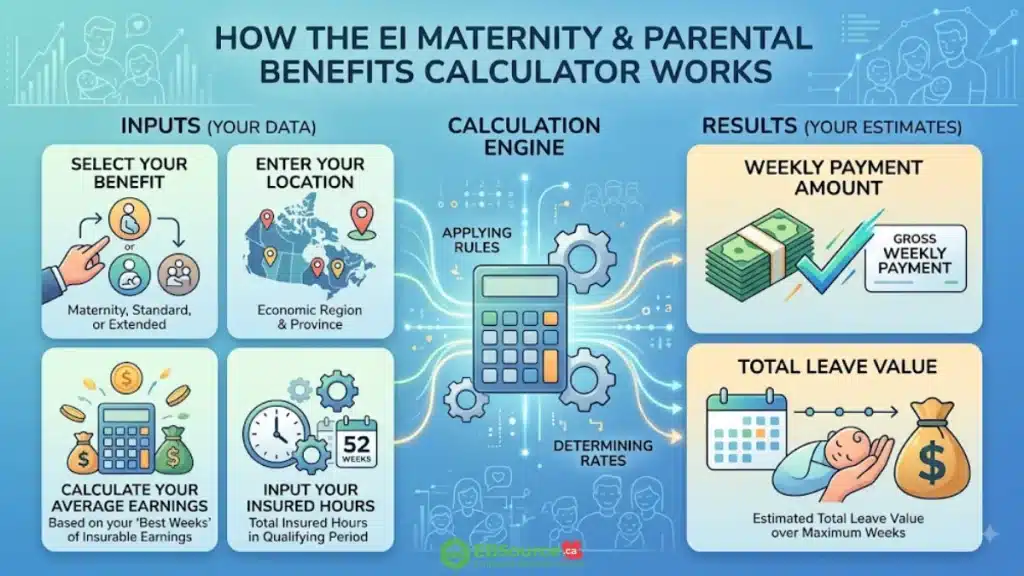
The Employment Insurance maternity and parental benefits calculator works in two stages. You supply four inputs, and it returns a weekly amount and a gross total. It does not look up your earnings, so the quality of your estimate depends on the figures you enter.
When entering information, you need to select the benefit you are applying for, your province and economic region, your average insurable weekly earnings, and your total insurable hours from the past 52 weeks. By choosing your region, the calculator will tell you how many best weeks apply to you, which you will use to figure out your earnings before entering them.
In the results step, the EI maternity and parental benefits estimator calculates 55% of your earnings for maternity and regular parental benefits, or 33% for extended parental benefits. It then limits the weekly amount to the highest allowed amount for 2026 and multiplies it by the number of weeks you can receive EI benefits.
| Stage | What happens | Where the figure comes from |
|---|---|---|
| Input | You select the EI maternity calculator; EI standard parental calculator or EI extended parental benefits calculator | Your own circumstances |
| Input | You select your province and economic region, which returns your number of best weeks, between 14 and 22 | Service Canada regional rates table |
| Input | You add together your highest paid weeks of insurable earnings, divide by that number of best weeks, and enter the result | Your Record of Employment |
| Input | You enter the hours of insurable employment you accumulated in the 52 weeks before your claim starts or since the start of your last EI claim, whichever period is shorter. If you had an EI claim in the past 52 weeks, do not automatically enter all hours worked during the full year. | Your Record of Employment |
| Result | Your average is multiplied by 55%, or 33% for extended parental benefits | Employment Insurance Act, section 14 |
| Result | The weekly figure is capped at $729, or $437 for extended parental benefits | Service Canada, EI benefit amount |
| Result | The weekly figure is multiplied by the maximum weeks for the benefit you selected | Service Canada, EI maternity and parental |
What Affects the Amount the EI Maternity and Parental Estimator Shows?
There are five factors that determine the result, which are insurable earnings, average insurable weekly earnings, best weeks, economic region, and the weekly maximum. Each factor affects the final amount as follows:
- Insurable earnings: the compensation from employment that counts toward your claim, including wages, bonuses, commissions and certain tips, up to an annual ceiling of $68,900 in 2026. The CRA decides which types of earnings are insurable, not your employer and not you.
- Average insurable weekly earnings: the weekly average calculated from your best weeks, before taxes. This is the figure you enter, and it is what the percentage is applied to, not your annual salary.
- Best weeks: a set number of your highest-paid weeks of employment, used instead of every week you worked. The count depends on where you live, which is why the same earnings history can produce a different weekly benefit amount depending on the claimant’s EI economic region.
- Economic region: the area you live in, which sets how many best weeks are used in your calculation. You need to select your region before you calculate the average insurable weekly earnings to enter.
- Weekly maximum: the ceiling your payment cannot exceed, set at $729 a week in 2026 for maternity and standard parental benefits, and $437 a week for extended parental benefits.
In addition, there are two more important limits to keep in mind before looking at your results:
First, the calculator shows the maximum weeks for the benefit you selected. Sharing parental benefits does not automatically reduce your individual maximum. One parent may still receive up to 35 standard weeks or 61 extended weeks. Sharing makes up to 5 additional standard weeks or 8 additional extended weeks available to the other parent or parents, bringing the family maximum to 40 or 69 weeks.
Second, the EI maternity and parental leave calculator does not include the family supplement, so families earning less than the limit might get more benefits than the estimate shows.
2026 Rates, Weekly Caps, and Week Maximums at a Glance
The table below compares the benefit rate, 2026 weekly maximum, maximum number of weeks and the period in which each benefit must be used.
| Benefit | Benefit rate | 2026 weekly maximum | Maximum weeks for one parent | Maximum weeks shared | Window to use the weeks |
|---|---|---|---|---|---|
| Maternity | 55% | $729 | 15 | Not shareable | Starts as early as 12 weeks before the due date, ends 17 weeks after the due date or the birth, whichever is later |
| Standard parental | 55% | $729 | 35 | 40 | 52 weeks from the week of birth or placement |
| Extended parental | 33% | $437 | 61 | 69 | 78 weeks from the week of birth or placement |
For a 2026 benefit period, maximum weekly insurable earnings are $1,325. If the average insurable weekly earnings used in your EI calculation reach that amount, the basic weekly benefit is capped at $729 for maternity or standard parental benefits and $437 for extended parental benefits. Annual salary alone does not determine whether you reach the weekly maximum.
Understanding the Differences Between Individual and Shared Columns
The shared numbers show the total benefits a couple can get, not just one parent. When parental benefits are shared, parents can receive up to 40 standard weeks or 69 extended weeks in total. However, no one parent can receive more than 35 standard weeks or 61 extended weeks. This means another parent must claim at least 5 standard weeks or 8 extended weeks for the family to use the full shared maximum.
This difference matters when calculating total benefits. Each parent files a separate application, and each benefit is calculated from that parent’s own insurable earnings. Hence, the household total is the sum of two separate calculations rather than a single weekly rate multiplied by 40 or 69 weeks.
It is also important to note that maternity weeks are not counted against the parental limits because maternity benefits can precede parental benefits within the same application. A birth parent claiming the maximum alone can get up to 50 weeks with the standard option or up to 76 weeks with the extended option.
Which Other Adjustments Might Change the Amount the Calculator Shows?
Four adjustments sit outside the calculator’s arithmetic: the family supplement, waiting period, your employment status, and employer top-up. They can increase or decrease your actual payment in various ways.
The Family Supplement Can Raise Your Weekly Payment
If your annual net family income is $25,921 or less, you have at least one child under 18, and you or your spouse or common-law partner receive the Canada Child Benefit, you may qualify for the EI family supplement from Service Canada. The supplement cannot exceed 25% of your weekly insurable earnings. This means the maximum potential replacement rate differs by parental-benefit option:
- Maternity and standard parental benefits: the 55% base rate can increase to as much as 80% of weekly insurable earnings.
- Extended parental benefits: the 33% base rate can potentially increase to as much as 58% of weekly insurable earnings.
The actual supplement may be lower, depending on family net income and the number and ages of the children. If both spouses are receiving EI at the same time, only one spouse can receive the Family Supplement. The total weekly EI payment, including the Family Supplement, cannot exceed the maximum weekly EI benefit rate.
You do not need to apply for this supplement; it is automatically calculated based on the income information already filed, so it’s important to keep your tax filings up to date if your income is close to the limit.
Waiting Period Is Currently Waived For New Claims
EI normally applies a one-week unpaid waiting period at the start of a claim. Still, a temporary measure waives it for initial claims that start between March 30, 2025 and October 10, 2026, including maternity and parental claims.
After October 10, 2026, the regular one-week waiting period will apply again unless the waiver is extended. The waiver applies to new EI claims that start between March 30, 2025 and October 10, 2026. After that date, the usual waiting period is expected to apply again unless the measure is extended. Make sure to check Service Canada’s website for the most current information.
Under the normal EI rules, only one waiting period generally applies when parents share parental benefits for the same child. For qualifying initial claims starting from March 30, 2025 through October 10, 2026, that waiting period is currently waived.
You can also choose to serve the waiting period if it benefits you, especially if your employer has a top-up plan that requires you to receive EI or have served the waiting period before they pay out. Confirm your employer’s plan before you file.
You Can Work While Receiving Benefits
Under the Working While on Claim rules, you can keep 50 cents of your benefits for every dollar you earn, up to a limit of 90% of your average weekly earnings. After reaching that limit, any additional earnings will reduce your benefits dollar for dollar.
For example, if Jordan usually receives $660 a week based on average earnings of $1,200 (which sets a limit of $1,080):
- Weekly earnings: $400
- Benefit deduction: 50% of $400 = $200
- Benefits for that week: $660 – $200 = $460
- Total income that week: $460 + $400 = $860
Make sure to report your earnings for the week you worked, not when you get paid. If earnings are reported incorrectly, you may receive an overpayment that you later have to repay. Note that these rules for EI maternity and parental benefits have been in effect since August 12, 2018.
A Properly Structured Employer Top-Up Is Not Deducted
An employer top-up for maternity or parental benefits is generally not treated as earnings or deducted from EI if the plan meets Service Canada’s requirements. The combined EI benefit and top-up cannot exceed 100% of the employee’s normal weekly earnings, and the maternity and parental top-up plans cannot be used to reduce other accumulated employment benefits such as vacation credits, banked sick leave or severance pay.
Ask your employer three questions before you choose between standard and extended:
- How is the top-up calculated? Many plans top up to a percentage of salary and pay less when your EI benefit is higher.
- How many weeks does it run? An employer top-up may cover fewer weeks than the employee’s full leave. Check the plan’s duration.
- Is it tied to the standard rate? A plan built around a 55% benefit may pay differently, or not at all, against the 33% extended rate.
What Do Real EI Maternity and Parental Benefits Calculations Look Like?
The three examples below cover the situations that most often surprise people: variable pay, a short work history, and the standard-versus-extended comparison. Each assumes no prior claims within 52 weeks and no family supplement.
Example 1: Uneven Or Commission Pay
Marcus earned about $62,000 over the year, with several thin weeks and a strong autumn, and lives in a region that currently uses the 21 best weeks. Because only his strongest weeks enter the calculation, his benefit is built from a higher figure than his annual average implies.
Here is how the EI maternity and parental benefits calculator works:
| Line item | Amount |
|---|---|
| Annual insurable earnings | $62,000 |
| Simple 52-week average | $1,192 |
| Best-weeks divisor | 21 weeks |
| Average insurable weekly earnings | $1,300 |
| Weekly benefit rate | 55% × $1,300 = $715 |
The takeaway: only your strongest weeks count, so variable pay can produce a higher benefit than steady pay at the same annual total.
Example 2: Short Work History
Noor worked 18 weeks at $1,200 in Toronto, which currently uses the 21 best weeks. Because Toronto currently requires 21 weeks in the benefit calculation, Noor’s $21,600 of insurable earnings is divided by 21 even though she earned those amounts over only 18 worked weeks.
The EI maternity and parental calculation is:
| Line item | Amount |
|---|---|
| Weeks worked | 18 |
| Total insurable earnings | $21,600 |
| Best-weeks divisor | 21 weeks |
| Average insurable weekly earnings | $1,028.57 |
| Weekly benefit rate | 55% × $1,028.57 = $566 |
| Gap against a simple 18-week average | $94 per week |
| Cost across a 35-week standard parental claim | 35 × $94 = $3,290 |
Example 3: Standard vs Extended Parental Benefits for One Parent
Sam has average insurable weekly earnings of $1,200 and is claiming alone rather than sharing weeks with another parent.
The two options compare as follows:
| Line item | Standard parental | Extended parental |
|---|---|---|
| Benefit rate | 55% | 33% |
| Weekly benefit | $660 (55% × $1,200) | $396 (33% × $1,200) |
| Maximum individual weeks | 35 | 61 |
| Gross total if every week is used | $23,100 | $24,156 |
The takeaway: The main trade-off is weekly cash flow versus duration, but the maximum gross totals are not identical. In this example, extended benefits provide a slightly higher total over a much longer period, while standard benefits provide substantially more income each week.
How to Choose Between Standard and Extended Parental Benefits
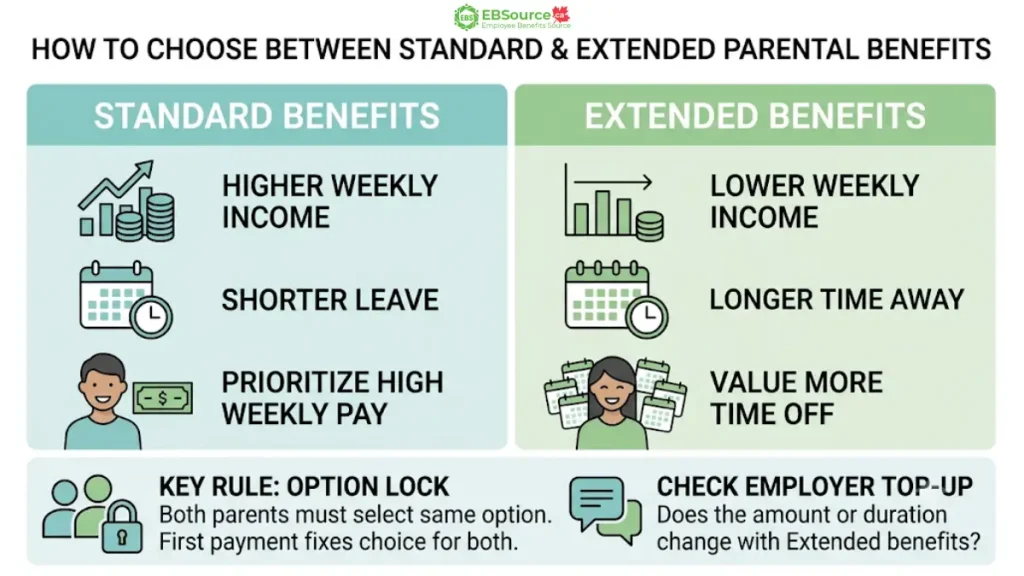
When deciding between standard and extended parental benefits, consider your household budget and your plans for returning to work. In short, calculate standard parental benefits if you need higher weekly income over a shorter leave, or extended parental benefits if a longer leave matters more than the weekly amount.
- Standard Benefits: If maximizing your weekly payment is a priority, the standard option is a better fit. If you expect to return to work within a year, the extended option might not help, as unused weeks expire at the end of the extended period.
- Extended Benefits: If you prefer a longer time away from work and can manage on a lower weekly amount, then the extended option may be more suitable.
Also, if your employer adds extra pay, be sure to know how it is calculated before deciding. If your employer offers a maternity or parental top-up, check whether the amount or duration changes when you choose extended parental benefits. Be sure to use an EI maternity and parental calculator for both options before you apply.
Watch the option lock: once either parent receives a payment under standard or extended parental benefits, neither of you can switch to the other option. Both parents must select the same option. If parents submit different choices, Service Canada uses the option selected on the first application received. Once a week of parental benefits has been paid to either parent, the standard/extended choice cannot be changed.
Do You Qualify For EI Maternity And Parental Benefits?
You qualify if your situation matches the benefit you claim, your weekly earnings dropped by more than 40%, and you have 600 insurable hours. Service Canada sets this out as four conditions because the situation test is written separately for maternity benefits and for parental benefits.
You need to demonstrate the following:
- Maternity benefits: you are pregnant or have recently given birth.
- Parental benefits: you are a parent caring for your newborn or newly adopted child.
- Your regular weekly earnings from work have decreased by more than 40 percent for at least one week.
- You accumulated 600 insurable hours of work in your qualifying period.
The first two decide which benefit you claim, and the last two are the financial tests behind both. Both financial tests are measured on your own record. Hours of insurable employment are not pooled between parents, so a partner with hours to spare cannot cover a shortfall in yours, and a second parent claiming parental weeks needs their own 600 hours and their own drop in earnings.
The earnings test measures the size of the drop rather than whether you stopped working entirely. A decrease of exactly 40% does not meet it because the rule requires more than 40 percent.
Your qualifying period is the 52 weeks before your claim starts, or the period since your last claim began, whichever is shorter. Hours worked before that window do not count, which matters most if you were away from work for part of the year.
Most claimants need 600 hours of insurable employment during their qualifying period. It does not move with your local unemployment rate, unlike EI regular benefits calculation, where the requirement runs from 420 to 700 hours depending on your economic region. EI sickness calculation and EI caregiving benefits calculation use the same flat 600 hours as maternity and parental claims.
If you are unsure whether you meet the hours requirement, you can still apply and let Service Canada determine your eligibility. Service Canada decides eligibility when it assesses your claim rather than from a self-check, and your Record of Employment may show more insurable hours than you counted, which matters most when you are close to the threshold.
Exception: If you received EI benefits in the past 52 weeks, the number of maternity or parental weeks now available to you may be lower, although you may be able to start a fresh claim if you have worked enough hours since. Contact Service Canada if this applies, because the better route depends on your hours and your dates.
Source: EI maternity and parental benefits – Do you qualify – Government of Canada
FAQs about EI Maternity And Parental Benefits Calculator
Does the EI maternity and parental benefits result show what lands in your bank account?
No, the result is a gross benefit amount. EI benefits are taxable, and federal and provincial or territorial taxes, where applicable, are deducted from your payments. The amount withheld may not equal your final tax liability for the year. EI maternity and parental benefits themselves are exempt from the EI benefit-repayment provision that can apply to regular benefits, including regular fishing benefits. However, family income can still affect whether you receive an EI Family Supplement and how much supplement is added.
Can self-employed people use this EI maternity and parental benefits calculator?
Not directly. This EI maternity and parental benefits calculator is designed for employees whose claims are based on insurable hours and earnings reported through Records of Employment. Self-employed people use different eligibility rules for EI special benefits.
For a 2026 claim, they generally must have an EI self-employed agreement with the Canada Employment Insurance Commission that has been active for at least 12 months, have earned at least $9,254 in net self-employed earnings in 2025, reduce the amount of time spent working on their business by more than 40% for at least one week, and meet the conditions for the specific benefit claimed.
Do these EI maternity and parental benefits apply if you live in Quebec?
Generally no. Quebec residents receive maternity, paternity, parental, and adoption benefits through the Quebec Parental Insurance Plan, not Employment Insurance. QPIP uses different rates, different week counts, a dedicated paternity benefit, and no waiting period, and its maximum insurable earnings rises to $103,000 on January 1, 2026.
All other EI benefit types, including sickness and caregiving benefits, remain available to Quebec residents. If you live in Quebec, use the QPIP estimator instead, because the figures on this page will not describe your entitlement.
Do twins or triplets give you more weeks of benefits?
No. The number of weeks of maternity and parental benefits does not change for a multiple birth or for adopting more than one child at the same time. Entitlement is set per pregnancy or per placement, not per child, so a parent of twins receives the same 15 maternity weeks and the same parental weeks as a parent of one baby.
The calculator behaves the same way. Enter your earnings once and select the benefit you are claiming, because there is nothing to multiply for a second or third child.
Families of multiples do have one lever. The extended option spreads a lower weekly payment across a longer period, which some households prefer when two infants push back the realistic return-to-work date.
What should you do next after calculating EI maternity and parental benefits?
Apply as soon as you stop working, without waiting for your Record of Employment, because delaying more than four weeks after your last day of work can cost you benefits. You will need your Social Insurance Number, your banking information for direct deposit, the dates and details of your recent employment, and your expected or actual date of birth if you are claiming maternity benefits. If you are claiming parental benefits, each parent files a separate application, and both must select the same option.