
Statutory Benefits in Canada: Programs and Coverage Overview
Statutory benefits are public income programs created by law. For employees, the main ones are the Canada Pension Plan (CPP) or Quebec Pension Plan (QPP), Employment Insurance (EI), the Quebec Parental Insurance Plan (QPIP) and workers’ compensation. Each one responds to a different life event.
That difference matters because payroll deductions do not automatically entitle you to a particular benefit. A job loss, an illness, a new baby and a workplace injury can each lead to a different program. This guide helps you find the program that fits your situation, understand how the systems differ, and access a detailed guide to eligibility, payments, and applications.
What Are Statutory Benefits in Canada?
Statutory benefits in Canada consist of public social insurance programs that employers must contribute to, and mandatory employment standards they must administer. Employers either bear the full financial obligation for these requirements or share it with the employee.
- Payroll-funded social programs: Funded through mandatory payroll contributions, these public programs provide financial safety nets.
- Minimum workplace entitlements: Governed by employment standards, these guarantees operate separately from the payroll-funded programs and mandate protected time off, including paid annual vacation, statutory holidays, and job-protected leaves.

This article covers the four payroll-funded social programs:
Canada Pension Plan (CPP) or Quebec Pension Plan (QPP) funds retirement income, disability benefits, and survivor benefits for employees and self-employed individuals.
- The Canada Pension Plan covers all provinces and territories except Quebec;
- The Quebec Pension Plan applies to employees working in Quebec.
EI (Employment Insurance) provides temporary income support to eligible workers across Canada, including Quebec. Eligible Quebec residents generally receive maternity and parental benefits through QPIP instead.
QPIP (Quebec Parental Insurance Plan) provides maternity, paternity, adoption, and parental benefits for eligible Quebec residents: both employees and the self-employed. It replaces EI maternity and parental benefits for Quebec residents.
Workers’ compensation covers work-related injuries and illnesses. Employers pay premiums; employees do not contribute directly. Each province and territory administers its own system.
Which Statutory Benefit Program Should You Check?
The programs introduced above support different situations. Start with what has changed in your work or family life, then use the links below to explore the relevant benefit.
| Situation | Relevant benefit | What it can provide |
| Job loss | EI regular benefits | Temporary income support while you look for work |
| Temporary illness or injury | EI sickness benefits | Temporary income support while you cannot work for medical reasons |
| Work-related injury or illness | Workers’ compensation | Income replacement and, depending on the applicable system and claim, treatment, rehabilitation and return-to-work support |
| Pregnancy, birth or adoption |
EI maternity and parental benefits;
QPIP for eligible Quebec residents |
Income support during time away from work for pregnancy, recovery from childbirth or caring for a new child |
| Critical illness or end-of-life care | EI family caregiver or compassionate care benefits | Temporary income support when you take time away from work to provide qualifying care or support |
| Severe, long-term disability | QPP or CPP disability benefits | Monthly income support for contributors who meet the program’s disability and contribution conditions |
| Retirement | QPP or CPP retirement pension | A monthly pension based on your contribution record and the age at which payments begin |
| Death of a contributor |
QPP or CPP survivor’s pension
QPP or CPP children’s benefits QPP or CPP death benefits |
Potential monthly payments to eligible family members and a separate lump-sum death benefit |
What Canadian Statutory Benefit Programs Can Provide
Keep in mind that most statutory income replacement benefits are considered taxable income, meaning you’ll have taxes withheld or owe taxes at year-end. However, workers’ compensation benefits are generally not taxable, although they must usually be reported on your income tax return. (Workers’ compensation benefits – Personal income tax – Canada.ca)
How Do the Main Statutory Benefit Programs Differ?
The programs differ in who they support, how long support lasts, who pays contributions or premiums and where employees access it. The comparison below gives you the basic information needed to understand each system.
| Comparison factor | CPP/QPP | EI | QPIP | Workers’ compensation |
| Who it supports | Eligible contributors and, for certain benefits, their families | Workers who meet the requirements for a particular EI benefit | Eligible Quebec residents, including employees and self-employed workers | Workers covered by the applicable compensation system whose claims are accepted |
| How long support lasts | Retirement pensions continue for life; other benefits have their own duration rules | A limited number of weeks, depending on the benefit and claim | A limited number of weeks, depending on the benefit and plan | Depends on the benefit, accepted condition and applicable system |
| Who pays contributions or premiums | Workers and employers; self-employed people pay both portions | Employees and employers; self-employed participation follows separate rules | Employees, employers and self-employed workers | Employers; employees do not pay compensation premiums through payroll deductions |
| Where employees access it | Service Canada for CPP; Retraite Québec for QPP | Service Canada | QPIP online services or customer service | The workers’ compensation authority covering their workplace |
Key Differences Between Canada’s Main Statutory Benefit Programs
Quebec distinction: EI remains relevant in Quebec, but eligible Quebec residents generally receive maternity and parental support through QPIP. Additionally, CPP and QPP are separate pension plans with coordinated contribution histories.
Use the guides linked in the previous section to check your specific benefit’s eligibility requirements, current payment limits and application steps.
What Determines Your Statutory Benefit Payments?
Your payment depends on the program and your circumstances. A published maximum is the upper limit, not your personal entitlement. To understand the income available to you, start with your estimated benefit, identify what reaches your bank account and establish how long that support could last.
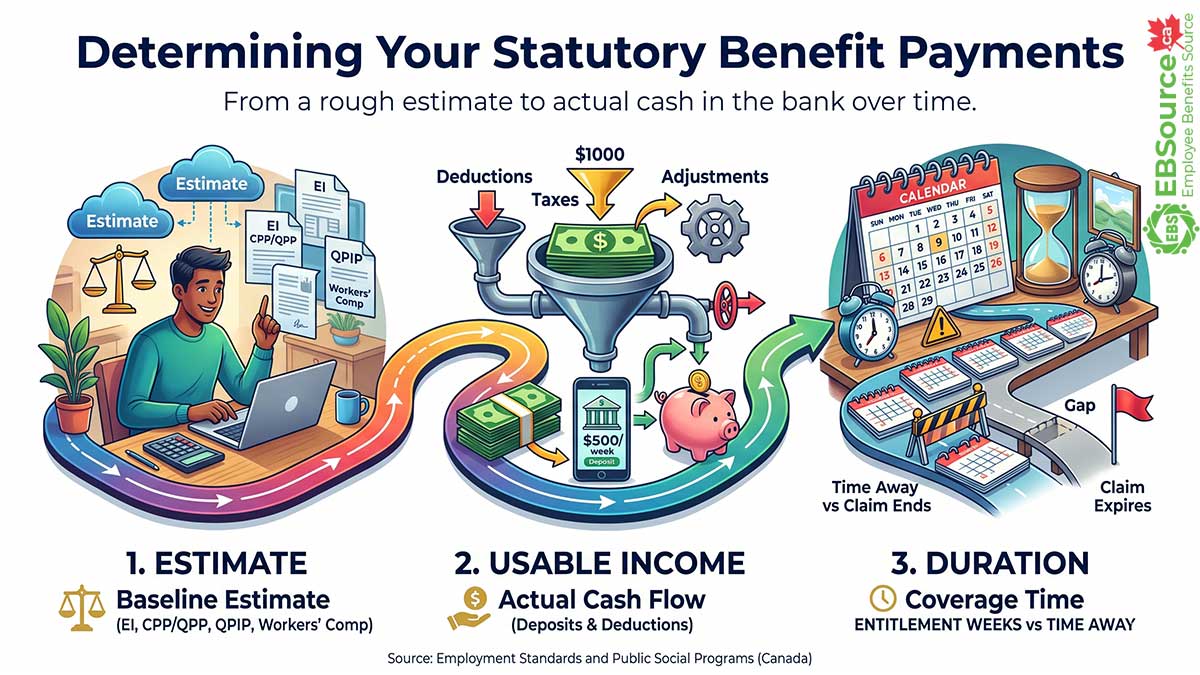
Start With Your Estimated or Approved Amount
Before applying, use an estimate based on your own information:
- EI: Enter your details in the EI benefits calculator.
- CPP/QPP retirement: Refer to the pension estimates in your personal statement or official account.
- QPIP: Use the official benefit calculation simulator.
- Workers’ compensation: Refer to the applicable board’s guidance; calculations vary by jurisdiction.
Record whether the estimate is weekly or monthly. Treat it as a planning figure until you receive a decision, then use the approved amount as your starting point.
Translate That Amount Into Usable Income
The approved benefit and the deposit in your bank account may differ because of applicable deductions, adjustments or the number of periods paid together.
Match your payment statement or online payment history to the deposit. Identify the period covered, the benefit payable and any deductions or adjustments.
For example, a $1,000 deposit covering two weeks represents $500 per week. If your first deposit includes retroactive payments, use the breakdown to separate those amounts from your ongoing income.
Establish How Long That Income Could Last
For temporary benefits, the payment amount tells only part of the story. You also need the number of payable weeks and the periods those payments cover.
Use your decision letter or claim account to identify the approved entitlement and any weeks already paid. Place the remaining payments against your expected time away from work to see whether an income gap may arise.
Your available benefit weeks may run out before the claim expires. For EI, for example, the claim can remain open after the available benefit weeks have been used.
How Do Statutory Benefits Interact With Workplace Benefits?
Statutory benefits provide public support, while employer-sponsored benefits provide coverage under a workplace plan. They can support the same person, but their payments don’t necessarily add up in full.
Workplace Benefits May Supplement Public Support
Your employer may provide paid sick time, disability insurance or a benefit top-up. These arrangements may help cover an income gap, but the amount available depends on the workplace plan and how it interacts with the public program.
One Payment May Reduce Another
A workplace disability policy may account for CPP/QPP disability or workers’ compensation payments when calculating its own benefit. This is often called an offset or integration of benefits. (Source)
Look under “other income,” “offsets”, or “integration” in your benefit booklet. Ask the plan administrator to identify which public payments affect your workplace benefit and provide a breakdown of the resulting amount. Do not budget by adding each program’s advertised payment together.
If a public benefit is approved retroactively, ask whether your workplace insurer will recalculate benefits already paid before you spend the lump sum. (Source)
Each Program Makes Its Own Decision
Approval under a workplace plan does not automatically establish entitlement to a public benefit, or vice versa. Each applies its own requirements and assesses its own claim.
For example, receiving workplace disability payments does not automatically qualify you for CPP disability benefits. Use the guide for each relevant benefit to understand its separate requirements.
Your Next Step
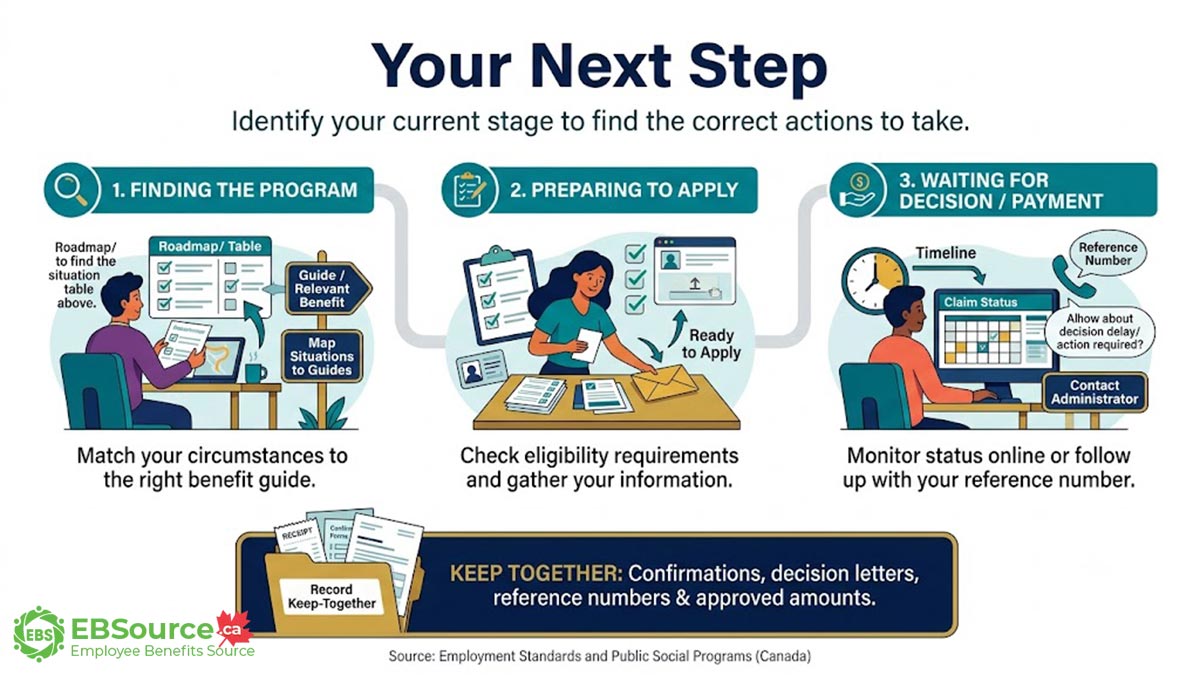
Choose your next action based on where you are now:
- Finding the right program: Match your circumstances to the situation table above, then follow the link to the relevant benefit guide.
- Preparing to apply: Use that guide to identify the eligibility requirements, information to gather and the official application route.
- Waiting for a decision or payment: Open your claim account or latest correspondence to identify outstanding requests. If the delay is unclear, contact the administrator with your reference number and ask what action is needed and who must take it.
Keep your application confirmation and decision letters together. They include your reference numbers, approved amounts, and instructions needed to manage your benefit.
Frequently Asked Questions about Statutory Benefits in Canada
Can working for more than one employer cause excess payroll deductions?
Yes. Each employer calculates deductions separately, so your combined CPP contributions or EI premiums may exceed the annual employee maximum. Eligible excess amounts are reconciled when you file your income tax return. Include the tax slips from all your employers so the calculation reflects your total deductions.
Can a family member manage my benefits for me?
Depending on the program, you may authorize someone to communicate or act on your behalf. CPP consent to communicate does not authorize someone to apply or change your payment address (Source). EI has a separate representative process for claimants unable to manage their claim because of health problems. (Source)
Do part-time employees participate in statutory programs?
Part-time status alone does not determine coverage. EI uses insurable-employment rules, CPP/QPP use their own pensionable-employment and contribution rules, and workers’ compensation coverage depends on the applicable system. Eligibility for a particular payment is assessed separately.
Can I opt out of statutory contributions?
You generally cannot opt out because you do not expect to claim benefits. Contribution requirements differ by program. However, certain working pension recipients can elect to stop CPP or QPP contributions if they meet that plan’s conditions.
Are OAS and GIS the same as CPP?
No. Old Age Security is generally based on age, legal status and residence history rather than employment contributions. Guaranteed Income Supplement provides additional support to eligible low-income OAS recipients. They are important components of retirement income for many Canadians but fall outside the scope of this article.