


To understand Employment Insurance benefits, you need to figure out which of the four types fits you: regular, sickness, caregiving, or maternity and parental. Once you identify the relevant benefit, the calculator can estimate the standard weekly rate. Eligibility and the number of payable weeks may still depend on information the calculator cannot assess.
Most EI benefits pay 55% of your average weekly earnings, up to $729 a week, except for extended parental leave, which pays 33% and is capped at $437. Besides, how long you get payments also varies widely: regular claims normally run from 14 to 45 weeks (temporarily up to 65 for long-tenured workers), while extended parental benefits can provide up to 69 weeks when shared between two parents (up to 61 weeks for one parent alone).
Also, extra benefits like the family supplement or extra payments from your employer can raise your payments, while taxes and earnings during your claim may reduce what you receive. The EI benefits calculator cannot tell if you qualify, so it’s important to understand these details.
EI Economic Region
Your EI regular benefits estimate
Select a benefit type and fill in your details, then click Calculate Benefits to see your estimate.
Data sources: Regional unemployment rates and best-weeks divisors are based on Service Canada’s current EI Program Characteristics table. A notice of violation from a previous EI claim can increase the number of hours required. This calculator uses rules for claims beginning in 2026 and the EI regional data period shown below. It should not be used to recalculate an earlier claim. EI regional data period: September 6, 2026 to October 10, 2026. Last verified by EBSource: September 7, 2026.
Which EI Benefit Should You Calculate?
EBSource’s Employment Insurance Benefits Calculator groups EI estimates into four paths: regular benefits, sickness benefits, caregiving benefits, and maternity/parental benefits. The benefit that applies depends on your circumstances, not on which option produces the highest estimate.
Among these, EI caregiving benefits and EI maternity and parental benefits have more than one category or option:
- EI caregiving benefits have three categories, and the correct category depends on who you are caring for, their age, and whether the medical certificate confirms a critical illness or injury or a need for end-of-life care.
- EI parental benefits come in standard and extended options; compare both before applying because the choice affects both the weekly payment and the number of weeks available.
Find the situation below that best matches yours:
| Your situation | Relevant EI benefits |
|---|---|
| Your job ended through no fault of your own, through a layoff, a shortage of work, or the end of a seasonal contract | EI regular benefits |
| You cannot work for medical reasons, including illness, injury, quarantine, or organ or tissue donation | EI sickness benefits |
| You are caring for a critically ill or injured child under 18 | EI caregiving benefits: family caregiver benefit for children, up to 35 weeks |
| You are caring for a critically ill or injured adult | EI caregiving benefits: family caregiver benefit for adults, up to 15 weeks |
| You are caring for someone needing end-of-life care | EI caregiving benefits: compassionate care benefits, up to 26 weeks |
| You are pregnant or have recently given birth | EI maternity benefits, up to 15 weeks, not shareable |
| You are a parent caring for a newborn or newly placed child | EI parental benefits: standard or extended, an option you and the other parent select together |
When Should You Check the EI Rules Before Using the EI Calculator?
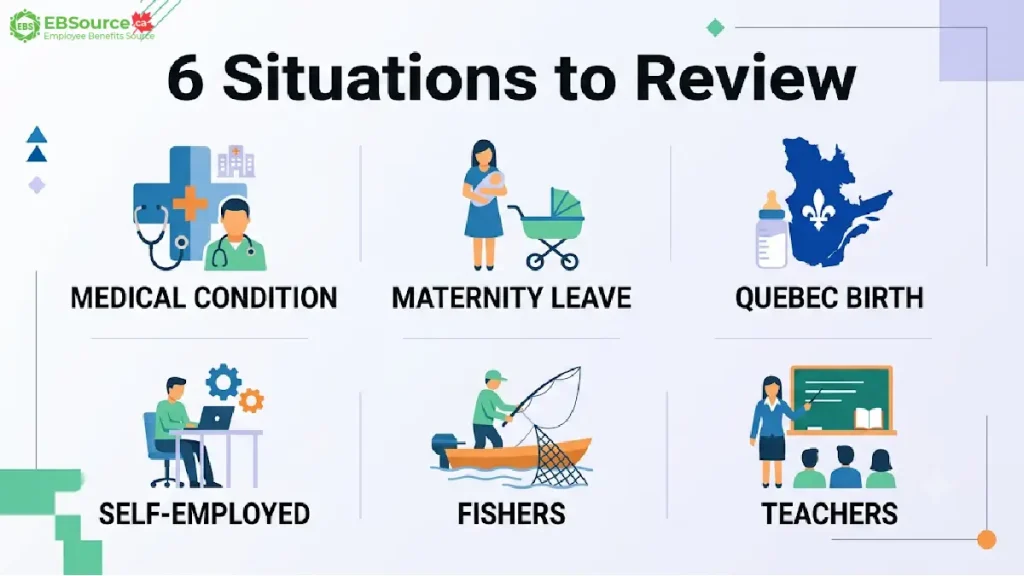
There are six specific situations to look at more closely before you use the EI benefits calculator: a medical condition during a regular claim, maternity leave overlapping with parental leave, a birth or adoption in Quebec, a self-employed claim, a fishing claim, and a teaching contract.
Here is how each one works:
- A medical condition during an EI regular claim: If you become unable to work for medical reasons during an existing EI claim, sickness benefits may be payable within the same benefit period. Check whether those weeks qualify for sickness benefits rather than treating them as a new claim with a new benefit rate.
- EI maternity benefits followed by parental benefits: These are separate benefits, so calculate them separately: once for maternity benefits and again for parental benefits. Maternity and standard parental benefits both use the 55% EI rate, while extended parental benefits use the lower 33% rate. To estimate your full leave, calculate the maternity portion, then the parental option you plan to use.
- Quebec residents applying for EI maternity or parental benefits: Use the Quebec Parental Insurance Plan instead of this page. The EI regular, EI sickness, and EI caregiving calculators still apply.
- Self-employed claimants: Only special benefits are available, and your agreement with the Canada Employment Insurance Commission generally must have been active for at least 12 months, with additional earnings conditions based on your net self-employment income in the previous calendar year. Your benefit is calculated from your self-employed earnings rather than insurable hours, so the 600-insurable-hour requirement shown for employees does not apply to self-employed claimants. If you also have insurable employment as an employee, separate rules apply to that employment.
- Fishers: Fishing benefits are calculated using insurable fishing earnings rather than insurable hours, so the calculators on this page will not produce an appropriate estimate.
- Teachers: Teachers may still qualify for EI regular or special benefits, but additional rules apply during non-teaching periods.
What Are the EI Benefit Rates and Maximum Weeks for 2026?
Every EI benefit on EBSource pages pays 55% of your average insurable weekly earnings, up to $729 a week in 2026. Extended parental benefits are the one exception, at 33% and $437. Both maximums apply to claims beginning on or after December 28, 2025, and reflect the 2026 maximum insurable earnings of $68,900.
The benefit duration varies by claim type and qualifying criteria. For instance, under the normal rules, EI regular benefit weeks range from 14 to 45 weeks based on your insurable hours and the unemployment rate in your EI economic region, while extended parental benefit weeks can be up to 69 shared weeks.
The qualifying-hour rules also differ by benefit type: special benefits (sickness, caregiving, maternity, and parental) require at least 600 insurable hours for employees, while EI regular benefits require between 420 and 700 hours, depending on the unemployment rate in your region.
Once you know which benefit applies, the Employment Insurance calculator uses these figures:
| Benefit | Rate | 2026 weekly maximum | Maximum weeks | Insurable hours needed |
|---|---|---|---|---|
| EI Regular | 55% | $729 | 14 to 45, set by hours and regional rate (temporarily up to 65 for long-tenured workers) | Normally 420 to 700, by region |
| EI Sickness | 55% | $729 | Up to 26 | Normally 600 |
| EI Caregiving | 55% | $729 | 15, 26, or 35, depending on which caregiving benefit applies | Normally 600 |
| EI Maternity | 55% | $729 | Up to 15, not shareable | Normally 600 |
| EI Standard parental | 55% | $729 | Up to 35 for one parent, 40 shared | Normally 600 |
| EI Extended parental | 33% | $437 | Up to 61 for one parent, 69 shared | Normally 600 |
Note: These figures are the standard entrance requirements for insurable employees. If you have a violation on a previous EI claim, you may need more insurable hours to qualify for a new claim.
What Does the EI Estimate Leave Out?
The calculator does not account for every factor that can affect your EI claim. Some factors can increase what you receive, while others can reduce, delay or change your payments.
Each one is set out below, along with the guide that works through it in full:
| Factor not included in the estimate | What it does |
|---|---|
| Income tax | EI benefits are taxable, and tax is deducted from payments. The amount withheld may not equal your final tax liability for the year |
| The family supplement | Can raise the effective rate to as much as 80%, subject to the weekly maximum, so some households receive more than the estimate shows |
| Employer top-up plans* | Employer supplements can increase total income while you receive EI, but the rules depend on the benefit type. SUB plans for temporary stoppage of work, training, illness, injury or quarantine generally must be registered with Service Canada and meet the applicable 95% limit. |
| Earnings reported during a claim | Employment earnings and certain other amounts reduce the benefit payable for the affected weeks: 50 cents of benefits are deducted per dollar earned up to 90% of your previous weekly earnings, and dollar for dollar above that |
| The one-week waiting period | Currently waived |
| Separation earnings | After the temporary measure ends, amounts such as severance, vacation pay or pay in lieu of notice may be allocated to your EI claim under the normal earnings rules and can delay or reduce benefits for affected weeks. The result depends on the type of payment and how Service Canada allocates it. |
| Any eligibility decision | The EI calculator produces a number for people who do not qualify, because the eligibility gate is different for every benefit and none of them is part of the formula |
You may qualify for the Family Supplement if your annual net family income is $25,921 or less, you have a child under 18, and you or your spouse receives the Canada Child Benefit. It can increase EI payments for eligible low-income families. For benefits that use the standard 55% rate, it can raise the effective rate to as much as 80% of weekly insurable earnings. The Family Supplement itself is capped at 25% of weekly insurable earnings, and the total payment remains subject to EI’s statutory weekly maximum. Service Canada adds it automatically, so you do not need to apply separately.
(*) Maternity, parental and caregiving top-ups follow separate rules, do not require Service Canada registration, and can generally bring combined weekly income up to 100% of normal gross earnings when the required conditions are met.
Why Might Your EI Payment Differ From the EI Estimate?
There are four main factors that can affect the amount of your Service Canada payment:
- the earnings reported on your ROE, which may differ from the amount you entered,
- an existing claim from the past 52 weeks,
- the regional unemployment data in effect when your claim is established,
- and eligibility, which the EI benefits calculator never assesses.
The EI benefits calculator relies on the information you enter. Service Canada determines your claim using your ROE, claim history, regional data and other information on file.
Here is why your calculator estimate may differ from Service Canada’s determination:
| Factor | What the EI calculator uses | What Service Canada uses |
|---|---|---|
| Earnings | The weekly figure you enter | Your ROE(s), including amendments, plus information you provide about your insurable earnings and highest-paid weeks. |
| Claim history | A fresh claim every time | An existing claim within 52 weeks, normally reactivated |
| Regional data | The rate period the tool was last updated against | The regional rate applicable when Service Canada establishes your claim |
| Eligibility | Not assessed | Assessed, and it can end the claim regardless of the arithmetic |
When an employer makes changes to a ROE, a new serial number is issued, and the updated earnings replace the previous estimates. If you started an EI claim in the last 52 weeks and still have weeks left, Service Canada will usually restart your claim instead of opening a new one. However, sometimes it might be better to start a new claim, but you could lose any unused weeks from the old claim, so consider the effects.
Your region is also fixed when you file. Entitlement is set by the rate in force at the time you file, and it does not change if you move afterwards. Those rates are republished roughly every four weeks.
For example, the current rate period is from September 6 to October 10, 2026. Claims governed by a later rate period may use different regional unemployment rates, qualifying-hour requirements and best-week divisors.
If your regional unemployment rate goes down between periods, the effect works against you on all three fronts: you need more insurable hours to qualify, more best weeks are used in the divisor (which can lower your weekly rate if some of those weeks are low-earning), and fewer weeks of benefits are payable. If the rate goes up, each of those moves in your favour.
Factors to Check If Your EI Payment Is Lower Than the Estimate
When you receive your EI benefit statement, you may see that the weekly amount is less than the tool’s estimate. This difference usually comes from one of seven reasons, grouped into two categories.
Three of these reasons come from the information you gave, and you can fix them by correcting your details and using the EI benefits calculator again. The other three reasons come from Service Canada’s records and may include a changed ROE, a reopened claim, or a change in the regional rate between the last tool update and when you filed your claim.
The seventh reason to think about is taxes. This is not really a gap but the difference between the total estimated amount and the money put into your account.
Check them in that order, so the ones you can still fix come first.
- Did you enter net pay instead of gross insurable earnings?
- Did you divide your salary by 52 rather than using your best weeks?
- Did you select extended parental when you meant standard, or the wrong caregiving benefit?
- Has an employer filed an amended ROE since you applied?
- Was an existing claim from the past 52 weeks reactivated?
- Did the applicable regional rate change between the tool’s last update and the period in which Service Canada established your claim?
- Is tax being withheld from each payment?
Key takeaway: Treat the EI calculator result as a planning estimate. Your actual benefit amount is the amount Service Canada determines after processing your claim.
Which Employment Insurance Rules Could Change Your Estimate?
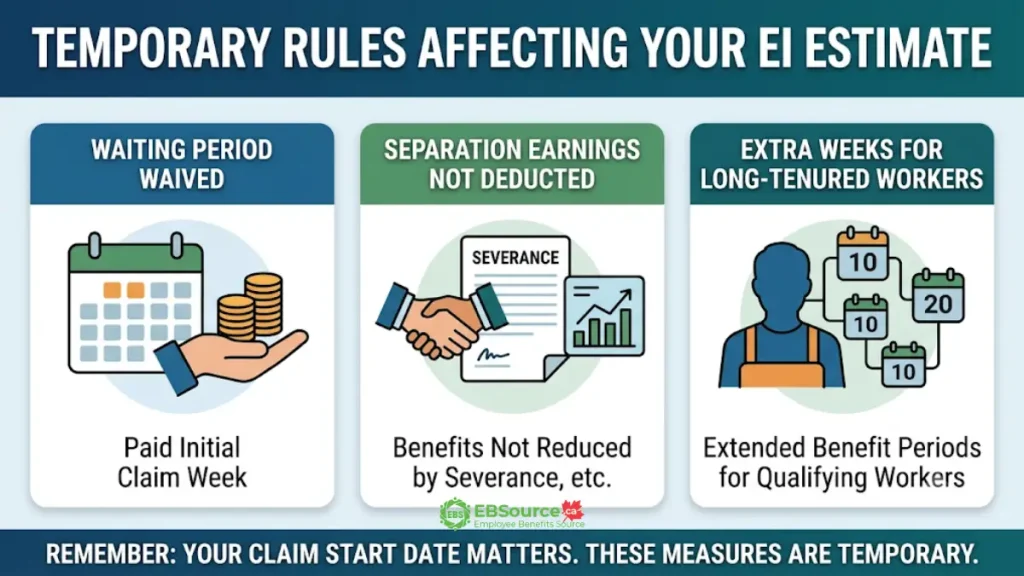
If your claim starts in 2026, Service Canada’s current temporary economic-conditions page identifies three measures that directly affect the calculations. Two of them apply to every EI benefit estimator on EBSource: for new EI claims starting between March 30, 2025 and October 10, 2026, the usual one-week waiting period is waived, and separation earnings such as severance are not deducted. The third, up to 20 additional weeks for long-tenured workers, applies only to EI regular claims.
Here is what each measure changes, and which date decides whether you get it.
| Measure | What it does | Which date decides |
|---|---|---|
| Waiting period waived | Allows EI benefits to be payable from the first week of the claim instead of after the usual one-week waiting period. The waiver does not add an extra week to your maximum benefit entitlement. | The date your new claim starts (claims starting March 30, 2025 through October 10, 2026) |
| Separation earnings not deducted | Severance, vacation pay, pay in lieu of notice, closure bonuses, and sick leave credits are not allocated against the claim | The date your claim starts, or the date the allocation starts (either falling between March 30, 2025 and October 10, 2026) |
| Additional weeks for long-tenured workers | Adds up to 20 weeks of regular benefits, raising the maximum from 45 to 65 weeks, with the benefit period extended by 20 weeks to match | The date your claim starts (claims starting June 15, 2025 through October 10, 2026) |
You may still choose to serve the waiting period if it is to your advantage because of a Supplemental Unemployment Benefit top-up from your employer.
To count as a long-tenured worker, you must:
- have received at least one week of EI regular benefits on the claim,
- received fewer than 36 weeks of regular or fishing benefits in the three years before your claim started,
- and have paid at least 30% of the maximum annual EI premium in at least seven of the ten years before the year your claim starts.
If you qualify, the additional weeks are added to your claim automatically; there is no separate application. The EI regular benefits guide covers the long-tenured measure in full, along with the conditions you must meet.
Separately, workers in seasonal employment in targeted regions may qualify for extra weeks of regular benefits. If your work is seasonal, check the seasonal workers page before relying on the week counts above.
Note: These temporary measures have been extended before, so check the temporary-measures page before relying on the current October 10, 2026 end date.
How We Keep the EI Calculator Up to Date
Regional unemployment rates, best-week divisors, and qualifying hours come from Service Canada’s EI Program Characteristics table, which is updated about every four weeks. The current table covers September 6, 2026 to October 10, 2026, and includes 62 economic regions across all provinces and territories. Regional unemployment rates vary, ranging from 2.6% in South Central Quebec to 28.7% in Northern Manitoba.
Correspondingly, qualifying hours range from 700 in the lowest-rate regions down to 420 in the highest, and the best-week divisor ranges from 22 weeks down to 14. The EI benefits calculator shows the effective period for the regional data, and users should ensure it matches the current period before relying on any results.
We verify rate and ceiling figures against the published 2026 parameters during each review, and we recheck the status of temporary measures monthly until they expire or are extended. Regions are identified by postal code rather than by city name, and results are rounded to the nearest dollar and presented before tax.
This page does not calculate EI premiums or employer contributions. Additionally, territorial rates follow a different smoothing rule compared to the rest of the country: outside the territories, rates are seasonally adjusted three-month moving averages, while in the territories, the rate used is the greater of the three-month or the twelve-month moving average, which can result in a higher territorial rate being maintained for a longer period, even after conditions improve.