


A pooled benefits plan is a risk-sharing arrangement designed to protect small businesses from severe claims volatility. Instead of pricing your policy solely on your own team’s claims, the insurer blends eligible claims experience across a wider group of participating employers.
However, pooling does not guarantee the lowest premium, and does not mean every benefit or renewal factor is shared. Your renewal pricing may still heavily reflect your group’s own routine claims, demographic changes, and broader market inflation.
Choosing the right pooling structure is not just about finding the lowest premium. Small business employers must clarify how much claims risk the company should keep, how much should be transferred into a broader pool, and how to compare pooling proposals.
On this page
What Is A Pooled Benefits Plan?
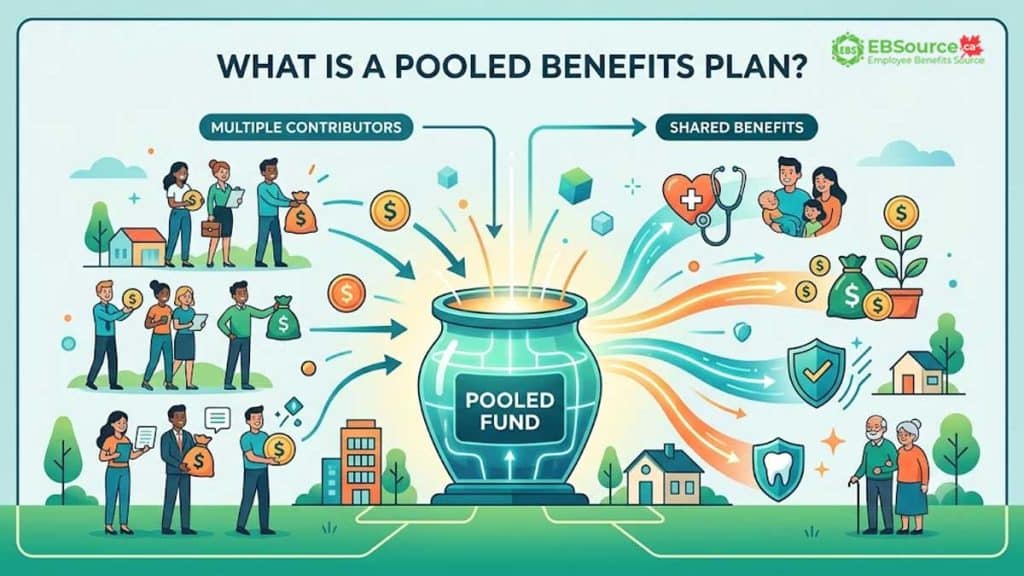
Benefits pooling is a risk-sharing arrangement in which many employers participate in a broader insurance pool instead of having each group priced only on its own claims experience.
This matters most for small businesses because their claims are hard to predict. A company with a few hundred employees has enough people for claims to average out year to year, but for a small company, a single large claim can make the whole group look risky when it is not. Pooling mitigates this by treating the small business as part of a much larger risk community.
Benefits pooling is simply a backend financial method. For your team, their daily coverage experience remains the same. They may get the same benefits card, access the same online portal, and submit claims just like they would with any traditional group insurance plan. The difference is how those eligible claims are funded and evaluated behind the scenes.
Does “Fully Pooled” Mean Everything Is Pooled Equally?
Small employers usually misunderstand what a carrier means when they say a plan is “fully pooled.” It is easy to assume this means all health, dental, disability, and life claims are grouped together and priced using a single methodology.
In reality, a single benefits contract can use completely different rating methods for each benefit line. For example, Life and Accidental Death & Dismemberment (AD&D) might be demographically rated, while Long-Term Disability (LTD) might be pooled based on group size and plan design. Routine dental claims are often managed through plan limits, co-insurance, and experience rating, whereas pooling thresholds* are especially important for extended health and drug claims, where one claimant can generate unusually high costs.
The phrase “fully pooled” can also refer to different parts of the arrangement. When reviewing a proposal, use the framework below to interpret what “pooled” actually means in each context:
| When a quote says “pooled,” it may mean | The key question to ask |
|---|---|
| A pooled small-business program in which renewal rates are largely set using the experience of the wider program | Is my renewal set at the pool level, or does it still use my own group’s claims? |
| Pooled rating on a benefit line using broader insurer experience | Which benefits are pooled: Life, AD&D, LTD, critical illness, health, or dental? |
| A high-cost claim pool (a stop-loss arrangement that limits how much of a large claimant’s costs enter the employer’s renewal experience) | Does the threshold apply per person, per certificate or per claim type? |
| A high-cost drug pool* | Does my policy and each certificate actually qualify, and how is Quebec handled? |
The takeaway: Do not assume that every component is pooled equally because the proposal uses the term “fully pooled.” Ask for the rating and renewal method for each benefit line in writing.
*Pooling thresholds and high-cost drug pools will be detailed later in this article.
How Are Pooled, Experience-Rated, and ASO Plans Different?
It helps to see how it compares to the two other common ways a benefits plan can be funded: experience-rated and Administrative Services Only (ASO) plans. The core difference between these models is who carries the claims risk and how the employer’s future costs are determined.
The table below compares the three arrangements:
| Funding type | Who carries the claims risk? | What drives renewal | Potential fit |
|---|---|---|---|
| Pooled Funding | The insurer or program pool carries most of the insured claims risk covered by the arrangement. | Mostly pool experience and trend | Small groups wanting stable, predictable premiums |
| Experience-rated | The insurer pays eligible claims under the policy. The employer’s claims experience carries more weight in renewal pricing. | Your own claims carry more weight, plus trend and credibility | Mid-size groups with steady, credible claims |
| Administrative Services Only (ASO) | The employer funds eligible claims. The administrator processes claims and manages the plan according to the contract. | Your actual paid claims, plus admin and any stop-loss cost | Larger groups able to absorb claim swings |
The practical distinction is:
- Pooling transfers more claims volatility to the insurer or program pool;
- Experience rating gives the employer’s own claims more influence over renewal pricing;
- ASO returns more claims risk, control and potential savings to the employer.
Employers should compare the actual contract terms rather than selecting a plan based only on the funding label.
How Do Pooling Mechanics and Renewals Work?
Pooling affects how claims are assigned for pricing and renewal purposes. Two parts of the pooling arrangement matter most:
- The stop-loss threshold, which determines how large claims are allocated; and
- The renewal methodology, which determines how the next year’s rates are calculated.
What Does a Stop-Loss Threshold Do?
A stop-loss threshold is a critical mechanism that protects groups against unpredictable, high-cost claims. A common misconception is that a stop-loss threshold acts like a deductible, meaning the insurer only starts paying for a claim after that dollar amount is reached.
Instead, the threshold affects how claims are treated for pricing purposes. Depending on the contract, amounts above the applicable threshold may be transferred to a pool, excluded from the employer’s direct experience or assigned less weight during renewal.
When reviewing a quote as part of the group benefits quoting process, you should ask exactly how this threshold is applied:
- Is it applied per person (each individual’s claims are counted separately)?
- Is it applied per certificate (the combined claims of an employee and their dependents)?
- Or is it applied to the entire group (a hybrid or aggregate model)?
A lower threshold may transfer more risk to the pool, but it may also result in a higher pooling charge. The value of the arrangement depends on the protection received for the cost charged.
How Does Pooling Affect Premiums and Renewals?
When claims are evaluated through a broader risk-sharing structure rather than being attributed entirely to one small plan, it helps stabilize your costs. The core mechanism is offsetting: in any given year, a single group’s bad year is diluted by the many groups having ordinary years.
Below is how pooling changes the way claims experience flows into renewal pricing compared to a plan without strong pooling:
| Scenario | Without Strong Pooling | With Pooling |
|---|---|---|
| Claims are lower than expected | The group may receive more direct pricing benefit. | Some benefit may be reflected, but results are blended with the pool. |
| One large claim occurs | The group may face a sharper renewal increase | The claim impact is diluted across the broader pool, subject to plan terms |
| Pool-wide trend increases | The group may still see an increase. | The increase may reflect broader market and pool trends rather than only the group’s own claims |
| Claims fluctuate year to year | Premiums may move more sharply. | Renewals tend to be smoother and more predictable. |
Despite this protection, many business owners are frustrated when they receive a rate increase, asking: “If my plan is pooled, why did my premium still go up?“
The answer is that your renewal is not a single calculation based only on your claims; it is a stack of adjustments. Pooling can reduce the direct effect of specified high-cost claims, but it does not eliminate every factor that affects renewal rates.
| Driver | What It Means | Can Pooling Remove It? |
|---|---|---|
| Market Trend | Overall healthcare and drug cost inflation. | No. Pooling shares the impact across a wider base, but does not control underlying inflation. |
| Demographic Changes | Changes in the group’s age distribution, coverage mix, insured volumes, and other permitted demographic rating factors. | No. If your group profile changes significantly, your baseline rates may adjust. |
| Plan-Design Changes | Any coverage enhancements or increased limits you added to the policy. | No. Richer benefits naturally require higher premiums. |
| Routine Experience | The predictable claims (like dental or regular physio) that fall below your stop-loss threshold. | Partially. Depending on the contract, these may still heavily influence your specific renewal. |
| Catastrophic Claims | Severe events (like specialty drugs) that exceed your applicable threshold. | Partly. Eligible amounts above the applicable threshold may be pooled or excluded from the employer’s direct experience. Pool-level results may still affect rates. |
| Pooling Charge | The fee the insurer charges to provide stop-loss protection and run the pool. | No. This is a fixed or calculated cost embedded in your rates. |
You can clearly see that a severe claim is less likely to be loaded entirely onto your own renewal. Instead, your premium tracks the broader market trends and the pool’s steady behaviour, resulting in renewals that are smoother and much easier to budget for.
For small and medium-sized employers, this smoothing effect is valuable. However, remember the ultimate trade-off: pooling does not make costs disappear, and does not guarantee the lowest premium. What pooling truly buys is protection against severe volatility. You are simply giving up some upside in an exceptionally quiet year in exchange for more predictable costs when claims are unexpectedly high.
Special Focus: How Does High-Cost Drug Pooling Work?
The clearest example of benefits pooling’s value is a recurring high-cost drug claim. One specialty-drug claim can distort a small plan’s renewal on its own. This is not a rare edge case: TELUS Health 2026 Drug Trend Report indicates specialty-drug users make up only about 2.1% of claimants but roughly 33.9% of private drug-plan spending.
In most of Canada, high-cost drug pooling runs on two layers: The insurer’s Extended Drug Policy Protection Plan (EP3) and the industry pool administered through the Canadian Drug Insurance Pooling Corporation (CDIPC).
The first layer of protection is the EP3. Each insurer may set its own pooling threshold and charge. When an eligible claim exceeds the threshold, the applicable amount may be transferred from the employer’s direct claims experience to the insurer’s broader pool.
When a drug claim becomes large and recurrent, it can reach the industry pool run under the CDIPC framework. A claim must exceed the Initial Threshold of $65,000 in two consecutive years to become eligible, and must exceed the Ongoing Threshold of $32,500 in later years. The industry pool then covers 85% of eligible costs above the Ongoing Threshold, up to a maximum pooled amount of $500,000.
The insurer retains substantial financial risk, including 100% of the first year’s claim, 100% of amounts below the Ongoing Threshold, 15% of the eligible excess, and 100% of amounts above the maximum. These retained amounts are not automatically assigned to the employer’s direct renewal experience; they may be handled through the insurer’s EP3 or other permitted pool-level pricing.
Note that eligibility is not automatic for every certificate. CDIPC rules include exclusions designed to prevent anti-selection, including certain certificates with existing high drug claims when a plan moves from ASO or refund accounting to fully insured coverage.
Quebec is different. Quebec has its own mandatory drug-pooling framework, QDIPC, which takes precedence over CDIPC and can apply differently. The QDIPC 2026 pooling terms set a threshold of $10,000 per certificate for groups under 25 certificates, with its own annual factors. Quebec employers should confirm the applicable threshold and funding rules with their carrier or administrator.
How Should a Small Business Choose a Pooling Structure?
Choosing the right pooling structure is not just about finding the lowest premium. For small businesses, the more important question is: how much claims risk should the company keep, how much should be transferred into a broader pool, and how to compare quotes?

Use this three-step framework to evaluate your business needs and compare insurer proposals effectively.
Step 1: Determine What Risk You Can Absorb
Your first step is to assess your company’s financial tolerance and the statistical reliability (credibility) of your group’s claims.
Many employers make the mistake of using headcount as the sole deciding factor. While group size is an important planning guideline, it is not a rigid rule. For example, a 40-person company with high turnover may have entirely unpredictable claims. In contrast, a 40-person company with a highly stable workforce and consistent demographics may be able to safely retain more risk.
To determine your risk tolerance, ask yourself these financial questions:
- Could our business comfortably absorb a 15%, 25%, or 40% renewal increase?
- Would a large premium spike force us to reduce employee coverage?
- Do we value upfront premium savings more than long-term budget stability?
A stronger pooling arrangement may better match a business that prioritizes budget predictability and has limited capacity to absorb renewal volatility.
Step 2: Identify Which Claims Need Protection
When reviewing your company’s claims history, do not just look at the total dollar amount spent. You must ask what kind of claims are driving your experience.
A proper review should categorize your claims to determine what kind of pooling protection you actually need:
- Routine usage (Predictable): Claims for standard dental cleanings, vision care, and massage therapy. A small business with consistent routine usage may not need to pay a premium to pool these benefits.
- One-time large claims (Volatile): A sudden medical emergency or an out-of-country hospitalization. These require a solid stop-loss threshold to ensure a single event does not ruin your renewal.
- Recurring catastrophic claims (Severe): Expensive, ongoing specialty drugs. This is the highest risk for a small employer and requires robust, long-term pooling protection.
A group with high but predictable dental usage might simply need a plan design adjustment, whereas a group with exposure to rare, high-cost health claims needs stronger pooling.
Step 3: Compare Quotes With an Advisor
Pooling structures can look identical on the surface, but the underlying contracts can be vastly different. Two quotes may both advertise “pooling,” yet one might offer much weaker protection.
Do not accept a proposal at face value. Work with your advisor to extract the following details from every quote:
- Funding basis by benefit: Which specific lines are pooled, and which are experience-rated?
- Pooling threshold application: Is the stop-loss limit applied per person or per certificate?
- Pooling charge: What exact percentage is the insurer charging to take on the stop-loss risk?
- Rate-guarantee period: How long is the initial pricing locked in?
- Renewal formula: How much weight (credibility) will be assigned to your group’s own claims next year?
Run a 3-Scenario Quote Test
To truly see how a proposed plan will perform, ask your advisor to model these three specific scenarios before you sign:
Scenario 1: A normal claims year
Assume that routine health and dental claims remain close to the group’s expected level. Ask:
- How much of the group’s own experience would influence renewal?
- Would favourable experience benefit the employer?
- Which pool-level or market factors could still increase rates?
Scenario 2: One large non-recurring claim
Assume that one employee or covered family incurs a $50,000 eligible extended-health claim. Ask:
- Which threshold would apply?
- Would the claim be assessed per person or per certificate?
- How much would remain in the employer’s experience?
- How much could be transferred to the pool?
- Could the claim continue to influence renewal in a later year?
Scenario 3: One recurring specialty-drug claim
Assume that a covered person requires a $70,000 eligible medication in two consecutive years. Ask:
- How would the insurer’s own drug pool apply?
- When could the claim become eligible under the applicable industry pooling framework?
- What amounts or percentages would the insurer retain?
- Would the certificate remain eligible after a carrier or funding change?
- How would the treatment differ for a Quebec certificate?
For each scenario, ask the advisor to show which amounts would enter the group’s experience, which may be pooled, and which renewal variables cannot be quantified without the insurer’s proprietary pricing model.
Look for Proposal Warning Signs
As you evaluate the results of the 3-scenario test and your quote decoder, watch out for these warning signs:
- A pooling charge that is not explained: Ask for the charge, the threshold it purchases and the claims it protects. Compare equivalent terms rather than comparing percentages in isolation.
- Thresholds applied to the whole group: An aggregate threshold may provide less targeted protection against a single high claimant than a per-person or per-certificate threshold. Ask the advisor to demonstrate the result under a defined catastrophic-claim scenario.
- No clarity on drug pooling: If the insurer cannot explain how recurring specialty medications are handled, walk away.
- “Bait and switch” aggressive pricing: Low first-year pricing may not indicate sustainable renewal pricing. Ask for the rate guarantee, pooling terms and renewal methodology before comparing proposals.
- Refusal to share the renewal methodology: If a carrier will not clearly explain their renewal math, you cannot properly forecast your future costs.
When Might a Pooled Plan Not Be the Best Fit?
A pooled option may not be the best fit when an employer has stable claims, strong cash flow and a greater willingness to accept cost fluctuations in exchange for more control or potential savings.
If your group has several years of credible claims data and wants favourable experience to have more influence on renewal pricing, an experience-rated arrangement may deserve consideration.
If your group is large enough to statistically absorb claim swings and you have a high tolerance for risk, an experience-rated or Administrative Services Only (ASO) arrangement allows you to keep the premium savings when your team’s claims are low.
Pooling may also provide limited value when the main cost pressure comes from frequent routine claims or an overly generous plan design rather than catastrophic claims. In that case, reviewing deductibles, coinsurance, benefit maximums or drug-management provisions may be more effective than increasing pooling protection.
What Common Mistakes Do Small Employers Make with Pooling?
The most common pooling mistakes involve chasing short-term pricing, under-pooling volatile benefits, misunderstanding drug-pool rules, ignoring drug-cost inflation, and deciding without documented history.
Watch out for these five avoidable errors:
Serial carrier-switching
Repeatedly switching carriers only to obtain a lower first-year rate may create renewal and administrative risks. A new insurer might raise your rates sharply at renewal time once they understand your actual claims experience. Frequently changing insurers also confuses members and disrupts administration without addressing the main reasons for rising costs.
Under-pooling high-variance benefits
Employers sometimes leave volatile lines such as long-term disability or life insurance experience-rated to save a small amount today. For a small group, one large claim on an unpooled volatile benefit can produce a renewal increase far larger than the premium you saved by not pooling it.
Misreading the two-year drug rule
Many employers assume that a single large drug claim immediately shifts entirely to the industry pool. In practice, a claim must exceed CDIPC’s Initial Threshold for two consecutive years before industry pooling applies, and the insurer still retains the amount under the ongoing threshold plus 15% of the excess.
Ignoring drug-cost inflation
It is a mistake to treat pooling as a cure for rising drug costs. Pooling shares the impact of high-cost drugs across a wider base, but it does not control inflation or the arrival of new specialty drugs, so budgets should still plan for the underlying trend.
Overreacting to a single year of data
The most common analytical mistake small businesses make is overinterpreting a single year of claims data. One catastrophic claim can easily skew a single year, making a healthy group look high-risk. Claims history should always be reviewed over multiple years when possible.
FAQs about Employee Benefits Pooled Options for Small Businesses
Are pooled benefits always cheaper than traditional group benefits?
Not always. In a low-claim year, an experience-rated or Administrative Services Only (ASO) arrangement may actually cost less. The main advantage of pooling is not guaranteed savings; it is protection from severe claim volatility and the assurance of more predictable renewals over time.
Does the CDIPC high-cost drug pool apply to ASO plans?
No. The CDIPC framework and its EP3 rules only apply to fully insured plans. ASO and refund-accounting plans are excluded from this industry-wide pool. If an employer with an ASO plan wants protection from catastrophic drug claims, they must purchase separate, private stop-loss insurance.
Can we integrate a pooled plan with a Healthcare Spending Account (HSA)?
Yes. Many small businesses pair a standard pooled group plan with a Healthcare Spending Account (HSA) structured as a qualifying PHSP to cover coverage gaps or provide flexible top-ups for their employees. When setting this up, ask whether the insurer offers an integrated HSA alongside their pooled plan, or if you will need to set one up separately through a third-party administrator. Federal and Quebec tax treatment can differ, so Quebec employers should confirm the taxable-benefit and RL-1 reporting consequences before adding an HSA.