
Employee Benefits in Canada: Understanding the Benefits Journey and Plan Options



If you run a business in Canada, choosing employee benefits starts with understanding what your business needs and what options are available. The right approach depends on where your business is in the benefits journey. You need to start by understanding the coverage you need, then designing a plan, comparing providers, considering the tax treatment, and managing an existing plan.
A group benefits plan can include much more than traditional health and dental coverage. Depending on your goals, it may combine group insurance such as prescription drugs, dental, disability, and life insurance with Health Spending Accounts, employee support programs, and group retirement plans. Employers also need to consider eligibility, cost-sharing, tax treatment, provider selection, and how the plan will be managed over time.
EBSource helps Canadian employers make sense of these choices, from understanding the foundations of employee benefits to building and maintaining a plan that fits their business. The guidance considers both federal requirements and provincial differences, so you can make informed decisions at each stage of your benefits journey.
Employee Benefits in Canada: A Quick Overview
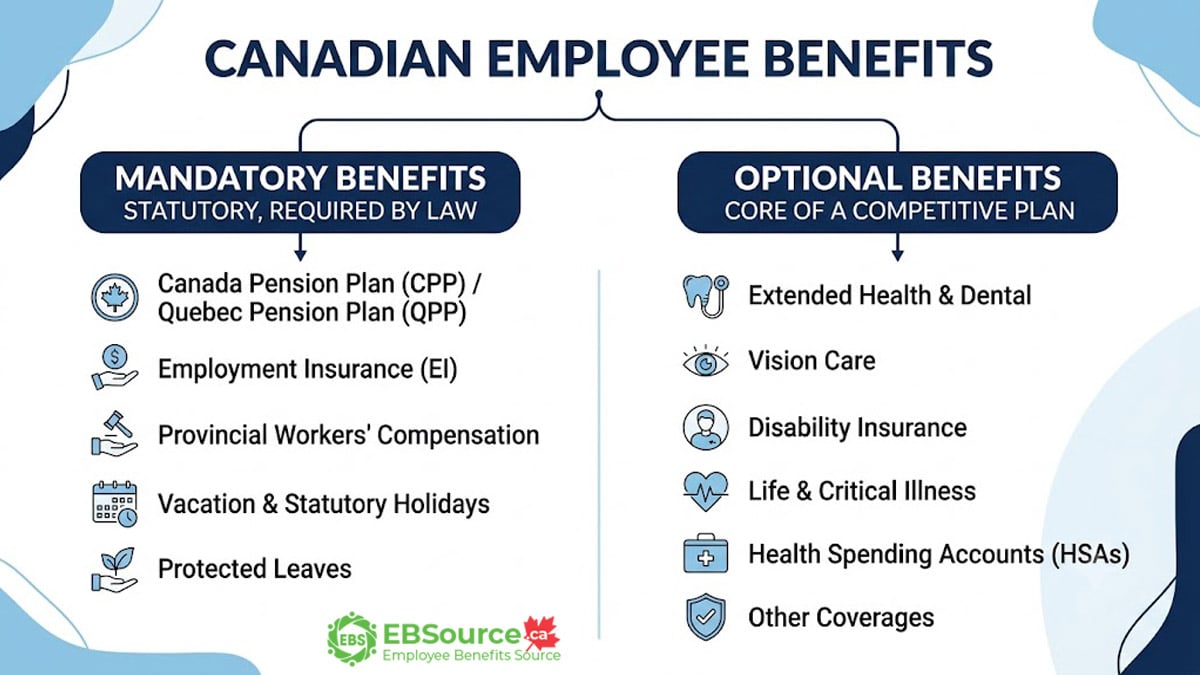
For Canadian employers, employee benefits generally fall into two broad categories: mandatory benefits and optional benefits.
| Category | What it includes | Employer requirement |
| Mandatory benefits |
|
Required according to federal, provincial, or territorial rules, though specific standards vary by jurisdiction |
| Optional benefits | Extended health, dental, vision, disability, life insurance, critical illness, HSAs, EAPs, and retirement programs | Generally optional, subject to specific provincial requirements |
Table comparing mandatory and optional employee benefits for Canadian employers
A special note for Québec: The province requires all residents to have prescription drug insurance. If you offer a group plan, your eligible employees must join it. If you don’t, they must enroll in the public plan.
Where is Your Business in the Employee Benefits Journey?
A group benefits plan is not a single decision but a sequence of them. From understanding your coverage options to designing your plan, choosing a provider, understanding the tax treatment, and managing the plan over time, each stage requires different information and focus.
Knowing where your business is in the journey is the key to making the right choices for your business and your team:
Understand the coverage types
You need to know what you are legally required to provide versus what is optional before comparing any quotes:
- Mandatory Employer Obligations: These are statutory entitlements, payroll contributions, and other employment obligations required by law. They include Canada Pension Plan (CPP) or Quebec Pension Plan (QPP), Employment Insurance (EI), provincial workers’ compensation, and federal and provincial employment standards dictate minimum requirements for time off such as vacation, statutory holidays, and protected leaves.
- Optional Group Benefits: These are the core of a competitive plan and include coverages like extended health, dental, vision, disability, life insurance, critical illness coverage, Health Spending Accounts (HSAs), and other benefits.
Focus on this stage if: You are new to offering benefits or want to ensure your business is meeting its foundational legal requirements.
Design the plan
Once you know the building blocks, you can design your employee benefits plan by deciding how to assemble them: how costs are shared between you and your employees, who is eligible and when, what coverage levels to set, and how to structure disability premiums for optimal tax treatment.
Your group benefits plan design can determine the cost-sharing structure, eligibility rules, waiting period, coverage limits, deductibles, and flexibility built into the plan.
Focus on this stage if: You have a general idea of what you want to offer but need to define the specific structure and financial details of your plan.
Compare and choose a provider
With your plan design documented, you match it to the right carrier. This stage covers what to evaluate beyond the first-year quote: renewal track record, contract flexibility, digital experience, and advisor alignment.
The right employee benefits provider depends on your business size, workforce, budget, coverage needs, and long-term priorities.
Focus on this stage if: You have a documented plan design and are prepared to take it to the market to find the best long-term partner.
Understand the Tax Treatment
Benefit taxation in Canada follows specific rules that should drive your plan design decisions.
Non-taxable benefits generally don’t create taxable income for employees, while taxable benefits are included in their taxable income. The tax treatment often depends on who pays the premium and what type of coverage you’re providing. So, Getting the tax treatment right is a win-win: it helps employees keep more of what you pay for, and it helps employers avoid unexpected taxable benefits, source deductions, and reporting consequences.
Focus on this stage if: You want to optimize the tax efficiency of an existing or planned arrangement.
Administer and maintain the plan.
A live plan requires ongoing management: enrolments, terminations, renewals, compliance with employment standards changes, and periodic redesign based on utilization data and workforce needs.
Over time, employers may also need to review plan costs, employee needs, plan performance, and opportunities to improve the program. Employee benefits plan insights can help you evaluate these decisions as your workforce and business needs change.
Focus on this stage if: You have an existing plan and want to manage it more effectively, control costs, or enhance its value.
What's included in a Modern Group Benefits Plan
A competitive group benefits plan in Canada is built around four key components: group insurance, health spending accounts, employee support programs, and group retirement plans, each designed to meet a different employer objective. Understanding these pillars allows you to construct a plan that is both cost-effective and highly valued by your team.
Group Insurance: The Foundational Safety Net
Group Insurance is the traditional form of coverage where premiums are pooled among all members, and the insurance carrier pays for eligible claims. This pillar provides a crucial safety net and includes:
- Extended health benefits, including prescription drugs, paramedical services, medical equipment, and out-of-province and emergency travel medical coverage
- Dental care
- Vision care
- Group life and accidental death & dismemberment (AD&D)
- Group disability Insurance (both short-term and long-term)
- Group critical illness (CI)
Employers choose group insurance to offer financial security against significant, unexpected health events. It provides predictable monthly costs and is often the most valued component of a benefits plan, forming the core of the program for most businesses.
Health and Spending Accounts: Flexible, Tax-Efficient Funding
Health and Spending Accounts function like a dedicated budget that an employer allocates to each employee for eligible expenses.
When structured to meet the Canada Revenue Agency’s requirements for a Private Health Services Plan (PHSP), a Health Spending Account (HSA) provides notable tax advantages. Outside of Quebec, employer contributions to a qualifying PHSP are generally a deductible business expense and are not a taxable benefit to the employee. It is important to note, however, that in Quebec these employer contributions are considered a taxable benefit for the employee.
This category also includes Wellness or Lifestyle Spending Accounts (WSAs/LSAs), which cover a wider range of items that are generally not medical expenses.
Source: Canada Revenue Agency – Medical Expenses; Revenu Québec – Contributions to a Group Insurance Plan
Employee Support Programs: Proactive Well-being
These programs extend support beyond traditional medical coverage to address an employee’s overall well-being and productivity. These are often low-cost and can help address issues before they escalate into more serious claims. This category includes:
- Employee Assistance Programs (EAPs) for confidential counselling
- Virtual Care (telemedicine) for quick access to medical professionals
- Mental Health and Financial Wellness applications and tools
Employers can choose these programs to provide proactive, accessible support that helps employees navigate life’s challenges and foster a healthier workforce.
Group Retirement Plans: Investing in Long-Term Loyalty
Employer-sponsored retirement plans help employees build financial security for the future. This pillar is a powerful tool for attracting and retaining talent, especially as employees advance in their careers. Key options include:
- Group Registered Retirement Savings Plans (RRSPs)
- Deferred Profit Sharing Plans (DPSPs)
- Defined Contribution (DC) and Defined Benefit (DB) Pension Plans
Employers implement retirement plans because they demonstrate a long-term commitment to their workforce and carry a clear, dollar-for-dollar value that can be more tangible than insured benefits.
What Employee Benefits Does Your Workforce Value Most?
Understanding what employees care about helps you allocate your benefits budget where it generates the greatest return on retention and engagement. The insights from research below show that the most valued employee benefits in Canada generally fall into five key categories: flexible and hybrid work arrangements, mental health support, retirement and financial security programs, financial wellness benefits, and health and dental coverage.
Here’s a closer look at what employees value in each of these five areas:
Flexible and Hybrid Work
Flexibility is no longer a perk but a fundamental expectation for the Canadian workforce. While many companies have adopted some form of hybrid work, the degree of flexibility can vary depending on an employee’s role and seniority.
Key insights:
- Nearly 7 in 10 Canadian job seekers prefer hybrid work (Source).
- 66% rank control over their schedule and workplace among the biggest factors in job satisfaction (Source).
- 38% of workers who aren’t job-hunting say keeping their current flexibility is part of why they stay (Source).
What this means for employers: Document your flexibility policy clearly in job postings and benefits communications. Even a moderate approach builds trust when it’s transparent to employees.
Mental Health Coverage
While most Canadian benefits plans now include mental health support, the financial limits are often too low to meet the actual needs of employees. The primary barrier preventing people from seeking help is financial, which can make a plan with low coverage limits feel almost useless. That said, improving access to mental health care is a strategic investment for businesses, as it directly contributes to a more stable, healthy, and productive workforce.
Key insights:
- 34% of Canadian workers carry a high mental health risk (Source).
- 62.3% rarely or never use mental health services; 78.6% would go at least twice a year if cost weren’t a barrier (Source).
- 39% feel burnt out, with the Mental Health Research Council of Canada reporting that burnout can cost $5,500-$28,500 per employee a year (Source).
What this means for employers: To ensure your mental health coverage is effective, it’s important to set maximums that reflect local provider fees and your employees’ needs. Canadian survey data show that affordability can be a barrier, but they do not establish a single annual coverage threshold that is appropriate for every workforce.
Retirement and Financial Security
Long-term financial security remains a top priority for employees, and company-sponsored retirement programs are a key part of that. However, the true value and differentiating factor of such a plan is the employer’s contribution. While a plan without an employer match is a starting point, a company contribution demonstrates a more tangible investment in an employee’s future. This can be a highly effective tool, especially for professionals in their 30s and 40s.
Key insights:
- Retirement plans rank in the top tier of benefits Canadian employees want.
- Employer contributions can significantly increase the perceived value of a retirement plan.
What this means for employers: The right contribution level should be benchmarked against your industry, workforce, and budget. For example, even a modest 3% match on a $75,000 salary ($2,250/year) delivers a tangible, recurring value that employees weigh heavily against competing offers.
Financial Wellness
The stress caused by personal financial concerns directly impacts employee productivity, engagement, and overall well-being.
Key insights: The share citing personal finances as a stressor rose from 35% in 2022 to 43% in 2024 (Source).
What this means for employers: Consider low-cost additions like financial literacy workshops, emergency savings matching, or student debt programs. These signal that you understand the challenges employees face beyond the workplace.
Extended Health and Dental
While modern perks gain traction, traditional health and dental plans remain the core of any benefits package. Employees are clear that they want to see more investment in these core services. Therefore, a strong foundation of traditional benefits is essential to ensure employees can care for their physical and mental well-being without financial disruption.
Key insights: The 2024 Benefits Canada Healthcare Survey found that employees most prioritized improved coverage for major dental services (22%) and vision care (21%). (Source).
What this means for employers: Before adding trendy perks, ensure your foundational coverage is strong. Employees notice when dental maximums haven’t increased in a decade.
What Group Benefits Plan Design Decisions Matter Most for Employers?
Five structural decisions can have an outsized effect on your group benefits plan’s long-term cost and the value employees actually receive. Most employers focus on choosing a carrier first, but the decisions below shape outcomes far more than any provider selection.
Decision 1: What percentage of premiums does the employer pay versus the employee? (Cost-Sharing Ratio)
Common models in Canada include 50/50, 67/33, 75/25, and 100/0 (fully employer-paid).
Decision 2: Who pays the LTD premium, employer or employee?
This is an important tax consideration in plan design. How disability benefits are taxed all comes down to who pays the premiums.
- If the employer pays any portion of the premium, benefits paid to a disabled employee are generally considered taxable income.
- For the benefit to be received completely tax-free,the plan is typically structured as a genuine “employee-pay-all” arrangement, where the employee pays 100% of the premium. (Source)
Because the rules are specific, confirm your contract and payroll setup with an insurer and a qualified tax professional before deciding how premiums will be paid.
Decision 3: When do employees qualify and who’s covered? (Waiting Period and Eligibility Rules)
Waiting periods for new hires can range from immediate eligibility to several months. While a period of up to three months is a common approach in Canadian plan designs, first-day coverage is increasingly used by employers competing for talent in tight labour markets. The most suitable structure depends on the employer’s hiring goals, insurer contract and workforce.
Other eligibility considerations include:
- Whether part-time employees qualify, as eligibility often depends on the group contract and insurer rules, which may specify minimum weekly hours
- Whether coverage extends during statutory leaves
- How the plan handles contractor exclusions
Decision 4: How you design your pharmacy coverage.
Drug plans now drive a disproportionate share of total plan cost. Key structural choices include:
- Mandatory generic substitution: The plan pays only the generic price when one is available
- Prior authorization requirements: For specialty or high-cost drugs
- Annual or lifetime maximums: On drug spending
- Pooling threshold: Above which catastrophic claims are shared across a larger risk pool rather than affecting your group’s experience alone
Decision 5: Whether your plan is built with flexibility for future adjustments.
Can you make changes at renewal without a full restructure?
- Add employee classes (for example, separating executives and general staff)
- Layer a Health Spending Account on top of insured coverage to provide flexibility without raising pooled premiums
- Adjust co-insurance levels or maximums without cancelling and re-issuing the entire policy
Plans designed with flexibility let you respond to changing workforce needs and market conditions without major disruption.
Steps to set up a group benefits plan for the first time
Setting up a group benefits plan requires five core steps: preparing your employee census, defining your budget and plan objectives, obtaining quotes through a licensed advisor, selecting an insurer, and enrolling employees within the insurer’s implementation timeline.
Here’s the step-by-step process:
Step 1: Prepare your employee census.
The census is a spreadsheet listing every eligible employee’s date of birth, sex, province of residence, annual salary, job title or class, and number of dependents (with dependent ages).
Step 2: Define your budget and plan objectives.
Before approaching the market, determine your maximum monthly cost per employee or total annual benefits budget, your competitive positioning goals (matching industry norms versus leading on benefits), and whether you want employees to share premium costs.
Industry norms can vary depending on the type of business and workforce. See our employee benefits by industry guide for a closer look at how expectations may differ across sectors.
Step 3: Engage a licensed group benefits advisor.
In Canada, group benefits plans are commonly sold through licensed group benefits advisors and group benefits brokers, who are compensated through insurer commissions or client-paid fees. Some carriers and benefits platforms may also offer direct or digitally assisted purchasing paths.
When selecting an advisor, you should consider their provincial licence, experience with employers of your size, carrier access, service model, compensation disclosure, and approach to renewals.
Step 4: Review quotes and select an insurer.
Your advisor will present a market comparison showing premiums, plan designs, insurer financial ratings, and service capabilities from multiple carriers.
Step 5: Enrol employees and launch the plan.
During this period, the insurer issues the master policy, the employer signs the plan sponsor agreement, employee enrolment forms or online enrolments are completed, and benefits booklets or digital access credentials are distributed.
The following are estimated timelines for setting up a group benefits plan, which can vary depending on workforce size, plan complexity, and insurer requirements:
| Business Size | Typical Setup Timelines |
| Micro (2–9 employees) | 2–4 weeks |
| Small (10–49) | 3–6 weeks |
| Mid (50–249) | 4–8 weeks |
| Large (250+) | 6–12 weeks |
Note: The timelines are planning estimates based on general industry experience, not guaranteed insurer service standards. The timeline typically starts from the moment a complete employee census is submitted to the insurer and generally includes standard underwriting and the employee enrolment process. Actual implementation time depends on group size, underwriting, and plan complexity.
Why Employee Benefits Matter for Canadian Employers
In Canada’s publicly funded healthcare system, employers are not legally required to provide most supplemental health and insurance benefits. However, provincial and territorial health plans cover core medical services, but coverage for things like prescription drugs, dental, vision, and mental health services is often limited or restricted to specific groups.
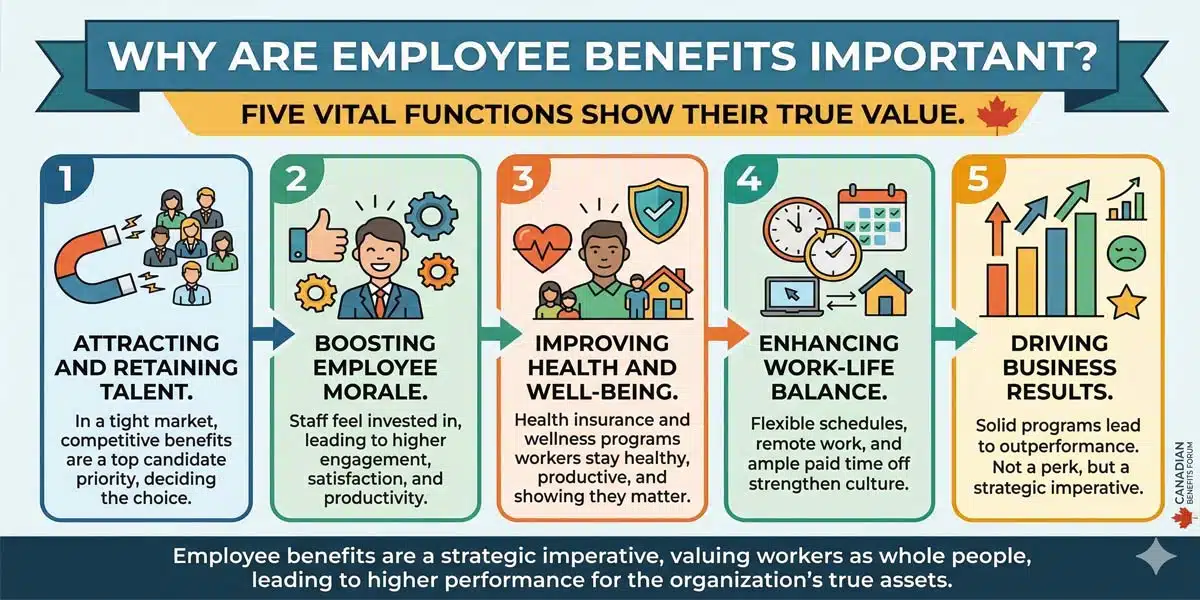
That’s why employees look to their employer to fill these gaps. In a tight labour market, the absence of a benefits plan can be a significant disadvantage, as it may be perceived as a sign that a company is not competitive or is less invested in its workforce. By contrast, a well-designed employee benefits plan can strengthen recruitment and retention, reduce the costs of turnover, support employee health and productivity, and provide a tax-efficient way for compensation. The key benefits include:
- Attract and Retain Top Talent: Employees increasingly rank benefits as a top factor when deciding to accept or stay in a role. A strong package removes a common reason candidates say no.
- Mitigate the High Cost of Turnover: Replacing an employee in Canada is becoming more expensive. A 2026 survey from Express Employment Professionals and Harris Poll reported that the average cost now exceeds $30,000 per departure due to recruitment expenses and lost productivity (Source). A benefits plan can improve retention, with the cost of the plan often being less than the cost of replacing a single employee.
- Increase Productivity and Reduce Absenteeism: Access to preventive care and necessary treatments can support employee well-being. This leads to fewer sick days, better focus at work and higher overall productivity. However, the direct impact on productivity and absenteeism will naturally vary.
- Tax-Effective Compensation: For a business, premiums paid for health and dental plans are a tax-deductible expense. For employees, employer contributions are generally non-taxable for federal income tax purposes if the plan qualifies as a Private Health Services Plan (PHSP). However, Quebec applies separate provincial rules, where employer contributions to group insurance plans are generally considered a taxable benefit. This makes it one of the most efficient ways to enhance a total rewards package.
That said, companies that recognize and adapt to employees’ expectations are better positioned to build a loyal and engaged workforce.
Frequently Asked Questions about Employee Benefits in Canada
What are Employee Benefits in Canada?
In Canada, “employee benefits” refers to any form of non-wage compensation an employer provides to a worker as part of an employment relationship. These benefits support employee well-being, financial security, and work-life balance through a range of programs and protections.
There are two main types of employee benefits in Canada: mandatory and optional. They are designed to complement one another to support employee well-being, financial security, and work-life balance through a range of programs and protections.
Am I legally required to offer health insurance to my employees?
As a general rule, Canadian employment standards legislation does not require employers to provide private health and dental insurance. However, an obligation to provide benefits can arise from other sources, such as a collective agreement, an individual employment contract, or human rights requirements.
However, Quebec has a unique system for prescription drug coverage. In Quebec, all residents are required to have prescription drug insurance. While you, as an employer, can choose whether to offer a group insurance plan, if you do offer one, your eligible employees under age 65 are generally required to join it for prescription drug coverage. The main exception is if they are already covered by another private plan, such as a spouse’s.
If your employees do not have access to a private group plan, they must get their coverage through the public Quebec plan (RAMQ).
That said, Statistics Canada reported that 76.1% of full-time employees had workplace medical or dental benefits through their main job in 2024, making them a practical necessity for competitive hiring. (Source)
Can I offer different benefits to different employees?
Yes, but with guardrails. You can create different “employee classes” (e.g., executives, salaried, hourly) and offer different coverage levels to each class. However, the classes must be defined by legitimate, non-discriminatory business criteria, not by selecting specific individuals.
Do part-time employees get benefits in Canada?
There is no legal requirement to provide group benefits to part-time employees in Canada. However, they are still covered by certain statutory programs. For instance, they will contribute to CPP and EI as long as they meet the eligibility rules. When it comes to workers’ compensation, coverage is handled differently in each province and territory and depends on your specific industry and business classification.
When are employees eligible for benefits in Canada?
Eligibility for an optional group benefits plan is usually governed by the plan contract and employer policy, but employment standards, human-rights obligations, collective agreements and statutory-leave rules can also affect how coverage is administered. Quebec’s VRSP rules are a separate retirement-plan obligation. Most Canadian employers make full-time employees eligible after a waiting period, which typically ranges from immediate eligibility up to three months.