


Pacific Blue Cross (PBC) is one of the leading employee benefits providers in British Columbia. It stands out from many national insurers because it focuses on the local area and operates as a not-for-profit organization.
Pacific Blue Cross provides group benefits for employers through five types of plans. These range from Business Select for small businesses with two employees to Large Business Plans for bigger organizations that need customized benefits.
The starting price for Blue Chip small business plans is about $50 per employee each month. However, the actual rates can vary based on factors like the employee census, the plan design, and the chosen benefits.
Finally, a great benefits plan is only as good as the employee experience it delivers. PBC shines here through speedy claims processing, seamless direct billing via its Insta-Claim network, and strong digital support.
On this page
What Sets Pacific Blue Cross Apart as an Employee Benefits Provider
Pacific Blue Cross (PBC) is structurally different from most Canadian employee benefits carriers in three distinct ways: it operates as a not-for-profit health benefits society, it focuses almost exclusively on the British Columbia markets, and it actively administers provincial healthcare programs.
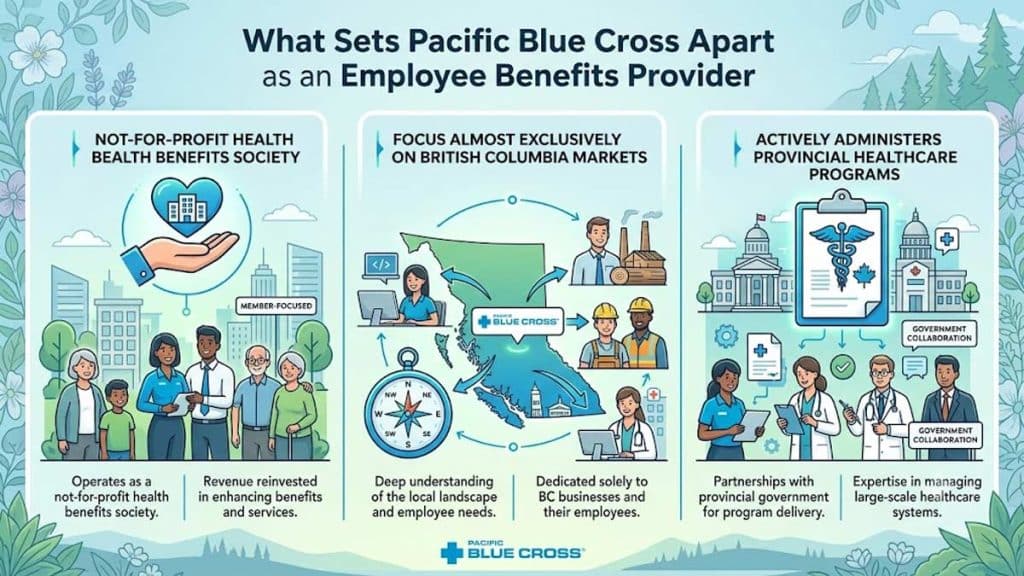
Understanding these characteristics will help you evaluate whether PBC’s unique model offers a tangible advantage for your business or if a traditional national carrier would be a better fit.
Not-for-Profit Model
PBC is a not-for-profit organization, unlike insurance companies that are owned by shareholders. This doesn’t guarantee lower premiums since those depend on your group’s specific risk profile and claims history. However, it does change the company’s financial priorities.
Because PBC does not need to generate quarterly dividends for investors, operating surpluses are reinvested directly into the organization. For employers and members, this translates to technology & service reinvestment and long-term value:
- Investing in Technology and Services: Pacific Blue Cross focuses on improving digital tools, like the Insta-Claim system, increasing connections with providers, and enhancing services for members.
- Long-Term Focus: PBC makes strategic choices that prioritize fair pricing and the long-term health of members instead of seeking quick financial gains.
BC-Focused Positioning
PBC members can submit eligible claims from anywhere in Canada. However, the organization focuses its infrastructure and provider relationships mainly in British Columbia.
For employers with a mostly British Columbia (BC) workforce, this regional focus provides a big logistical benefit. PBC has a strong local presence and works with many BC healthcare providers. This makes it easy and reliable for employees to use direct billing through the Insta-Claim system when they receive care in the province.
Deep Integration with the BC Healthcare Ecosystem
Through its PBC Solutions division, Pacific Blue Cross actually administers provincial healthcare programs, including aspects of the Medical Services Plan (MSP) and PharmaCare. This gives PBC a structural familiarity with BC’s public health system that national carriers simply cannot replicate.
For employers, this integration pays off in two major ways, including prescription drug coordination and streamlined claims, specifically:
- Prescription Drug Coordination: PBC intimately understands PharmaCare formularies. This means your plan design can seamlessly align with provincial coverage rather than duplicating or conflicting with it.
- Streamlined Claims: Claims for services that interact with MSP billing are processed more smoothly due to PBC’s administrative proximity to the provincial system.
This is a genuine differentiator for BC-based employers whose employees primarily access healthcare within the province. However, if you have a significant out-of-province workforce, a national carrier’s broader infrastructure will likely serve you better.
How Flexible Are Pacific Blue Cross Plan Designs?
Pacific Blue Cross (PBC) offers three distinct plan tiers for small and mid-sized employers, plus fully custom arrangements for large groups. While PBC’s product lines span the full range of flexibility, each tier comes with specific constraints that employers must understand before committing.
Here is a quick breakdown of how PBC’s plan tiers map to different employer profiles:
| Plan Line | Target Employer | Design Flexibility | Key Constraint |
|---|---|---|---|
| Business Select | 2-3 employees (First benefits plan) | Low: Standard core health plan with optional dental and benefit enhancements | Must have fewer than 4 full-time employees. |
| Blue Chip | SMEs seeking a straightforward digital plan | Moderate: Choose from preset configurations | Requires 75% enrollment activation. |
| Blue Plus | 4+ participating employees that need tailored coverage | High: Modular benefit building blocks | Requires 100% participation for groups of 4-9 people. |
| Large Business | 50+ employees (Complex needs) | Full Custom: Built from the ground up | Requires a direct PBC underwriting relationship. |
Caption: Pacific Blue Cross employee benefits plan tiers, target employer size, design flexibility, and key eligibility requirements.
Most BC small businesses with fewer than 15 employees will evaluate Business Select or Blue Chip first. However, if your team requires disability or critical illness coverage, you should bypass those and begin your search at Blue Plus.
Source: https://www.pac.bluecross.ca/group
To determine the right fit, it helps to look more closely at how these three primary small-business tiers, the starter plan, the middle ground, and the modular choice, match different company profiles and operational needs:
Business Select (The Starter Plan)
Designed for micro-businesses launching their first group plan. It requires a minimum of two employees working at least 20 hours per week permanently.
- Best for: Startups and micro-businesses that want to offer basic health and dental perks to attract early hires, without dealing with complex administration. This is a plan you start with, not one you grow into.
- Example: A local bakery or a two-person consulting firm
Blue Chip (The Middle Ground)
Offers preset configurations selected through the EasyBlue digital platform, bypassing custom underwriting. In terms of customization, you simply select among preset packages (the tier of coverage), meaning you cannot independently set specific co-insurance percentages or annual maximums.
- Best for: Small, growing companies that want good coverage for services like massage therapy or vision can get what they need without the hassle of putting together a plan from separate parts.
- Example: A 10-person marketing agency or a boutique law firm
Blue Plus (The Modular Choice)
You have the most control over design with PBC’s packaged options. You can choose different coverage levels for each benefit and add extras like Healthcare Spending Accounts (HSAs), Disability, or Critical Illness. However, you still need to work within PBC’s set options instead of choosing any amount you want. There are stricter eligibility rules; for example, your business must be operating for at least one year.
- Best for: Established mid-sized teams that need tailored coverage to remain competitive in the talent market.
- Example: A 30-person manufacturing firm or a growing tech startup
While a 30-person employer gets meaningful flexibility here, if you want to set a highly specific parameter, like a $427 annual paramedical maximum or a complex five-tier benefit class structure, you will find Blue Plus constraining compared to what a national carrier would build on a fully custom basis.
When to upgrade: The gap between a top-tier Blue Plus plan and an entry-level Large Group plan is where employers most often misjudge their needs. Before making the leap to a custom arrangement, request a detailed proposal from PBC specifying exactly how the custom plan will differ from Blue Plus in terms of reporting depth, account management, and the renewal process.
What Determines Pacific Blue Cross Employee Benefits Pricing?
Pacific Blue Cross (PBC) does not publish a full public rate card. However, by looking at their public pricing signals, plan design options, and not-for-profit structure, employers can build a solid framework for estimating and influencing what they will pay.
To find out your total cost accurately, you need to look beyond just the initial premium. Understand how census-driven underwriting works, the long-term benefits of a non-profit model, and how PBC compares to national carriers in Canada.
What Do Pacific Blue Cross Group Plans Actually Cost?
While PBC anchors its public pricing around a $50 per employee per month starting rate for the mid-tier Blue Chip plan, this figure represents the absolute floor for a pre-packaged configuration rather than a market average.
PBC organizes its insurance packages by combining health, dental, and life insurance. As you move from the “Most Affordable” option to the “Most Coverage” option, you will see significant increases in premiums. Other insurance options skip standard public prices in favour of custom pricing.
Depending on the size of your workforce, you can choose different options. Business Select gives indicative quotes, Blue Plus offers rates based on components, and Large Business uses pricing based on claims.
- Business Select (2+ employees): There is no public starting price. To get an estimated price, you need to contact PBC or a broker.
- Blue Plus (10-50 employees): Component-level control means that prices can vary widely depending on the modules you choose.
- Large Business (50+ employees): Fully custom pricing negotiated based on claims experience, group size, and underwriting assessments.
How the Not-for-Profit Structure Affects Pricing Over Time
PBC is a not-for-profit organization, so it doesn’t need to make extra money to pay shareholders. This might lead you to wonder if your initial quote will be lower than that of a for-profit company.
The true financial benefit of being not-for-profit shows up when it comes time to renew. PBC doesn’t have to meet investor profit goals, so it has less reason to raise rates when your claims are stable. Over several years, this can lead to more consistent costs.
Think of PBC’s not-for-profit status as a sign of long-term cost stability, rather than just a lower price in the first year.
How Pacific Blue Cross Pricing Compares to National Carriers
PBC’s pricing is highly competitive when its operational model creates efficiencies, specifically for BC-concentrated workforces using the local Insta-Claim network. However, national carriers like Sun Life, Manulife, or Canada Life often win on price when economies of scale come into play.
To help you understand where PBC offers the best financial value compared to national carriers, here is a comparison based on different employer profiles:
| Specific Employer Scenario | PBC Pricing Competitiveness | National Carrier Competitiveness | The Verdict & Why |
|---|---|---|---|
| 5-person BC retail shop (Basic Health & Dental only) | Highly Competitive: Plans start at just $50/mo per employee | Moderate: Often has higher minimum premiums for micro-groups | PBC Wins: Entry-level packaged plans (like Blue Chip) are highly optimized for micro-businesses in BC. |
| 25-person BC tech startup (Complete Health, Dental, Vision) | Strong: Low admin costs via local Insta-Claim network | Strong: Standard SME pricing | PBC Wins: The local provider network and modular pricing keep administrative costs low for BC-only teams. |
| 85-person logistics firm (Staff spread across BC, AB, and ON) | Moderate: Less optimized for out-of-province claims | Highly Competitive: National risk pooling | National Wins: National carriers leverage economies of scale and cross-province risk pooling to drive down premiums for larger, distributed teams. |
| 40-person BC company (Bundling Benefits + Group RRSP) | Less Competitive: Requires a separate RRSP provider | Highly Competitive: Multi-line discounts available | National Wins: PBC does not offer in-house retirement products, meaning it cannot offer the multi-line discounts that large national carriers provide. |
Caption: A sample comparison of how Pacific Blue Cross pricing might stack up against national carriers across different business scenarios.
Pro Tip: If you want a meaningful price comparison between PBC and a competitor, you must ensure both quotes use identical plan designs and identical census data. A quote that looks cheaper but quietly excludes pooling charges, taxes, or administrative fees is a trap.
What Is the Real Member Experience With Pacific Blue Cross?
Pacific Blue Cross generally delivers a smooth experience for routine claims, but employee satisfaction can vary depending on the type of support they need. To understand the day-to-day member experience, employers should look at both Where Pacific Blue Cross Performs Well and Where Members Experience Friction, as each can influence employee satisfaction, benefits utilization, and HR workload.

Where Pacific Blue Cross Performs Well
When evaluating the day-to-day member experience, PBC’s strongest assets are its automated and point-of-sale systems.
The platform cuts down administrative delays through three core operational advantages: the immediate cash-flow relief of The Insta-Claim Network, the lightning-fast turnaround of 24-Hour Digital Reimbursement, and the direct escalation paths provided by Local Administrator Support.
The Insta-Claim Network’s Cash Flow Impact
This is PBC’s most significant practical advantage. Insta-Claim allows thousands of BC pharmacies, dental clinics, and paramedical providers to submit claims directly on the member’s behalf.
Example: Consider a junior employee in Surrey seeking mental health support. A standard session costs CAD 150 if they have to pay upfront and wait for reimbursement; that CAD 150 might prevent them from seeking care before payday. Because PBC expanded Insta-Claim to Registered Clinical Counsellors across BC in July 2025, that same employee simply pays their 20% co-pay (CAD 30) at the front desk.
24-Hour Digital Reimbursement for Routine Claims
For standard claims submitted via the online portal or mobile app, PBC’s backend processing is exceptionally fast. Currently, 86% of PBC’s 68.7 million annual claims are submitted digitally.
Example: If a family in Kelowna submits a clear CAD 100 receipt for pediatric physiotherapy through the portal on Tuesday evening, they usually receive the funds in their checking account by Wednesday night or Thursday morning. This 24-hour timeframe is a standard that few regional carriers consistently meet.
Local Administrator Support
While member-facing phone support has limitations, benefits advisors and plan administrators highly value PBC’s local service model.
Example: When an HR manager in Victoria is trying to resolve a complex billing issue for a new hire, they aren’t routed to a massive national call centre in another time zone. Having direct access to account managers, underwriters, and over 700 staff members based in Burnaby allows for faster escalation and resolution of employer-level administrative issues.
Where Members Experience Friction
Member complaints, gathered from app store reviews, the Better Business Bureau, and employer feedback, cluster around specific operational bottlenecks.
HR teams should anticipate complaints turning up in three distinct areas: technical disruptions from Mobile App Interface Glitches, administrative delays within the “Black Hole” of Non-Routine Claims, and access barriers caused by Strictly Business-Hours Phone Support.
Mobile App Interface Glitches
The mobile app offers convenient access to claims submission and benefit information, but the overall user experience receives mixed feedback. As of mid-2026, the Android app holds a 3.3 out of 5 rating on Google Play, with recent reviews frequently citing login issues, loading problems, and occasional usability limitations.
Example: Picture an employee standing at a pharmacy counter trying to pull up their digital ID card for a new prescription. If the app forces an unexpected login loop or the biometric (Face ID) login fails following a software update, a commonly reported issue, the employee is left stranded at the register. This is the type of friction that immediately results in a frustrated email to HR.
The “Black Hole” of Non-Routine Claims
Standard claims are cleared in 24 hours, but claims requiring manual review (like coordination of benefits or medical documentation) can experience significant delays.
Example: A classic example involves custom orthotics. An employee submits the claim, but it gets flagged because the physician’s referral note is missing a specific diagnostic detail. Instead of receiving a proactive email alert stating, “Action Required: Please upload a new doctor’s note,” the claim often sits in a “Pending” status. The employee only discovers the hold-up weeks later when they log in to check the status, leading to a poor member experience.
Strictly Business-Hours Phone Support
PBC’s customer service hours are strictly Monday to Friday, 8:00 a.m. to 4:30 p.m. PST, with no evening or weekend support.
Example: If a warehouse shift worker or a busy 9-to-5 office employee has a complex question about specialty drug coverage, their only option is to call during their lunch break. Because 12:00 p.m. is a peak period, they frequently hit extended hold times. If their lunch break ends before they reach an agent, the inquiry goes unresolved.
Pro tip: When assessing PBC’s service, employers must weigh the volume of successful automated claims against the friction of edge cases. PBC processes over CAD 2.4 billion in total billings annually for 1.8 million members; the vast majority of these transactions happen seamlessly via Insta-Claim or the 24-hour digital portal.
However, employers should be prepared for the reality of the member experience:
- If an employee has a standard dental visit or massage, the experience will be flawless.
- If an employee has a complex specialty drug claim, requires manual documentation review, or relies heavily on a flawless mobile app UI, they are likely to experience friction.
HR teams should factor this into their internal benefits communication and support strategies.
Is Pacific Blue Cross the Right Fit for Your Business?
The Pacific Blue Cross (PBC) is not a universal solution. Its regional concentration creates distinct advantages for the right employer profile, but genuine limitations for the wrong one. Understanding this distinction early will save you time and frustration during the quoting process.
Here is a breakdown of which employers are the best fit for PBC, and who should look elsewhere.
The Ideal Fit: When to Choose Pacific Blue Cross
The strongest alignment with Pacific Blue Cross exists if your business requires a BC or Yukon geographic focus, prioritizes health and dental benefits over retirement, fits a size of 2 to 50 (or 50+) employees, and values local BC PharmaCare expertise:
- Geographic Focus: Your workforce is entirely or predominantly located in British Columbia or the Yukon.
- Benefit Priorities: Your primary goal is offering strong extended health and dental coverage (rather than group retirement or pension plans).
- Company Size: You have between 2 and 50 employees (perfect for their packaged plans like Business Select or Blue Plus), or you have over 50 employees and are looking for a custom BC-centric plan.
- Local Expertise: You value working with a provider that deeply understands provincial systems, like BC PharmaCare.
The Advantages: Employers in this profile benefit immensely from PBC’s dense Insta-Claim network within BC, local account service, and a plan design process built specifically around BC workforce norms. Furthermore, the two-employee minimum makes PBC highly accessible to micro-businesses that national carriers might ignore.
The Trade-offs: Choosing PBC means accepting that you will not have an integrated group RRSP or wealth management platform from the same provider. You will also experience limited service depth for employees who relocate outside of BC, and you will be using a digital onboarding platform (EasyBlue) that is newer and still evolving compared to the legacy portals of national carriers.
The Mismatch: When to Choose a National Carrier
PBC is a poor fit when your company’s needs exceed its regional infrastructure. You should evaluate national carriers like Sun Life, Manulife, or Canada Life if your business operates with a multi-province or national presence, demands integrated platforms, or handles global expatriate needs:
- Multi-Province or National Presence: You require consistent network access and service responsiveness across Canada.
- Integrated Platforms: You want a single provider relationship that covers health benefits, group RRSPs, defined contribution pensions, and group savings, all in one place.
- Global Needs: You are an enterprise group that requires expatriate or global coverage (PBC does not maintain international networks).
The decision is rarely ambiguous. If more than 20% to 25% of your workforce is located outside of BC, or if you need benefits and retirement on a single platform, a national carrier will serve you better operationally, regardless of PBC’s provincial advantages.
5 Essential Questions to Ask Before Signing with PBC
Before signing, ask your broker or PBC advisor these five essential questions covering quote comparisons, historical renewal trends, utilization reporting, claims disputes, and the carrier transition process:
- How does PBC’s quote compare to a national carrier on an identical plan design? Compare identical plan designs so you don’t mistake lower coverage for a lower price.
- What has PBC’s renewal trend looked like for groups of our size and industry? Gauge long-term cost stability, not just year-one pricing.
- What utilization reporting and claims data will we receive as plan sponsors? Regular reporting helps you monitor plan performance and identify opportunities to control future costs.
- How does PBC handle claims disputes, and what is the formal appeals process? Know how your employees will be treated when things go wrong.
- What does the transition process involve if we are moving from our current carrier? Assess the administrative burden on your HR team.
These questions are important for careful evaluation. They help you determine if PBC’s operational abilities meet your management needs, ensuring you make the best decision for your team and your finances.
Pacific Blue Cross (PBC) is a great option for employers in British Columbia. It has benefits, including its not-for-profit model, strong local healthcare connections, and quick digital claims processing.
However, PBC may not be the best fit for businesses with employees in multiple provinces, companies that need retirement solutions, or organizations looking for highly customized national plans. National carriers would better suit those needs.