


In Canadian group benefits, a late applicant is any employee or dependent who enrols in the plan more than 31 days after becoming eligible. For employees, missing that window can result in dental dollar caps, delayed coverage or outright denial of benefits. This risk is specific to group insurance plans (health, dental, life, and disability) and does not apply to other benefits that have their own enrolment rules, such as Group RRSPs or Health Spending Accounts.
However, late applicant status can be avoided through timely onboarding, proper use of life-event triggers, and clear communication between the plan administrator and each eligible employee.
On this page
What is a Late Applicant in Group Benefits?
A late applicant is a person who enrols in a group benefits plan after the enrolment deadline, often 31 days after the eligibility date. This rule applies equally to new employees and to their dependents, such as a new spouse or child.
For example, if an employee marries but does not add the spouse to the plan within 31 days of the wedding date, the spouse is considered a late applicant. The same principle applies to adding a newborn, an adopted child, or a common-law partner who has met the cohabitation requirement.
Why does the 31-day rule exist?
Insurers set premium rates on the assumption that all eligible members will join, which spreads financial risk across healthy and less healthy individuals. The 31-day rule exists to prevent employees from only joining the plan when they need expensive care, which causes a significant rise in claims and higher premiums for every plan member.
When Does the 31-Day Enrolment Window Start?
The single biggest reason employees accidentally become late applicants is confusing their hire date with their eligibility date. The 31-day enrolment window begins on the employee’s eligibility date, not their hire date. The eligibility date is the day the benefits plan officially begins, which comes after any employer-mandated waiting period.
To better understand how this timeline works in practice, consider the following example for a new hire:
- Employment Hire Date: June 1
- Waiting Period: 3 months
- Eligibility Date: September 1
- Benefits Registration Deadline: October 1 (31 days after the September 1 eligibility date)
In this case, an employee who enrols after October 1 is a late applicant. To prevent this, many insurers allow employees to complete and submit their enrolment forms during the waiting period, even though coverage will not start until the eligibility date.
For dependants being added due to a life event, the 31-day window starts on the date of the event itself:
- The new spouse must be enrolled within 31 days of the marriage date.
- A newborn or newly adopted child must be enrolled within 31 days of the date of birth or adoption.
- A common-law partner becomes eligible after a set period of cohabitation, typically 12 months, though this can vary by insurer. After that, the 31-day window begins.
Some insurers measure the deadline by the date the enrolment form is received, not the date the employee signs it. Employees should submit forms early, and plan administrators should upload or send them before the plan deadline. A form completed on time but submitted late by the plan administrator may still result in late applicant status.
What Happens When You Are a Late Applicant?
When you (or your dependent) are flagged as a late applicant, your status changes from “guaranteed” to “conditional.” Missing the enrolment deadline can lead to three major consequences: losing automatic approval, facing a possible denial of benefits, and being subject to coverage restrictions.
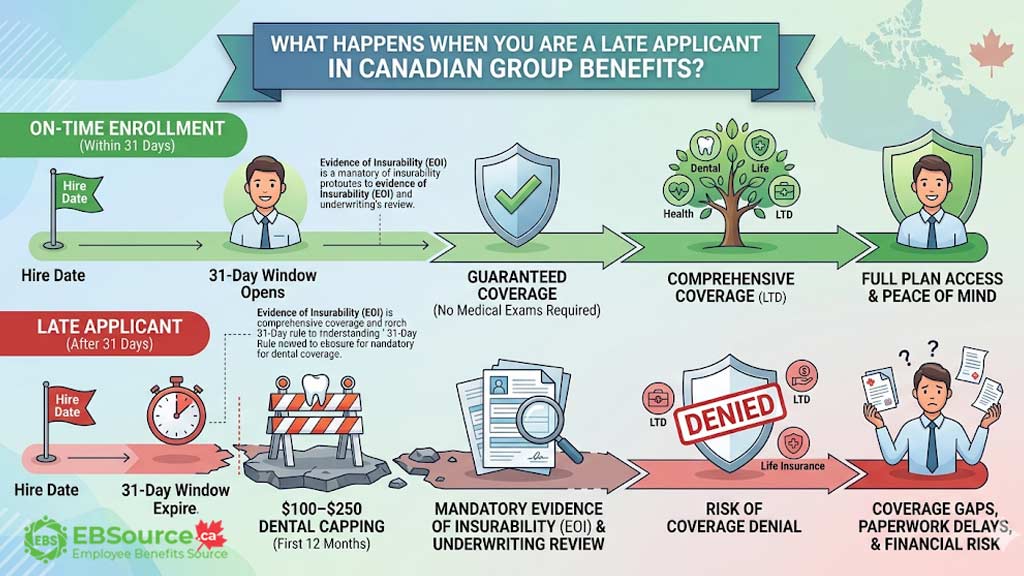
The three major consequences are:
Loss of Automatic Approval
Missing the enrolment deadline means that you lose the right to automatic approval and may need to provide Evidence of Insurability (EOI). EOI is the process by which an insurer assesses an individual’s health to determine eligibility for coverage. Depending on your health history, the insurer may request blood tests, medical exams, or attending physician statements (APS).
Cost responsibility can depend on the carrier, the type of evidence requested, and the group contract. You should ask the insurer or plan administrator who will cover the costs before booking tests or requesting physician records.
Outright Denial of Benefits
The insurer’s review of the EOI application can lead to one of three outcomes: full approval, approval with restrictions, or outright denial.
- Approved: The applicant is granted coverage.
- Approved with Restrictions: The applicant is granted coverage but with specific restrictions, such as a cap on dental benefits.
- Denial: The insurer denies the application for coverage, and the individual is excluded from that part of the benefits plan.
During the review period, you have zero active coverage. If approved, coverage begins on the insurer’s approval date, not the original eligibility date, creating a potential coverage gap. During that gap, the employee is fully exposed and here is what could happen:
- If the employee is diagnosed with a serious illness during weeks 2–4 of the review, the diagnosis becomes a pre-existing condition that the insurer may use to deny the application entirely.
- If the employee needs emergency dental work during the review period, none of it is covered.
- If the employee dies during the review period, the life insurance benefit has not yet been approved, meaning no payout to their beneficiaries.
Coverage Restrictions
Even if you are eventually approved, you will face significant delays and limitations that do not apply to on-time applicants. Some consequences are temporary while others are permanent.
The most common penalty is a restriction on dental benefits. Many employee benefits providers, such as Manulife, Sun Life, Canada Life, and iA Financial Group, cap dental reimbursements at a low amount (e.g., $100 to $250 per person) for the first 12 months of coverage.
A $250 annual limit might sound like a minor inconvenience until you look at what dental work actually costs in Canada. According to Canada Life, the average cost for a dental crown in Canada is between $900 and $1,500 and can reach up to $2,000 in provinces like Ontario.
The following example shows how a late applicant dental cap can significantly increase out-of-pocket costs compared to a regular plan member with standard coverage:
| Regular Plan Member (80% coverage) | Late Applicant ($250 cap) | |
|---|---|---|
| Crown cost | $1,200 | $1,200 |
| Insurance pays | $960 | $250 |
| You pay out of pocket | $240 | $950 |
In this scenario, missing the enrollment deadline costs you an extra $700 out of pocket for a single dental procedure. The financial impact can even worsen if additional treatment is required. A root canal combined with a crown can cost between $2,000 and $3,500. Because the late-applicant restriction is an annual limit, you will be covered for a maximum of $250 for the entire year, leaving you to pay the remaining thousands yourself.
The table below summarizes the most common restrictions across four core benefit categories:
| Benefit Type | Typical Late Applicant Restriction | Duration |
|---|---|---|
| Health (extended health care) | EOI required; if approved, effective date is the insurer’s approval date, not the original eligibility date | Gap from eligibility date to approval date |
| Dental | Per-person dollar cap of $100 to $250 | First 12 months of coverage |
| Life and AD&D | EOI required; denial possible for high coverage amounts or pre-existing conditions | Permanent if denied; standard coverage resumes after approval |
| Long-term disability (LTD) | EOI required; denial is most common for applicants with pre-existing conditions | Permanent if denied |
Note: These restrictions are general industry patterns. The specific penalties, dollar caps, and timelines may differ between insurers and between plan contracts within the same insurer. So, always refer to your plan’s certificate of insurance or benefits booklet for the definitive terms that apply to your coverage.
Quebec-Specific Considerations
Quebec has special prescription drug insurance rules administered by the RAMQ (Régie de l’assurance maladie du Québec). If you are a Quebec resident under 65 and eligible for a private group plan, you must join that plan and provide coverage under it for your spouse and children unless they already have private coverage.
This creates a significant risk for late applicants in Quebec. They will lose access to the employer’s private drug plan and still have to pay the annual premium under Quebec’s public prescription drug insurance plan, which is up to $766 per adult for the 2025-2026 benefits year.
What to Do If You Are Already a Late Applicant?
Late applicant status is not a permanent dead end, but resolving it requires quick action to minimize your risk. These may include contacting your plan administrator or benefits advisor to discuss making retroactive premium payments, submitting an Evidence of Insurability (EOI) or waiting for a plan renewal/insurer switch.
Here is how each option works:
- Explore Back-Pay Premiums: Some insurers allow employers to pay the missed premiums retroactively from the original eligibility date. If this option is permitted, the employee can be enrolled without providing an EOI. However, this is not a universal policy, and employers must confirm with their insurer if it is allowed and how far back they can pay.
- Submit the EOI Promptly: If back-paying premiums is not an option, you must complete the EOI process immediately to minimize any further delay in obtaining coverage.
- Wait for an Insurer Switch: When a company changes its benefits provider, the new insurer often allows all employees to enrol without late applicant restrictions, offering a fresh start.
Never attempt to falsify hire dates or life event dates to appear on time. This is considered fraud and can lead to the denial of future claims and potential termination of the entire group plan.
Expert insight: Offsetting Out-of-Pocket Costs at Tax Time
If your late applicant status results in denied or restricted coverage and you end up paying for medical or dental expenses out of pocket, those unreimbursed amounts may qualify for the Medical Expense Tax Credit (METC) on your federal tax return. While the METC will not fully offset the cost of being a late applicant, it can provide meaningful tax relief, especially if you incur high dental or medical costs during your restricted coverage period.
Employer Liability: The Cost of Failing to Enrol Employees on Time
For plan administrators and HR teams, late applicants pose a significant legal risk. Employers and plan administrators can face liability if they fail to provide employees with clear information about benefits, forms, deadlines, and warnings about the consequences of late enrolment.
Case study: Grams v. Maple Leaf Metal Industries (2006)
The most widely cited case in this area is Grams v. Maple Leaf Metal Industries. In 2006, a twenty-two-year-old employee was advised upon hiring that he was eligible for group benefit coverage after a three-month waiting period. However, the employee did not enrol until seven months after his hire date. The day after he completed the enrolment form, he was killed in a workplace accident.
The employer was sued. The court found that the employer owed a duty of care to the employee. They had an implied contractual obligation to provide sufficient information about coverage, strict timelines, and the severe consequences of failing to apply.
Because the employee was also partially responsible for ignoring the paperwork, the court reduced the damages by 50%, but the employer was still held financially liable for half of a massive life insurance payout (source).
How Can Employers Avoid Late Applicant Risk?
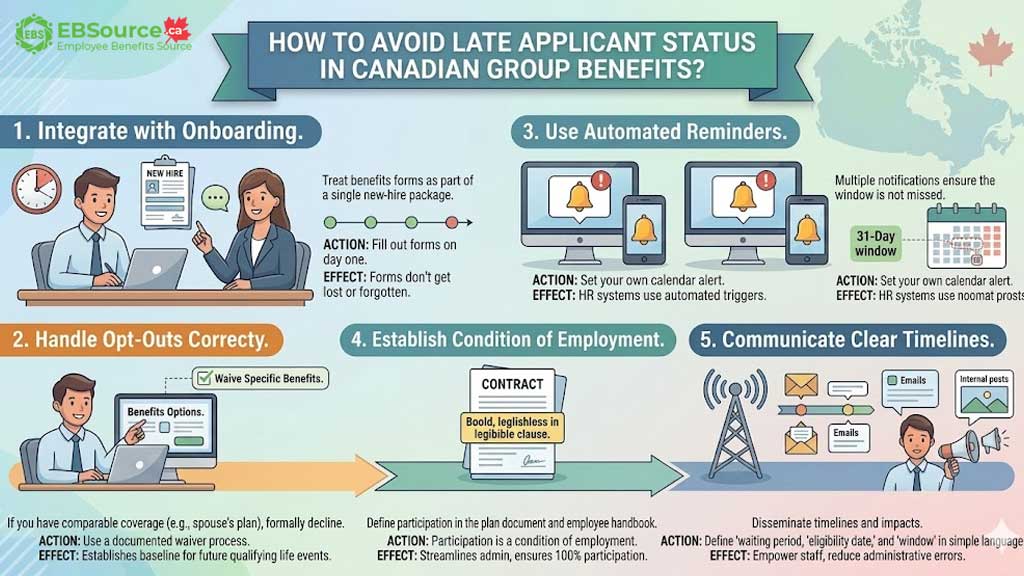
Late enrollment is almost always preventable with four proactive practices: enroll during onboarding, set reminders, manage the risk of waiving coverage, and communicate clearly.
These practices help protect both employees and employers:
Enrol During Onboarding
Include benefits enrolment as a standard part of the new-hire process. The forms can be completed on the first day and submitted by the plan administrator at the end of the waiting period. Do not wait for the eligibility date to begin the paperwork; by then, the 31-day clock is already ticking.
Many employers also require participation in the benefits plan as a condition of employment. This simplifies administration and ensures no one misses the window.
Set Calendar Reminders
Plan administrators should use a reminder system to track every new employee’s 31-day enrolment deadline. Given the employer liability risks outlined above, this is not optional; it is a core administrative responsibility.
A practical calendar can be:
- Offer & Onboarding Stage: Include benefits enrollment packets alongside the official offer letter. State the strict 31-day deadline explicitly.
- Day 1 of Employment: Collect completed enrollment forms or partial waiver documents immediately. Do not wait for the waiting period to end.
- 14 Days Before Eligibility: Run a system audit. Flag any missing forms and issue an automated warning to both the employee and their line manager.
- Eligibility Date: Verify the employee meets the Actively-at-Work requirement before finalizing the submission to the carrier portal.
- Within 31 Days Post-Eligibility: Ensure all data is uploaded into the carrier system to secure Guaranteed Issue status.
Managing Waiving Coverage
When a new employee says, “I don’t need company insurance because I am covered under my spouse’s plan”, allowing them to just skip the paperwork is a mistake that can leave your company financially liable if an accident happens. Formally completing the waiver section of the enrolment form preserves employees’ right to join the plan later without being considered a late applicant.
Total Waiver vs. Partial Waiver: Avoid the Trap
Many employees become late applicants because they misunderstand the concept of waiving benefits. It is important to understand the difference between total and partial waivers:
- Total Waiver: Opting out of the entire plan. This is exceptionally rare and usually only permitted if you can prove you have identical, comprehensive coverage elsewhere (which is uncommon).
- Partial Waiver: You opt out of Health and Dental because you are covered under your spouse’s plan. However, you must still enroll in the pooled mandatory benefits, such as Life Insurance, AD&D, and Long-Term Disability.
If an employee assumes that a “waiver” means they don’t have to fill out any forms at all, they will be considered a late applicant for their mandatory pooled benefits.
Communicate Clearly
Employers need to educate employees on the consequences of missing the enrolment deadline and the importance of reporting life events in a timely manner. This communication should happen during onboarding, at each benefits renewal, and whenever an employee reports a life event. As the court cases above demonstrate, an employer who fails to communicate benefits deadlines can be held legally liable.
FAQs about Late Applicants in Group Benefits
Do I have to pay out of pocket for medical tests requested during the EOI process?
Yes. If the insurance underwriter requires additional details, blood work or specific physician reports to assess your late application, you are strictly responsible for paying any associated costs.
Is it possible to appeal if an insurance carrier denies my late application?
If coverage is declined, ask for the insurer’s written decision and next steps. You may be able to submit missing information, request reconsideration, use the insurer’s complaint process or seek legal advice if the denial appears connected to a protected ground or an employer administration error.
What happens if I miss the 31-day window because I was on vacation or medical leave?
A vacation, medical leave or other absence does not automatically extend the enrolment deadline. However, leave-related situations should be checked against the plan contract, active-at-work rules, and the employer’s duty to communicate benefits deadlines.