



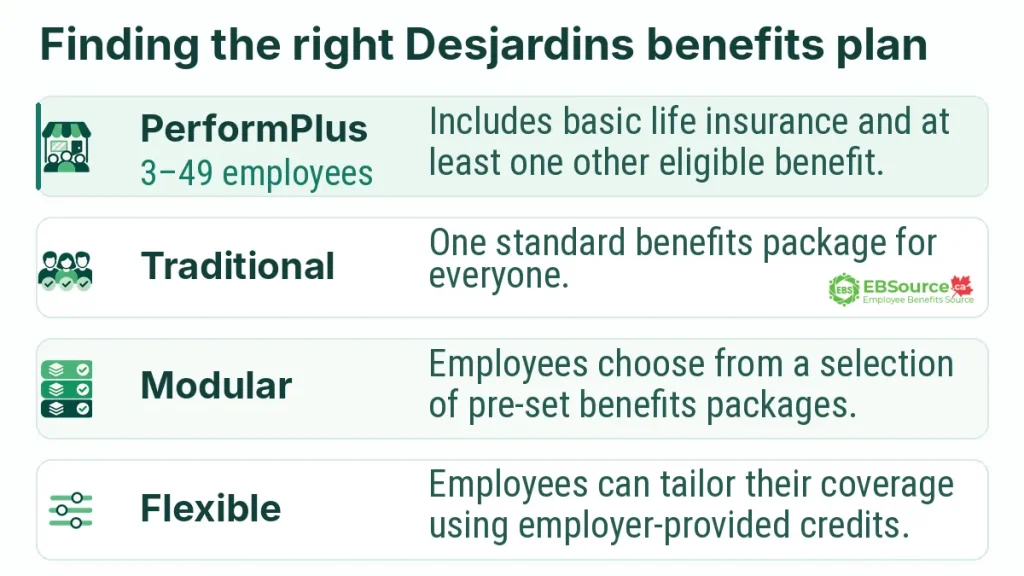
Desjardins group benefits can be a good option for Canadian employers that value coverage flexibility, prescription drug cost controls and additional plan administration services. Small businesses with 3 to 49 employees can start with PerformPlus, while larger organizations can choose from traditional, modular and flexible plans.
However, Desjardins is not the best choice for every employer. Eligibility requirements, service availability and contract terms differ. Public information also makes it difficult to assess how Desjardins compares with competitors on premiums and claims service.
This review covers its coverage, plans, admin tools, limitations and financial strength so you can decide whether to request a proposal.
On this page
What Are the Main Advantages and Limitations of Desjardins Employee Benefits?
Desjardins’ main advantages come from its range of plan structures, insurance categories and administration options. Its limitations mostly come from eligibility requirements, plan-specific coverage conditions and uncertainty about the costs and outcomes for your specific business.
Here’s how each advantage pairs with its limitation:
| Main advantage | Corresponding limitation |
|---|---|
| Broad selection of group insurance products | Actual coverage varies by contract |
| PerformPlus for small businesses | Mandatory basic life insurance and another qualifying benefit |
| Traditional, modular and flexible plans | More employee choice can increase administration |
| Health and wellness spending accounts | Funding, tax and eligibility conditions |
| Multiple drug-cost management measures | Provincial restrictions and possible employee cost-sharing effects |
| Admin 360° | Requires four specified insurance categories |
| TED data transfers | Compatibility and implementation must be confirmed |
| IntelliFlex | Designed for groups of at least 500 people |
| Omni digital services | Service performance cannot be established from functionality alone |
| Prevention and assistance programs | Some services require separate arrangements or charges |
| Strong financial rating | Does not demonstrate premium or claims-service superiority |
Which Canadian Employers Are Most Likely to Benefit from Desjardins?
Desjardins is among the leading group benefits providers for small to large Canadian companies. But employee count is just the starting point. Whether Desjardins is a good fit depends on group size, coverage needs, employee choice and the amount of administration an HR team can manage.
Here’s when Desjardins is worth considering in each employer situation, and when you may want to look elsewhere:
| Employer situation | When Desjardins is worth considering | When to look elsewhere or reconsider |
|---|---|---|
| Small business with 3 to 49 employees | Needs life insurance plus another qualifying benefit and values bundled coverage | Wants a single benefit without the required PerformPlus combination |
| Employer with straightforward coverage needs | Wants consistent benefits and minimal employee decision-making | Needs substantially different coverage for distinct employee groups |
| Employer with diverse employee needs | Values modular or flexible coverage and can administer employee choices | Added flexibility would create more work than value |
| Employer with limited HR capacity | Could benefit from Admin 360° and meets its coverage requirements | Does not need all four required coverage categories or cannot justify the full arrangement |
| Large organization with 500+ members | Needs employee benefit selection and re-enrolment support | Needs straightforward coverage without advanced selection tools |
| Existing Desjardins client | Has coverage or administrative issues that a redesign may resolve | Proposed improvements fail to address the actual problem |
| Employer considering switching | Desjardins offers a meaningful improvement in total value | Savings would require unacceptable coverage reductions or transition risks |
These employer needs also vary by industry. Based on Desjardins’ published features, the following businesses may find certain options worth exploring:
- Professional services firms: PerformPlus for small firms, and modular or flexible plans for growing teams with varied needs.
- Retail businesses: PerformPlus for single stores, and IntelliFlex for chains with 500 or more plan members.
- Manufacturing companies: Traditional plans for consistent coverage, plus disability and absence prevention services.
- Construction companies: Disability coverage, absence prevention services and virtual healthcare for crews across job sites.
- Health care organizations: Flexible plans and IntelliFlex for large, varied workforces.
Note: These are EBSource's suggestions based on Desjardins' published plan features, not Desjardins industry programs. The right choice still depends on your group size, coverage needs and proposal terms.
Source: Group benefits plans – Desjardins
How Does PerformPlus Work for Small Businesses?
EBSource score for small-business suitability: 7.5/10
PerformPlus is Desjardins’ customizable group benefits solution for businesses with 3 to 49 employees. Employers can choose from several insurance types, but every plan must include basic life insurance and at least one additional qualifying benefit:
- Short-term disability insurance
- Long-term disability insurance
- Extended healthcare
- Dental care
Employers can then add options such as critical illness, dependant life, optional life and accidental death and dismemberment (AD&D) insurance. In other words, PerformPlus is flexible about what to add, but not about what must be included.
Desjardins’ detailed PerformPlus materials outline specific requirements for adding a Health Spending Account (HSA). The plan must include extended healthcare and have at least two plan members. Desjardins also specifies a minimum of $250 per plan member per year and $2,500 for the group, subject to the current plan terms.
What Changes for Employers With Employees in Québec?
Québec has special prescription drug insurance rules. Employees under 65 who have access to an eligible private plan generally must join that coverage unless an exception applies, such as having qualifying coverage through another private plan.
Desjardins’ PerformPlus brochure also states that private group plans covering accident, illness (including dental) or disability benefits in Québec must include prescription drug coverage.
Employers with Québec employees should confirm that the proposed plan meets provincial drug insurance requirements and determine which employees must enrol.
Traditional vs. Modular vs. Flexible Plans: Which Desjardins Plan Structure Fits Your Workforce?
EBSource score: 7.5/10
While PerformPlus serves smaller employers, mid-size and large organizations can compare Desjardins’ traditional, modular and flexible plan structures. The main difference is how much choice employees have over their coverage. Compare the cost and administrative impact of each structure before deciding that greater flexibility offers better value.
In short, a traditional plan is a sensible starting point when employees have similar coverage needs and administrative simplicity matters most. A modular plan may be preferable when employees have a few distinct needs that predefined packages can address. Consider a flexible plan when employee choice is a priority, and the employer can manage the added enrolment and credit-allocation requirements.
Traditional Plans
Traditional plans may suit employers that want consistent coverage across the workforce. You choose the benefits offered, which makes it relatively easy to explain what employees receive.
The trade-off is less flexibility for employees with different personal or family circumstances. Younger employees and workers supporting families, for example, may value dental, vision and other benefits differently, even though they receive a similar package.
Modular Plans
Modular plans let employees choose from predefined packages. This gives them more choice than a traditional plan while keeping a controlled structure. For example, you might offer several combinations with different levels of healthcare and dental coverage.
However, each module must be a meaningful choice. If the packages differ only slightly, they may add administrative complexity without adding much value for employees.
Flexible Plans
Flexible plans let you offer benefit options and allocate credits that employees use to select their coverage. This structure can accommodate a wider range of employee needs, which may help organizations with diverse workforces or different employee groups.
The main trade-off is complexity. You’ll need clear enrolment procedures, credit rules, change restrictions and employee communications. You should also decide whether you need additional technology or administrative services.
How Well Does Desjardins Support Employer Benefits Administration?
EBSource score: 8.0/10
Choosing a plan structure also means deciding how its day-to-day administration will work. Whether employees receive standard coverage or choose their own benefits, HR must manage enrolment, employee changes, payroll information, absences, billing and reporting.
Desjardins helps in two layers. First, plan administrators get a secure website for day-to-day tasks. Second, you can choose from three additional services, depending on your plan and how much work you want to hand off.
Standard Online Administration
The secure administrator website is the basic toolset. Through it, authorized users can:
- Add plan members
- View employee coverage information
- Manage absences
- Review monthly billing
- Access reports and administrative forms
Online enrolment is also available for applicable plans. These tools can reduce manual processing, but employers are still responsible for making sure employee records and required changes are accurate.
Admin 360°, TED and IntelliFlex
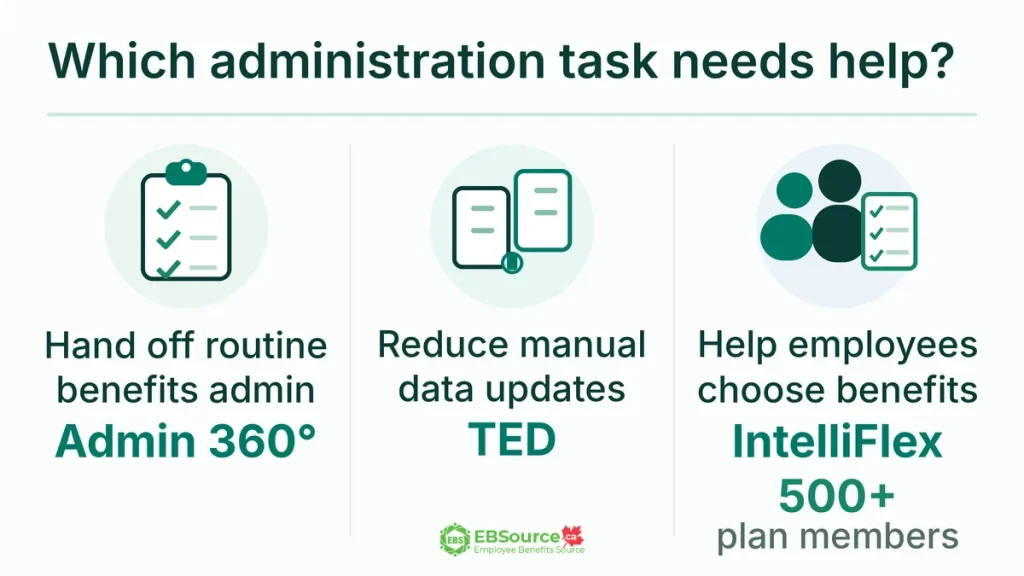
Beyond the standard administrator website, Desjardins offers three additional administration services: Admin 360° handles routine benefits administration, TED transfers employee data, and IntelliFlex supports benefit selection for large groups. Each serves a different purpose and has separate requirements:
- Admin 360° is a full administration service. It allows employers to delegate much of the routine group benefits administration to Desjardins.
- TED (Transfer of Electronic Data) connects your HR or payroll system with Desjardins. Employee information can then be updated automatically, reducing the need for manual changes and forms.
- IntelliFlex supports employee benefit selection and re-enrolment and is designed for groups of 500 or more people. Ask Desjardins whether the platform fits the plan structure and enrolment process you propose.
Depending on your plan, you might use one, several or none. Here’s how they compare:
| Service | Main requirement | Can be used with a traditional plan |
|---|---|---|
| Admin 360° | Life, disability, extended healthcare and dental coverage with Desjardins | Yes. According to Desjardins’ plan administration page, it works with traditional, modular and flexible plans. |
| Transfer of Electronic Data (TED) | Compatible data and implementation arrangements | Whether it fits depends more on the HR and payroll systems than on the plan structure. |
| IntelliFlex | Designed for groups of 500 or more plan members | It’s most useful when employees have benefit choices. If you have a traditional plan, ask Desjardins whether it’s available and worthwhile for your group. |
How Much Do Desjardins Employee Benefits Cost?
Market premium competitiveness: Not independently rated
Administration services can reduce manual work, but employers still need to weigh their value against the plan’s total cost. Desjardins does not publish standard premiums that reliably predict what an individual business will pay.
Pricing depends on the selected benefits, workforce characteristics, coverage terms and underwriting. Spending accounts, administration, optional services, renewals and transition work can all add to what you pay, along with applicable taxes and any contract-specific fees.
To keep the comparison fair, work through these steps:
- Establish the same benefit categories.
- Match reimbursement percentages and deductibles as closely as possible.
- Compare benefit maximums and exclusions.
- Use consistent workforce information.
- Separate mandatory and optional services.
- Identify administrative and implementation costs.
- Evaluate employer contributions and employee out-of-pocket expenses.
Example: Why the Lowest Premium May Not Be the Best Deal
A Canadian employer with 25 employees is comparing two group benefits proposals, called Plan A and Plan B. Both cover the same employees, and the employer pays 75% of the monthly premium.
| Cost factor | Plan A | Plan B |
|---|---|---|
| Monthly premium per employee | $210 | $225 |
| Employer contribution | 75% | 75% |
| Monthly employer cost per employee | $157.50 | $168.75 |
| Annual employer premium cost (25 employees) | $47,250 | $50,625 |
| Additional annual employer cost | $0 | $3,375 |
Plan B costs the employer $3,375 more per year, or $135 per employee. Employees also pay an additional $3.75 each month toward their premiums.
That difference may be worthwhile if Plan B provides higher dental reimbursement limits, better prescription drug coverage or lower out-of-pocket expenses for services employees regularly use. However, if the additional coverage offers little practical benefit, Plan A may be the more economical choice.
The decision: Plan B needs to deliver enough additional value to justify its higher cost. Employers comparing Desjardins with another insurer should request quotes based on comparable employee information and coverage requirements, then review the differences in writing before selecting a plan.
What Employee Benefits Does Desjardins Offer?
A fair cost comparison starts with understanding exactly what coverage an employer is paying for. Desjardins offers benefits for employees’ health, income and financial security, including extended healthcare, prescription drugs, dental, life, disability and critical illness insurance. Spending accounts, travel assistance and wellness services may also be available.
Extended Healthcare and Prescription Drug Coverage
EBSource score: 7.5/10
Desjardins offers a broad range of supplementary healthcare benefits, including services that provincial health insurance may not fully cover. Depending on the plan, eligible expenses may include:
- Prescription medications
- Physiotherapy, massage therapy and psychological services
- Vision care and medical equipment
- Hospital accommodation and home care
- Travel-related emergency medical expenses
- Certain gender affirmation expenses and other specialized coverage options
Note that this long list doesn’t tell employers how much the plan actually pays for each expense.
For example, take two plans that both include prescription drugs. One may reimburse a higher percentage of eligible medication costs. The other has lower premiums but stricter drug restrictions. Both provide drug coverage, yet employees could face very different out-of-pocket costs.
How Effective Are Desjardins’ Prescription Drug Cost Management Options?
EBSource score: 8.0/10
Beyond determining which medications are covered, employers also need to understand how prescription drug spending is managed. Drug claims can account for a substantial share of plan costs, particularly when employees need expensive medications.
Desjardins offers several measures to manage these expenses:
| Cost-management measure | Main purpose | Important consideration |
|---|---|---|
| Generic substitution | Encourages lower-cost generic alternatives | Exceptions and reimbursement rules |
| Prior authorization | Reviews certain drugs before reimbursement | Employee access and treatment continuity |
| Drug utilization review | Identifies potential prescribing or dispensing concerns | How findings affect claims |
| Tiered formulary | Uses different reimbursement levels for selected drugs | Changes to employee cost-sharing |
| Active Pharmacy | Encourages cost-effective maintenance medication choices | Not available in Québec |
| Specialty drug patient support | Helps employees manage complex medication needs | Not available in Québec |
If prescription drug costs rise at renewal, first find out what’s driving the increase. Common causes include:
- Higher prices for existing medications
- More employees using prescription drugs
- A small number of high-cost medications
- Changes in the mix of prescribed drugs
- Pharmacy dispensing costs
Then ask which Desjardins programs address that cause without unnecessarily increasing employees’ out-of-pocket costs.
Employer takeaway: A drop in claims spending isn’t automatically a better result if employees face much higher out-of-pocket costs or barriers to treatment.
Dental Insurance
EBSource score: 7.5/10
Alongside prescription drug coverage, dental insurance is another important part of group health benefits. Desjardins offers preventive care, basic and major restorative treatments, and orthodontics, with coverage limits and reimbursement levels that vary by plan.
Under its PerformPlus plan for small businesses, the available choices and restrictions are outlined below:
| Dental category | Desjardins PerformPlus options | What employers should confirm |
|---|---|---|
| Preventive care | Reimbursement choices from 50% to 100%. Recall examinations can be covered every 6, 9 or 12 months. Scaling and root planing limits can be set at 6, 8, 10 or 12 units. | Selected reimbursement rate, recall frequency and scaling limits |
| Basic restorative | Reimbursement choices from 50% to 100% for eligible basic services, including restorations, endodontics and periodontics. | Covered procedures, reimbursement rate and whether the annual maximum is separate or shared |
| Major restorative | Reimbursement choices of 50%, 60%, 70% or 80% for eligible major services such as crowns and dentures. Annual maximums may be separate or combined with other dental categories. | Coverage for major treatment, annual maximum and eligibility restrictions for very small groups |
| Orthodontics | Reimbursement choices of 50% or 60%, with separate lifetime maximum options ranging from $1,000 to $3,500. Adult orthodontics is an additional option. | Adult eligibility, lifetime maximum |
Keep in mind that a treatment being covered isn’t the same as what an employee will actually receive. For example, a plan may cover crowns but reimburse only a percentage of the eligible fee-guide amount. If the dentist charges more than that amount, the employee also pays the difference.
Life, Disability and Critical Illness Benefits
EBSource score: 8.0/10
While healthcare and dental benefits help employees manage treatment expenses, life, disability and critical illness insurance address different financial risks.
Desjardins offers coverage in each category:
- Group life insurance: Pays a benefit to designated beneficiaries when an insured employee dies. Employers can consider basic coverage and available optional insurance, subject to policy conditions.
- Short-term disability insurance: Replaces part of an eligible employee’s earnings during a covered short-term disability.
- Long-term disability insurance: Provides income protection during qualifying extended periods of disability.
- Critical illness insurance: Pays a benefit when a covered medical condition or event meets the policy’s requirements.
However, how well these products protect employees depends on policy wording and eligibility conditions. This matters most for disability insurance, since similar plans can produce different outcomes. So, confirm these provisions before signing:
| Disability provision | What the employer should confirm |
|---|---|
| Waiting or elimination period | When payments can begin |
| Income replacement percentage | How the benefit amount is determined |
| Disability definition | What conditions qualify initially and later |
| Benefit duration | How long payments may continue |
| Other income offsets | Whether other benefits reduce payments |
| Exclusions and limitations | Circumstances where coverage is restricted |
| Rehabilitation support | Assistance available during recovery and return to work |
Spending Accounts
EBSource score: 7.5/10
Beyond traditional insurance coverage, employers can add flexibility through spending accounts. Desjardins offers health and wellness spending accounts funded by employer credits, although they cover different expenses.
A health spending account (HSA) provides credits for eligible healthcare and dental expenses. However, it isn’t automatically a substitute for insurance against major financial risks, such as long-term disability.
A wellness spending account (WSA) covers a broader range of expenses. Desjardins describes categories such as fitness, professional development, work-life balance, transportation and other approved wellness activities. Employers decide which categories are available, so employees can use their credits for different priorities.
The tax treatment also differs. Eligible HSA reimbursements may be non-taxable federally, although Québec’s provincial tax treatment can differ. WSA reimbursements are generally taxable employment benefits. So confirm the reporting rules before adding either account.
Prevention, Wellness and Assistance Services
EBSource score: 7.0/10
Spending accounts offer flexibility in how employees use their benefits, while prevention and assistance services address broader workplace health needs. Desjardins offers programs that support healthcare access, prevention, disability management, and employee wellbeing.
Here’s what each service does and what to confirm:
| Service | Main purpose | Availability consideration |
|---|---|---|
| Health is Cool 360° | Wellness platform with health navigation and prevention resources | Confirm access under the proposed plan |
| Virtual healthcare | Remote consultations and healthcare assistance | Confirm inclusion and applicable charges |
| Health assistance | Telephone guidance on health-related concerns | Associated with extended healthcare coverage |
| Autonomy Assistance | Assistance locating recovery and home-care resources | Associated with home-care coverage |
| Employee assistance program | Counselling and personal support | Optional program |
| Manager assistance program | Support with workplace and management concerns | Confirm specific entitlement |
| Absence prevention and accommodation services | Assistance with workplace adjustments and recovery | Eligibility and per-use charges may apply |
Desjardins describes an employee assistance program (EAP) offering up to 12 hours of counselling for eligible participants, under the program’s conditions.
Note: This doesn't guarantee that every Desjardins group benefits plan includes EAP counselling.
How Convenient Is Desjardins for Employees Using Their Benefits?
EBSource score for digital tools: 7.5/10
The practical value of these benefits and support services also depends on how easily employees can access them. Simple claims submission, coverage information and self-service tools can improve the employee experience while reducing routine questions for HR.
Desjardins offers a member website, a mobile app and payment card features. Through the Omni app, eligible plan members can:
- Submit healthcare claims
- Review claims history
- Access their payment card
- Set up direct deposit
- View information about their coverage
Keep in mind that an app doesn’t show how quickly complicated claims are processed. It also doesn’t show how well an insurer resolves disputes or helps employees facing delays.
How Financially Strong Is Desjardins as an Insurance Provider?
EBSource score: 8.5/10
Convenient digital tools support everyday claims and plan management, but employers also need confidence in an insurer’s long-term ability to meet its obligations. Financial strength provides a separate measure of reliability beyond the employee experience.
Desjardins Financial Security Life Assurance Company underwrites Desjardins group insurance products. On May 22, 2026, AM Best gave it these ratings:
| Desjardins Financial Security | |
|---|---|
| Financial Strength Rating | A (Excellent) |
| Long-Term Issuer Credit Rating | a+ (Excellent) |
| Rating outlook | Stable |
On AM Best’s scale, an A (Excellent) Financial Strength Rating means the insurer is very well placed to meet its ongoing insurance obligations. According to AM Best, Desjardins’ ratings reflect its very strong balance sheet, strong operating performance and appropriate enterprise risk management.
How Does Desjardins Score as a Group Benefits Provider?
Overall EBSource score: 7.7/10
Financial strength is one important consideration, but it does not establish whether Desjardins is the right provider for a particular employer. To evaluate the broader offering, EBSource assessed 11 categories using public documents, coverage options, eligibility requirements and administration features. The scores reflect documented capabilities and restrictions, not independently verified pricing or service outcomes.
Here’s how Desjardins scores in each area:
| Evaluation criterion | EBSource score | Assessment |
|---|---|---|
| Financial strength | 8.5/10 | AM Best A (Excellent) rating for Desjardins Financial Security, with a stable outlook |
| Employer administration | 8.0/10 | Online tools, data integration and delegated administration, with eligibility requirements for some services |
| Prescription drug cost management | 8.0/10 | Multiple management tools, with some programs not available in Québec |
| Life, disability and critical illness | 8.0/10 | Comprehensive financial protection options, with strength depending on policy terms |
| Small-business suitability | 7.5/10 | PerformPlus supports smaller groups but requires a minimum combination of benefits |
| Plan design and customization | 7.5/10 | Traditional, modular and flexible structures, with more choice adding more administration |
| Extended healthcare and prescription drugs | 7.5/10 | Broad coverage options, with reimbursement levels that vary by plan |
| Dental insurance | 7.5/10 | Multiple treatment categories, with plan-specific reimbursement |
| Health and wellness spending accounts | 7.5/10 | Added flexibility, with funding, tax and eligibility requirements |
| Employee digital experience | 7.5/10 | Digital claims, payment cards and member self-service |
| Prevention, wellness and assistance programs | 7.0/10 | Wide range of support services, though some are optional or charged separately |
How we scored: These are EBSource editorial assessments of what Desjardins documents publicly, how useful each feature is in practice and what restrictions apply. These 11 category assessments describe documented Desjardins capabilities. They should not be treated as the site-wide comparative rating unless calculated using EBSource’s common provider-rating methodology.
EBSource’s editorial scores do not independently establish:
- Premium competitiveness: Whether Desjardins offers lower premiums than competing insurers for an equivalent group plan.
- Actual claims-processing performance: Average settlement times, dispute resolution outcomes or independently measured member satisfaction.
- Renewal-rate stability: Whether a particular employer will experience lower premium increases over time.
- Carrier-transition performance: Whether moving an existing group plan to Desjardins will be faster or easier than switching to another provider.
To assess these outcomes, employers need comparable quotes, specific experience, or independently verifiable performance data. Don’t draw these conclusions based solely on product availability or digital functionality.
What Should Employers Confirm Before Choosing or Switching to Desjardins?
The overall score helps employers assess Desjardins’ documented strengths and limitations, but the final decision depends on each business’s needs and proposal terms. The next steps differ for first-time buyers, existing Desjardins clients and employers considering a switch.
Here’s what to confirm in each situation and the most useful next step:
| Employer situation | What to confirm | Decision to make |
|---|---|---|
| Buying benefits for the first time | Itemized quotes, mandatory benefits, eligibility, employer and employee contributions, coverage limits | Is the proposed plan affordable and suitable for the workforce? |
| Already insured with Desjardins | Renewal changes, claims trends, current coverage usage, available redesign options, alternative quotes | Is it better to redesign, negotiate or explore switching? |
| Switching from another insurer | Side-by-side coverage comparison, treatment authorization requirements, active disability claims, effective dates and transition responsibilities | Do the improvements justify the cost and disruption of changing carriers? |
Here’s how this plays out in practice:
First-time buyer: A 12-person business wants dental coverage but has no immediate need for life insurance. Since PerformPlus requires basic life insurance and another qualifying benefit, the employer must account for that package requirement before requesting a quote.
Existing client: A business receives a substantial renewal increase. Before changing insurers, it compares proposed changes to the current plan, their effect on employee coverage and the cost of competing quotes. A lower premium isn’t automatically better.
Switching employer: A business finds an attractive Desjardins quote, but some employees are receiving ongoing disability benefits and prescription treatments. It should get written confirmation of how existing claims and coverage will be handled before approving the switch.
If you’re comparing Desjardins with other carriers, read our reviews of:
- Empire Life employee benefits
- Equitable Life employee benefits
- RBC Insurance employee benefits
- iA employee benefits
What Do the Insurance Terms in This Desjardins Employee Benefits Review Mean?
Group benefits come with terms that may be unfamiliar to employers buying insurance for the first time. These definitions explain how common insurance terms affect plan costs, coverage and employee claims.
Plan Design and Costs
- Credit allocation: The amount an employer gives employees to spend on benefit options under a flexible plan.
- Underwriting: How an insurer assesses risk and determines coverage terms and pricing.
- Reimbursement percentage: The share of an eligible expense that the plan pays. For example, 80% coverage means the plan pays $80 of an eligible $100 expense, before any deductible or other limits.
- Deductible: The amount an employee must pay before the plan starts covering certain expenses.
- Benefit maximum: The highest amount a plan will pay for a particular benefit, usually per year or over a lifetime.
Prescription Drug and Dental Coverage
- Prior authorization: Approval required from the insurer before certain prescription drugs or treatments qualify for reimbursement.
- Drug utilization review: A review of prescription drug use to identify potential safety concerns, inappropriate use or unnecessary costs.
- Tiered formulary: A list of covered drugs divided into groups with different reimbursement levels.
- Drug cost-sharing: How prescription drug costs are divided between the insurance plan and the employee.
- Scaling units: Time used to measure dental scaling services. One unit generally equals 15 minutes.
- Root planing: A deep-cleaning procedure that removes plaque and tartar from tooth roots below the gumline.
- Endodontics: Dental treatment involving the inside of a tooth, such as root canal treatment.
- Periodontics: Dental care focused on the gums and other structures supporting the teeth.
- Dental fee-guide amount: A reference amount for dental treatment costs. Insurance reimbursement may be based on this amount rather than the dentist’s actual charge.
Disability Insurance
- Elimination period: The waiting period between the start of a qualifying disability and when insurance benefits can begin.
- Other income offsets: Payments from other sources, such as CPP disability benefits, that may reduce disability insurance payments under the plan.