
What Happens to Your Pay and Workplace Benefits During Leave in Canada?


During a leave from work, three separate questions matter: are you allowed to take the leave, what income may be available while you are away and which workplace benefits continue. The answers depend on the reason for the leave, your employer’s programs and the rules that apply to your situation.
Start with the reason you are away. Then identify the leave rules, possible income sources, benefit coverage and any application deadlines.
On this page
What Should You Check Before Taking Leave?
Before you stop working, check three decisions separately: whether you can take protected time off, what replaces your income and which workplace benefits stay active. Each one is decided by a different source. See who determines each part, then watch for the timing gaps that can stop pay or coverage.
Three Decisions to Check Before Leave
The table below shows what each decision covers and what it leaves open.
| Decision | Who determines it | What it establishes | What it does not settle |
| Leave entitlement | Employment standards, a collective agreement or a workplace policy; the Leave of Absence guide covers the details | Whether you can take protected time away and return to your job | Whether you are paid while away |
| Income replacement | Your employer (paid sick days, top-ups), your insurer (STD or LTD) or a public program such as EI or workers’ compensation | Whether you receive income, how much and for how long | Whether your health, dental or life coverage continues |
| Benefit continuation | Employment standards, your plan terms and your premium arrangement | Which workplace benefits stay active and who pays the premiums | Whether your leave or income claim is accepted |
Three separate decisions to check before leave
A common mix-up: HR confirms the leave dates, and the employee assumes their STD claim is also moving. In most workplaces, the insurer needs its own claim form and medical information before it pays anything.
When Pay or Coverage Can Stop During Leave
Pay or coverage often stops because of timing or missing paperwork, even when you qualify. Watch for these four points:
- Waiting periods: Many disability plans pay nothing for the first days or weeks of an absence. Check whether paid sick days are meant to cover that stretch.
- Medical paperwork: Insurers and Service Canada each use their own forms. A doctor’s note for your employer may not satisfy either one.
- Premiums without a paycheque: If your share of premiums normally comes off your pay, you may need another way to pay it while you are away.
- Mismatched end dates: Your leave, your income support and your coverage can each end on a different date.

Which Pay and Benefits Apply to Your Type of Leave?
Your reason for leave decides which income route and benefit risk to check first, and each situation has its own trap. Find your row in the table for the payer, the risk and the next step.
Leave, Income and Benefit Routes by Situation
Use the table below to find the income route, benefit risk and next step that fit your situation.
| Your situation | Income route | Benefit risk to check | Next action |
| Illness or non-work injury | Paid sick days, then STD or EI Sickness Benefits in Canada, then LTD for long absences | Your STD waiting period may be longer than your remaining paid sick days, leaving unpaid days in between | Count your sick days against the waiting period and ask HR for STD claim forms |
| Stress, anxiety, burnout or another mental health condition | The same route as illness: paid sick days, STD or EI sickness, then LTD | Insurers may ask for a treatment plan and regular updates; an EAP may stay available while you are away | Ask each payer what medical information it needs, and send it to the payer rather than your manager |
| Work-related injury or illness | Start with your province’s or territory’s workers’ compensation board; EI or an employer plan may interact with a pending or denied claim | Some STD plans pay while a workers’ compensation claim is pending, but ask you to repay the plan if the board accepts it | Report the injury to your employer right away and file with the board |
| Pregnancy, birth or adoption | EI Maternity and Parental Benefits (QPIP in Quebec), plus any employer top-up | If you stop paying your premium share, disability coverage can lapse before your return date | Get written confirmation of which premiums continue and how you will pay them |
| Caring for a seriously ill or dying family member | EI Caregiving Benefits and any paid personal days | Service Canada needs a medical certificate about your family member, not about you | Ask your family member’s doctor for the certificate early |
| Extending an existing leave | Each payer must accept the new dates; payments do not extend on their own | Your leave, income and coverage can end on different dates | Send the new dates to each payer separately, before your current end date |
| Gradual return to work | Partial earnings may reduce STD, LTD or EI payments | Some plans require a minimum number of weekly hours before full coverage restarts | Report your hours and earnings to each payer before you start |
Leave, income and benefit routes by situation
Which leave you can take, how long it lasts, what notice and evidence your employer may ask for and whether your job is protected are covered in Leave of Absence in Canada, with a separate guide for Stress Leave in Canada. That right may come from employment standards, a collective agreement, a workplace policy or your employer’s duty to accommodate a disability. To compare holiday and paid time off guides, see Time Off Work in Canada.
Income programs work differently. EI is federal, so most of its rules are the same everywhere. The main exception is Quebec, where QPIP pays maternity and parental benefits instead of EI, while EI sickness and caregiving benefits still apply. Workers’ compensation is run separately by each province and territory.
How Can Your Income Sources Work Together?
Leave income sources do not always add together. Sick pay, STD, EI, workers’ compensation and LTD may reduce one another, and an employer top-up may or may not count against EI. Your STD plan also decides whether EI pays first or second. A long illness and a parental leave each follow their own sequence, and LTD is the usual next step when an absence runs long.
For how STD plans pay and how to claim, see Short Term Disability Benefits in Canada.
Common Offsets Between Leave Payments
An offset means one payment reduces another. Two are common:
- Sick pay or STD and EI: If your employer’s plan is registered in the EI Premium Reduction Program, you use that plan first, and any sick pay or wage-loss payments that overlap with EI sickness benefits are deducted in full, according to Employment and Social Development Canada. If the plan is not registered, EI is reduced by 50 cents for each dollar of those payments.
- LTD and CPP or QPP disability: LTD plans often reduce your payment by any CPP or QPP disability benefit you receive, and may require you to apply for it.
Employer top-ups: Some employers top up EI maternity or parental benefits through a supplemental unemployment benefit (SUB) plan, which brings your total closer to your regular pay. A qualifying payment under a registered SUB plan may top up EI without being deducted from it. Other employer payments may be treated as earnings, so ask HR how the arrangement is registered and report all payments to Service Canada.
Your benefits booklet lists the offsets in your plan. Ask HR for it before you estimate your income, and tell Service Canada about any sick pay or disability payments you receive.
Should You Apply for EI Now or Wait for STD?
How EI fits depends on your STD plan. The Premium Reduction Program (PRP) lowers an employer’s EI premiums when its own sick-leave or STD plan pays before EI. Find the row that matches your workplace, then apply within the 4-week window unless you are sure EI will not apply.
| Your situation | How EI usually fits | What to do |
| No STD plan | EI sickness benefits are usually your main income once paid sick days run out | Apply as soon as you stop working |
| STD plan registered in the Premium Reduction Program | You use the STD plan first; EI pays little or nothing for the weeks STD covers | Ask HR whether the plan is registered, and apply early if STD may be denied or end before you can return |
| STD plan not registered | EI can be paid alongside STD, reduced by 50 cents for each dollar | Apply within 4 weeks and report every STD payment |
| STD claim denied or delayed | EI may become your main income source | Apply right away if you have not, and ask the insurer for its reasons in writing |
How EI fits with your STD plan
This table covers how EI treats your STD payments. Your STD policy may separately reduce its own payment because of EI or other income, so check both sets of rules before you estimate your total.
Example: How sources can line up during a long illness
This example uses assumed plan terms to show the order, not real rates or waiting periods. Your plan may work differently.
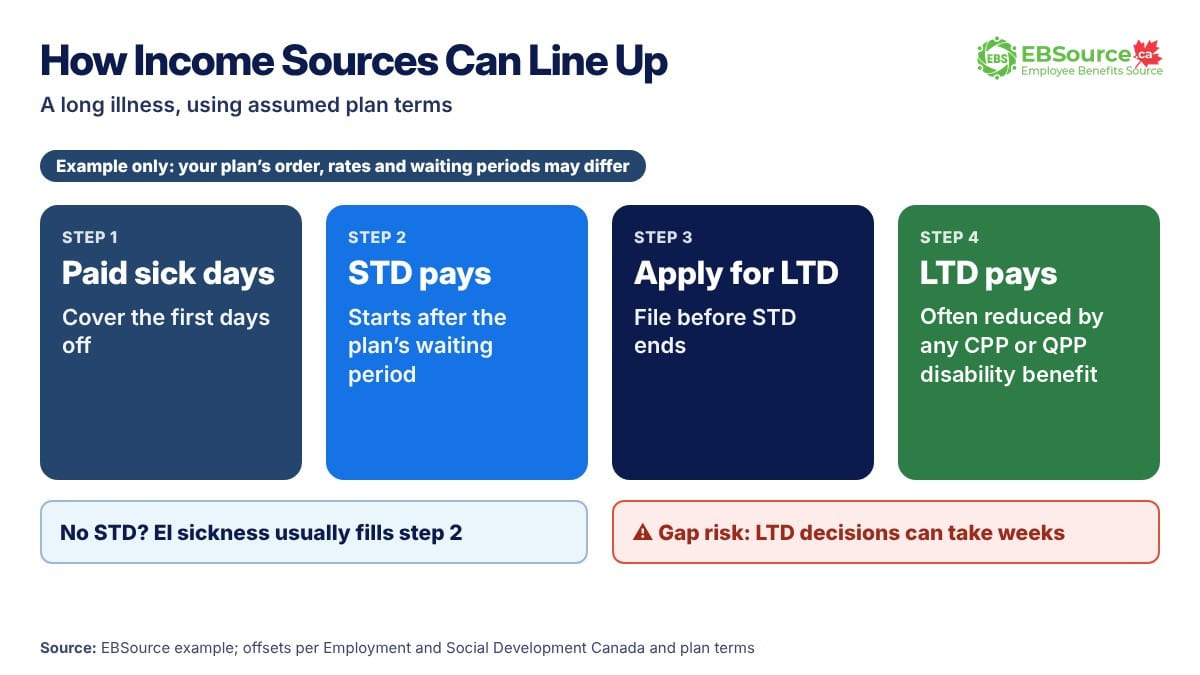
- Step 1: Your remaining paid sick days cover the first days off.
- Step 2: Once the STD waiting period ends, your STD plan starts paying a share of your earnings.
- Step 3: As STD nears its end, you file the LTD application your insurer asked for.
- Step 4: LTD starts paying, often reduced by any CPP or QPP disability benefit you are approved for.
Without STD, step 2 would usually be EI sickness benefits instead. The gap to plan for sits between steps 3 and 4, because LTD decisions can take time.
Example: How a parental leave can play out
This example also uses assumed plan terms. It shows why premiums matter even when you are not sick.
- Step 1: Before the leave, HR confirms in writing that health, dental, life and disability coverage continue, and that you will pay your share by pre-authorized debit.
- Step 2: EI parental benefits start, and your employer’s SUB plan tops them up for the weeks the plan covers.
- Step 3: The top-up ends partway through the leave. Your income drops, but your premium share stays the same.
- Step 4: A health problem starts shortly before your return date. Because your disability coverage stayed active, you may be able to file an STD claim. If the condition continues past your scheduled return date, an active plan may let the claim start when you would otherwise have returned, depending on its definitions and the medical evidence.
If premiums had stopped at step 3, step 4 could leave you with no STD to claim. The point to plan for is the income drop when the top-up ends.
When to Start Planning for Long-Term Disability
Plan the handoff early if recovery might take months. Short-term coverage has an end date, and long-term disability claims often take weeks to assess. Ask your insurer when to start an LTD application, rather than waiting for STD or EI to run out.
What Happens to Your Workplace Benefits?
Your workplace benefits can continue, change or pause during leave. The result depends on your jurisdiction, the type of leave and your plan terms. Check what each type of coverage can lose if it lapses, including pension contributions, then get four answers from HR in writing: what stays active, what you owe, how you pay and when anything ends or restarts.
What Each Type of Coverage Can Lose
Each benefit follows its own rules during the same leave. This table shows what can change, what a lapse can cost you and what to confirm.
| Coverage | What can change during leave | What a lapse can cost you | What to confirm |
| Health and dental | Often continues if premiums are paid; some plans pause it during a long unpaid leave | Claims for care during the gap; a late re-enrolment may come with waiting periods or limits | Whether claims are paid during leave and how premiums are collected |
| Life insurance | The amount is often tied to your salary and active employment | Optional coverage you re-apply for later may need health questions (evidence of insurability) | The amount during leave and whether optional coverage needs a separate payment |
| Short-term and long-term disability | May lapse if premiums stop, especially during a non-medical leave | Income protection if you become ill before you return | Whether coverage stays active and what keeps it active |
| Pension or retirement savings plan | Your contributions and employer matching may stop when pay stops | Employer contributions for the leave period, unless the plan lets you make them up | Whether contributions continue, and whether you can make up missed ones later |
| Optional employee-paid coverage | Your share usually comes off your pay, so it can stop when pay stops | The coverage itself, if a payment is missed | How and when to pay your share |
What each workplace benefit can lose during leave
Questions to Ask HR Before You Leave
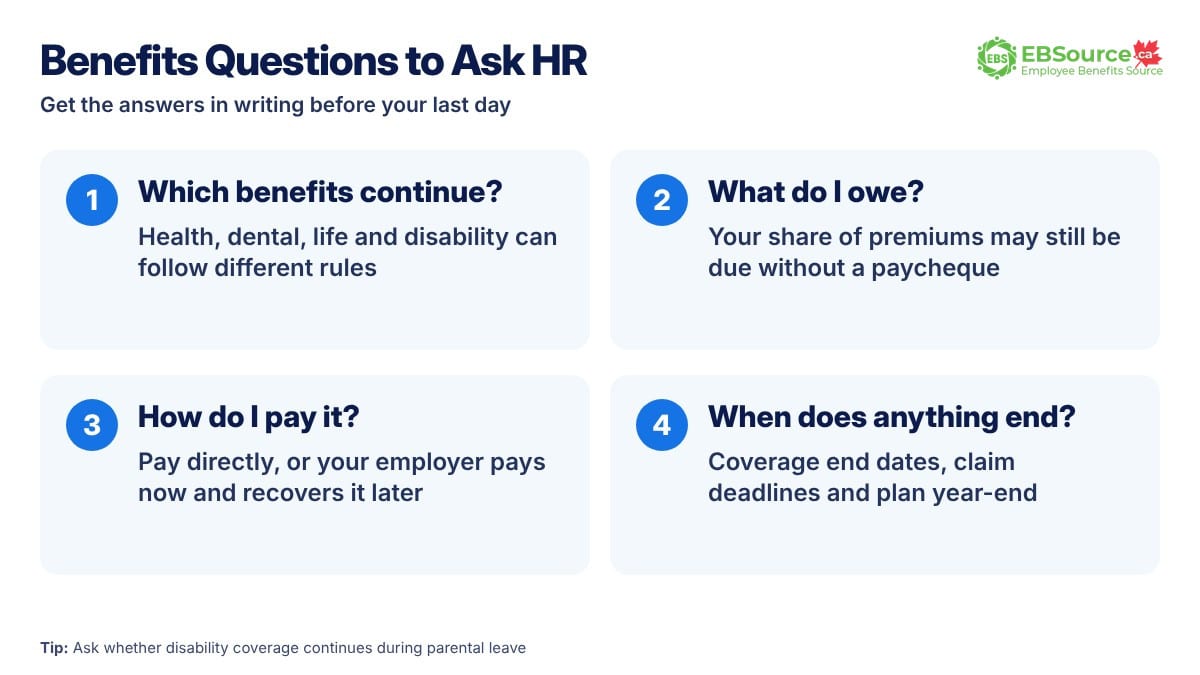
Ask these before you leave, and keep the answers with your leave paperwork:
- Which benefits continue? Health, dental, life and disability coverage can follow different rules during the same leave.
- What do I owe? Your share of premiums may still be due even when your pay stops.
- How do I pay it? Ask whether you pay directly, or your employer pays now and recovers it after you return.
- When does anything end or restart? Note coverage end dates, claim deadlines, your plan’s year-end and whether coverage restarts on its own when you return.
In many jurisdictions, employers must keep benefit plans running during pregnancy and parental leave if you keep paying your share. If you choose not to pay, or your plan and jurisdiction allow coverage to stop, you can lose the protection shown in the parental leave example.
What Should You Do Before Your Last Day?
Before your last day, gather the documents each party may ask for, know which party handles which question, and start your income claims. Missing paperwork is a common reason a first payment arrives late.
Documents to Keep Ready
Keep these in one place before your last day:
- Your benefits booklet or plan summary
- STD or LTD claim forms, including the employee, employer and doctor sections
- Any medical forms your insurer or Service Canada asks for
- Whether your employer will issue your Record of Employment (ROE) electronically or on paper. You do not need to wait for it before applying for EI
- Written confirmation of your leave dates and how premiums will be paid
Who to Contact and What to Ask
Each party handles a different piece of your leave, and none of them updates the others for you. This table shows where to take each question.
| Contact | What to ask them |
| HR or payroll | Top-up rules, premium payments, pension contributions and when your ROE will be issued |
| Your manager | Handover, how to stay in touch while away and your return schedule (not your leave entitlement or benefits) |
| Insurer or plan administrator | Claim forms, waiting periods, medical requirements and payment dates |
| Service Canada | EI eligibility, application status and reporting while on benefits |
| RQAP (Quebec only) | QPIP maternity, paternity and parental benefits |
| Workers’ compensation board (work-related injury only) | Claim forms, reporting deadlines and how its payments interact with workplace plans |
| Your doctor or treating professional | Medical forms for your insurer or Service Canada, expected time off and work limits |
Who handles each part of your leave
Steps to Take Before Your Last Day
These steps start each claim and keep your leave, income and benefits moving at the same time:
- Confirm the leave route with your employer. The Leave of Absence guide covers eligibility, notice and job-protection rules for your jurisdiction.
- Book a medical appointment early, so your doctor can complete insurer and Service Canada forms on time.
- Apply for income support as soon as you stop working. For EI sickness benefits, applying more than 4 weeks after your last day of work may cost you benefits, according to Service Canada’s application page.
What Should You Do if Your Leave Changes?
A new return date does not update your income or coverage on its own, and the parties involved do not pass updates to each other. Tell each one separately, send medical updates only where asked, check which payment or coverage ends first, and watch for overpayments if you return early.
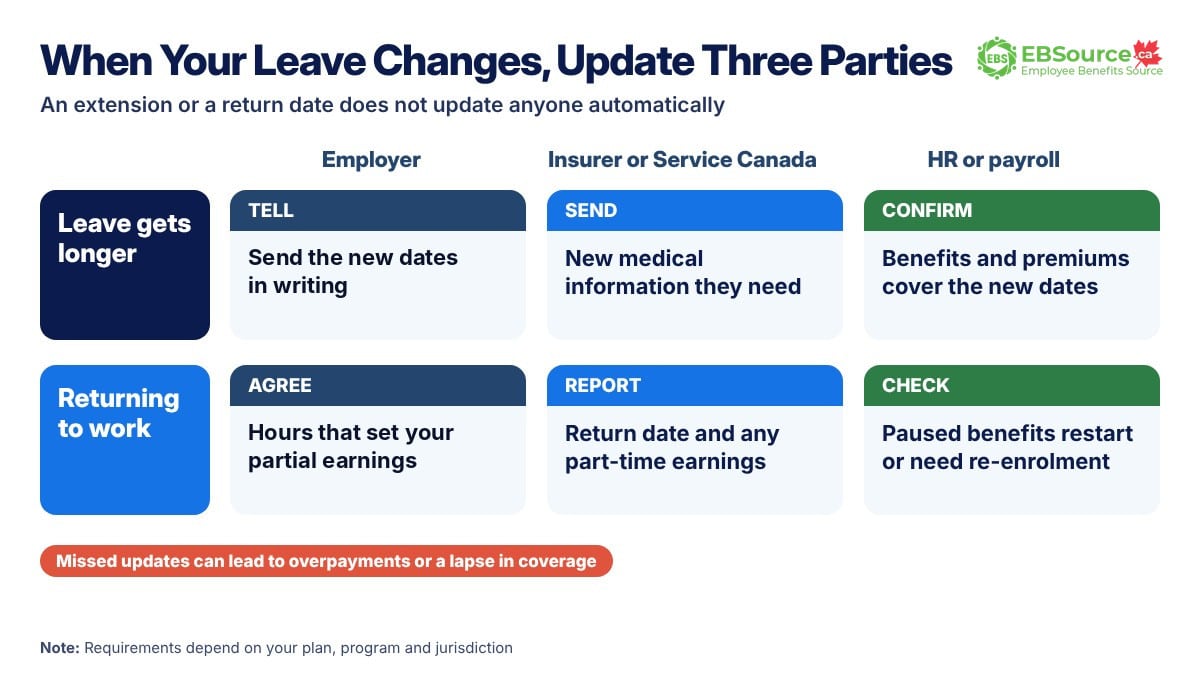
Use this checklist whenever your return date moves, earlier or later:
- Employer: Give HR the new dates in writing. Extension rules, notice and evidence requirements are covered in the Leave of Absence guide.
- Each payer separately: Your insurer, Service Canada, RQAP or workers’ compensation board will not hear about the change from HR. Send the new dates to each one that pays you.
- Medical updates: Send updated forms only to the party that asks for them.
- What ends first: A longer leave can outlast your STD period, your EI weeks or your premium arrangement. Check which ends first, and line up the next income source or the LTD application before it does.
- Overpayment risk: If you go back earlier than planned, tell each payer before your first day back. Payments made for weeks you worked may have to be repaid.
How Does Returning to Work Affect Your Pay and Benefits?
Going back can change your income and coverage, especially with a gradual return. Before your first day back, confirm your return date, hours and duties, any work limits, how partial earnings affect your payments, when benefits restart, whether your pay stub is correct and who needs your return date.
Confirm these points first:
- Return date: Confirm the exact date with HR, so each payer stops paying on the right day.
- Hours and duties: Your schedule during a gradual return, since it sets your partial earnings. Return rights and the accommodation process are covered in the Leave of Absence guide.
- Work limits: If you return to lighter or modified duties, your insurer may need your doctor’s description of your limits to decide on partial benefits.
- Partial earnings: How part-time earnings affect STD, LTD or EI payments, and who you must report them to.
- Coverage restart: Whether paused benefits restart automatically or need re-enrolment, and whether your plan requires a minimum number of weekly hours.
- Pay and deductions: Check your first pay stubs to confirm that your leave balances, benefit premiums and pension contributions have restarted correctly.
- Notifications: Which parties need your return date, so payments stop on time and you avoid an overpayment.
Which Calculator Fits Your Leave Situation?
Pick the calculator that matches your situation once you know which EI benefit may apply. Each one gives a gross estimate before tax, not an eligibility decision, so Service Canada confirms the final amount. If you are unsure which EI benefit fits, start with the calculator directory.
This table matches each leave situation to the EBSource calculator built for it.
| Your situation | Calculator |
| Off work because of illness, injury or a mental health condition | EI Sickness Benefits Calculator |
| Taking time off for a birth or adoption | EI Maternity and Parental Benefits Calculator |
| Caring for a seriously ill family member | EI Caregiving Benefits Calculator |
| Not sure which EI benefit applies | EI Benefits Calculator |
EBSource calculators by leave situation
Quebec residents planning maternity or parental leave should estimate through QPIP instead. The sickness and caregiving calculators still apply in Quebec.
What Deadlines Should You Watch During Leave?
Each stage of leave has its own question, contact and deadline, and missing a deadline usually costs income or coverage rather than the leave itself. The table below lists each stage of leave with its key question, contact, deadline and the risk of missing it.
| Stage | Question | Contact | Deadline to watch | If you miss it |
| Before leave | Which payer comes first? | HR and your insurer | The STD waiting period and claim deadline in your booklet | Unpaid days or a late first payment |
| Your last day | Do I need to apply for EI? | Service Canada | Apply within 4 weeks of your last day | You may lose EI benefits |
| During leave | Which benefits stay active? | HR or your plan administrator | Each premium due date | Coverage, including disability, can lapse |
| Long illness | When does LTD start? | Your insurer | The LTD application date your insurer sets, usually before STD ends | A gap with no income while LTD is assessed |
| Leave extension | Who needs my new dates? | Your employer, insurer and any public administrator | Before your current end date | Payments or coverage stop on the old date |
| Before return | How do hours and earnings affect my payments? | HR, your insurer, Service Canada | Before your first day back | An overpayment you may have to repay |
| Employment ends | When does my coverage end? | HR and your insurer | The conversion window in your booklet, which is often short | You may lose the option to keep life or health coverage on an individual policy |
Leave action map with deadlines by stage
If your workplace has no short-term disability coverage, you may need to rely on paid sick days and EI sickness benefits before longer-term coverage becomes available. If coverage exists but its waiting periods, offsets or claim sequence are unclear, ask HR for the benefit booklet and a written explanation of how the plan coordinates with EI. For how longer claims are paid, see Long-Term Disability Insurance.
For HR and payroll teams: Repeated questions about waiting periods, premium collection, EI coordination or gaps between STD and LTD may mean the plan or employee communication needs review. Check the current EI waiting-period rule on Canada.ca before relying on your plan to bridge it, since temporary measures have waived it for claims starting within set dates. To compare coverage configurations and the decisions involved in a plan review, see Group Disability Insurance.
Frequently Asked Questions About Employee Leave and Benefits
Should I wait for my ROE before applying for EI?
Service Canada says not to wait for your documents before you apply. If your employer issues ROEs electronically, it sends yours straight to Service Canada, and you can generally view it in My Service Canada Account. If you receive a paper ROE, submit it as Service Canada instructs.
Who should receive my medical information?
Send medical evidence for an STD or LTD claim directly to your insurer using its forms. Service Canada has its own medical certificate requirements for EI sickness benefits. Your employer may separately ask how long you will be away or what changes you need at work.
What if I need leave before my workplace benefits start?
Many group plans cover new employees only after a set period. If you become unable to work before your coverage starts, the plan may not pay STD or LTD benefits for that absence. EI sickness benefits may be another option if you meet Service Canada’s requirements, including 600 insured hours. Ask HR for your coverage start date in writing.
What happens to my benefits if my job ends during leave?
The effect depends on your plan, the employment standards that apply and any notice period. Some employment laws protect your job and benefits while you take certain types of leave (see the Leave of Absence guide). An approved STD or LTD claim may continue under the policy’s rules. Ask your insurer how termination affects your claim and whether you can convert any coverage to an individual policy, including the deadline.
What if I can’t pay my share of premiums during unpaid leave?
It depends on the type of leave and the rules that apply. During protected leaves covered by employment standards, your benefits may need to continue if you keep paying your share, while your employer continues its required contributions. For other unpaid leave, your plan may have different rules. If you can’t pay, contact HR before missing a payment and ask whether coverage can continue and what happens if it cannot.