



Empire Life offers flexible group health, dental, life, disability and critical illness coverage and retirement plans to Canadian employers, with funding options that range from fully insured plans to selected self-funded (ASO) arrangements. This provider also has strong financial support and specialized claims assistance.
But how well do its plans meet different business needs, and where might employers face additional costs or limitations? Does it offer the right balance between good coverage, reasonable costs, and reliable service?
This review covers coverage, costs, claims service, administration and the questions employers should ask before choosing or renewing an Empire Life plan.
On this page
Empire Life Employee Benefits Overview
EBSource’s 7.6/10 overall rating is a weighted editorial assessment, not a rating issued by Empire Life or a credit rating agency. This employee benefit provider scores highest for financial strength and lowest for wellness. Its main advantages are plan flexibility and documented disability support.
| Employer evaluation point | Empire Life position |
|---|---|
| EBSource overall rating | 7.6/10 |
| Best suited for | Small and mid-sized employers seeking flexible plan design and documented disability support |
| Main trade-offs | Public pricing unavailable; EAP and telemedicine may require additional coverage |
| Small-group offering | BeneFit for eligible groups issued with 2-19 lives |
The rating helps identify what to investigate, but it cannot tell you whether Empire Life will offer the best price or terms for your workforce. For the full scoring framework and a comparison with other insurers, see EBSource’s recommended employee benefits providers.
Source: Ratings – Empire Life and Fast facts – Empire Life
Is Empire Life Financially Secure Enough for Long-Term Claims?
For employers making a multi-year commitment, Empire Life’s capital position is a meaningful strength. As a federally regulated insurer, Empire Life must hold enough capital to meet OSFI’s requirements.
Based on December 31, 2025, OSFI filings, Empire Life reports that it ranks among the top 10 Canadian life insurers by total assets. EBSource rates Empire Life 8.5/10 for financial strength. Its A (high) financial strength rating and 150% LICAT ratio support this assessment, although earnings and capital levels can fluctuate.
| Indicator | Latest figure | What it tells employers |
|---|---|---|
| Financial strength rating | A (high), stable trend, from Morningstar DBRS (July 13, 2026) | An independent view of the insurer’s ability to meet its obligations. |
| LICAT ratio | 150% at September 30, 2026, down from 159% at June 30 and up from 145% a year earlier | Available capital compared with the buffer OSFI requires. |
| Q3 2026 earnings | Net loss attributable to common shareholders of $23 million, compared with net income of $93 million in Q3 2025 | Shows the current quarter’s profitability and year-over-year change. One quarter should not be used alone to assess claims-paying ability. |
Note: The LICAT ratio measures solvency. It says nothing about premium affordability or how claims are handled.
Can Employers Build a Complete Benefits Plan with Empire Life?
Empire Life offers the major types of group insurance coverage: extended health and prescription drugs, dental, life and AD&D, short- and long-term disability, critical illness and travel emergency assistance.
Empire Life also offers Group Retirement Savings, which is separate from its group health and insurance benefits. Employers that want to combine both services should evaluate the retirement plan separately.
A small or mid-sized employer can consider a single core plan from Empire Life, with one insurer handling billing, claims, and administration.
EBSource rates Empire Life 7.5/10 for coverage, but how much protection employees receive depends on the plan design.
| Coverage | What Empire Life offers | What to check in your proposal |
|---|---|---|
| Extended health | Prescription drugs with a pay-direct drug card, major medical, paramedical, vision and hospital benefits | Drug formulary, high-cost drugs and prior authorization, reimbursement levels, deductibles and maximums |
| Mental health (within extended health) | Coverage for eligible mental health practitioners | Eligible practitioners, per-visit reimbursement, annual maximum and whether practitioners share one limit |
| Dental | Basic, major and orthodontic services | Coinsurance by service type, annual and orthodontic maximums, recall frequency and fee guide year |
| Life and AD&D | Group life, accidental death and dismemberment, and dependant life | Benefit formula, non-evidence maximum and age reductions |
| Weekly Indemnity and LTD | Short- and long-term income replacement | Definition of disability, waiting period, benefit duration, non-evidence maximum and taxability |
| Critical illness | Lump-sum benefit for covered conditions | Covered conditions, benefit amount, survival period and exclusions |
| Travel Emergency Assistance | Emergency medical coverage and assistance, delivered by Trident Global Assistance | Eligibility, trip-duration limit, lifetime maximum and exclusions |
Empire Life provides coverage for gender-affirming procedures and treatments that provincial health plans do not cover. But this is subject to specific plan terms and requires pre-authorization. Employers should confirm the applicable maximums, exclusions and eligibility requirements in their proposed benefit schedule.
Source: Our Products – Empire Life
What Can Employers Change in an Empire Life Plan?
Empire Life lets employers adjust benefit limits and how claims are funded. EBSource rates Empire Life 8.0/10 for plan flexibility, one of its stronger scores. The score isn’t higher because available options depend on group size, product eligibility, and underwriting approval.
| Option | Group size in Empire Life materials | What it is |
|---|---|---|
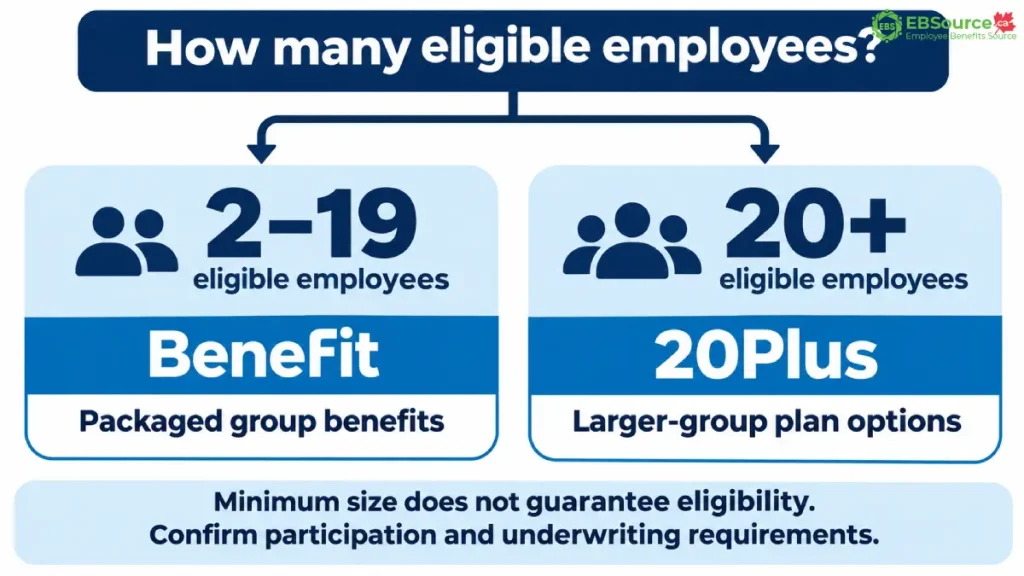
| BeneFit | 2 to 19 eligible employees | A packaged plan for small groups |
| 20Plus | 20 or more employees | The product family for larger groups |
| Dental ASO | From 2 insured lives | Self-funding for dental only |
| Extended health ASO | From 20 insured lives | Self-funding for health benefits under 20Plus |
Group size does not guarantee eligibility or access to every funding option. Employers should first confirm participation and underwriting requirements. Then decide whether the available plan design and funding risk suit their workforce and budget.
How Do Shared Health and Dental Maximums Work?
Instead of a separate limit for each service, employers can set one annual maximum that employees spend as they choose. It’s available on both health and dental benefits:
- Healthcare Essentials keeps core protection for prescription drugs, private duty nursing (up to $10,000 a year) and emergency travel assistance. Employers can then add major medical services, such as paramedical and vision care, under one annual maximum.
- Dental Flex applies one annual maximum across basic, major and orthodontic dental services.
For example, suppose a Dental Flex plan has a $2,000 annual maximum per certificate and no previous claims. If an eligible crown procedure costs $1,700, the amount remaining depends on the plan’s coinsurance:
- At 100% coinsurance, the plan pays $1,700, leaving $300 of the annual maximum.
- At 80% coinsurance, the plan pays $1,360, leaving $640 of the annual maximum, while the member pays $340.
This simplified example assumes the full $1,700 is eligible under the applicable dental fee guide, and no other restrictions apply.
For employers, the trade-off is that a shared maximum offers flexibility in how employees use their dental coverage, but one expensive procedure can reduce the amount available for other services during the benefit year.
Employer action: Consider this design when a shared spending limit suits your budget and workforce needs. Also, check whether dental limits apply to each person or the entire family.
Should Employers Pay a Fixed Premium or Fund Their Own Claims?
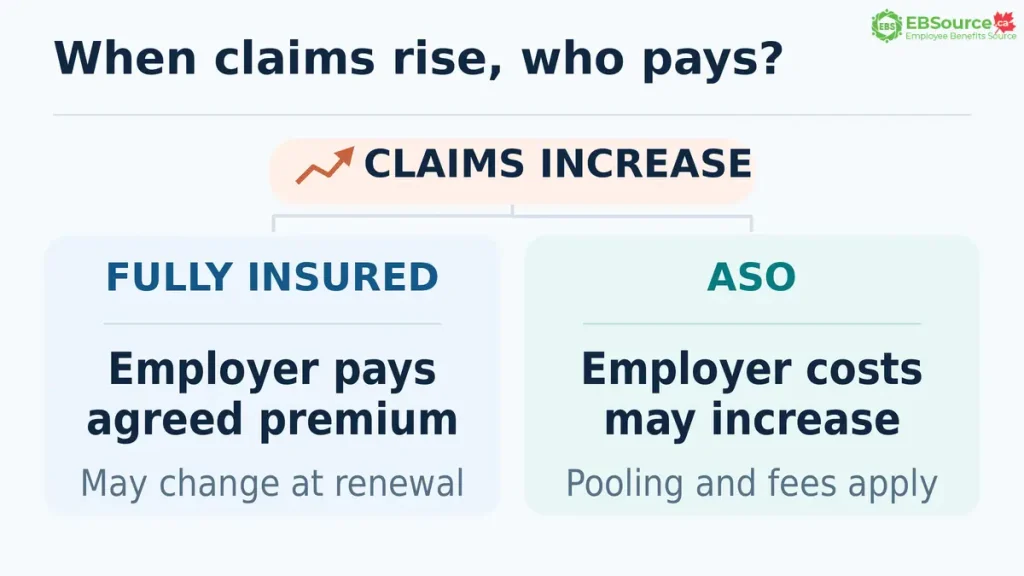
Fully insured plans offer predictable premiums during the guaranteed period. With Administrative Services Only (ASO) funding, employers pay for actual claims, which can make costs less predictable.
The main decision for fully insured plans and ASO is how much financial risk the employer can accept. Empire Life also does not publish premiums, fees or renewal history, so proposals are the only way to compare costs. Before selecting a funding arrangement, employers should compare total costs, reconciliation rules, and any pooling or stop-loss protection.
| Factor | Fully insured | ASO |
|---|---|---|
| What you pay | A quoted premium for the policy period | A monthly deposit, then actual claims plus charges at reconciliation |
| Who bears claims risk during the year | Empire Life | You, subject to pooling or stop-loss |
| Low-claims year | Rates remain fixed during the guarantee period; total premiums vary with enrolment | Lower claims may reduce costs; surplus treatment depends on the contract |
| High-claims year | Claims experience may affect future renewal rates | The employer may owe additional claims costs, subject to the contract’s pooling or stop-loss provisions |
EBSource rates Empire Life 8.0/10 for cost transparency. It reflects how well Empire Life explains its pricing, not how competitive its prices are.
With 20Plus ASO, eligible employers with at least 20 insurable employees can self-fund selected health benefits. Options include drug coverage, incidental health expenses, or extended health benefits excluding out-of-country coverage. Empire Life administers the self-funded claims, while the remaining insured benefits follow the contract.
Depending on the proposal, ASO expenses may include administration, commissions, applicable taxes, pooling, stop-loss or insured-benefit charges. Quotes are based on factors such as:
- the employer group’s size and demographics,
- the benefits and maximums chosen,
- the level of pooling,
- how costs are shared with employees, and, for established groups, past claims.
What Can Employers Expect from Empire Life’s Claims Service?
Employers can expect fast electronic processing for routine claims and structured support for employees on disability. That’s why EBSource rates Empire Life 8.0/10 for claims service.
Direct billing depends on whether a provider participates, and specialized disability services are used when they suit a claim rather than being available automatically to every member.
Employers should also ask Empire Life for written service standards, including disability decision times and how often they will receive updates on open claims.
Here’s how routine health and dental claims and disability claims work:
Routine Health and Dental Claims Are Processed Electronically
Employees can submit routine health and dental claims in three ways:
- At the clinic: massage therapists, chiropractors, physiotherapists and vision care providers registered with providerConnect can submit claims directly. Employees pay only the portion the plan does not cover.
- At the pharmacy: the pay-direct drug card confirms coverage when the prescription is filled.
- Online: employees submit eClaims for paramedical, vision, dental, drug and spending account expenses through the plan member website.
Claims processed in real time are usually reimbursed within 24 hours. However, some claims may take longer if they need extra documents or review.
Disability Benefits Include Return-to-Work Support
A disability absence may last months, so early claim management and return-to-work support matter. Empire Life offers five case-management services to support recovery and return to work, subject to eligibility and referral requirements.
| Service | Role in disability management |
|---|---|
| Pharmacogenomics testing | Shows how genetics may affect a person’s response to certain drugs when medication isn’t working |
| Medaca | Speeds up access to a psychiatric assessment |
| Medical Confidence | Helps employees reach specialists and navigate the healthcare system |
| Therapist-guided iCBT | Offers structured online therapy when in-person care is hard to access |
| The Claim Lab | Identifies non-medical barriers, such as workplace or personal factors, that slow a return to work |
Note: These services help Empire Life tailor disability claim management to individual circumstances, but not all are automatically provided. Access depends on the service, eligibility and the claim-management process. Employers should confirm which supports apply to their disability plan.
Employer actions: Employers can help by reporting absences quickly, considering modified duties, and cooperating on return-to-work plans, without needing to see an employee's diagnosis or treatment details.
Which Wellness Services Does Empire Life Include, and Which Cost Extra?
EBSource rates Empire Life 6.0/10 for wellness because virtual care and its Employee Assistance Program (EAP) cost extra. However, eligible members can access several health-navigation programs at no additional premium.
| Program | What it offers | Availability and important condition |
|---|---|---|
| Teladoc Medical Experts (formerly Best Doctors) | Expert medical opinions, health navigation and Weight Management | Included with extended health |
| Mental Health Navigator | Help finding mental health support | Members 18 and older |
| Caregiver Program | Support for employees caring for family members | Through Mental Health Navigator; added March 1, 2026 |
| Menopause Care Program | Menopause support | Eligible extended health members; added September 2025 |
| Men’s Health Program | Men’s health support | Eligible members and dependants 18 and older; announced November 10, 2026 |
Two services must be added to the plan and paid for separately:
- Telemedicine, including myStrength: myStrength has been available since December 1, 2025, and requires Telemedicine coverage.
- AssistNow EAP: delivered by Kii Health since January 1, 2025.
If virtual care or counselling support is a priority, include them in your proposal and budget, and check whether employees already have them elsewhere.
Do Empire Life’s Digital Tools Reduce Your Administrative Work?
Empire Life’s online tools appear well suited to basic administration: enrolling employees, updating records, reviewing claims and accessing plan information.
However, these tools still leave employers with ongoing administrative work. Digital enrolment is a shared process: the administrator enters employment information and starts the application, and the employee completes it.
That’s why EBSource rates Empire Life 7.0/10 for digital experience. Employers with frequent staffing changes should assess this workload and ask whether the tools connect to their HR and payroll systems.
Empire Life does not publicly describe its integration options, so they need to be confirmed, but that does not mean they are unavailable.
| Administrative task | What Empire Life documents | What remains unconfirmed |
|---|---|---|
| Enrolling new employees | Digital enrolment, started by the administrator and completed by the employee | Automated follow-up; administrators track incomplete applications themselves |
| Updating records | The Group Administrator Portal handles additions, terminations and leaves | How salary and class changes are processed |
| Billing and plan records | Downloadable billing and digital benefit cards | Confirm invoice formats, payroll summaries and export options available to your plan |
| Reporting | Enrolment reports by group or division | Claims and usage analytics |
| Administrator access | Portal access for named administrators | Permission levels for different roles |
| Payroll and HRIS connection | Not documented publicly | API access, file feeds or other automated data exchange |
Employers with frequent staffing changes should request a portal demonstration, especially for reporting and payroll integration.
Can Empire Life Cover a Workforce Spread Across Canada?
EBSource rates Empire Life 7.5/10 for accessibility. Employees across Canada can use the pay-direct drug card, electronic claims and virtual programs.
However, direct provider billing depends on clinic participation, some drug-management features differ in Quebec, and travel coverage operates within contractual limits. As a result, national availability does not guarantee the same experience at every pharmacy, clinic or worksite.
Here is how access works for each type of care:
- Prescriptions: The pay-direct drug card is presented at the pharmacy. Empire Life notes there may be cases where an employee pays up front and submits a claim.
- Paramedical and vision care: Direct submission is available only at clinics registered with providerConnect. Employees at unregistered clinics pay first and claim online.
- Travel: Travel Emergency Assistance provides emergency medical coverage and assistance while employees travel, within the trip limits in your plan.
- Virtual services: Teladoc programs included with extended health are delivered by phone or online, so access doesn’t depend on local providers.
- Quebec: Some Empire Life drug-management features state that they do not apply in Québec. Confirm formulary rules, specialty-pharmacy requirements, French-language service and minimum provincial coverage obligations.
These gaps matter most for employers with rural or remote staff, where fewer pharmacies and clinics may offer direct billing, and for those with employees in Quebec.
| Workforce situation | What to confirm |
|---|---|
| Employees in several provinces | That every benefit and service applies in each province |
| Remote or rural employees | Whether nearby pharmacies and clinics accept direct billing |
| Quebec employees | Drug plan administration, French-language materials and service, and any programs not offered in Quebec |
| Frequent travellers and employees working abroad | Trip-duration limits, the lifetime maximum and eligibility under Travel Emergency Assistance |
What Should First-Time Buyers Check Before Choosing Empire Life?
For first-time buyers, the biggest risk is choosing a plan that looks comprehensive but comes with unexpected eligibility rules, cost-sharing or coverage gaps. With Empire Life, group size also matters, because it determines which product you qualify for and which options you can use.
For very small groups, confirm which benefits are mandatory and how many optional benefits must be selected. Minimum group size alone does not establish eligibility for the plan design you want. For example, groups with two or three employees must also select at least two optional benefits, excluding the AssistNow EAP.
Before the effective date, get written answers to these questions:
| Question | Written confirmation to request |
|---|---|
| Which product does our group qualify for? | Product name, eligible group size and participation requirements |
| Which benefits are mandatory and which are optional? | Benefit schedule showing required and optional coverage |
| How will costs be shared? | Employer and employee contribution for each benefit |
| When does each employee become eligible? | Waiting periods, hours-worked requirements and late-enrolment rules |
| Who needs medical evidence? | Coverage available without medical evidence and when extra evidence is required |
| When does coverage start? | Effective date and enrolment deadlines |
| What does the plan administrator have to do? | Administrator responsibilities, portal access and enrolment tracking |
| Do we have employees in Quebec? | How employer contributions to a private health services plan will be reported as a taxable benefit on the RL-1; confirm with your payroll provider or accountant |
Before accepting an Empire Life proposal, employers should have written confirmation of eligibility, mandatory benefits, employee cost-sharing and enrolment responsibilities.
Once the plan is in place, make sure employees know how to use it. Ask Empire Life for employee-facing instructions for included programs such as Mental Health Navigator and Teladoc Medical Experts.
Check out our guide to the recommended employee benefits providers for small businesses.
Should Existing Clients Renew or Change Their Empire Life Plan?
If you already have an Empire Life plan, employee benefits renewal is the best time to review it. You can renew it unchanged, negotiate the price, redesign benefits or change how the plan is funded.
Because Empire Life does not publish renewal pricing, employers should use their claims history, fees and benefit usage to evaluate renewal options. Start renewal discussions early and review these five areas:
| Renewal decision | Information to review |
|---|---|
| Pricing and claims | Claims summaries for at least two years (where available and sufficiently aggregated to protect member privacy). Gather information about trend factors, pooling charges, renewal assumptions and how your experience was weighted. |
| Benefit design | Use of health and dental maximums, and spending account usage and forfeited balances. |
| Funding | ASO reconciliation statements and charges, and whether headcount changes make you eligible for a different product or extended health ASO. |
| Employee support | Which new wellness programs apply to your contract, and how open disability claims and case-management services are being used. |
| Administration | Who has portal access, new fees or procedures, and changes to communicate to employees. |
If rising costs are the main issue, first identify whether the increase comes from claims experience, pooling charges, changes in plan design or the insurer’s renewal assumptions. That distinction determines whether negotiation, redesign or a competing quote is the most useful next step.
Is Switching to Empire Life Worth the Risk?
Switching providers can bring lower premiums, a design that better suits your workforce or access to Empire Life’s disability support. But switching also creates risks that may appear after the old policy ends, including coverage gaps and administrative problems.
Before you switch to Empire Life, confirm how these four risks will be handled:
| Switching risk | What must be confirmed |
|---|---|
| Coverage continuity | Who manages open disability claims, how ongoing treatments and prior authorizations continue, and how actively-at-work rules affect absent employees. |
| Contract differences | Maximums, exclusions, disability definitions, pre-existing condition limits and evidence requirements. |
| Financial exposure | Premiums for equivalent coverage, first-year ASO deposits and reconciliation, and unused spending account balances. |
| Implementation | Effective dates with no gap in coverage, enrolment, payroll, employee communication and Quebec requirements. |
Empire Life also offers optional obesity-management drug coverage. These medications are not automatically included in every group plan and require prior authorization when the coverage is selected. Employers should verify whether their proposed drug plan includes this category and what restrictions apply.
For example, consider a 60-employee company that currently offers comprehensive health and dental coverage. It receives an Empire Life proposal with lower premiums, but the drug plan uses a different formulary and the paramedical and dental maximums are lower.
The employer needs to know whether the savings come from Empire Life’s pricing or from reduced coverage. A side-by-side benefit comparison will show this, especially if the current insurer quotes the same design. If the savings disappear once coverage is matched, the switch simply buys less coverage.
How Does EBSource Calculate Empire Life’s Rating?
Eight weighted categories: Insurers are assessed on financial strength, coverage, cost transparency and service capabilities, among others. Financial strength carries the most weight (20%) and cost transparency the least (5%). The full framework is on the EBSource providers page.
Scoring: Each category receives a score out of 10, which is multiplied by its weight. The eight weighted results are then added together. Empire Life’s total is 7.625, rounded to 7.6/10.
Evidence: The ratings are based mainly on Empire Life’s financial disclosures, Morningstar DBRS’s rating, Empire Life’s product guides and administrator materials, and its service and program announcements.
Basis for lower scores: A lower score reflects a documented limitation, a meaningful trade-off or a measurable disadvantage, not simply missing public information. Missing information can reduce the cost transparency score, because transparency is what that category measures. In other categories, details that could not be confirmed are flagged for employers to ask about rather than deducted from the score.
Review date: The rating reflects evidence available as of November 17, 2026, including the Men’s Health Program announced on November 10, which does not change the wellness score.
Employers prioritizing bundled wellness services, digital integration or different funding options may also want to compare: