



Choosing a group benefits provider is a long-term commitment, and switching later can be even more challenging, especially if employees have ongoing claims. Canada Life, one of Canada’s largest insurance providers alongside Sun Life and Manulife, is a common choice for employers.
It offers health, dental, disability, life, and retirement savings plans in one package. But a broad range of benefits doesn’t automatically make a provider the right fit. Limited public information on plan details and group pricing can make it harder to compare options before requesting a quote.
However, at EBSource.com, we have the insights to provide an in-depth review that explains which businesses Canada Life may suit, which options to consider, and what to check before signing.
On this page
Canada Life Employee Benefits Review at a Glance
What makes Canada Life worth considering is that it has an A+ AM Best financial strength rating and digital tools for employers and employees. GroupNet supports plan administration, while My Canada Life at Work helps employees manage claims and coverage.
Here are the key facts employers should know about Canada Life:
| Canada Life | |
|---|---|
| Parent company | Great-West Lifeco Inc. |
| Financial strength | AM Best affirmed Canada Life’s A+ (Superior) Financial Strength Rating on March 27, 2026. This indicates a strong ability to pay claims. |
| Capital level | Consolidated LICAT ratio of 127% as of September 30, 2026, above OSFI’s 100% supervisory target. LICAT measures whether an insurer holds enough capital to cover its risks. |
| Small business program | Freedom at Work, for companies with up to 75 employees. |
| Large-plan experience | Administers the Public Service Health Care Plan and, since November 1, 2024, the federal public service and pensioners’ dental plans. |
| Products for specific employees | Freedom to Choose (coverage employees keep when they leave), Welcome Plan (employees new to Canada), Ambassador (employees working abroad), CANUS (employees based in the US). |
| Employee platform | My Canada Life at Work (website and app): submit claims, check coverage, get cost estimates and use the HSA. |
| Administrator platform | GroupNet for Plan Administration: enrolment, billing and cost reports. Ask for a demo during the quote stage. |
| EBSource ranking | 3rd of 19 providers (8.5 / 10). |

Is Canada Life the Right Choice for Your Business?
Canada Life may suit employers that need national coverage, specialized employee benefits or a ready-made small-business package. The main caution is the service problems reported during the 2023 federal health-plan transition.
Here’s how to tell whether Canada Life is the right provider for your business:
Canada Life may be worth evaluating if you:
- Have employees in more than one province and want one provider that operates nationally.
- Run a unionized, multi-union or public-sector plan. Canada Life administers very large plans, but ask for evidence from plans like yours.
- Want health, dental, life, disability and retirement savings from one provider, so you have fewer contracts and contacts to manage.
- Run a small business and want a ready-made package instead of designing a plan from scratch.
- Have newcomers, staff abroad or US-based employees, since Canada Life has a dedicated product for each.
Canada Life may not suit your situation right now if you:
- Want to compare plan details before talking to anyone. Canada Life publishes few plan details and no group rates up front.
- Want a program publicly designed for mid-size employers. Canada Life doesn’t identify one, so ask what it offers for your group size.
- Can’t afford service disruption during a provider switch. Large plan transitions have caused service problems before, so plan the switch carefully.
Overall: Canada Life is worth considering if financial strength, national reach and broad coverage matter to your business. Compare the written terms before deciding.
What Does Canada Life Offer Businesses of Different Sizes?
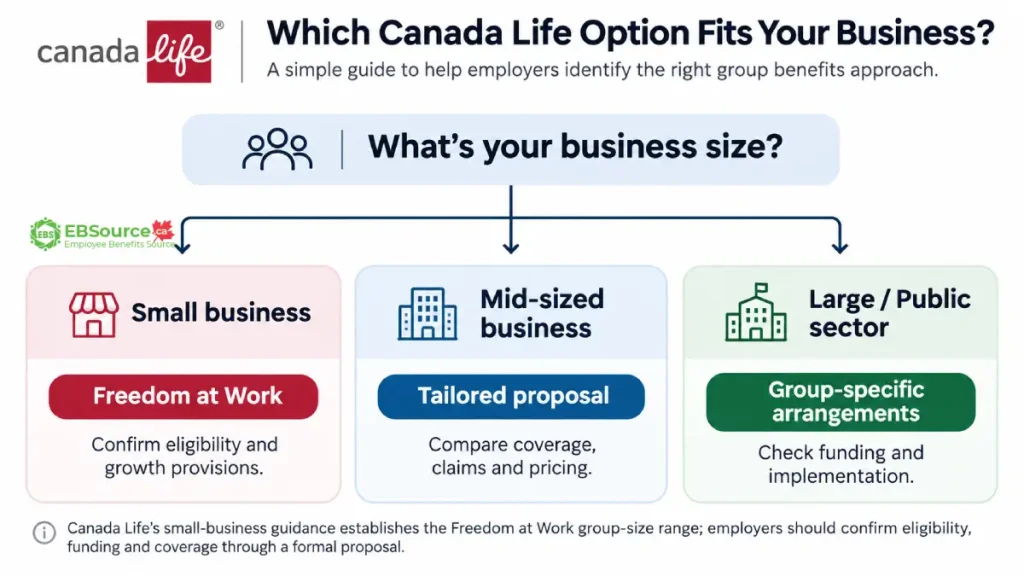
Canada Life offers Freedom at Work to eligible small businesses with up to 75 employees. Larger employers should request proposals tailored to their workforce, funding needs and administration requirements.
Canada Life Group Benefits for Small Employers
Freedom at Work requires at least three employees to participate in group benefits. Employers can combine three options:
- Group benefits: Health, dental, disability and optional specialty benefits.
- Personal insurance: Employees can purchase Freedom to Choose life, critical illness or accident coverage that continues after they leave.
- Retirement savings: Performers offers a Registered Retirement Savings Plan (RRSP), Deferred Profit Sharing Plan (DPSP), or both, with an optional Tax-Free Savings Account (TFSA). Canada Life lists no employer administration or upkeep fees, but employers still handle payroll deductions, contributions and participation authorization.
For businesses with fewer than three employees, Canada Life recommends Freedom to Choose individual health and dental insurance instead.
Source: Guide to employee benefits packages for small businesses – Canada Life
Growth consideration: Ask how exceeding 75 employees would affect pricing, coverage and administration.
Canada Life Group Benefits for Mid-Size Employers
Canada Life does not publicly identify a mid-size program. Ask about customized benefits and savings packages for mid-sized businesses. Then, request a tailored proposal that explains:
- Employee classes: Whether coverage can vary by role, location or bargaining unit.
- Plan flexibility: Whether employees can choose different coverage levels.
- Retirement savings: Available options, fees and employer responsibilities.
Suggested starting point: Request a core health, dental, life and disability proposal, then ask Canada Life to price the HSA and Consult+ separately.
Renewal consideration: Ask how claims history, pooling (sharing very large claims across many employers) and the initial rate guarantee affect future premiums.
Our group benefits provider comparison evaluates Canada Life against other providers for mid-size employers. “Mid-size” is EBSource’s comparison category, not a Canada Life program.
Canada Life Group Benefits for Large and Public Sector Employers
Large and public-sector employers should evaluate a tailored Canada Life group benefits arrangement, with coverage, funding and administration assessed separately.
Depending on the workforce, options to investigate include:
- Core health, dental, life and disability coverage,
- Combined short- and long-term disability coverage,
- Welcome Plan, Ambassador and CANUS,
- Workplace retirement savings.
Canada Life administers major federal employee benefits plans, including:
- Public Service Dental Care Plan: Administered since July 2023, covering approximately 1.7 million members.
- Pensioners’ Dental Services Plan: Administered since November 2024.
These federal plans use Administrative Services Only (ASO) funding, meaning the government pays claims while Canada Life administers them. This demonstrates large-scale administration experience, but doesn’t establish how well Canada Life would serve your business.
Before signing: Confirm funding options, payroll integration, union requirements and transition support. The service problems reported during the 2023 federal health-plan transition make written escalation procedures especially important.
What Does Canada Life Offer Employers?
Canada Life combines core group insurance with optional services such as virtual care, spending accounts, family-building support and retirement savings. Availability depends on your plan design, so confirm which features are in the quote and which cost extra.
For a quick check, here’s how each benefit maps to a common employer need:
| Benefit | When it may help |
|---|---|
| Prescription drug cost controls | Managing drug spending, especially specialty drugs |
| Disability management | Shortening absences and supporting a return to work |
| Mental health support | Reducing stress-related absences and claims |
| Family-building coverage | Supporting employees through fertility treatment |
| Virtual care (Consult+) | Giving employees quick access to a doctor or nurse |
| Health spending account (HSA) | Covering eligible costs the main plan doesn’t fully pay |
| Life, AD&D and critical illness insurance | Basic financial protection, with optional extra coverage |
| Welcome Plan, Ambassador and CANUS | Covering newcomers, staff abroad and US-based employees |
| Workplace retirement savings | Offering benefits and savings through one provider |
Prescription Drug Coverage That Helps Control Costs
Best for: Employers managing high prescription drug costs, especially specialty drugs.
Prescription drug claims can drive major costs for group health plans, and a few expensive specialty drugs can raise premiums for the whole group.
When choosing this option, check whether Canada Life’s proposal includes these cost controls:
- Prior approval: Some drugs require approval before reimbursement.
- Lower-cost alternatives: Plans may limit payment to the price of a cheaper treatment, subject to exceptions.
- Biosimilars: Plans may favour lower-cost alternatives to biologic drugs, subject to medical exceptions and applicable rules.
- Provincial coordination: Employees may need to access available provincial drug programs first.
Some plan designs may also cover medical cannabis. Confirm eligibility and limits separately.
Important distinction: Drug controls manage reimbursable expenses. Claims pooling helps protect an employer’s claims experience from certain large claims. Ask how both affect your renewal.
Disability Coverage That Helps Employees Return to Work Sooner
Best for: Employers where long absences are common and costly, such as construction, manufacturing, health care, unionized and public-sector workplaces.
A long absence can reduce productivity and may raise disability costs at renewal. Rehabilitation specialists can step in while an employee is still on short-term leave, since this plan option covers both short- and long-term disability. They may arrange treatment or plan a gradual return to work rather than waiting for a long-term claim.
Mental Health Support With Free Workplace Tools
Best for: Employers experiencing increased stress-related absences or mental health claims who want a structured approach to address the causes.
Canada Life gives employers free tools to help prevent mental health problems at work, because this provider funds Workplace Strategies for Mental Health. It also helped develop the National Standard of Canada for Psychological Health and Safety in the Workplace.
These tools are free for any employer, not just Canada Life clients, so you can try them before you choose.
What to confirm: Therapy coverage and Employee Assistance Program (EAP) services are separate benefits. Check whether they’re included and what limits apply.
Family-Building Coverage
Best for: Employers seeking to support employees pursuing fertility treatment and other family-building needs.
Canada Life’s optional family-building coverage may cover eligible services such as fertility testing, IVF, IUI, donor eggs and surrogacy-related services.
(Important condition: Fertility-drug coverage is required before employers can add the family-building benefit.)
Additionally, all members of Canada Life group plans receive a 30% discount on a Sprout Family membership. This Canadian virtual service offers unlimited telehealth consultations, treatment discounts, and a personalized review of the employee’s benefits coverage.
If inclusive coverage is a priority, Wawanesa is also worth a look, since it covers fertility, anti-obesity and gender-affirming drugs. Learn more in our Wawanesa employee benefits review.
Virtual Care Through Consult+
Best for: Employers who want staff to get medical advice quickly without leaving work.
Consult+, provided by Dialogue, lets employees consult a doctor or nurse online, often the same day.
Dialogue also provides Sun Life’s Lumino Health Virtual Care, so virtual care alone shouldn’t decide between the two providers. When comparing quotes, check which services are included (such as mental health support or prescriptions), whether family members are covered and whether Consult+ costs extra.
Our Sun Life employee benefits review explains how Sun Life combines virtual care with its group plans.
Health Care Spending Account With Simpler Claims
Best for: Employers who want to offer more flexible health spending within a defined allocation, while keeping claims manageable.
A Health Spending Account (HSA) can reimburse eligible expenses that the main health or dental plan doesn’t fully cover. With Canada Life, employees can request reimbursement for unpaid balances in one claim, rather than submitting a separate HSA claim.
Source: How do you use your healthcare spending account (HCSA)? – Canada Life
Life, AD&D and Critical Illness Insurance With Flexible Payment Options
Best for: Employers that want basic protection for staff, with optional coverage employees can add.
Canada Life offers life, accidental death and dismemberment (AD&D), and critical illness insurance through different coverage options:
- Basic group coverage: Employer-paid or cost-shared protection for eligible employees.
- Optional group coverage: Extra insurance employees may choose, subject to eligibility and medical evidence requirements.
- Freedom to Choose: Employees purchase personal insurance separately from the group plan and can keep it when they leave.
What to compare: Coverage amounts, premiums, medical requirements and whether protection continues after employment ends.
Coverage for Newcomers, Employees Abroad and US-Based Staff
Best for: Employers hiring internationally, assigning employees overseas or maintaining a US-based team.
Canada Life has three products for employees with international coverage needs:
- Welcome Plan: For eligible newcomers waiting for provincial health coverage.
- Ambassador: For eligible Canadian employees working abroad.
- CANUS: For eligible employees assigned to the US, certain US residents and cross-border workers.
These products are separate from the standard Canadian group plan.
Confirm eligibility waiting periods, covered countries, coverage duration, and local insurance requirements.
Workplace Retirement Savings Plans Alongside Benefits
Best for: Employers wanting one provider for group benefits and workplace savings.
In October 2026, Canada Life introduced workplace savings options that let employees direct their contributions toward short-term goals, such as a TFSA, while employer matching contributions support retirement savings.
The approach may appeal to employees balancing immediate expenses and long-term savings. Canada Life and Deloitte research found that Gen Z employees withdrew 12% more from their RRSPs than millennials at the same age.
Canada Life also provides a free employer toolkit with assessments, communication templates and videos.
iA Financial Group’s Symbiosis platform also brings group insurance and retirement savings together. Read our iA Financial Group employee benefits review if you want one provider for both.
What to compare: Available savings accounts, employer contribution rules, fees and employee flexibility.
What Should Employers Compare Before Choosing Canada Life?
Before selecting Canada Life, compare Canada Life with at least one other provider using the same employee information, coverage requirements and pricing assumptions. A lower premium may mean less coverage or greater renewal risk.
Use the decision sheet below to check whether each written proposal meets your needs:
| Factor | What a passing proposal must show |
|---|---|
| Eligibility | Required employee groups and dependants qualify, with participation rules and waiting periods clearly stated. |
| Coverage | Health, dental and optional services meet your required reimbursement levels, limits and exclusions. Extra costs are disclosed. |
| Drug coverage | High-cost drugs, prior authorization, biosimilars and provincial coordination are addressed. |
| Disability | Waiting periods, disability definitions, benefit amounts and rehabilitation services meet your requirements. |
| Cost | Employer and employee costs, administration fees and optional charges are clear and based on comparable assumptions. |
| Renewal | Rate guarantees, claims experience and pooling arrangements are documented. |
| Administration | Enrolment, billing, reporting and support responsibilities are manageable for HR. |
| Transition | A written implementation plan covers ongoing claims, coverage dates, payroll changes and escalation contacts. |
How to use the results
- All factors pass: Compare total annual costs and final contract terms before choosing.
- Information is missing: Request written clarification before accepting the quote.
- A critical factor fails: Ask for a revised plan or compare another provider.
Don’t rely on Canada Life’s reputation alone. Your final decision should reflect the coverage, costs and service commitments in the written proposal. For help structuring what you ask for, see our employee benefits plan design guide.
What Should Quebec Employers Check Before Choosing Canada Life?
Employers with Quebec employees must consider provincial drug coverage, payroll taxes and French-language requirements when comparing Canada Life proposals.
Mandatory drug coverage: Under Régie de l’assurance maladie du Québec (RAMQ) rules, Quebec residents under 65 with access to a qualifying private plan generally must enrol in its drug coverage, along with eligible spouses and children. Employees covered by another qualifying private plan can opt out with proof.
Employer action: Confirm the proposal’s drug coverage meets RAMQ minimums and how opt-outs will be documented.
Provincial tax treatment: Qualifying employer-paid health and dental benefits are generally tax-free federally but taxable for Quebec income tax.
Employer action: Ask payroll how these benefits, including any taxable HCSA amounts, will appear on employees’ RL-1 slips, and confirm what information Canada Life will provide.
French-language requirements: The contract, benefit booklet, enrolment materials and employee communications must be available in French as required.
Employer action: Ask which French-language documents Canada Life provides and which your business must prepare.
Source: Information on private plans – Revenu Québec
The Bottom Line
Canada Life is worth considering if your business needs broad benefits, national coverage and established administration tools. Its specialized products and large-plan experience add value for employers with complex needs.
However, limited public pricing and plan details make written comparisons essential. Before choosing Canada Life, compare its coverage, total costs and renewal terms with at least one other provider using the decision sheet above.
Disclaimer: This review is general information only, not insurance, tax or legal advice. Talk to a licensed advisor and read your plan contract and booklet before making decisions.