


This Québec calculator adheres to federal payroll rules from the CRA while incorporating 2026 Québec deductions, with the date modified set to September 21, 2026.
Tracking every dollar from your Québec paycheque starts with five easy steps: finding your total income before taxes, working out required payments, figuring out your federal and provincial taxes, and finally calculating your take-home pay. To show how these steps work together, we also include a clear example with a $60,000 salary that breaks down each deduction.
Understanding the calculation also brings up a question: why does Québec handle taxes differently from other provinces? The answer is that Québec administers its own provincial income-tax system through Revenu Québec and administers QPP and QPIP contributions. Québec residents also receive a 16.5% federal Québec abatement, which is calculated on the federal tax return.
The following sections will explain each part in more detail, including the gross-to-net calculation and example, as well as the unique provincial rules in Québec.
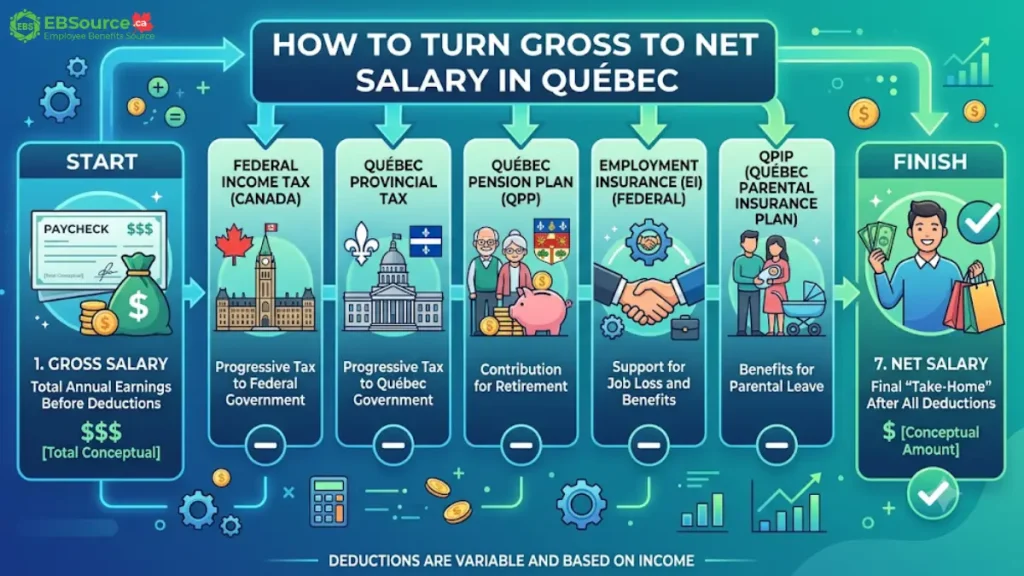
How to Turn Gross to Net Salary in Québec
To estimate your take-home pay in Québec, you need to calculate each deduction individually and then subtract the total deductions from your gross salary. The process is: first, annualize your gross pay; next, calculate the mandatory contributions, including EI, QPIP, and QPP; then, determine your federal income taxes as well as QC provincial income taxes; after that, sum all deductions; and finally, estimate the result.
Each step is explained in detail below:
Step 1: Gather Your Inputs
You need these 3 key pieces of information at the beginning:
- Gross Pay per Period: This is your salary before any deductions are made.
- Pay Frequency: Determine how often you are paid; options include weekly (52 pay periods), biweekly (26 pay periods), semi-monthly (24 pay periods), or monthly (12 pay periods).
- Deductions: Identify any amounts that your employer deducts, such as contributions to an RRSP.
To calculate your gross annual pay, multiply your gross pay per period by the number of pay periods in a year (Gross pay per period x number of pay periods = annual gross pay)
Step 2: Calculate EI, QPIP, and QPP
QPP, EI and QPIP are not calculated on one universal gross-income amount. QPP applies to pensionable salary or wages. EI applies to insurable earnings. QPIP applies to eligible salary or wages.
- EI: 1.30% x gross pay per period (maximum $895.70 per year).
- QPIP: 0.430% x gross pay per period (maximum $442.90 per year).
- QPP: 6.30% x (gross pay minus the prorated $3,500 basic exemption) (maximum $4,479.30 per year).
- QPP2: 4% × earnings between $74,600 and $85,000 (maximum $416 per year)
They vary by income level, each stopping at a specific cap. By finding these caps first, we can make the calculations easier for each period, since contributions will change from a percentage to a fixed yearly amount after these points.
Here are the contribution thresholds in Québec:
| Annual earnings range | Rule that applies | How the math works |
|---|---|---|
| Up to $3,500 | Only EI and QPIP are collected | EI and QPIP apply to every dollar earned, while QPP remains at zero until earnings exceed the $3,500 exemption. |
| Over $3,500 to $68,900 | EI, QPIP, and QPP apply as percentage deductions | EI applies at 1.30%, QPIP at 0.430%, and QPP at 6.30% on earnings above the $3,500 exemption. |
| Over $68,900 to $74,600 | EI reaches its maximum; QPP and QPIP continue | EI is capped at $895.70. QPP continues at 6.30% until earnings reach the YMPE, and QPIP continues at 0.430%. |
| Over $74,600 to $85,000 | EI and base QPP are maxed; QPP2 begins | EI remains capped at $895.70 and total first-tier QPP at $4,479.30. QPP2 adds 4% on earnings above the YMPE, and QPIP continues. |
| Over $85,000 | EI, base QPP, and QPP2 are maxed | EI is fixed at $895.70, total first-tier QPP at $4,479.30, and QPP2 at $416. QPIP continues until it reaches $442.90 at $103,000 of earnings. |
Step 3: Calculate Federal Income Tax (including the Abatement)
Calculating federal tax for Québec employees consists of four key stages: determining annual taxable income, calculating Basic Federal Tax, subtracting Federal Non-Refundable Tax Credits, and applying Québec Abatement.
Below are four stages to estimate the federal income tax in Québec:
Stage 1: Determine Annual Taxable Income
To find your annual taxable income, start with your gross pay for each pay period. Subtract any additional contributions to the QPP and other source deductions, such as contributions to an RRSP. Then, multiply the result by the total number of pay periods in the year to get your annual taxable income.
Stage 2: Calculate Basic Federal Tax
Consult Chart 1 from the T4032-QC guide to find the applicable tax rate (R) and constant (K) based on your annual taxable income. Calculate your basic federal tax by multiplying your taxable income by R, then subtracting K.
For example, if your income is $62,798.84, which falls into the second bracket, the calculation would be: $62,798.84 x 0.205 – $3,804 = $9,069.76.
Stage 3: Subtract Federal Non-Refundable Tax Credits
Next, add the following amounts together, and then multiply the total by 14% (the lowest federal rate) to determine your non-refundable tax credits, which are:
- Basic personal amount: $16,452 for incomes up to $181,440.
- QPP base contributions: Calculate as per-period QPP multiplied by (0.0530/0.0630) multiplied by the total pay periods, with a maximum of $3,768.30.
- EI premiums and QPIP premiums: Use the annual totals.
- Canada Employment Amount: $1,501 or actual employment income, whichever is lower.
After calculating this total credit amount, subtract it from your basic federal tax to get the pre-abatement federal tax.
Stage 4: Apply the Québec Abatement
To apply the Québec abatement, multiply the pre-abatement federal tax by 16.5%. Then, subtract this number from your total federal tax. The result is the total federal tax you need to pay for the year. Finally, divide this amount by the number of pay periods to find out how much federal tax to deduct each time.
The abatement can be confusing because it is not a cheque or a separate credit; it just lowers the federal tax you have to pay. Here is an example of how it works:
| Step | Example amount |
|---|---|
| Federal tax before the Québec abatement | $5,000 |
| Québec abatement at 16.5% | -$825 |
| Federal tax after the Québec abatement | $4,175 |
Québec receives a reduction because it runs more of its own programs than other provinces do. This cut is not an extra bonus and does not appear on your TP-1 form; it just reduces the amount of federal tax you owe.
Step 4: Calculate Québec Provincial Income Tax
To calculate your basic Québec tax, apply the Québec tax bracket rates to your annual taxable income. Next, calculate your Québec non-refundable tax credits.
To estimate Québec income tax, first determine Québec taxable income after applicable deductions, including the Québec deduction for workers and deductible additional QPP contributions. Apply the 2026 Québec tax brackets, then subtract the applicable Québec personal tax credits. For a basic example using only the Québec basic personal amount, the personal credit is $18,952 x 14%. Do not separately add base QPP contributions, EI premiums or QPIP premiums to this provincial credit calculation.
Step 5: Figure Out Your After-tax Salary in Québec
Your after-tax salary in Québec is calculated by subtracting total deductions from your gross salary. A Québec employee’s take-home pay can be reduced by five main statutory deductions: QPP contributions, EI premiums, QPIP premiums, federal income tax and Québec income tax.
Source: Payroll Deductions Tables – EI, and income tax deductions – Québec – Government of Canada & SOURCE DEDUCTION 2026 – TABLE FOR QUÉBEC – INCOME TAX – REVENU QUÉBEC
Example of Calculating Gross to Net Income in Québec
For example, if your gross annual salary is $60,000, your estimated take-home pay in Québec, including personal credits such as the federal Basic Personal Amount and the Québec Basic Personal Amount, is about $45,893, approximately 76.5% of the gross salary.
The after-tax income breakdown is:
- Gross Salary: $60,000
- Estimated Taxes & Deductions: ~$14,107
- After-tax Salary: about $45,329 (about $45,328.53 before rounding)
- Estimated Average Income-tax Rate: ~16.8%
- Estimated Overall Deduction Rate Including QPP, EI and QPIP: about 24.5%.
- Marginal Tax Rate: ~36.1% (meaning any additional income earned above this level is taxed at this combined federal-plus-provincial rate)
The detailed calculations for these numbers are shown in the table below:
| Deduction or calculation | Amount |
|---|---|
| Employment Insurance (EI) | $60,000 × 1.30% = $780 |
| Québec Parental Insurance Plan (QPIP) | $60,000 × 0.430% = $258 |
| Québec Pension Plan (QPP) | Base QPP: ($60,000 − $3,500) × 5.30% = $2,994.50 Enhanced QPP: ($60,000 − $3,500) × 1% = $565 Total QPP: $2,994.50 + $565 = $3,559.50 |
| Federal taxable income | $60,000 − $565 = $59,435 |
| Québec taxable income | $59,435 − $1,450 = $57,985 |
| Federal basic personal amount | $16,452 |
| Canada employment amount | $1,501 |
| Federal income tax | 14% on the first $58,523 = $8,193.22 20.5% on the remaining $912 ($59,435 − $58,523) = $186.96 Total gross federal tax: $8,193.22 + $186.96 = $8,380.18 Total federal credit base: $16,452 + $2,994.50 + $780.00 + $258.00 + $1,501 = $21,985.50 Federal credit value: $21,985.50 × 14% = $3,077.97 Federal tax before Québec abatement: $8,380.18 − $3,077.97 = $5,302.21 Québec abatement: $5,302.21 × 16.5% = $874.86 Net federal tax: $5,302.21 − $874.86 = $4,427.35. |
| Québec basic personal amount | $18,952 |
| Québec provincial tax | 14% on the first $54,345 = $7,608.30 19% on the remaining $3,640 ($57,985 − $54,345) = $691.60 Total Québec gross tax before credits: $7,608.30 + $691.60 = $8,299.90 Québec basic personal amount credit: $18,952 × 14% = $2,653.28 Tax after the basic personal amount credit: $8,299.90 − $2,653.28 = $5,646.62 |
| Total deductions | $3,559.50 + $780.00 + $258.00 + $4,427.35 + $5,646.62= $14,671.47 |
| Estimated annual after-tax income | $60,000 − $14,671.47 = $45,328.53 |
For a Québec employee earning $60,000 in 2026, under the simplified assumptions used in this example, estimated annual take-home pay is approximately $45,329. Total estimated deductions are approximately $14,671, including QPP, EI, QPIP, federal income tax after the Québec abatement, and Québec income tax.
This estimate assumes the federal and Québec basic personal amounts, the Canada Employment Amount, applicable federal QPP/EI/QPIP credits, the Québec deduction for workers and no other personal deductions or credits.
What Makes Québec Income Taxes Different?
Instead of having the federal government collect provincial tax on its behalf, Québec runs its own income tax system and collects its provincial tax directly through Revenu Québec.
This leads to five unique features: Québec uses QPP instead of CPP; Québec workers also pay QPIP premiums; Québec workers pay a lower EI premium rate; Québec residents receive a 16.5% federal Québec abatement; and Québec residents file a separate TP-1 tax return with Revenu Québec.
See this side-by-side table to view the differences in components of Québec income tax quickly:
| Feature | Québec | Most other provinces | Québec paycheque impact |
|---|---|---|---|
| Pension plan | QPP and additional QPP, also known as QPP2 | CPP and CPP2 | Pension deductions may differ from those in other provinces. |
| Parental insurance | Québec Parental Insurance Plan (QPIP) | No separate QPIP deduction | Adds a payroll deduction not seen in most provinces. |
| EI rate | Lower Québec EI rate | Standard EI rate | Partly offsets the QPIP deduction. |
| Federal tax | Reduced by the 16.5% Québec abatement | No Québec abatement | Federal withholding is lower than it would otherwise be. |
| Provincial tax return | Separate Revenu Québec TP-1 return | Filed through the CRA return package | Tax filing is not handled only through the CRA. |
Here are details about three key components that differentiate paycheques in Québec:
Québec Pension Plan
Québec employees contribute to the QPP at a rate of 6.30% on pensionable earnings above a $3,500 exemption, with a maximum contribution limit of $4,479.30. Additionally, employees may contribute QPP2 at a rate of 4% on earnings between $74,600 and $85,000, with a maximum contribution of $416.
For example, an employee earning $90,000 at a steady rate may reach the annual QPP and QPP2 limits later in the year. Once each applicable annual maximum is reached, that contribution stops for subsequent pay periods, which can increase the employee’s net pay toward year-end. The exact pay period depends on the employee’s pay frequency and earnings pattern.
Lower EI and Québec Parental Insurance Plan
EI premiums in Québec are lower, set at 1.30% of insurable earnings (up to a maximum contribution of $895.70) on insurable earnings up to the $68,900 maximum. However, employees also need to pay QPIP premiums at a rate of 0.430% of insurable earnings, up to the QPIP maximum insurable income of $103,000, capped at $442.90.
A lower EI rate does not always mean that employees in Québec pay less in total payroll deductions. In Québec, the separate QPIP fee replaces the parental benefit part covered by EI in other parts of Canada. So, to compare fairly, we should look at the total of EI plus QPIP rather than just EI.
For example, the maximum contribution for a worker in Québec is $895.70 (EI) plus $442.90 (QPIP), for a total of $1,338.60. In contrast, a worker in the rest of Canada pays a maximum of $1,123.07 in EI alone.
Québec tax bracket
Québec provincial tax is assessed using four brackets:
- 14% on income up to $54,345,
- 19% on income from $54,345 to $108,680,
- 24% on income from $108,680 to $132,245,
- 25.75% on income above $132,245.
Tax credits include a basic personal amount of $18,952, as well as credits for QPP base contributions, EI, and QPIP.
Federal tax rate in Québec
Québec is the only province in Canada that collects its own personal income tax directly. This unique system provides a 16.5% Québec abatement on your federal tax liability, reflecting longstanding federal-Québec fiscal arrangements under which Québec opted out of certain federal transfer programs.
Misunderstanding about Québec abatement
One part of a Québec paycheque that people often get wrong is the abatement. It lowers the federal tax you have to pay, but it does not change your income or provincial tax. Many people mistakenly believe the abatement is a refund, replaces provincial tax, or is a separate payment. In fact, it is none of these.
The table below explains the three most common wrong ideas we see:
| Common misunderstanding | Correct interpretation |
|---|---|
| The abatement gives me 16.5% of my income back | No. It reduces your federal tax, not your gross income. |
| It replaces my Québec tax | No. You still calculate Québec provincial tax separately. |
| It shows up as a separate payment or cheque | No. It simply lowers the federal tax you owe. |
Tax return in Québec
In practice, your federal T1 return will show a reduced federal tax amount due to this abatement, while you will file a separate provincial TP-1 return with Revenu Québec. Additionally, your T4 slip will include Québec-specific deduction codes, meaning that your pay stub deductions will differ from those of colleagues in Ontario or British Columbia.
When getting ready to file your taxes, which includes two different returns and several supporting papers, it’s helpful to collect everything in one place before you begin. This will ensure that the numbers on your federal T1 and provincial TP-1 match and that all amounts related to abatement, QPP, EI, and QPIP are included.
Use the checklist below to make sure you have everything you need:
- Federal T1 return to the CRA
- Provincial TP-1 return to Revenu Québec
- T4 slip (employment income and deductions)
- RL-1 slip, if applicable
- QPP, EI, and QPIP amounts withheld
- Any RRSP or RPP deduction receipts
- Any instalment payments already made during the year
Québec vs Ontario Income Tax: How Do They Compare?
As mentioned above, in Québec, workers contribute to the QPP instead of the CPP, pay a separate QPIP premium, receive a lower EI rate, and benefit from the 16.5% federal abatement for Québec. Ontario workers follow the CPP system, pay the standard EI rate, and may also be affected by the Ontario surtax and health premium.
This means the difference between the two provinces is not only about provincial tax brackets. It is also about which payroll programs apply before the employee receives their take-home pay.
The table below outlines the main figures for 2026 that an employee in Québec and Ontario would see on their paycheque:
| Feature | Québec, 2026 | Ontario, 2026 |
|---|---|---|
| Pension plan | QPP and QPP2: total first-tier QPP at 6.30%, maximum $4,479.30; QPP2 at 4%, maximum $416 | CPP and CPP2: total first-tier CPP at 5.95%, maximum $4,230.45; CPP2 at 4%, maximum $416 |
| Parental insurance | QPIP: 0.430%, maximum $442.90 | None; parental benefits are covered through EI |
| EI rate | Reduced Québec EI rate: 1.30%, maximum $895.70 | Standard EI rate: 1.63%, maximum $1,123.07 |
| Provincial tax brackets | Four brackets, from 14% to 25.75% | Five brackets, from 5.05% to 13.16% |
| Basic personal amount | $18,952 | $12,989 |
| Surtax | None | 20% over $5,818 of basic Ontario tax; plus 36% over $7,446 |
| Health premium | None | Up to $900, based on taxable income |
| Federal abatement | 16.5% reduction in federal tax | None |
| Provincial tax return | Separate TP-1 return filed with Revenu Québec | Filed with the federal T1 return through the CRA |
Two points tend to surprise people here:
First, even though Québec’s provincial tax rates appear much higher than Ontario’s, the 16.5% federal reduction and Québec’s larger basic personal amount help narrow the difference. Because of this, the difference in take-home pay is usually smaller than the provincial tax rates alone would suggest.
Second, even though Ontario’s provincial tax rates may appear low at first, higher earners must pay additional amounts, such as the Ontario surtax and the Ontario Health Premium. These extras are calculated separately from the basic tax rates, leading to a higher total tax bill.
Example: $60,000 salary in Québec vs Ontario
To see how the difference works in practice, compare a single employee earning $60,000 in 2026 with only the basic personal credits and standard payroll deductions.
This table shows how the same gross salary can result in different take-home pay in Québec and take-home pay in Ontario.
| Item | Québec | Ontario |
|---|---|---|
| Gross annual salary | $60,000 | $60,000 |
| Pension contribution | QPP: about $3,560 | CPP: about $3,362 |
| Employment Insurance | EI: $780 | EI: $978 |
| Parental insurance | QPIP: $258 | No separate QPIP deduction |
| Federal tax treatment | Federal tax is reduced by the Québec abatement | No federal abatement |
| Provincial tax treatment | Higher provincial rates and a larger basic personal amount | Lower provincial rates, a smaller basic personal amount, and a possible health premium |
| Estimated take-home pay | About $45,329 | About $47,340 |
This example shows why comparing only one line, such as the provincial tax rate, can be misleading. A Québec employee pays QPP instead of CPP, pays QPIP separately, and receives a lower EI rate and a federal abatement. An Ontario employee does not pay QPIP but pays the standard EI rate and may pay the Ontario Health Premium.
As a result, two employees with the same $60,000 salary can have different take-home pay even before considering workplace benefits, RRSP deductions, union dues, or other payroll deductions. The main reason is that Québec and Ontario use different systems, not just different tax rates.
FAQs about the Québec income tax calculator
When do Québec residents need to make quarterly tax payments?
Québec residents may have to make instalment payments if insufficient tax is withheld during the year. For federal purposes, the CRA generally uses a $1,800 net-tax-owing threshold for Québec residents. Revenu Québec also applies a $1,800 net-income-tax-payable threshold under its own instalment rules. Each agency applies its own test, so you should review both CRA and Revenu Québec requirements.
What is the indexation threshold for source deductions in Québec?
For 2026, the threshold for calculating QC income tax on gratuities and retroactive pay is $18,952. This amount helps employers decide whether to use the periodic or non-periodic deduction method for special payments, such as bonuses and tips.
Which rules apply if I live in Québec but my employer is in another province?
If you live in Québec but your employer is in another province, the tax rules that apply to you depend on your province of residence as of December 31.
However, there can be problems with tax deductions from your paycheque. An employer in another province might not be prepared to withhold Québec income tax or to make the correct payments to the QPP and the QPIP. This can cause wrong amounts to be taken from your pay, even if your final tax bill is correct.
If this happens to you, you may need to make regular payments to Québec or talk to a payroll expert to avoid any unexpected issues when you file your taxes.
When is the deadline to file my Quebec tax return?
For the 2025 tax year, both your federal T1 return and your Quebec TP-1 return must be filed by April 30, 2026. This is also the last day to pay any taxes you owe. If you or your spouse ran a business during the year, you have until June 15, 2026, to file your returns, but any taxes owed still need to be paid by April 30.
Since Quebec residents must file two returns, Revenu Québec and the CRA follow the same deadlines, so you don’t need to remember different due dates for provincial and federal taxes.
What happens if I file my Quebec tax return late?
If you owe taxes and send your return after the deadline, you will have to pay a late-filing penalty. This penalty is 5% of the amount you owe, plus 1% more for each full month your return is late, up to 12 months. Also, interest will be charged on the unpaid amount.
Keep in mind that Revenu Québec and the CRA apply these penalties separately, so if you miss the deadline for both, you could be charged twice.
If you are owed a refund, there is no penalty for filing late, but you will not receive your refund or any benefit payments until you file your return.
Source: Principal Changes for 2026 – Revenu Québec
Disclaimer: This calculator estimates annual 2026 after-tax employment income. Per-pay-period values are annualized averages and are not exact payroll-withholding calculations. For official calculations, use Revenu Québec’s WebRAS or the formulas in TP-1015.F-V, Revenu Québec guidance, or professional tax advice.