



iA offers Canadian businesses flexible group plans, digital tools and group retirement savings solutions. This provider may be a good choice for businesses with at least 10 employees. Small businesses can explore its InCommand plan, while larger organizations may have access to more flexible coverage and additional services through its Symbiosis program.
But is iA the right employee benefits provider for your business?
This review covers iA’s eligibility requirements, costs, financial strength, and digital tools. We also assess its strengths and limitations to support Canadian employers in deciding whether its services match their workforce’s needs and their budget.
On this page
How We Rate iA Financial Group’s Employee Benefits
iA ranks fourth among 19 providers in EBSource’s employee benefits ratings. This review scores iA across six areas, highlighting its strengths and what employers should verify before buying or renewing a plan.
Note: These six ratings do not calculate or replace the overall 8.1/10 ranking. We do not compare iA's claims service, premiums or renewal rates with competitors because reliable, like-for-like data is unavailable.
Here’s how iA rates in each area:
| Area | Our rating |
|---|---|
| Plan fit and flexibility | 4.0/5 |
| Coverage and support options | 3.5/5 |
| Transparency of costs and conditions | 3.5/5 |
| Financial strength | 4.5/5 |
| Administration and digital tools | 4.0/5 |
| Symbiosis integration features | 4.0/5 |
What a rating means: A coverage rating of 3.5/5 reflects the options EBSource could verify, not how much iA reimburses or how often it approves claims. Actual reimbursement rates, exclusions and coverage maximums depend on your contract.
What Does Our Rating Not Cover?
Some aspects of iA’s performance cannot be reliably assessed without employer proposals or independently verified data. We leave these areas unrated:
- Claims service: No verified data confirms claims turnaround times or service quality.
- Customer satisfaction: No publicly available customer satisfaction survey with a clear methodology.
- Premium competitiveness: Comparable quotes must use the same workforce, coverage, funding model and effective date.
- Renewal stability: Insufficient long-term renewal data is available to assess rate stability.
- Symbiosis value: Fees, allowances and transition costs vary by employer proposal.
- Coverage generosity: Reimbursement rates and maximums depend on the contract.
Unrated items are excluded from the six detailed assessments in this review. These scores don’t measure claims service, customer satisfaction, pricing or renewal increases. They also don’t reflect the coverage level or benefits offered under a particular employer’s plan.
Which iA Group Plans Fit Your Business Size?
InCommand is designed for groups of 10 to 49 employees. Employers with 50 or more employees can explore broader plan designs and funding options. Employers with at least 100 employees may also qualify for Symbiosis if they hold both group insurance and retirement savings plans with iA.
The table below shows what each group size can access and what employers should confirm.
| Your headcount | Published information | What it means for you |
|---|---|---|
| Fewer than 10 | No standard group plan is publicly listed. | Ask an advisor whether iA has another option, and compare other providers or pooled plans. |
| 10 to 49 | InCommand: a pre-packaged plan with customizable features and add-ons. | Your business must be Canadian and operating for over one year. Eligible employees must generally enrol, subject to permitted waivers. |
| 50 or more | Traditional, modular or flexible plans, insured or Administrative Services Only (ASO). A Cost Plus Agreement is available on request. | Choose the level of employee flexibility and decide who assumes the claims risk. |
| About 100 or more | All 50+ options, plus possibly Symbiosis if you hold group insurance and group retirement savings with iA. | Access coordinated administration, a single point of contact and additional services across both plans. |
Note: Meeting the minimum employee count does not guarantee approval. iA may have underwriting requirements, such as:
- reviewing employee information,
- requested coverage,
- other conditions before accepting a group.
Ask iA to confirm these requirements in its proposal.
Source: Group insurance – Coverage and plans – iA Financial Group
Why iA Scores 4.0/5 for Plan Flexibility
What supports the rating: Employers with 50 or more employees can choose different plan structures and funding arrangements. This allows them to balance employee choice, cost control and claims risk.
What limits the rating: Flexibility depends on group size and plan design. Some customization and transition conditions also require clarification.
Employer takeaway: Request iA to demonstrate the different plan options using the same employee group and benefits. Focus on comparing who pays claims, who manages the plan and which costs may change at renewal.
When Should Employers Consider Other Benefits Providers?
iA may be less suitable for some employers, depending on their business size, enrolment needs and available resources:
- Very small or newer businesses: InCommand’s published requirements may rule out employers with fewer than 10 employees or less than one year of operation.
- Employers seeking minimal administration: xConnect may not justify its setup work and costs for teams with limited HR or IT resources.
- Employers keeping separate insurance and retirement providers: Symbiosis may not provide enough additional value to justify consolidating both plans.
See how another provider handles smaller groups in our Manulife employee benefits review.
What Benefits and Support Services Does iA Offer?
iA offers medical, paramedical, home care, dental, vision, life, critical illness, accidental death and dismemberment (AD&D), disability and travel insurance options. It also provides support services for prescription drugs, wellness and disability management.
The table below shows which features iA describes as included, which are optional and what employers should confirm before enrolling:
| Item | Status | What to check |
|---|---|---|
| PharmAssist Pro (drug evaluation and price negotiation) | iA describes it as included in clients’ drug plans. | Other PharmAssist options cost extra, and some limit where members can fill certain prescriptions. |
| Well-Balanced essentials (for example, a confidential health risk questionnaire) | iA describes them as included with plans. | Other Well-Balanced services are optional. |
| Home care | Complementary coverage | It applies to recovery after a hospital stay or day surgery. |
| Group critical illness | Available through iA’s Special Markets offerings | Confirm whether it can be included in your proposed employer plan, along with eligibility, benefit amounts and underwriting requirements. |
| ExtensiA (individual term life, AD&D and critical illness) | Optional, bought by employees | These are individual policies, not group coverage, and aren’t offered in Quebec. |
| Connection trip cancellation | Optional | Only included if you add it. |
| My Financial Insight | Licensed advisors give general investment and retirement advice. | Ask whether members can use it if you only buy group insurance from iA. |
| Reimbursement levels, maximums, disability definitions and waiting periods | Set by your contract | Get them in writing in your proposal. |
Why iA Scores 3.5/5 for Coverage and Support
What limits the rating: Service availability does not ensure employees will receive meaningful value. Two plans may have similar benefits but differ in reimbursement limits, restrictions and accessibility. Wellness resources do not necessarily include treatment reimbursement.
Employer takeaway: When evaluating a plan, consider how it meets three key employee needs: ongoing medication, mental health treatment and disability leave. Check what the plan covers, what employees need to pay, and any restrictions.
What Group Plan Costs Should You Expect With iA?
iA publishes its main eligibility requirements, including group size and certain conditions for InCommand, xConnect and Symbiosis. However, employers still need a proposal to confirm fees, services, allowances and renewal terms.
Here’s what iA publishes and what employers need to confirm:
| Item | Published information | What to confirm in your proposal |
|---|---|---|
| Eligibility | Group size requirements, InCommand enrolment rules and Symbiosis’s two-plan requirement | Waivers, headcount calculations and other conditions |
| Included and optional services | PharmAssist Pro and Well-Balanced essentials are included; other options may cost extra | Exact services included in your quote |
| Fees | xConnect costs depend on integration requirements | Setup charges, ongoing fees and payroll-provider costs |
| Symbiosis allowances | Examples of eligible uses | Allowance amounts, conditions and deadlines |
| Renewal and exit | Limited public detail | Renewal methodology, any fees for ending the plan and changes to included services |
At renewal, compare iA’s proposed rates, coverage changes and service terms against your current contract. If the renewal meets your budget and employee needs, you may not need to change providers. If costs rise without a clear explanation, ask your advisor to review alternative plan designs and comparable market quotes.
Why iA Scores 3.5/5 for Cost Transparency
What limits the rating: Published information does not show total costs. A lower initial premium may not mean a lower total cost after administration fees, optional services and integration charges.
The score doesn’t penalize iA for offering customized premiums. Instead, it reflects how much employers can learn about their potential costs before receiving a quote.
Employer takeaway: Build a side-by-side cost comparison that lists premiums, one-time charges, ongoing service fees, and funding responsibilities. Also include renewal and termination conditions, highlighting any uncertain costs.
How Financially Strong Is iA Financial Group?
iA’s insurance company holds an AM Best A+ (Superior) financial strength rating. iA also reported a group solvency ratio of 131% as of September 30, 2026, above the applicable regulatory minimum. A solvency ratio measures whether an insurer has enough capital to cover the risks it takes on.
| iA Financial Group | |
|---|---|
| Insurer | Industrial Alliance Insurance and Financial Services Inc. |
| Financial strength ratings | AM Best A+ (Superior), S&P AA- and DBRS AA (low) |
| Solvency ratio | iA reported a group solvency ratio of 131% as at September 30, 2026. This exceeds the applicable regulatory minimum of 90% under Quebec’s capital adequacy guideline for life and health insurers (CARLI). |
Note: iA is assessed under Quebec's capital rules, which differ from those used for federally regulated insurers. As a result, its solvency ratio should not be compared directly with ratios calculated under the federal system. The credit ratings apply to the insurance company. The reported solvency ratio applies to the wider group.
Why iA Scores 4.5/5 for Financial Strength
What supports the rating: The insurance company’s AM Best A+ (Superior) rating indicates strong financial capacity to meet insurance obligations. Under EBSource’s rating scale, A+ earns 4.5/5, while the maximum score is reserved for A++.
Employer takeaway: Use financial strength to estimate the insurer’s security; also assess coverage, contract terms, and administration separately. Strong financial ratings provide reassurance. But they don’t show whether the coverage, pricing, or service terms suit your business.
Note: The 4.5/5 score is EBSource’s editorial conversion of published insurer financial-strength ratings. It is not a rating issued by AM Best, S&P or DBRS Morningstar.
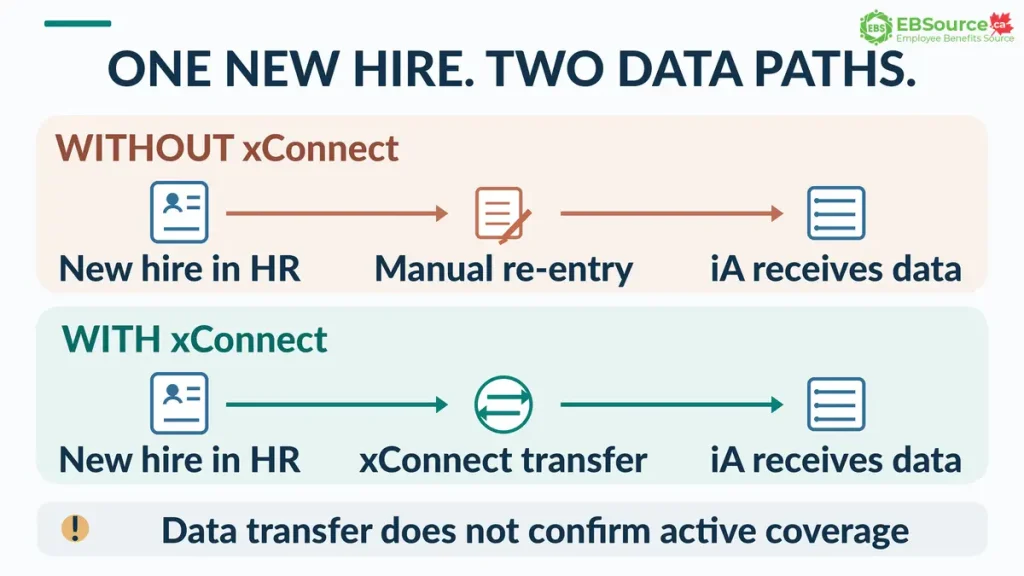
What Administrative Tasks Can iA’s Tools Automate?
iA offers online tools for employees and administrators, while xConnect can automate data transfers between the insurer and an employer’s payroll or HR system.
Through My Client Space and iA Mobile, members can submit claims, review coverage, manage contributions, arrange direct deposit, estimate drug reimbursements and locate pharmacies.
For HR teams, xConnect’s main advantage is less manual data entry. Employers can choose the modules they need, as shown below:
| Plan | xConnect service | Data flows | Manual work reduced |
|---|---|---|---|
| Group insurance | Employee and insurance data: employment status (disability, death, termination, retirement), hire date, location, new hires, benefit changes and, optionally, dependants | From your systems to iA | Manual updates in the admin portal |
| Group retirement | Contribution remittance | From payroll to iA | Collecting and uploading contribution files |
| Group retirement | Payroll deduction updates when members change contribution rates in My Client Space | From iA to payroll | Re-keying rate changes into payroll |
| Group retirement | Bonus and commission elections | From iA to payroll | Collecting election forms |
| Group retirement | Optional eligibility management: eligibility detection, enrolment kits and missing-information reports | Both ways | Tracking who has become eligible |
What Does xConnect Require From HR and IT?
xConnect can reduce manual data entry, but employers need HR and IT resources to implement it. Its value depends on how much administrative work it saves compared with setup and ongoing costs.
Before implementing xConnect, confirm:
- Staffing: One IT resource and one HR resource to support setup.
- Eligibility: Whether your organization meets the service requirements.
- Costs: iA’s setup estimate and any additional payroll-provider fees.
- Technical setup: Whether your payroll system can connect directly to iA through an API or transfer files securely. Ask your software provider which option it supports.
- Ongoing responsibilities: Data transfer frequency, error handling, reconciliation and implementation timelines.
Why iA Scores 4.0/5 for Administration and Digital Tools
Its self-service tools and xConnect can reduce duplicate data entry across HR, payroll and benefits systems. However, integration costs, technical requirements and ongoing administrative responsibilities limit the rating.
Employer takeaway: Ask iA to demonstrate how xConnect handles new hires, employee departures, leaves of absence and retirement contribution changes. Confirm which tasks are automated, which remain with HR and who resolves data errors.
What Does iA’s Symbiosis Program Offer?
Symbiosis combines group insurance and retirement savings services for eligible employers that hold both plans with iA. Launched in June 2024, the program offers coordinated administration, reporting and additional support.
Some services normally depend on plan size or retirement assets. Symbiosis makes them accessible to participating employers, although certain features still cost extra or require setup.
| Service | Outside Symbiosis | Within Symbiosis |
|---|---|---|
| Single point of contact | Depends on plan size or assets | Available |
| Education, marketing and communication specialists | Depends on plan size or assets | Available |
| Governance meetings and consolidated reports | Depends on plan size or assets | Available |
| xConnect data exchange | Depends on plan size or assets | Available, at extra cost and subject to implementation requirements |
| Transition allowance for new business | Depends on plan size or assets | Available |
| Symbiosis allowance | Not available | Available |
| My Client Space and iA Mobile | Standard access for each product | Single sign-on for both plans |
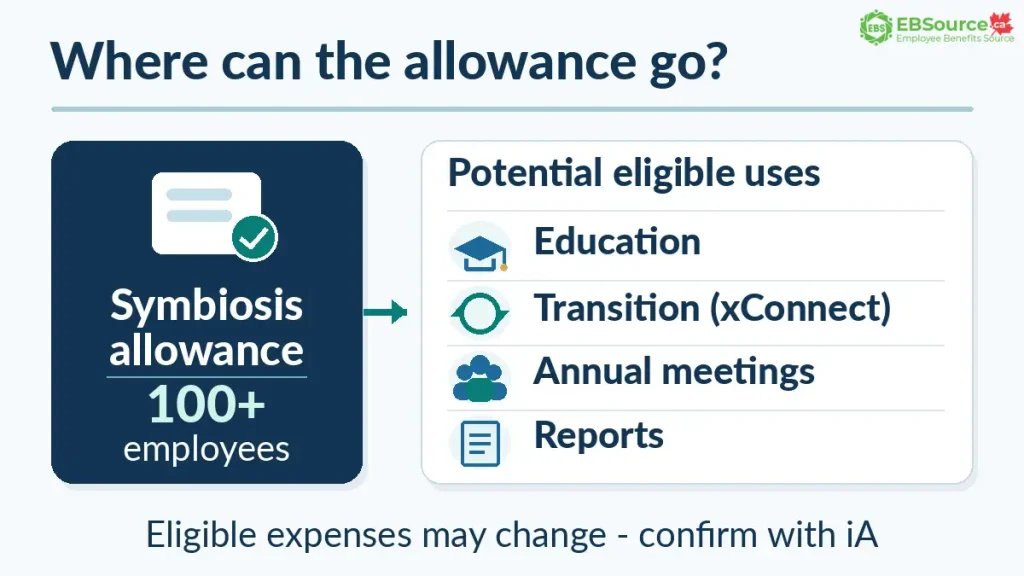
Symbiosis allowances may support employee education, transition costs, meetings and reporting. iA’s 2024 launch announcement also mentioned wellness accounts and telemedicine.
However, these are examples, not guaranteed benefits. Check the written Symbiosis allowance schedule for amounts, eligible expenses and deadlines.
Important note: iA may change, suspend or end the program without notice. Eligible expenses may also vary under provincial legislation.
Retirement plan types: iA offers Registered Pension Plans (RPPs), group Registered Retirement Savings Plans (RRSPs), Deferred Profit Sharing Plans (DPSPs), group Tax-Free Savings Accounts (TFSAs) and First Home Savings Accounts (FHSAs). Its Voluntary Retirement Savings Plan (VRSP) is available only in Quebec.
When Does Symbiosis Add Value?
Symbiosis scores 4.0/5 for coordinated reporting, specialist support and a single contact, balanced against potential fees. Its value depends on whether efficiencies and allowances exceed switching and ongoing costs.
Use the following calculation to estimate whether Symbiosis could deliver net value:
Estimated annual net benefit = Documented annual administration savings + eligible annual financial benefits – additional annual service costs – annualized transition costs
Note: Use the same evaluation period for all amounts. Treat unconfirmed allowances and estimated time savings separately, and avoid counting the same benefit twice. Do not treat one-time transition allowances as recurring annual savings.
Symbiosis may be worth considering when:
- HR manages two providers: Combining reporting and administration could reduce duplicate work.
- Employees need retirement education: Specialist support may help your workforce understand and use the plan.
- A plan change is already planned: An allowance could offset some existing transition costs.
It may offer less value when:
- Your current retirement provider is more competitive: Compare investment choices, fees and services before moving.
- Switching costs are high: Include implementation, data transfers and employee communications.
- You expect to separate the plans later: Confirm how leaving affects services, allowances and pricing.
Canada Life also offers both plans through one provider; read our Canada Life employee benefits review to compare.
Employer tip: Ask for a written service schedule that outlines how often reports are given, the main contact's responsibilities, escalation procedures, and how to access specialists. This helps you tell the difference between real integration and merely convenient features.
What Should Employers Check Before Switching to iA?
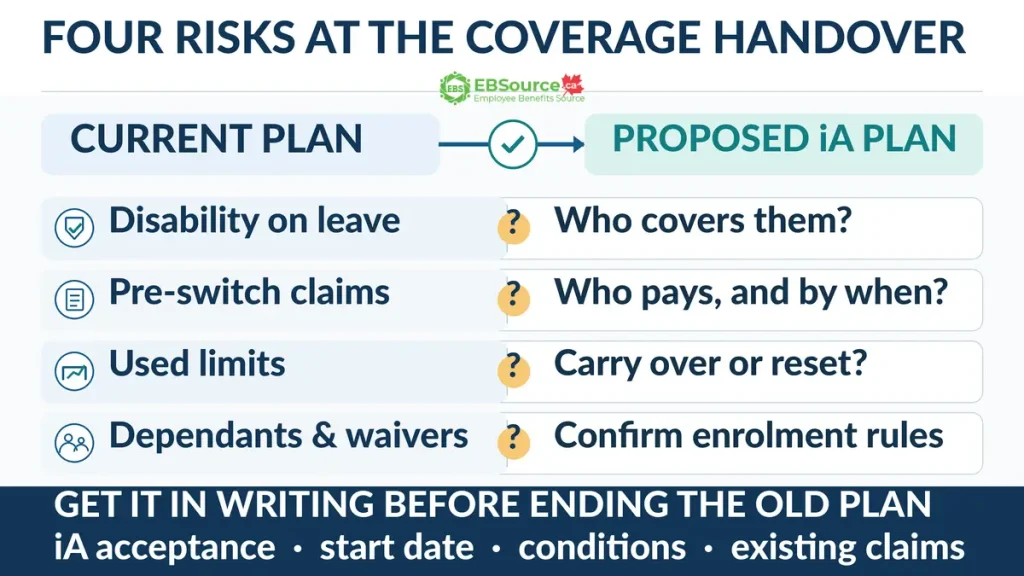
A lower premium may not be worthwhile if employees lose important coverage. Before switching, compare iA’s proposal with your current plan, including coverage limits, disability benefits, outstanding claims and administrative requirements.
| What to compare | Why it matters |
|---|---|
| Dental coverage | Compare the fee guide year, cleaning frequency, major dental procedures and orthodontics. |
| Paramedical coverage | Compare annual maximums and reimbursement limits for the services employees use most. |
| Disability waiting periods and maximums | Confirm which provider covers employees already on a claim or on leave. |
| Claims incurred before the switch date | Confirm who pays them and the deadline for submitting them to your old provider. |
| Deductibles and maximums already used this year | Don’t assume they carry over or reset. Ask iA. |
| Dependants, waivers and late applicants | Make sure no one falls through the cracks when data moves between providers. |
| Quebec employees: drug coverage | Your plan must meet the basic prescription drug coverage rules of the Régie de l’assurance maladie du Québec (RAMQ), including exemptions for employees with other qualifying private coverage, such as a spouse’s plan. |
| Quebec employees: tax treatment | Employer-paid health plan contributions are generally a taxable benefit for Quebec income tax, so confirm payroll treatment. |
| Quebec employees: plan documents | Plan documents must meet French-language requirements. |
| Payroll setup and employee communications | Plan for deduction changes, new benefit cards, app setup and enrolment communications. |
Before ending your existing plan, obtain written confirmation of:
- iA’s acceptance,
- the effective date,
- any outstanding underwriting conditions,
- how employees already receiving benefits will be handled.
Coordinate the termination and start dates with both insurers to reduce the risk of a coverage gap.
Our Equitable Life review offers another perspective on coverage and plan administration.
What Should Existing iA Clients Review?
Existing iA clients should review their coverage, costs and administrative responsibilities before each renewal. This helps HR identify changes that could affect employees, payroll and the overall benefits budget.
Check these points with your advisor ahead of renewal:
- Included services: Request an updated list of PharmAssist, Well-Balanced and online administration features covered by your contract.
- Plan flexibility: If your business has grown beyond 49 employees, ask about modular or flexible plans. Employers approaching 100 employees who hold both plans with iA can also ask about Symbiosis.
- Renewal pricing: Ask iA to explain how claims experience, pooling adjustments and other pricing factors influence your renewal increase.
- Disability benefits and EI changes: Confirm whether annual EI changes affect the insured amount, premium or benefit formula.
Source: COMMUNIQUÉ – To Group Insurance plan administrators – Annual update – iA Financial Group
HR teams should also keep track of the following requirements:
- New-hire enrolment: iA’s administrator guide allows 31 days after eligibility to enrol employees through My Client Space. Late applications may face additional requirements.
- Employee departures: Transit may allow eligible departing employees to obtain individual health coverage without a medical exam within 60 days. Confirm the deadline’s start date, eligibility rules, coverage and rates.
- Life insurance claims: Identify who will help beneficiaries use iA’s Express Life Claims process for eligible claims of $75,000 or less.
- Plan communication: Administrators must provide plan information and relevant documents at enrolment or when requested. Check iA’s administrator guide for the full responsibilities.
- Employee education: iA offers webinars on financial, physical, mental and social wellbeing. Relevant sessions can support employee communication, but webinar topics do not guarantee insurance coverage.
What is the General Perception of iA Financial Group’s Retirement Solutions?
iA Financial Group’s group retirement solutions have a positive reputation among Canadian benefits consultants and brokers, particularly for customer service, plan administration and retirement planning support.
In NMG Consulting’s 2023 Canadian Group Retirement Study, published in March 2024, iA ranked first among five major providers on the Business Capability Index, based on feedback from 61 consultants and brokers. Its strongest areas included relationship management and operational capabilities.
iA also offers diversified investment options, including ATTITUDE life cycle portfolios and SecurOption, helping members build guaranteed retirement income.
However, costs and value vary by plan. Investment fees, fund choices and withdrawal conditions depend on the employer’s arrangement, and some individual members have raised concerns about high investment fees.
How We Calculated iA’s Ratings
This review evaluates iA for Canadian employers with at least 10 employees, focusing on mid-sized businesses. Employers with fewer than 10 employees fall outside the scoring scope, so the absence of a publicly listed plan for them does not reduce iA’s rating.
| Category | What determines the score | What doesn’t determine the score |
|---|---|---|
| Plan fit and flexibility | Documented plan designs, funding choices, customization and access conditions | Premium competitiveness |
| Coverage and support options | Confirmed benefit categories, support services and availability conditions | Assumed reimbursement levels or claims approval rates |
| Transparency of costs and conditions | Clarity of eligibility, charges, allowances, renewal and exit conditions | The absence of a universal premium |
| Financial strength | The insurance company’s AM Best rating, using our published conversion scale | Customer service or claims speed |
| Administration and digital tools | Self-service functions, data exchanges and implementation requirements | Unverified claims of time savings |
| Symbiosis integration features | Coordination across both plans, and conditions of access and operation | Unquoted financial savings |
They assess iA’s publicly documented plan features, eligibility conditions and services to help employers evaluate its suitability. Each category is rated separately.
We rated each area on this scale:
| Rating | What it means |
|---|---|
| 1/5 | Very limited ability to meet the need being rated |
| 2/5 | Meets some basic needs, with significant limitations |
| 3/5 | Meets core needs, but advanced options or conditions of use are limited or unclear |
| 4/5 | Meets core needs well and offers advanced options, with notable conditions or trade-offs |
| 5/5 | Meets all requirements in the published category-specific rubric, with supporting evidence for each requirement |
For most categories, a half-point score means the evidence meets one rating level and partly meets the next. For example, 3.5/5 means iA meets the 3/5 standard and partially meets the 4/5 standard.
Financial strength follows a separate AM Best conversion scale:
- A++ = 5.0,
- A+ = 4.5,
- A = 4.25,
- A− = 4.0,
- B++ = 3.5,
- B+ = 3.0.
The Bottom Line
iA Financial Group is a strong option for Canadian employers with at least 10 employees seeking customizable group benefits and coordinated insurance and retirement administration.
Its strengths include flexible plan designs, established digital tools, strong financial ratings and the Symbiosis program for eligible employers.
However, very small or newly established businesses may face eligibility restrictions, while additional service fees, integration requirements and contract-specific coverage conditions could affect overall value.
Therefore, consider iA if its plan structure and services match your workforce’s needs. Employers should conduct a comprehensive cost comparison before switching benefits providers.
Source: Group insurance – iA Financial Group
Key Terms Used in This iA Financial Group Employee Benefits Review
Some group benefits terms can be confusing. Here is what they mean when comparing iA Financial Group’s plans, costs and services:
- Administrative Services Only (ASO): A funding arrangement where the employer pays eligible benefit claims while the insurer handles claims processing and administration. Some benefits may remain insured separately.
- Cost Plus Agreement: An arrangement that lets employers pay for certain eligible medical expenses not covered by the standard benefits plan, often for selected employees. Coverage and tax treatment depend on the arrangement.
- Underwriting requirements: The information and conditions an insurer reviews before agreeing to provide coverage. These may include group size, employee details and, for some benefits, medical evidence.
- Solvency ratio: A measure of an insurer’s available financial resources compared with the capital required under regulatory rules. It helps indicate financial strength but does not measure customer service.
- CARLI: Short for Capital Adequacy Requirements Guideline – Life and Health Insurance. These Quebec regulatory rules set out how life and health insurers must measure and maintain adequate capital.
- xConnect data exchange: iA’s system for automatically transferring information between an employer’s payroll or HR software and iA’s systems. It reduces manual updates and duplicate data entry.
- Pooling adjustments: Changes in a plan’s renewal calculation related to sharing eligible large claims across a wider insurance pool, including any associated pooling charges. The effect depends on the contract.
- Claims experience: The claims made under an employer’s benefits plan during a particular period. Insurers may use this information to help calculate renewal rates.
- Enrolment waiver: An exemption from joining some or all parts of a benefits plan when its rules allow it, such as when an employee has other qualifying coverage.
- API connection: A link that allows two software systems to exchange information automatically. This can reduce the need to enter the same data twice.
- Transition allowance: Financial support that may be offered to help cover eligible costs when moving to a new benefits arrangement. The amount and conditions depend on the employer’s agreement.