


Losing a key employee costs a small business more than recruiting a replacement. You also spend time training new hires, and productivity suffers while a position is empty.
Employee benefits may help you retain good people, but adding more coverage will not solve every retention problem. Low pay, poor management, and unpredictable schedules may also drive employees away.
This guide helps Canadian small employers identify whether benefits contribute to turnover, choose benefits that address the problem, and measure whether your investment makes a difference.
On this page
Are Benefits the Reason Your Employees Leave?
Adding benefits without understanding why employees leave can waste money. If employees leave for higher pay, better dental coverage may not convince them to stay.
Start by gathering feedback from three sources:
- Exit feedback: Ask departing employees why they are leaving and what might have made them stay. Use consistent questions to identify patterns.
- Stay surveys: Ask current employees what they value and what might make them leave. Keep surveys short, explain how responses will be protected, and avoid promising anonymity you cannot guarantee in a small team.
- Your existing benefits plan: Review coverage limits and available summary reports to identify potential gaps. Ask your carrier or advisor what information is available. If your group is too small for meaningful or privacy-safe reports, rely more on voluntary feedback and plan documents.
Use the findings to identify the most important problem before deciding what to change.
| Employee feedback or behaviour | Possible issue | What to investigate |
|---|---|---|
| Leaving for higher pay | Uncompetitive salaries | Compare pay and total compensation with the market. |
| Concerned about prescription, dental, or therapy costs | Coverage gaps | Review limits and out-of-pocket expenses. |
| Reporting stress or burnout | Workload or management issues | Examine workloads, management practices, and available support. |
| Struggling with unpredictable schedules | Work-life conflict | Review scheduling, flexibility, and paid time off. |
| Worried about lost income during illness or injury | Limited income protection | Assess sick pay and disability coverage. |
| Leaving for better overall packages | Limited long-term value | Consider retirement contributions and career development. |
| Unclear about available benefits | Poor communication | Improve benefit explanations, enrolment, and claims support. |
For more insight, see our guide to Why Employees Leave Small Businesses.
Three Examples of Matching Benefits to Retention Problems
Employees are leaving for higher pay.
Exit feedback shows that employees are accepting better-paid jobs, but the employer plans to add dental coverage.
What to do: Review salary competitiveness first. Dental coverage is unlikely to compensate for a significant pay gap.
Employees need better dental coverage.
Employees say their annual dental maximum runs out too quickly, while the owner is considering an unrelated new benefit.
What to do: Compare the cost of increasing the dental maximum with the cost of the proposed benefit. Addressing the confirmed gap may offer better value.
Employees are struggling with scheduling.
Retail employees say unpredictable shifts make it difficult to arrange childcare and other commitments.
What to do: Try publishing schedules earlier or allowing shift swaps before spending more on insurance. Gather feedback and monitor staffing outcomes.
Start with one practical change and decide how you will measure its impact before committing long term.
Which Employee Benefits May Help Reduce Turnover?
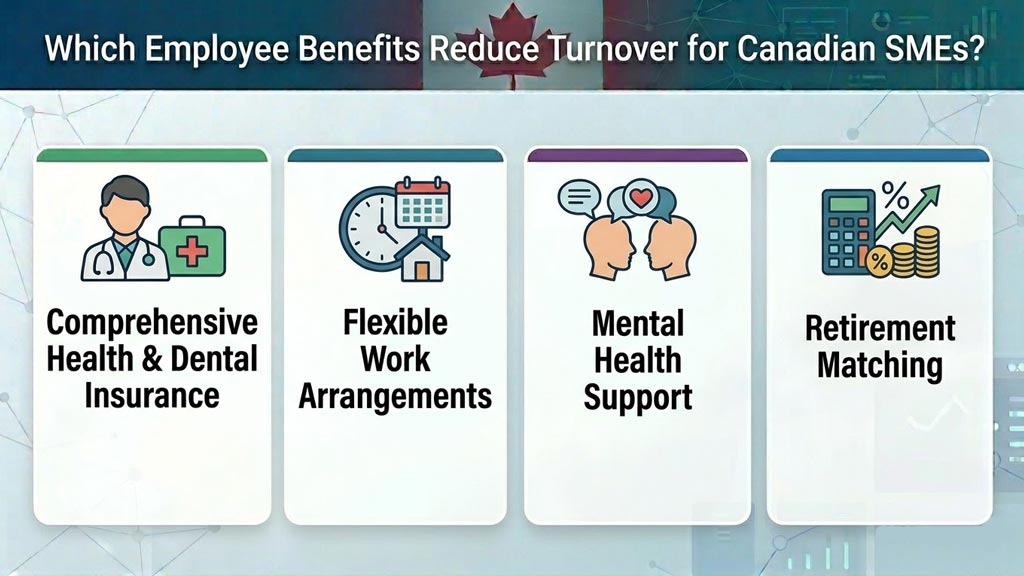
Extended health and dental insurance, mental health support, flexible work, and retirement contributions can all make a job more attractive. The right options depend on employee needs, your budget, and the nature of your business.
| Benefit | How it helps | Signals to look for |
|---|---|---|
| Extended health and dental | Reduces out-of-pocket healthcare costs | Employees mention prescription or dental costs, or competitors offer stronger coverage. |
| Mental health support | Improves access to care | Employees report stress, burnout, or difficulty affording treatment. |
| Flexible work and paid time off | Eases work-life conflict | Employees raise concerns about scheduling, commuting, or not having enough time off. |
| Employer retirement contributions | Strengthens long-term financial security | Experienced employees leave for better total compensation packages. |
Health and Dental Coverage: Help With Everyday Health Care Costs
Extended health and dental benefits can help employees pay for eligible expenses that public coverage or existing insurance does not fully cover.
This support can be valuable to employees with recurring medical expenses or family members who depend on their coverage. However, low reimbursement rates, annual maximums, and restrictions on eligible drugs can limit their value.
Before you expand coverage, identify the gaps in your current plan and compare the cost of closing those gaps with the cost of adding a new benefit. Targeted improvements can make your overall compensation package more attractive without creating unnecessary expenses.
Mental Health Benefits: Make Support More Accessible
Mental health support can help employees access care, manage personal challenges, and seek assistance before concerns become harder to handle.
A 2025 workplace study by Mental Health Research Canada estimated that burnout costs employers $5,500 to $28,500 per employee each year through absenteeism, presenteeism (working while unwell), and turnover.
These figures do not predict what your business will spend or save, but they show the potential impact of burnout on the workplace. The impact can be greater in small teams, where one struggling person can affect everyone.
Small businesses can consider two options:
- Employee Assistance Program (EAP): An EAP provides confidential support for short-term personal or work-related concerns. Some programs also offer counselling or support for employees’ family members.
- Mental Health Practitioner Coverage: This benefit helps employees pay for eligible mental health services from practitioners such as psychologists or social workers, subject to plan limits.
Consider mental health support when employees report stress, difficulty accessing care, or concerns about treatment costs. These benefits show your business takes employee well-being seriously.
However, benefits cannot fix workplace problems. If employees leave because of heavy workloads, harassment, or poor management, you also need to address those underlying conditions.
Employer Retirement Contributions: Add Long-Term Value
Retirement contributions can make your package more attractive to employees who want help saving for the future.
Two arrangements Canadian employers may consider are:
- Group Registered Retirement Savings Plan (Group RRSP): Employees contribute through payroll, and employers may match or add contributions.
- Deferred Profit Sharing Plan (DPSP): Employers contribute for eligible employees under the plan’s rules. Under CRA requirements, employer contributions must vest after no more than two years of plan membership, or sooner if the plan allows.
Retirement contributions may appeal to employees who value long-term financial security. But they may be less helpful for those struggling with immediate living costs who may prioritize salary, healthcare coverage, or paid time off.
Retirement contributions are an ongoing financial commitment, so confirm your business can sustain them before introducing a plan.
Flexibility and Paid Time Off: Reduce Work-Life Conflict
Employees sometimes leave because their schedules do not fit their personal responsibilities.
According to MHRC’s 2025 study, paid time off (69%), personal days (58%), and flexible schedules (52%) were the workplace supports most often seen as effective.
A 2025 Robert Half survey also found that 56% ranked hybrid work as their preferred work model, and 38% of those not looking for a new job say they do not want to lose their current flexibility.
These findings do not reflect every Canadian workforce, but they suggest flexibility can be an important part of an attractive compensation package.
Flexible Work Options
Depending on the role, small businesses can consider:
- flexible start and finish times
- shift swaps
- hybrid work
- more predictable scheduling
These options can improve the employee experience without a major investment.
Paid Time Off
Canadian employment standards set minimum requirements for vacation and public holidays; the rules depend on the applicable jurisdiction.
Meeting these legal minimums alone will not help your business stand out. Offering an extra week of paid vacation or additional paid sick days can help employees manage personal responsibilities and recover from illness or stress.
Consider replacement staffing, overtime, workload distribution, and administrative responsibilities to avoid overburdening other employees.
Important: Choose Benefits Your Business Can Afford
Small businesses often have limited budgets for employee compensation. In 2025, the Canadian Federation of Independent Business (CFIB) reported that half of small businesses said they could not offer compensation packages that matched those of large companies.
Before committing to a benefit, calculate annual premiums, contributions, administration costs, and potential renewal increases. Also consider whether the plan would remain affordable if your business grows more slowly or operating costs rise.
How Can You Tell Whether the Change Is Working?
To evaluate whether a benefits change is helping, compare employee turnover and feedback before and after implementation.
Fewer departures do not automatically mean the new benefit caused the improvement. Pay increases, management changes, working conditions and the wider job market can also influence retention.
Start by establishing a baseline, then monitor the same measures over time.
Start With Your Voluntary Turnover Rate
Voluntary turnover measures how often employees choose to leave your business during a given period.
Voluntary turnover rate = (Voluntary departures / Average number of employees) * 100
For example, if your business averages 20 employees during the year and two resign, your annual voluntary turnover rate is 10%.
Record the rate before introducing the change. Then use the same calculation and time period to assess results afterwards.
In a small business, even one resignation can significantly change your turnover rate. Compare similar periods and, where practical, use full-year data.
Also consider employee feedback alongside the figures. A short-term improvement is not enough to prove that a benefit improved retention.
Look Beyond the Turnover Rate
Use several measures to understand whether the change is helping.
| What to measure | What it tells you | What it cannot tell you alone |
|---|---|---|
| Voluntary turnover rate | Whether employees leave more or less often | Why they leave |
| Benefits satisfaction | Whether employees value the package | Whether they will stay |
| Benefits awareness | Whether employees understand available benefits | Whether they will use them |
| Participation or usage | Whether employees use a benefit | Whether it improves retention |
| Exit and stay feedback | Whether benefits influence decisions to stay or leave | Whether feedback represents everyone |
Interpret each measure in context. Low disability insurance use, for example, does not necessarily mean employees see little value in it. Similarly, high dental claims do not prove that dental coverage is reducing turnover.
Decide Whether to Keep, Improve, or Reconsider the Benefit
Once employees have had enough time to use the benefit, assess it by asking three questions:
- Do employees understand it?
- Can they access and use it?
- Does it meet an important need at a sustainable cost?
Then decide what to do next:
- Keep it if employees value the benefit, the cost is manageable, and it meets an important need.
- Improve it if employees find it useful, but coverage limits, access problems or poor communication reduce its value.
- Reconsider it if it doesn’t address the main retention concern or costs more than your business can reasonably sustain.
Before drawing conclusions, consider whether other changes, such as a salary increase or a new manager, may have influenced the results.
Review your findings before your plan’s renewal date. This gives you time to discuss costs, employee feedback and possible adjustments with your advisor.
The goal is not to prove that benefits alone kept employees. It is to learn whether the investment remains useful or whether another change deserves priority.
Make Benefits Part of Your Employee Retention Strategy
The right employee benefits plan addresses your employees’ needs while remaining affordable for your business. Gather feedback, prioritize the changes most likely to address retention problems, and review the results before your next renewal. Pair benefits with competitive pay, supportive management, and predictable schedules to give employees more reasons to stay.
FAQs About Employee Benefits to Reduce Turnover
Will Better Benefits Stop Employees From Leaving for Higher Pay?
Not necessarily. Pay can be an important factor in employees’ decisions to stay or leave, although its importance varies by workforce.
Benefits may make your overall compensation package more attractive, particularly when they cover expenses employees would otherwise pay themselves. However, if your salaries are significantly below market rates, review pay competitiveness first.
What Can I Do to Improve Retention if My Budget Is Very Tight?
Start with changes that require little additional spending:
- Explain your existing benefits more clearly.
- Publish schedules earlier or allow shift swaps where practical.
- Put a flexible or hybrid work policy in writing if the work allows it.
- Ask employees which existing workplace practices they would most like to change.
Additional paid leave may also help, but consider payroll, replacement staffing and operational costs before committing.
How Can I Make Sure Employees Understand Their Benefits?
Explain your benefits package during onboarding and remind employees regularly about available coverage, eligibility, and how to submit claims.
Use plain language and give employees an easy way to ask questions. You can also share a simple benefits guide that summarizes key coverage limits, waiting periods, and available support.
Ask employees whether they understand the plan and where they need clarification.
How Often Should a Small Business Review Its Employee Benefits Package?
Review your benefits package at least once a year, ideally before your plan’s renewal date. You should also consider an earlier review if employees raise recurring concerns, your workforce changes significantly, or costs become difficult to sustain.
Gather employee feedback, review available usage information, and compare your current coverage with your budget and retention priorities. Discuss potential adjustments with your benefits advisor before making changes.