
Group Disability Insurance in Canada: Types, How it Works and Coordination


Group disability insurance is an employer-sponsored benefit designed to replace a portion of your income if you are unable to work due to illness or injury. In Canada, most plans include two types of disability coverage: short-term and long-term.
These group plans are established through a contract between the employer and an insurer, in which the employer selects the plan design and either shares or pays the premium costs. Eligible employees are enrolled in a group policy with simpler enrollment than an individual policy.
Additionally, your group disability benefit may be reduced by payments from government programs such as CPP Disability Benefits, EI Sickness Benefits, or provincial workers’ compensation.
To help you decide whether you should have it, this article explores its types, how it works, and how it coordinates with other government benefits.
On this page
What is Group Disability Insurance?
Group disability insurance is an employer-sponsored benefit that provides income replacement when a plan member is unable to work due to illness or injury. It is one of the most common forms of employee benefits in Canada.
Its core purpose is income protection, not medical coverage. Because the risk is spread across the entire eligible employee group, individual members typically do not need to undergo a medical exam or answer detailed health questions to obtain coverage. This makes group disability insurance more accessible than individual policies.
What types of Group Disability Insurance in Canada?
Group plans usually consist of 2 main types of protection: short-term disability insurance covers the initial weeks or months of absence, whereas long-term disability insurance provides support for extended periods away from work. Together, they help replace lost income from both short and extended disability absences.
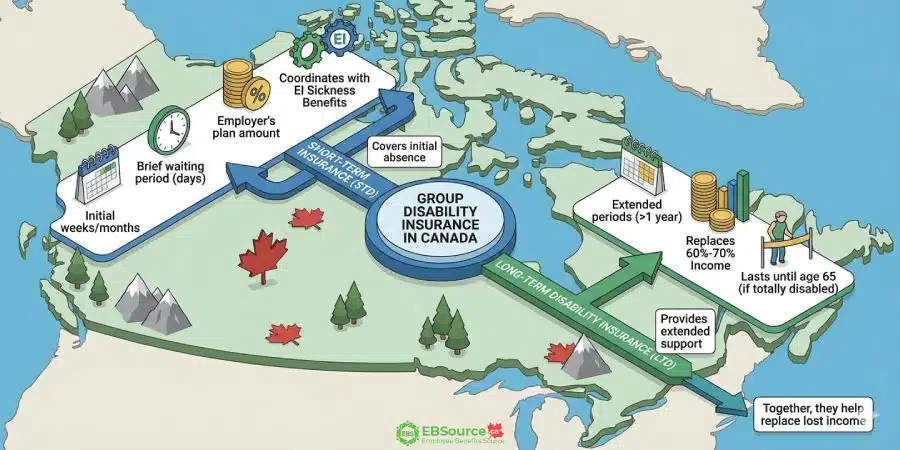
Below is an explanation of how each type of coverage benefits the policyholder:
Short-Term Disability Insurance (STD)
Short-term disability coverage generally offers benefits for up to six months if you are sick or injured, according to the Financial Consumer Agency of Canada. It usually begins after a brief waiting period, which can range from a few days for an illness to the day of an accident for injuries.
The exact amount you receive for STD depends on your employer’s plan. Also, many employers design their STD benefits to work alongside EI Sickness Benefits. Therefore, if your employer provides an STD plan, begin by following your employer’s STD claim process. Before applying for EI sickness benefits, check with your HR department to see whether EI is necessary for your situation and how the STD plan coordinates with it, including whether there are any top-ups or offsets.
Long-Term Disability Insurance (LTD)
Long-term disability coverage is designed for extended absences from work. It begins after your plan’s waiting (elimination) period, which often follows the end of STD, employer sick leave, or EI sickness benefits.
Most Canadian LTD plans are structured to replace a portion of your pre-disability income, usually around 60-70%, up to a specified plan maximum. The specific criteria for being classified as “disabled” and the duration of benefits can vary by plan booklet and may evolve over time. For instance, some plans implement a stricter definition of disability after a certain period.
How Does Group Disability Insurance Work?
Group disability insurance is based on a contract between an employer and an insurance company that outlines eligibility, enrollment, and premium sharing. In this arrangement, the employer sponsors and manages the insurance plan, offering eligible employees income replacement in the event of a disability.

Here is an overview of how group disability insurance works:
Establish the Group Disability Policy
The employer selects a group insurer (such as Sun Life, Canada Life, or Manulife) and sets the plan’s details, including benefits, waiting periods, and costs. The underwriting approach allows employees to enroll without completing a medical questionnaire or undergoing health screenings, provided they do so within the plan’s eligibility window.
Key Provisions in Group Disability Policies
Canadian group disability policies include several crucial provisions that determine coverage, such as covered causes, partial disability benefits, vocational rehabilitation, waiver of premium, pre-existing conditions, and survivor benefits.
Below is an explanation of each feature:
- Covered Causes: Most plans cover disabilities caused by accidents, injuries, or sickness, including physical and mental conditions.
- Partial Disability Benefits: Allow you to work part-time while recovering and receive proportional benefits based on loss of income or duties.
- Vocational Rehabilitation: Some LTD carriers provide job retraining services to help you return to alternate employment.
- Waiver of Premium (if included): Some insurance plans may waive certain premiums after benefits begin, but this rule varies by plan. Ask your plan administrator whether premiums continue during a disability leave and, if so, when they stop.
- Pre-Existing Conditions: Most plans limit or exclude coverage for medical conditions treated during the months before enrollment.
- Survivor Benefits: Some plans continue paying benefits to dependents for a period if you pass away while disabled.
Determine Eligibility and Enrollment Requirements
Eligibility for group disability insurance varies by employer’s plan, but most require employees to have a minimum service period and work a specified number of hours each week.
Once enrolled, employees receive a certificate or member booklet that explains the plan, including what defines a disability, the benefit amount, waiting periods, and exclusions. If an employee becomes disabled, they or their employer must file a claim with the insurer, along with medical proof. If the claim is approved, benefits start after a specified waiting period.
Determine Premiums Sharing
Group disability insurance premiums can be paid by the employer, the employee, or both. Typically, they are shared between the two.
Here are three ways to structure group disability premiums:
- Employer-Paid Premiums: If your employer pays the premiums, the costs are not disclosed to employees. Group coverage is simply included in the overall employee benefits package.
- Employee-Paid Premiums: If disability premiums are paid by employees, rates will vary based on factors such as age, income, gender, occupation, and more. Premiums are deducted from paychecks, along with supplemental insurance policies and other voluntary benefits.
- Shared-Paid Premiums: In some cases, a portion of disability insurance premiums is paid by the employer, and the remainder is paid by the employee through payroll deductions.
How these costs are divided is a key detail of any group disability plan, as it directly affects whether your benefits will be taxable.
How Group Disability Benefits Coordinate with Canadian Government Programs
Group disability benefits are typically reduced by any income you receive from CPP/QPP disability, EI sickness benefits, and workers’ compensation. This process is referred to as benefit offsetting.
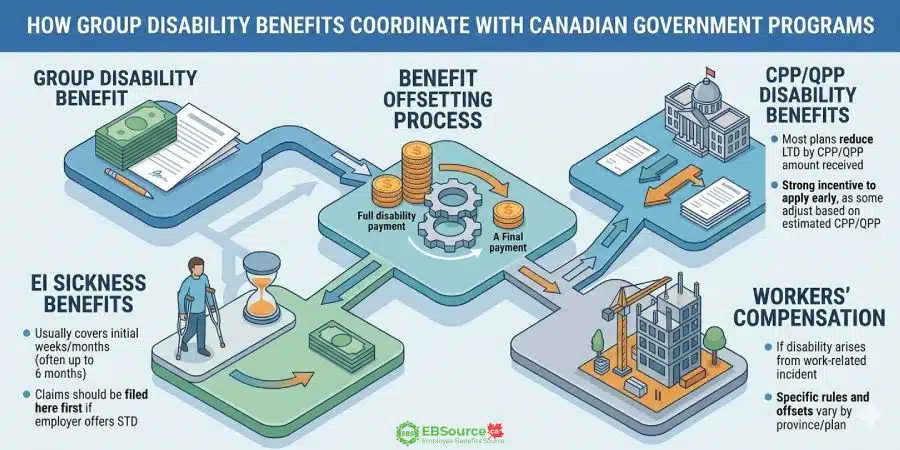
The three government programs that most commonly interact with group disability insurance in Canada are:
CPP Disability Benefits or QPP Disability Benefits: Many LTD plans decrease your benefits if you receive other disability income, such as payments from the CPP/QPP, or workers’ compensation. Additionally, your plan may require you to apply for specific programs. Your insurer will provide details on how offsets are calculated. It is important not to assume that an “estimated CPP/QPP offset” applies unless it is explicitly stated in your plan documents.
EI Sickness Benefits: If you qualify, EI sickness benefits can give you financial support for up to 26 weeks, covering 55% of your earnings, up to a maximum of $729 per week in 2026. LTD benefits start based on your specific plan and usually begin after a waiting period, which may not align with EI sickness benefits. Check your plan booklet for details about the waiting period and any coordination rules.
Workers’ Compensation: If your disability arises from a work-related incident, workers’ compensation benefits will usually reduce your group disability benefits. The specific rules regarding this offset vary by province and employer plan.
Group Disability Insurance vs Individual Disability Insurance
Group disability coverage is usually cheaper and easier to obtain, while individual plans offer more flexibility, such as portability and broader definitions of disability. Understanding these differences can help you determine if your group disability plan is enough or if you need additional individual coverage.
The table below compares the key differences between group and individual disability insurance in Canada.
| Feature | Group Disability Insurance | Individual Disability Insurance |
| Cost | Lower (employer subsidizes part or all of the premium) | Higher (you pay the full premium yourself) |
| Portability | Coverage ends when you leave your employer | Policy stays with you regardless of employer |
| Medical underwriting | Usually none (coverage based on group eligibility) | Required (health questions or medical exam) |
| Customization | Standardized plan set by the employer | Tailored to your income, occupation, and needs |
Table comparing group and individual disability plans based on cost, portability, underwriting, and customization
Should Employees Get Individual Disability Insurance Too?
If you are looking for a more accessible option for most employees, consider choosing group disability insurance, as it does not require medical underwriting and is less expensive out of pocket. However, keep in mind that it has limitations which may create gaps in your coverage. This could be especially relevant if you change jobs, earn above the plan’s salary cap, or need a broader definition of disability than what your group plan offers.
Therefore, some experts recommend that employees supplement group LTD coverage with individual disability policies. Note that the downsides are higher premiums and the need to qualify medically. Employees with chronic conditions may not be approved.
When it comes to your financial security, it’s wise to listen to the experts. That’s why many financial advisors strongly recommend securing your own portable LTD policy and maintaining both group and individual disability insurance.
Why is Disability Insurance Important?
A 2022 report from Statistics Canada revealed that 27% of Canadians aged 15+ had a disability in 2022 (about 24% among ages 25–64). This figure highlights why having adequate disability insurance is one of the most crucial financial safeguards you can have. Additional reasons it’s so vital include:
Income Replacement
STD and LTD plans may have different replacement rates, and higher earners may reach their plans’ maximum limits. According to government guidelines, disability insurance typically replaces a portion of income, often ranging from 60% to 85%. Many LTD plans are structured to provide about 60% to 70% of pre-disability income, subject to a maximum limit set by the plan.
High Prevalence of Disability
For many working Canadians, an extended absence from work due to illness or injury is a real possibility. That’s why ensuring your income is protected is a vital component of a sound financial plan, providing stability when you need it most.
Employee Retention
Offering group disability insurance boosts employee retention rates by demonstrating to your workforce that you care about their health, well-being and financial security. Keeping experienced employees through a disability minimizes business disruption.
Maintaining Productivity
Supporting employees through a disability with partial income replacement protects workforce productivity. Employees can focus on recovery with the security of returning to work when able.
Recruitment Edge
Providing group disability insurance coverage makes it easier for employers to recruit and attract top talent. It’s an attractive benefit that gives businesses a competitive edge.
Tax Paying for Group Disability Insurance in Canada
The taxability of benefits depends on who paid the premiums and how the plan is structured. If your plan is a wage-loss replacement plan, the CRA requires income tax withholding on benefits. Additionally, the reporting rules may vary depending on whether contributions to the CPP or EI are also deducted.
Employer note: CRA guidance permits businesses to deduct premiums paid for employee coverage related to sickness, accident, disability, or income insurance.
Disclaimer: This article offers general information applicable to Canada. The terms of disability plans can differ based on the insurer, employer, and province. Additionally, government programs (such as EI, CPP, and QPP) and tax regulations are subject to change. Always verify your eligibility, offsets, and tax implications by consulting your plan booklet, speaking with your plan administrator, and referring to the official guidance from the Government of Canada or the CRA.
FAQs about Group Disability Insurance
How do pre-existing conditions affect group disability coverage?
Pre-existing condition rules vary by insurance plan. Insurers often define a pre-existing medical condition as any illness or injury for which you sought or received treatment before you obtained coverage.
Some plans may not cover claims related to a pre-existing condition until you have been insured for a specific period. Be sure to review your plan booklet for details on the exact lookback period and any exclusion timeframes.
Can I receive disability benefits while working part-time?
Many group LTD plans offer partial disability benefits that allow you to work part-time while recovering and receive proportional benefit payments based on loss of income or duties.
What common limitations or exclusions apply to group disability benefits?
Limitations and exclusions are specific to each contract. Plans often have exclusions and termination rules, but the specific details vary by insurer and employer contract. Always refer to your plan booklet for accurate information on exclusions, rehabilitation requirements, and termination conditions.
Do all employers in Canada offer group disability insurance?
No, not all employers in Canada are required to offer group disability insurance. However, many employers choose to provide this coverage as part of their employee benefits package to attract and retain talent.
What qualifies as a disability under group disability insurance in Canada?
The definition of disability varies among insurance policies in Canada. Generally, a disability is considered a condition that prevents the insured from performing the essential duties of their occupation due to illness or injury.