
Group Life Insurance in Canada: Coverage Types, How It Works, and Key Plan Decisions


Group life insurance, as part of group insurance in Canada, is a life insurance policy offered through an employer that covers a group of employees under a single policy. While many people consider individual life insurance, group plans offered through employers or associations are often a more affordable and convenient option.
A group life plan can include employee basic life, employee optional life, dependent basic life, and dependent optional life insurance. For employers, five plan-design decisions are particularly important: how coverage amounts are calculated, how employee classes and coverage tiers are structured, who pays the premiums, whether AD&D is included, and whether employees can purchase optional life coverage.
On this page
What is Group Life Insurance?
Group life insurance is an employer-sponsored benefit that an employer provides to eligible employees through a single master policy held with an insurer. The policy provides a death benefit to an employee’s designated beneficiaries if the employee passes away while covered.
Unlike individual life insurance, group coverage pools the risk of multiple employees under one plan. Specifically, the insurer generally assesses the group as a whole when pricing coverage, so this makes group life insurance more affordable on a per-person basis.
Group life insurance is commonly structured as annually renewable term insurance and does not build cash value. It renews each year as long as the employer maintains the plan and the employee remains eligible. The premium rate may change at renewal based on the group’s claims experience and updated demographics, but coverage itself continues without the employee needing to reapply.
What Types of Group Life Insurance Coverage Can Employers Offer?
Group life insurance plans typically include employee basic life insurance, employee optional life insurance, dependent basic life insurance, and dependent optional life insurance. Each type is designed to serve a specific purpose and provide financial protection for employees and their families.
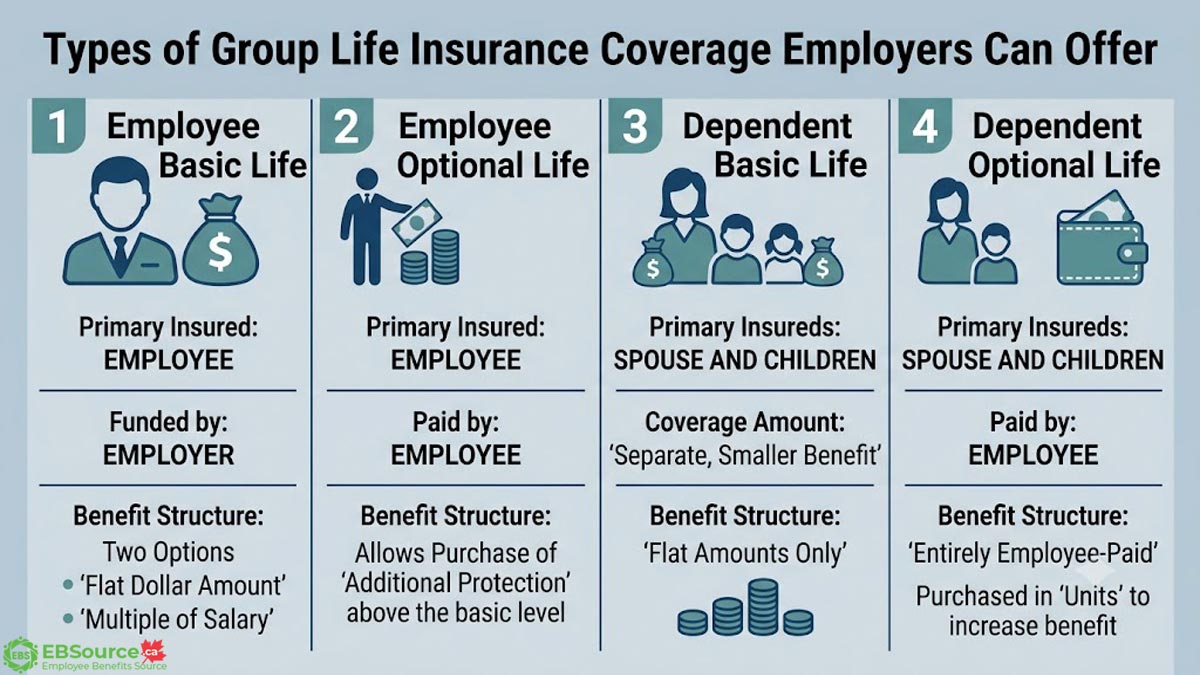
The four coverage types described below are the building blocks of a group life plan, and employers select which ones to include based on budget, workforce needs, and competitive positioning:
Employee Basic Life Insurance
Employee Basic Life Insurance is the most common component of a group life insurance plan. It provides a lump-sum death benefit to the employee’s designated beneficiary if they pass away while covered.
Coverage is commonly available with two options. Employers typically structure this benefit either as a flat dollar amount or as a multiple of the employee’s salary.
Employee Optional Life Insurance
For employees who find that the basic coverage isn’t enough for their needs (e.g., to cover a mortgage), Employee Optional Life Insurance allows them to purchase additional protection for themselves at their own expense.
Optional life gives employees the flexibility to increase their death benefit to better reflect personal financial obligations such as a mortgage or the cost of raising dependants.
Dependent Basic Life Insurance
Dependent Basic Life Insurance covers the employee’s spouse and eligible dependent children under a separate, smaller benefit. Dependent Life plans provide coverage in flat amounts only, and coverage for the spouse is generally higher than that available for children. This amount is intended to help the employee cover funeral costs and immediate financial disruption rather than to replace income.
Employers must decide whether to include dependent life as a standard part of the plan or to offer it as an optional add-on that employees can elect.
Dependent Optional Life Insurance
This layer allows an employee to purchase additional life insurance for their spouse and, in some cases, children. This may be useful for families where the loss of a spouse’s income or their contribution to the household (e.g., as a stay-at-home parent) would cause significant financial strain. This coverage is entirely employee-paid. The employee can purchase it in units (e.g., units of $10,000) up to a plan maximum.
How Group Life Insurance Works in Canada
The way group life insurance works in Canada can be understood in four key stages. It begins with the plan setup and administration, where the employer purchases and manages the master policy. Next comes employee enrollment, a process made simple by automatic approval up to certain coverage limits. The employee’s most critical step is designating a beneficiary to receive the funds. Finally, in the payout process, the named beneficiary receives a lump-sum payment after a claim is approved.
Plan Setup and Administration
The foundation of a group plan is that the employer is the policyholder. Because employers hold the master contract with the insurance company, they make all the key decisions, including which insurer to use, what the coverage levels will be, and how the costs are shared. While employees don’t own the policy themselves, they each receive a certificate of insurance that confirms their specific coverage under the group plan.
Premiums can be handled in one of three ways:
- Employer-Paid: The company covers the full cost.
- Employee-Paid: The employee pays the full cost, usually for optional or extra coverage.
- Cost-Shared: The employer and employee split the cost, which is the most common setup for basic coverage.
Any portion owed by the employee is conveniently paid through automatic payroll deductions. A major advantage of this group structure is that the rates are often lower than individual insurance. Because the insurer’s risk is spread across the entire employee group, the cost is much more manageable.
Tax Implications: When an employer pays an employee’s insurance premiums, they are usually considered a taxable benefit to the employee. However, the amount that shows up on the employee’s T4 slip isn’t always the exact premium the employer paid. For certain benefits, like group life insurance, the Canada Revenue Agency (CRA) uses a specific formula to calculate the value of the benefit. This final calculated amount is what gets reported as part of the employee’s income. For the employer, these payments are generally a tax-deductible business expense (Source).
Employee Enrollment and Coverage Limits
When an employee becomes eligible for benefits, usually after a short probationary period, they are enrolled in the group life insurance plan. As long as an employee enrolls within the specified window set by the group contract, they can get a substantial amount of coverage without having to answer medical questions or undergo an exam.
The Non-Evidence Maximum (NEM)
This easy enrollment is possible because of a feature called the Non-Evidence Maximum (NEM). The NEM is the highest amount of coverage an employee can automatically receive without having to provide “evidence of insurability” (proof of good health).
- If an employee’s coverage amount (often based on salary) is at or below the NEM, they are automatically approved.
- If a salary increase pushes an employee’s potential coverage above the NEM, they will still automatically receive the amount up to the NEM. For the excess amount, the insurance company will invite the employee to apply by completing a medical questionnaire. Approval for this extra coverage is not guaranteed.
The NEM amount is set by the insurer and depends on factors like the size of the company and its overall risk profile. Generally, larger companies have higher NEMs.
For example, the guaranteed NEM for life insurance in a 5-9-person firm could be as much as $150,000, with LTD NEM around $2,000/month (Source). As small employers grow in headcount, they become eligible for increases to the NEM levels for both Life and LTD coverage (Source).
The NEM underscores why group life insurance should not be an employee’s only protection. Because the NEM caps the amount of guaranteed coverage, employees who need protection beyond that limit may wish to review optional group coverage and individual insurance options with a licensed advisor.
Separate from the NEM, every group plan also has an overall maximum benefit. This is the absolute highest amount of coverage an employee can have under the plan, regardless of their salary. No employee’s coverage can exceed this pre-defined ceiling.
Designating Beneficiaries
A critical step for the employee is to name a beneficiary, the person or people who will receive the insurance payout. Employees typically name a primary beneficiary and a contingent (or secondary) beneficiary, who would receive the funds if the primary beneficiary is unable to.
While filling out the form is simple, the legal rules behind it are surprisingly complex and are not the same across Canada. Things like whether a designation can be changed, what happens after a divorce, how to handle funds for a minor child, and whether creditors can access the money all affect who gets paid. The biggest source of confusion comes from the legal differences between Quebec and the rest of Canada (the “common law” provinces like Ontario, BC, and Alberta)
The Payout Process
If an employee passes away while covered by the policy, the named beneficiary is responsible for filing a claim with the insurance company, a process often facilitated by the employer’s HR department. Once the claim is approved, the insurance provider pays the death benefit directly to the beneficiary.
While this death benefit is paid to a named beneficiary tax-free in most cases, it’s important to know that any interest earned on the payout before it is delivered may be considered taxable income.
Key Group Life Insurance Plan Design Decisions for Employers
Employers designing or reviewing a group life insurance plan should focus on five key decisions. These include how coverage amounts are calculated, whether different employee classes receive different coverage, who pays the premiums, whether AD&D is included, and whether employees can purchase optional coverage.
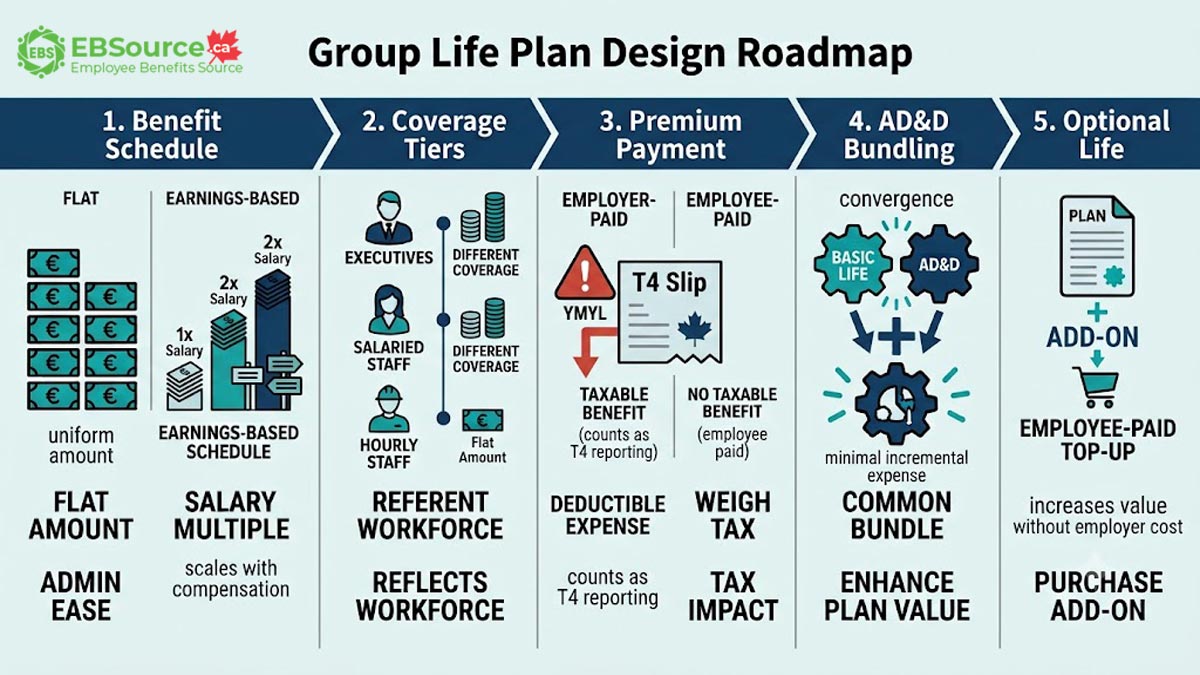
These decisions affect coverage levels, plan cost, employee tax treatment, and how the plan is administered, so they should be made in consultation with a licensed benefits advisor.
Decision 1: Choosing between a flat benefit schedule and an earnings-based schedule
This decision determines how coverage amounts are calculated for each plan member. You can choose between a flat schedule and an earnings-based schedule:
- Flat Schedule: Every employee receives the same coverage amount (e.g., $50,000). It is easy to administer because it doesn’t require constant payroll syncing. That said, since the amount stays the same regardless of salary, employers should check whether it still aligns with the intended purpose of the benefit across different employee groups, from entry-level staff to higher earners.
- Earnings-Based Schedule: Coverage scales with compensation (e.g., 1x or 2x annual salary). Employees generally view this as more equitable, but it requires your HR team to maintain accurate and up-to-date salary records to avoid liability issues.
Decision 2: Defining employee classes and coverage tiers
Employers can create separate employee classes, such as executives, salaried staff, and hourly staff, with different coverage levels for each class. This allows the plan to reflect the different financial exposures and retention priorities across the organization.
For instance, you offer management 2x their annual salary while providing hourly staff a flat $75,000 benefit. This hybrid approach allows you to align your benefits spend with different retention priorities and financial exposures across the company.
Decision 3: Deciding who pays the premium
Employers generally have two options for paying group life insurance premiums: the employer can pay the premium, or the employee can pay it. Who pays the premium affects the tax treatment for your employees:
- Employer-Paid: If the company covers the premium, it generally counts as a deductible business expense. However, under Canada Revenue Agency (CRA) guidelines, this creates a taxable benefit for the employee. For high earners with large coverage amounts, this taxable benefit may be noticeable on their paycheque.
- Employee-Paid: If the employee pays the premium out of pocket, the employer-paid taxable benefit does not apply. Employers should consider the convenience of covering the premiums themselves alongside the tax impact on employees when deciding which approach to use.
Decision 4: Bundling group life insurance with AD&D
AD&D coverage is commonly bundled with basic group life insurance because of its low additional cost. Employers can add AD&D to provide employees with supplemental protection for accidental death or severe injury.
That’s why many group insurance plans in Canada include AD&D as a standard component alongside basic life. It is one of the simplest ways to enhance the plan’s perceived value without a significant increase in overall plan cost.
Decision 5: Offering optional (supplemental) life coverage
Employers can give employees the option to purchase additional life coverage at their own expense to add value to the plan without increasing the employer’s costs. This also gives employees more flexibility to choose the amount of coverage they need beyond the basic group life benefit.
The key here is communication. Employers should work with their insurer to set the Non-Evidence Maximum for optional life and communicate clearly how employees can apply, what evidence of insurability may be required, and when the enrolment window opens. Clear communication at the time of hire is essential, because employees who miss the initial enrolment window may be required to provide evidence of insurability to access optional coverage later.
Decision Framework: Employer Self-Assessment for Group Life Insurance Plan Design
If you are an employer, you can evaluate whether a group life insurance plan is well-designed for your workforce by working through six diagnostic questions that connect workforce characteristics to specific plan-design choices.
This framework is not a replacement for advice from a licensed benefits advisor, but it provides a structured starting point for employers building a new plan or reviewing an existing one at renewal.
What is your workforce’s average age?
The age distribution of the group is one of the factors that can influence premium cost, since carriers often account for age when pricing group life insurance. That said, the exact rating approach still depends on the carrier, group size, and plan design.
The table below shows how different workforce age profiles can affect the plan-design decisions employers may want to consider:
| Workforce Profile | Implication | Recommendation |
| Younger workforce (average age under 35), growing headcount | Premiums are currently favourable but will rise as the group ages | Use this period to set a coverage level that will remain affordable over time; consider 2x salary if budget allows |
| Older workforce (average age over 50), stable or shrinking | Premiums are higher and will continue to climb at each renewal | Consider whether a flat benefit schedule with a defined maximum cap offers better cost control than an open-ended earnings-based schedule |
| Mixed age distribution with wide spread | Premiums may change at different rates as employees move through different age bands. | Review the demographic breakdown annually with your advisor to anticipate rate pressure before it arrives |
Is your workforce concentrated in one province or spread across several?
Where your employees are located can affect how you administer and maintain a group life insurance plan.
If all your employees are in one province, administration and compliance are generally simpler because you are working within one provincial framework.
If your workforce transits multiple provinces, you have to work with your insurer and benefits advisor to confirm that the plan meets the requirements in each province. Payroll and tax reporting should also be set up correctly for employees in each jurisdiction.
Also, Quebec employees require additional attention. Employer-paid group term life insurance generally creates a taxable benefit for federal payroll purposes, with the calculated benefit reported on the employee’s T4. For Quebec employees, employer contributions to group life insurance are also generally taxable for provincial purposes and are reported in the applicable RL-1 boxes. (Source)
Therefore, employers with a multi-province workforce should review provincial compliance with their insurer and benefits advisor at least annually, and whenever they expand into a new jurisdiction.
What is your employee turnover rate, and does it affect the value of the conversion privilege?
Turnover rate affects both the administrative cost of the plan and the practical value of the conversion option for departing employees.
If turnover is high, a significant number of employees leave each year and lose their group life insurance coverage. In this situation, the conversion privilege, which typically allows departing employees to convert to an individual policy within 31 days without evidence of insurability, becomes more important. High-turnover employers should confirm that their offboarding process includes clear communication about the conversion option and the deadline to exercise it. An employee who does not know the option exists cannot use it.
If turnover is low, the conversion privilege is exercised less frequently. Long-tenured employees benefit more from the ongoing plan, and the employer’s focus should shift to ensuring that coverage amounts keep pace with salary growth and changing family circumstances over time.
Are your employees likely to have individual coverage, or are they relying entirely on the group plan?
If your workforce demographic suggests employees are relying on the group plan as their primary or only life insurance, the plan-design decisions you make carry greater weight. In this case, employers can model the cost and coverage impact of different basic-benefit schedules, along with optional employee-paid coverage, to see what actually fits the workforce and budget rather than defaulting to a standard multiple of salary. Employers can evaluate the following options:
- Offering 2x salary rather than 1x salary as the base benefit
- Adding optional (supplemental) life coverage so employees can purchase more at group rates
- Communicating the coverage gap clearly during enrolment so employees understand what the group benefit does and does not cover
If your employees are predominantly higher earners who are likely to carry their own individual policies, the group benefit serves more as a supplemental layer. Even so, employers shouldn’t assume a 1x salary benefit is automatically sufficient; they need to confirm actual workforce data and budget to finalize the design.
Before choosing coverage, review Group Life Insurance vs Individual Life Insurance to understand which option best matches your family’s long-term financial needs.
How does your group life insurance compare to what competitors in your industry offer?
The level of coverage that employees expect can vary by industry, workforce, and how competitive the labour market is. The table below highlights a few common scenarios and what employers may want to consider when comparing their coverage with similar businesses:
| Industry Context | What to Consider |
| Industries where comprehensive benefits are standard (technology, financial services, public sector) | A 1x salary benefit with no optional life may put you at a disadvantage when competing for talent. Employers in these sectors often consider higher multiples plus optional coverage to stay competitive. |
| Industries where benefits are less standardized (retail, hospitality, skilled trades) | Even a basic group life insurance plan can be a differentiator; offering any group life coverage signals employer commitment |
| Rapidly growing companies competing for experienced talent | The benefits package is part of the total compensation offer; upgrading from 1x to 2x salary or adding AD&D and optional life can improve offer competitiveness at relatively low incremental cost |
The value of the plan as a recruitment and retention tool should be weighed alongside its direct cost. A modest increase in the benefit schedule may have a meaningful impact on how employees perceive the overall compensation package.
What Happens to Group Life Insurance When an Employee Leaves
Group life insurance coverage ends when employment terminates. When an employee resigns, is terminated, or retires, their coverage under the employer’s master policy ends on the date specified in the plan contract. Any dependent life coverage tied to that employee also ends at the same time.
To prevent this sudden gap in coverage, many group life insurance plans offer a conversion option that allows a departing employee to apply for an individual life insurance policy with the same insurer without providing evidence of insurability.
The group life insurance conversion is subject to a strict deadline, usually 31 days after coverage ends. Missing this deadline means employees lose the opportunity to obtain individual coverage without medical underwriting.
The rules for conversion, portability, and coverage amounts vary by insurer and the specific plan and product within that insurer. The table below summarizes the specific policies for Canada’s major group life insurance carriers:
| Carrier | Min. Group Size | Conversion Window | Max. Convert Amount | Converts To | Portability Option? | Coverage Reduction Schedule |
| Canada Life | ~3 lives | 31 days (Source) | $200K (<65); $50K (65+) | 1-Year Term, Term-to-65, or permanent plans | Plan-dependent | ~50% at 65; terminates at 70 or retirement |
| Sun Life | ~3 lives | 31 days (life); 60 days (health) (Source) | $200K ($400K in QC) | 1-Year Term, Term-to-65, or Sun Lifetime Alternative | Choices platform | ~50% at 65; terminates at 70 or retirement |
| Manulife | Varies | 31 days (standard); 60 days (FollowMe Life) (Source) | $200K ($400K in QC) | FollowMe™ Life (term) or other standard products | FollowMe™ Health & Dental | ~50% at 65; terminates at 70 or retirement |
| Desjardins | ~3 lives | 31 days (life); 60 days (health) (Source) | Per policy/provincial law | Individual Life and Critical Illness policies | Health Track Insurance | ~50% at 65; terminates per plan |
| Equitable Life | ~3 lives | 31 days (Source) | Per policy | Standard level-premium life plans | Plan-dependent | ~50% at 65; terminates at 70 or retirement |
| Empire Life | 3 lives | 31 days (before age 65) | $200K | 1-Year Term, Term-to-65, or permanent plans | Plan-dependent | 50% at 65; reduces to $5K at 70; terminates at 75 or retirement |
| RBC Insurance | ~5 lives | 31 days (Source) | Per policy | Permanent life plans | Plan-dependent | ~50% at 65; terminates at 70 or retirement |
| Beneva | ~3 lives | 31 days | Per policy/provincial law | Standard conversion products | Plan-dependent | ~50% at 65; terminates at 70 or retirement |
Carrier Highlights and Key Policies:
- Manulife: Offers the FollowMe brand as a dedicated product for employees leaving a group plan, giving them a 60-day window to apply for guaranteed acceptance on health and dental coverage.
- Sun Life: Uses the term “Guaranteed Issue” instead of NEM and offers the Choices platform as a comprehensive post-employment benefits option.
- Empire Life: Features a unique age reduction schedule where coverage reduces at age 65, again to a flat $5,000 at age 70, and finally terminates at age 75 or retirement.
What Employers Should Communicate
Employers should make the conversion option part of the standard offboarding process. At this stage, the employee should receive clear information about:
- when their group life insurance coverage ends;
- whether a conversion option is available;
- the deadline for applying;
- how much coverage can be converted; and
- who to contact at the insurer for the application and policy details.
A consistent written notice can help ensure employees do not miss a time-sensitive option when their employment ends. Employers should use the insurer’s current contract and conversion materials when preparing this notice, rather than relying on a standard deadline or assuming that the same conversion terms apply to every plan.
Frequently Asked Questions About Group Life Insurance in Canada
How does group life insurance differ from individual life insurance?
Group life insurance is owned by the employer and covers all eligible employees under a single master contract. Individual life insurance, on the other hand, is owned by the person. It is medically underwritten based on their health and lifestyle, and can be customized in terms of coverage amount, term length, and policy features. Individual policies stay in force regardless of employment status, while group coverage is tied to the job.
Does group life insurance build cash value over time?
No. Group life insurance in Canada is almost always structured as term insurance, which means it provides only a death benefit and does not accumulate any cash or savings value. Group term life exists solely to pay a benefit to your beneficiaries if you pass away while covered. When the coverage ends, there is no residual value or payout.
Why might an employer choose to offer group life insurance even if it is not legally required?
Canadian employers are not legally required to provide group life insurance, but many offer it because it is one of the most cost-effective benefits available. Group life premiums are significantly lower than individual policy rates because the risk is spread across the entire employee group. As a result, offering group life helps attract and retain talent, particularly in competitive labour markets. It also signals that the employer takes employee financial wellbeing seriously.
When should an employer review or renew a group life insurance policy?
Group life insurance policies in Canada are typically renewed annually. The insurer reviews the group’s claims history, demographic changes, and overall risk profile before issuing new premium rates. Employers should begin the renewal review process at least 60 to 90 days before the policy anniversary date. This allows employers to have enough time to negotiate rates, compare alternative quotes from competing insurers, or adjust the plan design if costs have increased significantly.
Can a small business with fewer than 10 employees get group life insurance?
Yes, although options may be more limited. Most major Canadian insurers require a minimum of three to five employees to qualify for a traditional group plan. Small employers may face higher per-employee premiums because the risk pool is smaller.