
Employee Benefits Plan Management and Cost Insights: Strategies for Canadian Employers


Managing an employee benefits plan involves more than maintaining coverage. Employers need to regularly assess plan performance, monitor spending, and determine whether changes are needed to keep the program sustainable over time.
Therefore, employee benefits plan management is the ongoing discipline of overseeing, funding, administering, and evaluating a Canadian group benefits plan so it delivers meaningful coverage without uncontrolled cost growth.
This guide outlines the key management priorities and strategic decisions that help employers keep their benefits plans effective, affordable, and sustainable over time. It is written for Canadian employers that already sponsor a group benefits plan and want to review its performance, costs, and ongoing suitability.
On this page
What Does Employee Benefits Plan Management Involve?
Employee benefits plan management is the strategic process of overseeing, funding, administering, and continuously evaluating a Canadian group benefits plan to balance cost control with appropriate employee coverage. Understanding what this process includes helps plan sponsors identify where costs originate and where they have the most room to act.
That said, effective plan management brings together several interconnected responsibilities. These decisions include monitoring claims and utilization, identifying major cost drivers, assessing whether their funding model and current plan provisions remain appropriate, and accounting for provincial requirements that affect coverage and spending. Employers also need to determine when professional advisory support is needed and use these insights to prepare for and plan management.
This guide covers each one as a distinct step in a cumulative process:
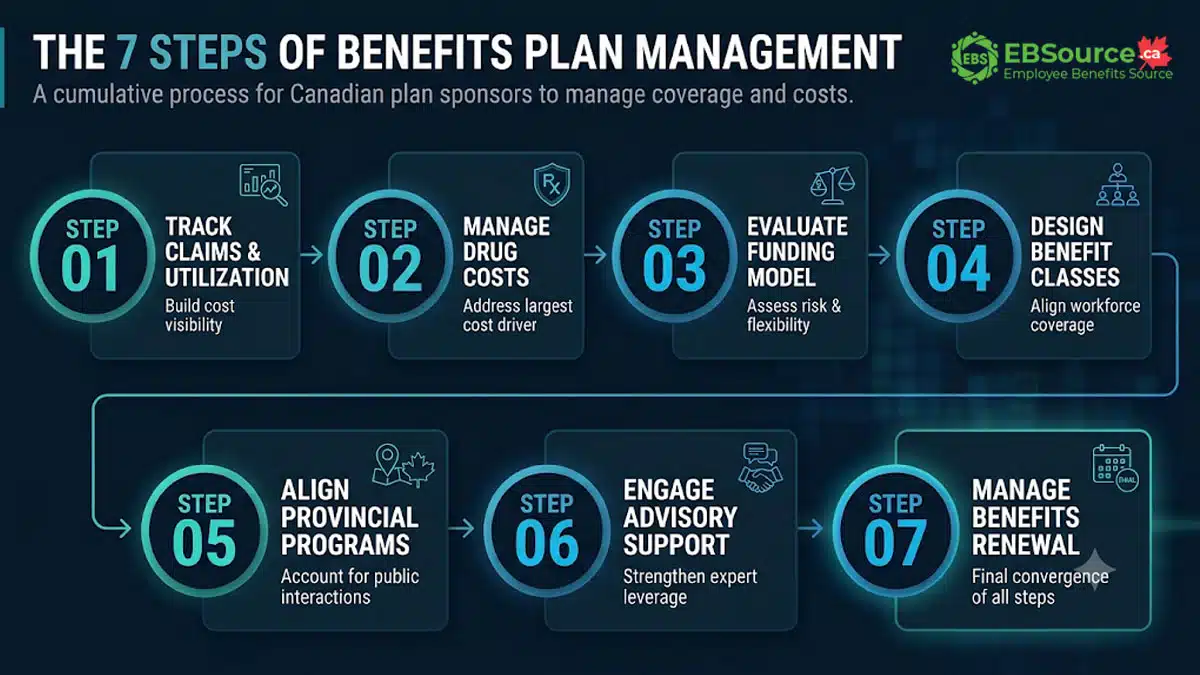
Step 1 – Build Cost Visibility Through Claims and Utilization Review: Understanding where plan dollars are going is the foundation for every management decision that follows.
Step 2 – Address the Largest Cost Driver: Prescription Drug Costs: Drug claims can represent a significant share of group health plan spending, making prescription coverage an important area for ongoing cost monitoring.
Step 3 – Evaluate Whether Your Funding Model Still Fits: The funding model determines how premiums are calculated, who absorbs claims volatility, and how much data visibility and flexibility the employer has.
Step 4 – Align Benefit Class Design With Coverage and Cost Objectives: Benefit classes define who qualifies for which coverage and how cost differences are distributed across the workforce.
Step 5 – Account for Provincial Program Interactions: Your private plan operates alongside provincial public drug programs that vary significantly across the country.
Step 6 – Engage Professional Advisory Support: Independent advisory expertise strengthens the employer’s position in renewal negotiations, ongoing plan reviews, and insurer comparisons.
Step 7 – Analyze and Manage the Benefits Renewal: The renewal is where the preceding six steps converge into a single consequential decision. Reviewing the factors behind renewal increases helps employers identify cost pressures and determine appropriate responses for better plan management.
The steps below focus primarily on financial performance because these are the areas where most management decisions concentrate. However, it is part of the whole picture; employers should also monitor enrolment accuracy, coverage changes, employee communications, and unresolved administration issues.
This guide serves as a starting point for Canadian employers, HR professionals, business owners, and finance leaders who want to understand and improve how their group benefits plans are managed. Each section introduces a key management responsibility and highlights what employers should consider.
Step 1: Build Cost Visibility Through Claims and Utilization Review
Strategic Action: Establish a regular claims monitoring schedule, with at least a mid-year review and a pre-renewal review, to track spending patterns, monitor changes in utilization, and identify emerging cost trends that may require attention or adjustments to the benefits plan.
Goal: Develop enough familiarity with your own data that you can identify cost drivers early, evaluate insurer proposals accurately, and make decisions about potential plan adjustments based on the factors actually driving costs.
Your benefits plan generates claims data continuously. That data tells a story about how the plan is being used, where spending concentrates, and whether emerging trends are likely to affect your next renewal.
When reviewing claims data, employers should focus on the patterns that help explain where benefits spending is concentrated and how utilization is changing. Key areas to monitor include:
- Benefit category breakdown: How total spending is distributed across drug, dental, extended health, vision, paramedical, and other categories.
- High-cost claimant analysis: Understanding whether a small portion of claims is driving a large share of total costs.
- Utilization trends: Whether claim volume is increasing, average cost per claim is rising, or both.
- Drug-specific reporting: Which medications generate the most spend; brand-name vs. generic share; individual drug cost changes.
- Plan usage patterns: Review how claims vary across coverage categories and employee classes to spot broader trends.
In addition, rather than relying on a single reporting period, employers should compare results over time to identify sustained changes and distinguish emerging trends from short-term fluctuations.
There are two review points per year that work well for most employers:
- Mid-year review (6 months before the anniversary date): Request interim claims data. Identify trends early enough to evaluate options before the renewal deadline. Flag any emerging high-cost situations.
- Renewal review (when the renewal proposal arrives): Compare the insurer’s projections against your actual data. Assess whether the pricing reflects your experience. Identify specific components to negotiate or adjust.
Step 2: Review Prescription Drug Costs and Coverage Controls
Strategic Action: Review the plan’s drug formulary, generic substitution rules, and cost-sharing provisions to identify whether the current arrangements remain appropriate for managing spending while maintaining access to necessary prescription coverage.
Goal: Bring drug cost growth under active management by monitoring the three main areas that control costs at different points in the claims process: which drugs are covered, which version is reimbursed, and how costs are shared.
Prescription drugs represent a major cost category in most Canadian group health plans (Source). When reviewing prescription drug spending, employers should consider the three main areas for ongoing review:
1. Drug formulary and coverage policies
Review how your plan determines which prescription medications are eligible for reimbursement and whether its current approach remains appropriate as new treatments become available.
When reviewing an existing formulary, employers should focus on whether the current rules still reflect the plan’s spending patterns and coverage objectives.
For a closer look at the available approaches, see Managed Drug Formulary vs. Open Formulary in Canada.
2. Generic substitution policies
Consider how your plan handles generic alternatives when equivalent medications are available. Changes in the availability and pricing of generic drugs may create opportunities to review prescription reimbursement practices.
Learn more in Mandatory Generic Substitution and Employee Benefits Cost Savings.
3. Dispensing fees and employee cost-sharing
Review how prescription dispensing fees and employee cost-sharing contribute to the overall cost of drug claims. These provisions can influence the amount reimbursed by the plan and the portion paid by employees.
To understand the available approaches and their implications, see Dispensing Fee Caps and Coinsurance in Canadian Group Benefits Plans.
Which Areas Should Employers Review First?
The right starting point depends on the plan’s current provisions and claims experience. Rather than assuming one measure will deliver the greatest savings, employers should identify where the available data points to the most significant cost pressure.
- If your plan uses an open formulary with limited drug evaluation or cost-management controls, review whether its current coverage approach remains appropriate for the group’s spending patterns and coverage needs.
- If the plan already has a managed formulary but does not encourage or require generic substitution where appropriate, review how generic alternatives are handled and whether current reimbursement practices remain suitable.
- If both are in place, examine dispensing fees and employee cost-sharing to understand their contribution to overall drug spending and out-of-pocket costs.
- If all three provisions are active, monitor whether they continue to reflect current market conditions, including changes in drug availability, pricing, and generic approvals.
At the end of this review, employers should know which drug plan provisions to revisit first and what coverage trade-offs each change would involve.
Step 3: Evaluate Whether Your Funding Model Still Fits
Strategic Action: Evaluate whether the plan’s current funding structure still aligns with the organization’s financial capacity, risk tolerance, and need for claims visibility.
Goal: Maintain a funding model that provides the right balance of cost predictability, financial transparency, and flexibility for the employer’s current circumstances.
The funding model is the financial architecture underneath your plan. It determines how premiums are calculated, who absorbs the impact when claims deviate from expectations, how much visibility you have into where the money goes, and how much flexibility you have to adjust the plan.
When reviewing an existing benefits arrangement, employers should consider how its funding structure affects three main areas:
- Cost predictability: Understand how consistently benefits expenses can be budgeted and whether monthly costs may fluctuate with claims activity.
- Financial risk: Consider how unexpected or unusually high claims may affect the organization’s financial obligations and what protection is available.
- Plan oversight and administration: Assess the level of claims information available to the employer and the resources required to monitor expenses and coordinate plan administration.
That said, an arrangement that worked well when the plan was first established may need to be reviewed as the organization’s financial circumstances and management needs evolve.
Several situations should prompt a funding model reassessment:
- The group has grown significantly, which can provide more stable claims patterns. In this situation, however, employers should also evaluate cash-flow capacity, stop-loss protection, administrative costs, and ability to manage a high-claims year.
- The employer has developed stronger internal capacity to monitor and manage plan data.
- The plan has been experience-rated with consistently favourable claims for several consecutive years.
- The employer is seeking greater transparency into where plan dollars are being spent, particularly to support the drug cost, class design, and claims monitoring activities described elsewhere in this guide.
Employers considering whether their current arrangement remains appropriate can explore the differences between ASO vs. Fully Insured Group Benefits in Canada.
Step 4: Align Benefit Class Design With Coverage and Cost Objectives
Strategic Action: Review the plan’s benefit class structure to assess whether differences in coverage levels, eligibility rules, and workforce composition are contributing to changes in claims costs, utilization, or pricing.
Goal: Ensure the class structure serves its intended purposes: differentiating total compensation, managing plan costs, and defining eligibility, while remaining aligned with current workforce demographics and insurer pricing requirements.
Benefit classes allow employers to provide different levels of coverage to different groups of employees. However, these differences can also affect how benefit costs are distributed across the workforce.
Three areas can help employers assess how their current benefit classes affect plan costs in plan management:
- Claims experience by class. Review whether certain employee groups account for a larger share of claims or have experienced significant changes in utilization. This can help employers identify where spending is concentrated and whether the pattern is consistent over time.
- Coverage differences between classes. Consider whether variations in coverage levels, maximums, and coinsurance are contributing to differences in claims spending. This helps employers understand how existing coverage arrangements influence overall plan costs.
- Changes in workforce composition. Employee turnover, promotions, changes in employment status, and shifts in the demographic profile of a class can affect its claims experience. Employers should consider whether these changes help explain fluctuations in plan spending.
For detailed guidance on class definitions, common structures, insurer pricing, and how to design or revise benefit classes, see How to Design Employee Benefit Classes in a Canadian Group Insurance Plan.
Step 5: Consider Provincial Requirements When Managing Benefits Plans
Strategic Action: Assess how provincial public drug programs interact with your group plan to identify potential coverage gaps, overlaps, and cost implications
Goal: Prevent coverage gaps, unnecessary duplication, and unexpected costs that arise when employers assume the same public coverage applies to employees across all provinces.
Your group benefits plan operates alongside provincial public drug programs and regulatory requirements, not instead of them. This distinction matters because assumptions about what “the government covers” are among the most common sources of coverage gaps, unnecessary duplication, and unexpected plan costs.
Employers, therefore, should verify the applicable program, employee eligibility, payer order, and covered medications before assuming that public coverage will reduce private plan costs. Particularly, Québec’s mandatory prescription drug insurance requirements and Alberta’s current coordination rules require further attention.
How Do Provincial Drug Programs Affect Coverage and Costs?
Provincial public drug programs can influence which expenses are covered by a private group plan, how much employees pay out of pocket, and where additional private coverage may be needed. The main differences include:
| Jurisdiction | Program / Requirement | What Employers Should Verify |
| Ontario | Ontario Trillium Drug Program | Eligibility, deductible, eligible drugs and interaction with existing private coverage (Source) |
| Alberta | Alberta Non-Group Coverage | Eligibility, premiums, prescription co-payments and the private-first coordination rules effective October 1, 2026 (Source) |
| British Columbia | BC Fair PharmaCare | Income-based deductible, family maximum and coverage coordination (Source) |
| Québec | Québec Mandatory prescription drug insurance | Private plan participation requirements, minimum coverage and applicable exceptions (Source) |
| Applicable participating jurisdictions | National pharmacare arrangements | Whether eligible contraception or diabetes medications and supplies are covered through a participating public program |
These programs have different scopes and eligibility criteria. Employers should not assume that all employees or their dependants automatically qualify for these programs.
An employee who relocates from one province to another may experience a meaningful change in their combined public and private coverage, even if your group plan has not changed at all. For employers, this can affect employee out-of-pocket costs, coverage coordination, and questions about whether the current plan continues to meet workforce needs.
Step 6: Engage Professional Advisory Support
Strategic Action: Identify the specific points in the plan’s lifecycle where independent advisory support will produce the most value, and understand how the advisor’s compensation structure may influence the recommendations you receive.
Goal: Secure professional support that strengthens the employer’s position in renewal negotiations, ongoing plan reviews, and insurer comparisons.
A benefits advisor can provide support at several points in the plan lifecycle, particularly when employers need to assess costs, respond to changes, or make decisions that affect long-term affordability.
- Reviewing renewal increases
- Monitoring plan costs and claims experience
- Comparing insurer proposals
- Reviewing the plan when business needs change
- Managing ongoing plan administration
Signals That You May Need Advisory Support
Certain situations create urgency around advisor engagement:
- A material renewal increase that cannot be explained by the available claims experience or pricing assumptions.
- You are considering a funding model transition.
- Your plan has not received a complete independent review despite meaningful changes in workforce size, coverage needs, funding arrangements, or business operations.
- Your claims experience or benefits spending has changed significantly, but you are unsure which areas of the plan need attention.
- Your organization is expanding into additional provinces or facing more complex plan administration requirements.
Step 7: Analyze and Manage the Benefits Renewal
Strategic Action: Break the renewal proposal into its component parts, assess whether each component is supported by the underlying data, and identify which specific cost drivers offer management opportunities.
Goal: Move from a binary “accept or shop” renewal decision to a component-level analysis that enables targeted responses to the actual factors driving the increase.
For many employers, the renewal or annual review arrives as a single headline number, a percentage increase, and the decision appears binary: accept it or shop.
In practice, neither response addresses what is actually happening inside the renewal or funding review. Depending on the funding arrangement, a renewal or annual financial review may involve:
- Claims experience and the credibility assigned to that experience.
- Expected claims trends and utilization assumptions.
- Pooling or stop-loss charges, where applicable.
- Administrative expenses, commissions, taxes and other applicable charges.
- Changes in workforce demographics, covered lives or benefit provisions.
Understanding these components changes the conversation entirely. Instead of asking the insurer to “lower the rate,” you can pinpoint which component is driving the increase, assess whether the underlying data supports the calculation, and evaluate specific responses that address the actual cost driver.
What Can Employers Do When Renewal Costs Increase?
After reviewing the proposed renewal and identifying the main cost drivers, employers can determine which areas require further attention. Thus, the appropriate response depends on what is driving the increase and how much flexibility the plan offers. For example, employers may need to:
- Clarify the insurer’s renewal assumptions
- Assess whether the current plan provisions remain appropriate
- Compare alternative arrangements
- Plan for longer-term affordability
However, not every renewal increase should be addressed through plan changes. Employers should better consider the potential cost savings alongside employee coverage, financial risk, and the overall value of the benefits program.
For a more detailed process covering renewal analysis and potential plan adjustments, see our guide to How to Reduce an Employee Benefits Renewal Increase.
Where Should Employers Start With Benefits Plan Management?
The seven steps above are designed to build cumulatively, but you do not need to begin at Step 1.
The right entry point depends on where the most urgency or opportunity exists. The table below maps common starting situations to the step that addresses them most directly, and identifies the logical next move.
| Your Primary Concern | Start With | Then Move To |
| You don’t know where your plan dollars are going | Step 1 – Build cost visibility through claims and utilization review. | Step 2 – Drug costs are typically the largest category your data will reveal. |
| Drug costs are outpacing all other benefit categories | Step 2 – Identify which of the three drug management levers your plan is missing. | Step 1 – Build the ongoing monitoring that sustains drug cost management over time. |
| Your funding model may no longer fit your organization | Step 3 – Compare your current model against your group’s size, claims stability, and data needs. | Step 1 – Claims monitoring is essential under ASO and valuable during any funding transition. |
| Your benefit classes no longer reflect your workforce | Step 4 – Assess whether class definitions and coverage differences still align with current workforce demographics. | Step 1 – Class changes affect insurer pricing, so cost monitoring should follow any restructuring. |
| You have employees in multiple provinces | Step 5 – Verify public-private program interactions before making plan design changes. | Step 2 – Drug cost decisions are the area most affected by provincial program coordination. |
| You need independent professional guidance | Step 6 – Evaluate whether your current advisory relationship matches your needs. | A strong advisory relationship can support cost reviews, funding assessments, renewal decisions, and ongoing plan management. |
| A renewal increase that seems too high | Step 7 – Begin with the renewal analysis. | Step 1 – Build the ongoing monitoring that prevents renewal surprises in future years. |
Table matching common employee benefits management concerns with the most relevant starting step.
Choosing a starting point is only the first part of the process. Each review should produce findings that support a clear management decision
How Can Employers Turn Review Findings Into Action?
The following table gives employers a practical way to organize those findings, track what evidence supports them, and assign responsibility for follow-up. It is meant to keep plan management decisions visible across review cycles so that nothing falls behind.
| Review Finding | Evidence Required | Possible Action | Decision Owner |
| Drug spending increased beyond expectations | Aggregated drug-category claims trends | Review formulary and reimbursement rules | HR + advisor |
| Plan costs are volatile or hard to budget | Funding terms and financial exposure | Reassess funding arrangement | Finance |
| Workforce composition has shifted | Current class definitions and coverage rules | Review class structure | HR |
| Provincial coverage rules have changed | Applicable government program and plan terms | Confirm coordination and update employee communications | Benefits administrator |
| Renewal increase is not supported by claims data | Renewal exhibit and pricing assumptions | Request clarification or evaluate alternatives | Finance + advisor |
Table outlining employee benefits review findings, supporting evidence, possible management actions, and decision owners.
The findings and actions above are examples meant to illustrate how the log works in practice. They are not based on any specific plan analysis and should be adapted to each employer’s own claims experience, plan provisions, and priorities. This framework is an EBSource editorial tool, not a legal document or industry standard.