
Group Critical Illness Insurance in Canada: Coverage, Tax Treatment, and Coordination


Group critical illness insurance is a benefit provided by employers that pays a one-time lump-sum benefit following a covered diagnosis that meets the plan’s criteria. Its tax treatment depends on how the plan is set up. In many employer-sponsored plans, the employer’s share of the premium is treated as taxable income to the employee. However, if a lump-sum payment is not considered a wage-loss replacement benefit, it usually is not taxed as employment income.
To assess whether offering this insurance is advisable, this guide provides key information on covered conditions, tax implications, interactions with other employee benefits, eligibility, and more.
On this page
What is Group Critical Illness Insurance?
Group critical illness insurance is a benefit provided by an employer or organization that pays a one-time, tax-free lump sum when a covered member is diagnosed with a qualifying serious illness. It pays out a non-taxable lump sum if the policyholder is diagnosed with a life-altering condition.
The benefit is separate from other group plans, and the member can choose how to use the money. According to the CLHIA, over 2 million Canadians have critical illness insurance through individual or group plans.

What is Covered Under Group Critical Illness Insurance in Canada?
The illnesses covered by a group critical illness plan differ by insurer and contract, but many plans in Canada include cancer, heart attack, Alzheimer’s disease, and stroke as core covered conditions. In addition to these core illnesses, some group insurance plans offer coverage for conditions such as coronary artery bypass surgery, major organ transplants, kidney failure, and multiple sclerosis.
The total number of covered conditions depends on the employer’s chosen plan tier, as some insurers organize their offerings into tiers. Different plans may also include a wider list of illnesses, such as:
- Blindness
- Deafness
- Parkinson’s Disease
- Coma
- Paralysis
- Major organ failure (lung, liver, pancreas, kidney)
- Severe burns
- Aplastic anemia
- Occupational HIV infection
- Aortic surgery
- Heart valve replacement/repair
Important note: Please be aware that the list shown is a general example, not a promise of coverage. The conditions covered under an employer’s group critical illness plan are defined in the insurance contract. So, employees should understand the policy definitions of covered illnesses and any applicable limitations or exclusions.
Common Group Critical Illness Claim Conditions
There are two common conditions for CI claims that vary by plan. Many plans stipulate that the diagnosis must occur after the coverage effective date. Additionally, the insured may need to complete a survival period, typically 30 days in some group plans, before any benefits can be paid. Be sure to check your plan booklet for the specific rules that apply to your coverage.
How are Group Critical Illness Benefits Taxed in Canada?
In many employer-sponsored critical illness arrangements structured as group sickness or accident insurance plans, the employer-paid premium or contribution is generally considered a taxable benefit for the employee, except when it pertains to a periodic wage-loss replacement benefit.
When employers cover the premiums for group critical illness insurance, this amount must be reported as a taxable benefit on the employee’s T4 slip. Conversely, if employees pay their own premiums, such as through payroll deductions for optional CI coverage, those premiums are not tax-deductible and cannot be deducted on individual income tax returns.
The CI payout is usually a one-time lump sum payment and is typically not considered a wage-loss replacement. However, the tax treatment can differ depending on the plan’s design, which may include features such as a return-of-premium option or a trust structure. If you have any uncertainties, verify your plan’s tax information with the plan administrator or refer to the CRA technical guidance.
However, tax treatment can become more complicated when it comes to return-of-premium benefits. Canada Life points out that the CRA and Revenue Quebec have not provided clear guidance on how to tax these benefits, leaving it open to interpretation. This is especially important for individual policies, so employees with a return-of-premium feature should get professional tax advice.
Read more: Group Critical Illness Insurance vs Individual Policy: A Detailed Comparison for Canadians
How Group Critical Illness Insurance Fits with Other Benefits in Canada?
Group critical illness insurance addresses specific gaps left by provincial health care, disability insurance, and group health plans.
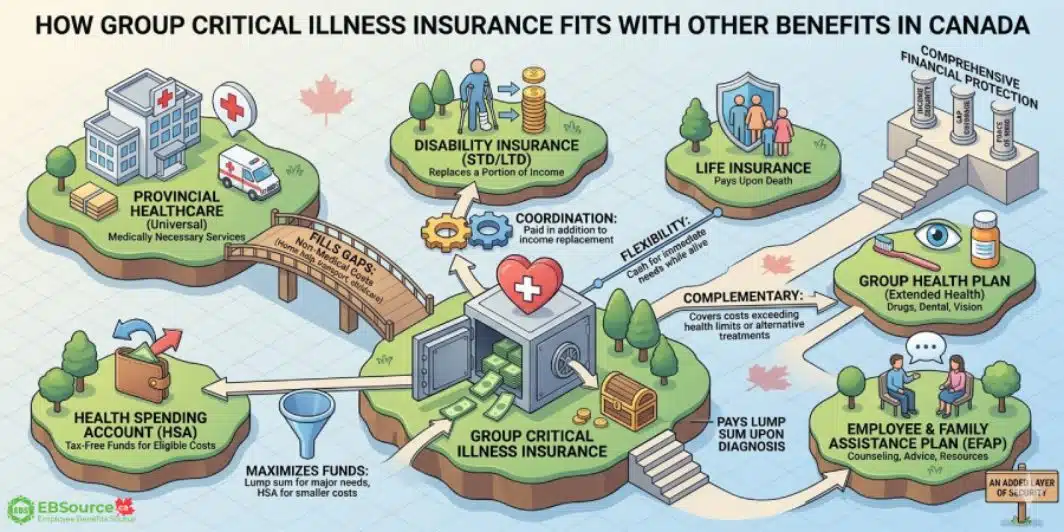
Here is how to coordinate with other employee benefits in Canada:
Provincial/Territorial Health Care and Group CI Insurance Coordination
Provincial and territorial health plans cover medically necessary hospital and physician services, but do not pay for lost income or non-medical costs that can arise during a serious illness. Group critical illness insurance helps fill this gap by providing a lump sum payment that can be used without restrictions.
Group Disability Insurance and Group CI Insurance Coordination
Commonly, group disability insurance provides a non-taxable monthly benefit to replace a portion of your income if you are unable to work, whereas group critical illness insurance provides a lump-sum payment upon a covered diagnosis. And, a critical illness diagnosis does not always result in a disability.
Some employees may return to work relatively quickly after treatment, but still encounter out-of-pocket expenses. In such cases, disability insurance may not provide any benefits, but group critical illness insurance would pay out, provided the diagnosis meets the plan’s criteria.
Group Health Plans and Group CI Insurance Coordination
Group health plans operate on a claims-and-receipts basis, while group critical illness insurance is not based on expenses. Instead, the CI benefit is paid in addition to any other benefits the plan member receives and can be used for various purposes, including paying off debt or funding alternative treatments that are not covered by the health plan.
Who is Eligible for Group Critical Illness Insurance?
Group critical illness insurance is commonly offered to employees enrolled in their employer’s group benefits plan, though eligibility criteria vary by plan. Many extended plans also offer optional coverage for spouses and dependent children.
Common requirements include the 5 following:
- Full-time employees: Generally eligible after a waiting period defined by the employer.
- Part-time employees: May qualify based on hours worked and the plan’s specific rules.
- Spouses: Some plans offer coverage for a spouse, typically at the employee’s expense.
- Dependent children: Many plans provide coverage for dependent children, often including conditions that apply to children.
- New hire: Usually has a limited enrollment period with simplified underwriting requirements.
Again, coverage for family members varies by insurer, so employees should refer to their benefits booklet or contact their plan administrator for more details.
For example, the CFMWS critical illness plan, which is underwritten by iA Financial Group, provides coverage for members and their spouses for 25 specific conditions. Additionally, it covers children for six childhood-specific conditions and 22 adult conditions.
Is Group Critical Illness Insurance Worth It for Employers?
Offering group CI insurance benefits not only to employees but also to employers. The advantages for employers include improved recruitment, higher employee retention, increased productivity, reduced absenteeism, lower insurance premiums, enhanced employee morale, and the ability to customize coverage options.
Below are 7 key advantages for employers:
- Improved recruitment: The benefit makes hiring easier by differentiating the company as an employer of choice.
- Higher retention: Employees are less likely to leave when they know they have critical illness protection.
- Increased productivity: Ensures employees can focus solely on their work.
- Reduced absenteeism: Minimizes unplanned absences when health issues arise.
- Low premiums: Group buying power provides savings compared to individual plans.
- Employee morale: Employees perceive this benefit as an indication that the company cares about their well-being.
- Customization: Policies can be tailored to meet the company’s budget and workforce demographics.
Overall, group critical illness insurance is an affordable investment in employee wellness that positively impacts the employer’s bottom line.
Top Providers for Group Critical Illness Insurance in Canada
The critical illness insurance market in Canada is served by several major insurance companies and some smaller regional providers. Notable names include Sun Life, Manulife, RBC Insurance, Canada Life, and Desjardins Insurance. When employers are considering group plans for their workforce, it’s important for them to research which Canadian Employee Benefits Providers offer the best options tailored to their specific needs and situations.
Below are 5 of the leading group critical illness insurance providers in Canada that offer competitive plans and benefits:
Sun Life Financial
Sun Life Financial is one of the leading insurance providers in Canada, offering group critical illness coverage. They have over 150 years of experience in the Canadian market. Sun Life provides critical illness policies as part of comprehensive benefit packages for employers.
Manulife
Manulife is a major Canadian insurance company that offers group critical illness insurance. They have developed specialized expertise in critical illness products catered to Canadian businesses. Manulife works with employers across industries to design policies that meet their needs.
RBC Insurance
RBC Insurance, part of the Royal Bank of Canada, provides group critical illness plans. RBC Insurance leverages RBC’s financial strength and resources to offer robust protection for organizations purchasing coverage for their employees. They are a trusted source for group benefits.
Canada Life
Canada Life is a well-known insurance provider in Canada, offering critical illness coverage for employer groups. They bring together experience, innovation and customer service to create competitive critical illness products. Canada Life aims to make group critical illness insurance easy to understand and access.
Desjardins Insurance
Desjardins provides group critical illness products through the Desjardins Group, the leading cooperative financial group in Canada. They draw on this cooperative heritage to offer responsible critical illness insurance for employer groups seeking financial protection.
In addition to these major insurers, smaller regional companies may offer competitive group critical illness options for certain industries or geographic markets. Comparing multiple providers is crucial to finding the best value in group critical illness coverage for any employer and their workforce demographics.
Article Sources
FAQs about Group Critical Illness Insurance
Can I get group critical illness insurance as a self-employed individual?
Group critical illness insurance is usually offered by employers or organizations to their members or employees. As a self-employed individual, you may explore individual critical illness insurance policies available in the market.
Can I have both individual and group critical illness insurance policies?
Yes, it’s possible to have both individual and group critical illness insurance policies. However, it’s essential to review each policy’s terms and coverage to avoid duplication and ensure adequate protection.
Can I change my coverage amount after enrolling in a group critical illness insurance plan?
The ability to change coverage amount may depend on the insurer and the employer’s policy. Some plans may allow changes during the annual enrollment period or with qualifying life events.
Do insurers require medical underwriting for group critical illness insurance policies?
Group plans often provide a certain amount of coverage automatically, known as “guaranteed issue.” You may need to provide proof of good health if you apply late, increase your coverage, or request an amount above the plan’s automatic approval limit.
Is group critical illness insurance portable if I change jobs?
Group critical illness insurance is typically tied to employment. If you change jobs, you may lose access to the group policy. In such cases, consider converting to an individual policy or exploring new coverage options with your new employer.