
Group Insurance in Canada: Coverage Options and How to Set Up a Plan


Group insurance in Canada is an employer-sponsored plan that brings employees under a single contract, giving them access to benefits like health, dental, life, disability and other coverage that are often more affordable than individual plans.
As part of employee benefits, a group plan is typically designed to fill important gaps left by provincial health plans. Plans commonly combine group health insurance, dental and vision care, group life and AD&D, income replacement through short- and long-term disability insurance, and may also include group critical illness coverage.
For employers, setting up a group insurance plan requires seven key steps: assessing workforce needs, setting a sustainable budget, comparing providers, choosing coverage levels, enrolling employees, setting up payroll deductions, and managing the plan over time.
What is Group Insurance in Canada?
Group insurance is a master policy purchased by an employer from an insurer that covers all eligible employees at pooled group rates. The employer acts as the plan sponsor and holds the master contract, while each covered employee receives a certificate of coverage confirming their individual entitlements under the plan. Therefore, group insurance can reduce per-person costs and often simplifies medical underwriting for eligible base coverage.
How Group Insurance Works
The core mechanism behind group insurance is risk pooling. Rather than assessing each employee’s health individually, pricing is established for the group as a whole.

However, the rating method can vary by benefit, group size, and other factors, instead of being a single flat rate for everything. This pricing is based on the characteristics of the workforce, the coverage selected, and, where applicable, the group’s claims experience and pooling arrangements.
In other words, this spreads the cost of claims across all plan members and, generally, results in lower premiums per person compared to individual insurance policies.
In addition, unlike individual health or life insurance, most employees joining a group plan do not need to complete a medical exam or answer detailed health questionnaires. It’s important to note, however, that evidence of insurability may still be required for employees who enroll late, apply for optional benefits, or request coverage above the plan’s non-evidence maximum.
What Does a Group Insurance Plan Cover?
A standard Canadian group insurance plan bundles group health insurance, dental, vision, group life, AD&D, short-term and long-term disability, and critical illness coverage.
The specific combination and level of coverage vary by employer and plan design, but most plans include the following components:
Group Health Insurance
Group Health Insurance is the broadest and typically the most-used component of a group plan. It helps pay for health care expenses that provincial health plans generally do not cover, including prescription medications, hospital stays, and paramedical services such as physiotherapy and massage therapy. Group health coverage may also help with emergency ambulance transportation, medical equipment, and certain home care services. These coverages include:
- Prescription drug costs: Paying for prescription medications
- Hospital stays: Coverage for semi-private or private hospital room fees above what provincial plans cover
- Paramedical services: Services like physiotherapy, massage therapy, chiropractors, psychologists, and more
- Ambulance transportation: For emergency medical transport
- Medical equipment: Such as wheelchairs, hospital beds, braces, etc.
- Home care: Nursing care and supervision services at home
Dental Care
Dental coverage is commonly structured in tiers. For employers, the main plan-design considerations include which services are covered, reimbursement levels, and annual or lifetime maximums. Coverage can range from routine oral exams and cleanings to basic treatments, major restorative procedures, and orthodontic treatment.
A key part of your plan design is setting the reimbursement levels for these different categories. For example, you can choose to cover routine services at a higher percentage than major procedures or orthodontics.
Vision Care
Vision care benefits help employers provide coverage for routine eye care while reducing employees’ out-of-pocket costs for exams and corrective eyewear.
When designing a plan, employers should consider how claims are paid, as providers may offer direct billing or require employees to pay upfront and submit claims for reimbursement.
Common vision care coverage includes routine eye exams, prescription glasses, contact lenses, and laser eye surgery:
- Routine eye exams: Coverage for eye exams is often subject to frequency rules (for example, once every 12–24 months) and a maximum dollar amount, rather than being fully covered each year
- Prescription glasses and contact lenses: Instead of a specific reimbursement percentage, coverage is typically defined by a maximum dollar amount available to an employee over a set period (e.g., every 24 months)
- Corrective laser eye surgery: Some plans can be designed to contribute toward this procedure, usually up to a lifetime maximum
Group Life Insurance
Group life insurance pays a death benefit to the employee’s designated beneficiaries. The benefit is typically set as a flat dollar amount or as a multiple of the employee’s annual salary. Many plans include a basic employer-paid amount with the option for employees to purchase additional supplemental coverage at their own expense.
Accidental Death and Dismemberment (AD&D)
AD&D coverage pays an additional benefit if death or a specified injury, such as the loss of a limb or eyesight, results from an accident. It is usually bundled with the group life insurance component and does not replace it.
Group Disability Insurance
Group disability insurance is vital for protecting an employee’s income during periods when they can’t work due to illness or injury. Group disability insurance protects an employee’s income through two primary forms of coverage designed for both short-term and long-term needs:
- Short-Term Disability (STD): STD coverage replaces a portion of an employee’s income during a temporary illness or injury that prevents them from working. The length of the benefit period is structured to coordinate with other income sources, like Employment Insurance (EI) sickness benefits.
- Long-Term Disability (LTD): LTD coverage begins after the short-term disability benefit period ends and replaces a portion of income. It is designed for more severe or prolonged disabilities, with a benefit period that can last for several years or until the employee reaches retirement age, depending on the contract.
Group Critical Illness (CI)
Group critical illness coverage pays a one-time lump-sum benefit upon diagnosis of a covered condition, such as cancer, heart attack, or stroke. Not all group plans include critical illness coverage; it is typically offered as an optional enhancement that adds to the overall plan cost.
Which Coverages Drive Employee Satisfaction vs. Which Drive Employer Cost
Not every benefit has the same impact on employee satisfaction or plan costs. Some coverages are highly visible because employees use them regularly, while others become most valuable when a serious health or financial need arises. For employers, the challenge is to balance the benefits employees value with the costs and risks associated with providing them.
A useful way to assess a benefits plan is to consider each coverage across two dimensions: employee value and employer cost. Specifically, each coverage line sits somewhere on two axes: how much employees value it (based on visibility, frequency of use, and emotional importance) and how much it costs you (based on claims volume, trend rate, and volatility).
The matrix below maps the five core coverage categories:
| Coverage Line | Employee Satisfaction | Employer Cost Impact | Strategic Role |
| Prescription Drugs | High. Used monthly and financially visible to employees | Highest. Drug costs can be a significant part of extended health spending and are exposed to drug-cost trends | Protect & Manage. Employees value it deeply, so the focus should be on smart plan design to manage cost escalation, which is a primary risk for many plans. |
| Dental | High. Routine visits and used particularly by employees with families | Moderate. Generally more predictable than drug costs. Dental costs are influenced partly by provincial fee-guide changes | High Value & Appreciation. Predictable cost, high employee appreciation. Because of its popularity, reductions in dental coverage can generate significant employee dissatisfaction. |
| Mental Health & Paramedical | High and rising. Now often seen as a hiring differentiator. | Low to Moderate. Plan maximums can help limit employer exposure | Growth Opportunity. Can be a relatively low-cost way to send a strong signal about company culture and support for retention. |
| Life Insurance & AD&D | Low. Value becomes clear when significant events occur | Low. Generally lower relative cost than health and disability coverage | Maintain Baseline. A standard of 1x or 2x salary coverage is a common approach, allowing budget for more visible coverages. |
| Long-Term Disability | Low. Employees may not think about it until they need it | High Risk. For smaller groups especially, a single claim can significantly impact renewal rates. | Get It Right Structurally. Focus on proper elimination period, benefit %, own-occupation definition, and correct premium payer. |
Important Note: The matrix above is a framework for decision-making, not a universal guide. The cost and value of each benefit will vary by workforce, plan design, insurer, and claims experience. Therefore, the right balance will depend on the employer’s workforce, budget, claims experience, and recruitment and retention priorities.
Decision Framework: Where to Invest When Budget Is Limited
If your business budget is limited and you have to prioritize, invest first in drug and dental, then structure LTD carefully, raise mental health and paramedical maximums where possible, and treat life/AD&D and vision as the flexible layer based on remaining budget.
Follow the priority sequence below:
Priority 1: Prescription Drug and Dental
For many employers, these are the cornerstones of a competitive plan. They are highly valued by employees because they are used regularly and generate direct out-of-pocket savings. The employer should manage drug costs through plan design (generic substitution, formulary management, dispensing fee caps), not by reducing coverage levels.
Priority 2: LTD Structure
LTD may receive less attention from employees because its value is difficult to appreciate until it is needed, but it can have a significant financial impact on a benefits plan.
Employers should focus on getting the design right rather than simply increasing the benefit amount: proper elimination period, appropriate benefit percentage, employee-paid premiums for tax efficiency.
Priority 3: Mental Health and Paramedical Maximums
To illustrate the rising demand, Medavie Blue Cross reported that claims spend for mental-health practitioners grew by more than 20% annually over the three previous years. (Source)
Rather than automatically increasing every practitioner maximum, employers should consider targeted changes based on utilization. For example, increasing psychology maximum from $500 to $2,000-$3,000 per year costs relatively little but signals that your workplace takes employee wellbeing seriously. This is increasingly a hiring differentiator in white-collar and technology sectors.
Priority 4: Life/AD&D and Vision
Life insurance, AD&D, and vision remain important parts of a well-rounded benefits plan, even though they may have less impact on day-to-day employee satisfaction.
When working within a fixed budget, employers can treat these as the flex layer you adjust based on remaining budget. Review whether current coverage levels match the needs of their workforce before adding enhancements.
How to Set Up a Group Insurance Plan in Canada
To set up a group insurance plan, you need to follow seven key steps. You’ll start by assessing your workforce needs and setting a sustainable budget, then move on to comparing providers and choosing the right coverage. Once you’ve selected a plan, the next steps are guiding employees through enrollment and setting up payroll deductions. The final step is ongoing plan management to keep employee information current, maintain coverage records, and handle day-to-day administration.
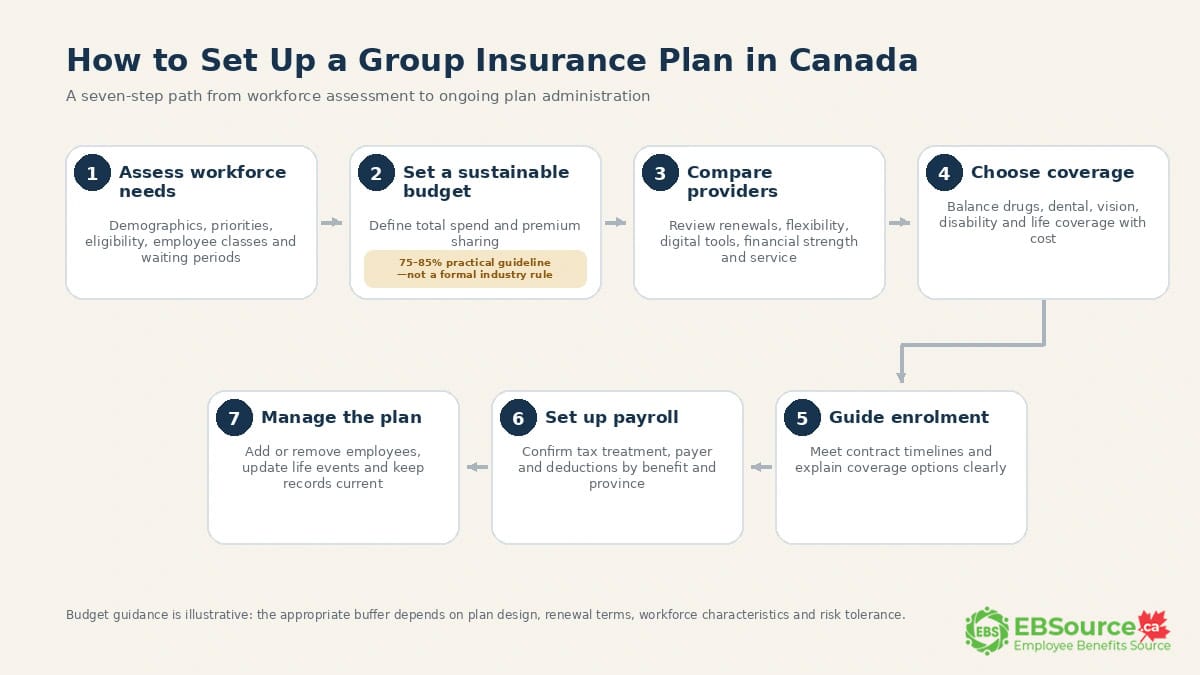
The following steps outline how employers can build a group insurance plan:
Step 1: Assess Workforce Needs
The first step is to understand the unique composition of your workforce. Rather than copying what another company offers, build a plan that reflects the specific demographics, life stages, and priorities of your own employees.
Consider the differences in your team’s needs:
- A team of young, single professionals might prioritize robust mental health support, flexible wellness spending accounts (for gym memberships, meditation apps, etc.), and vision care.
- A workforce with many established families may be more focused on comprehensive prescription drug coverage, orthodontics for dependents, and strong long-term disability insurance.
- An older, more tenured workforce might place the highest value on paramedical services (like physiotherapy and massage), critical illness coverage, and extensive drug benefits.
At this stage, also identify your intended eligibility rules, employee classes, waiting periods and whether employees will be required to participate in particular benefits. These decisions can affect both plan cost and administration in later steps.
Step 2: Establish a Clear and Sustainable Budget
Set your budget from the start by defining not only how much your organization can spend each year, but also how the cost of the plan will be shared between the employer and employees. Key factors to consider include:
- Total Spend: What is the maximum your organization is prepared to invest annually?
- Premium Sharing: How will the cost be split between the employer and the employees? A common model is a 50/50 split, but you can choose any structure, such as the employer covering 100% of the premium for the employee and having the employee pay for dependent coverage.
A Recommended Guideline for Long-Term Stability
A frequent error first-time plan sponsors make is building a budget that perfectly fits Year 1, leaving no room for renewal increases.
To build a more sustainable plan, consider adopting a strategic budgeting guideline. A common approach is designing the initial plan to cost roughly 75% to 85% of the company’s true maximum affordable budget. This buffer helps you absorb normal renewal increases over the next few years without making immediate cuts to coverage. However, this isn’t a formal industry rule, but rather a practical guideline that creates a financial buffer; the appropriate buffer depends on plan design, renewal terms, workforce characteristics, and risk tolerance.
For example, if a company can comfortably afford up to $6,000 per employee annually, a budget using 75% to 85% of that maximum would mean launching a plan closer to $4,800-$5,100 per employee in Year 1. This approach still allows for meaningful coverage through smart design choices (like reasonable maximums and appropriate co-insurance levels) while helping keep the plan sustainable over time.
Here is a look at how this budgeting guideline might play out:
- Year 1: Launch the plan below the maximum available budget to create long-term flexibility.
- Year 2: A typical renewal increase may be absorbed by the buffer you created, often without needing major plan changes.
- Year 3: Depending on claims trends and the size of the renewal increase, you may consider modest plan adjustments or introduce cost-management tools like a managed drug formulary.
- Year 4 and Beyond: With several years of claims data available, you can make more informed, data-driven decisions about where to invest in coverage and where to control costs.
Step 3: Compare Providers
With your team’s needs and budget in mind, employers can work with an advisor who has experience with groups of similar size and who maintains relationships with multiple major Canadian group insurers.
When comparing carrier quotes, evaluate each provider against these criteria beyond the first-year premium.
- Renewal history over the past three to five years for similar-sized groups
- Contract flexibility to accommodate mid-term plan design changes
- Digital tools for enrolment, claims submission, and plan sponsor reporting
- Financial strength ratings from agencies such as AM Best or DBRS Morningstar
- Dedicated service and support model for both plan sponsors and plan members
Comparing providers on these factors, rather than focusing only on the lowest premium, can help you choose a group insurance provider for your team that offers an appropriate balance of cost, coverage, flexibility, and service.
Step 4: Choose Specific Offerings
This is where you work with your chosen provider or a benefits advisor to build the actual plan. You will be making specific choices about what to include, balancing complete coverage with your budget.
You will decide on the coverage levels for essential benefits like prescription drugs, dental care, and vision, as well as safety-net coverage like disability insurance (to protect employee income) and life insurance (to support their families).
The goal is not to include every available benefit. It is to build a plan with coverage levels and cost-sharing arrangements that are appropriate for the workforce and sustainable for the business.
Step 5: Guide Your Team Through Enrollment
Once the plan is designed, you must enroll eligible employees within the specific timelines set by your group insurance contract.
You need to make this process as simple and clear as possible by providing easy-to-read summaries of the benefits and explaining the different coverage options. A smooth enrollment process ensures your team understands and values their new benefits.
Step 6: Set Up Payroll Deductions
Before configuring payroll, it is critical to work with your payroll department or provider to confirm the tax treatment for each benefit and who pays for it. This step is critical because the tax rules for employer-paid premiums are not the same for all benefits or in all provinces.
For example, employer contributions to health and dental plans are generally a non-taxable benefit for employees outside of Québec, but are treated as a taxable benefit for employees in Québec. Other benefits like life and disability insurance have their own distinct rules.
Getting the deductions right from the beginning matters because if they aren’t set up correctly, employees will see different amounts coming off their paychecks than what they were expecting, which creates confusion and frustration. Just as important, your insurer needs to receive the full premium payment on time every month to keep everyone’s coverage active without interruption.
Step 7: Policy Management
Once your plan is active, it requires regular administration to keep pace with workforce changes. Your insurer will provide access to an online portal where you can manage these updates throughout the year. This involves routine tasks like:
- Adding new employees to the plan.
- Removing employees who have left the company.
- Updating an employee’s coverage after a major life event, such as a marriage or the birth of a child.
Staying on top of these administrative tasks ensures your plan remains accurate and continues to run smoothly for your entire team.
Common Mistakes When Setting Up Group Insurance and How to Fix Them
An effective group benefits plan is a powerful tool for attracting and retaining talent. However, its value can be quickly undermined by entirely avoidable mistakes. From offering benefits that are too expensive to sustain to making tax and eligibility errors to overlooking province-specific compliance rules, these issues can lead to higher renewal costs, employee dissatisfaction, and administrative problems over time.
The following are four of the most common and costly mistakes Canadian employers make:
Mistake #1: Launching a Plan That’s Too Generous to Sustain
It often starts with the best of intentions: an employer wants to make a great impression by rolling out the richest benefits plan they can afford.
However, group insurance costs can rise at renewal due to claims experience, drug and dental trends, demographics, plan design, and insurer pricing. A plan that is already at the top of the budget can quickly become unsustainable.
When this happens, the employer faces a painful choice: absorb a massive cost increase or cut benefits. Employees almost always see a reduction in benefits as a direct takeaway from their compensation. The damage to morale is often far greater than if the company had started with a more modest, sustainable plan and gradually introduced improvements.
How to fix: Design a plan you can comfortably afford through at least two or three renewal cycles before adding major enhancements and a budget that can absorb reasonable renewal volatility.
Mistake #2: The Tax Trap of Employer-Paid Disability Premiums
This is one of the most common and financially devastating structural errors in a benefits plan. The mistake happens when an employer, wanting to be generous, pays the premium for an employee’s Long-Term Disability (LTD) insurance.
According to the Canada Revenue Agency (CRA), if an employer pays any portion of the LTD premium, the disability benefit becomes taxable income for the employee. For an employee on claim, this can reduce their monthly income by thousands of dollars right when they are most vulnerable. If the employee pays 100% of the premium, the benefit is received completely tax-free.
How to fix: The simplest way to avoid this tax trap is to have employees pay 100% of the Long-Term Disability premium. If you choose this path, it’s important to review whether an employee-pay-all arrangement makes sense and document the decision to ensure your payroll is set up correctly from the beginning.
Mistake #3: Covering Ineligible Members
It is surprisingly common for employers to pay premiums for people who are no longer eligible for coverage. This often includes over-age dependents who are no longer students, ex-spouses who were not removed after a divorce, or employees who have dropped below the minimum hours required for eligibility.
This wastes money in two ways: you are paying premiums for non-existent coverage, and any claims made by these ineligible members will artificially inflate your plan’s usage data. This inflated data then leads to a higher rate increase at your next renewal, costing the company even more.
How to fix: Conduct an eligibility audit at least once a year to remove ineligible members and prevent paying unnecessary premiums.
Mistake #4: Failing to Comply with Québec’s Unique Drug Insurance Rules
Employers headquartered outside Québec often make this mistake when hiring their first employees in the province.
For Québec residents under age 65, prescription drug insurance is mandatory. If an employee has access to a private plan, they generally must be covered by a private plan rather than the RAMQ public plan (Source). This private coverage may be available through their employer, spouse, or another eligible source. Spouses and children must also have private coverage unless they are already covered by another private plan.
Failure to enforce this can have financial consequences for the employee, who may be required to pay the annual RAMQ premium without being able to receive benefits from the public plan.
How to fix: Confirm each person’s actual coverage before treating enrollment in your company’s plan as mandatory. Make drug plan enrollment mandatory for all eligible Quebec-based employees and their dependents, as required by provincial law.
Managing and Renewing Your Group Insurance Plan
Getting your group insurance plan up and running is just the beginning. From that point forward, you’ll need to manage it actively: handling annual renewals, tracking how your employees use their benefits, and making adjustments as your business changes. The decisions you make at each renewal usually have a bigger impact on both your costs and employee satisfaction than your original plan design did.
Most group insurance policies renew once a year. When your renewal comes up, your insurer takes a close look at how much your group claimed over the past year. They’ll also consider any shifts in your workforce, whether your team is getting older, whether you’ve hired new people and added their families, and other demographic changes. On top of that, they factor in broader market trends, particularly rising drug costs, to arrive at your new premium rate.
Your renewal package typically arrives several weeks before your renewal date. This is your opportunity to review the proposed rates carefully with your benefits advisor. It is crucial to check the contract and renewal notice for the response deadline, as the terms will specify what happens if the employer does not formally accept or decline the offer by that date.
Employers can often make plan adjustments at renewal without cancelling the existing policy and starting over. Common adjustments include changing co-insurance levels, adding or removing coverage types, introducing new employee classes, adjusting annual benefit maximums, or layering a Health Spending Account on top of the insured plan for additional flexibility.
The Renewal Playbook: Exact Steps from 90 Days Out to Signing
Most employers experience renewal as a surprise: the insurer sends a number, the employer does not know whether it is reasonable, and the renewal is accepted by default. A more strategic approach involves following a structured timeline with specific milestones and decision points.
The playbook below gives you a concrete timeline with specific actions, benchmarks, and decision points:
| Milestone | Timing | Core Action | Deliverable |
| Phase 1: Gather Data | Day 90 | Request claims experience, census, and pooling reports | Complete data package for analysis |
| Phase 2: Analyze Renewal | Day 60 | Receive and deconstruct the renewal offer by coverage line | Line-by-line variance analysis against current plan costs and claims experience |
| Phase 3: Decide Path | Day 45 | Accept, negotiate, or market | Clear strategic direction with supporting data |
| Phase 4: Evaluate & Finalize | Day 30 | Compare alternatives (if marketed); lock in terms | Signed agreement or confirmed renewal |
| Phase 5: Communicate | Day 15 | Inform employees of any changes | One-page employee summary |
| Phase 6: Verify | Day 0 | Confirm census, enrollment, and plan design in insurer system | Clean policy start |
The timeline above outlines when to start, review, and finalize the renewal. Before making a decision, employers should look more closely at the proposed increase, claims experience, and plan design.