


Benefit Type Selection
EI Economic Region
Average Insurable Weekly Earnings
Insurable Hours in Your Qualifying Period
Eligibility Condition
Your EI caregiving benefits
Sample scenario shown - Use your own numbers to get started!
- This is an estimate only. EI benefits are taxable; amounts shown are before tax.
- For new EI claims starting from March 30, 2025 through October 10, 2026, the usual one-week waiting period is temporarily waived. If your claim starts after October 10, 2026, check the current Service Canada rule. If you are sharing caregiving benefits, normally only one caregiver serves the waiting period when a waiting period applies.
Estimated breakdown of your EI caregiving benefits
Estimated breakdown of your EI caregiving benefits
| Regional unemployment rate | Toronto - 6.8% |
|---|---|
| Required insured hours | 600 hours in the last 52 weeks |
| Number of best weeks | 21 weeks |
| Weekly EI caregiving benefit amount |
$1,000.00 x 55% = $550.00 The maximum weekly benefit is $729. Since $550.00 is below this limit, you receive $550.00 per week. |
| Statutory maximum benefit pool | 35 weeks |
| Maximum gross estimate if you receive every available week | $550.00 x 35 = $19,250.00 |
Data sources: Regional unemployment rates and best-weeks divisors are based on Service Canada’s current EI Program Characteristics table. A notice of violation from a previous EI claim can increase the number of hours required. This calculator uses rules for claims beginning in 2026 and the EI regional data period shown below. It should not be used to recalculate an earlier claim. EI regional data period: September 6, 2026 to October 10, 2026. Last verified by EBSource: September 7, 2026.
If you have reduced your work hours or stopped working to care for a seriously ill family member, this calculator can estimate your weekly EI caregiving benefit and the maximum number of weeks available for the benefit type that applies to you.
However, qualifying for income support is a separate issue. Service Canada looks at four main things: your hours of insurable employment, your lower earnings, a medical certificate for the person you care for, and how you are related to that person.
You enter information from your medical certificate and work record; the calculator applies a 55% benefit rate, caps it at $729 per week, and then multiplies that by the number of weeks you can receive benefits.
Who May Need the EI Caregiving Benefits Calculator?
EBSource’s EI Caregiving Benefits Calculator can help employees estimate the income EI may replace while they are away from work providing care or support.
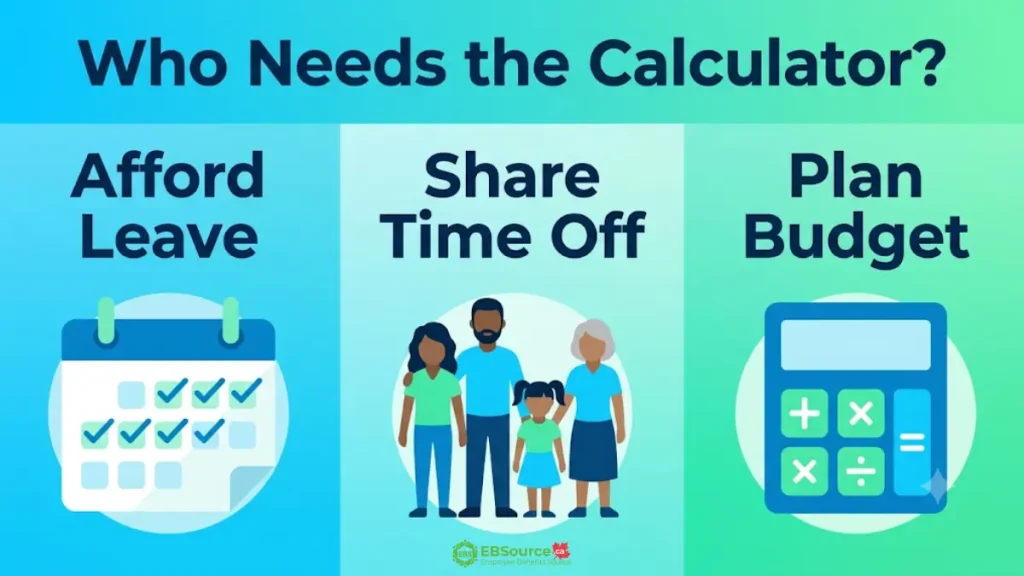
You can use the calculator in three ways:
- to check if they can afford the leave,
- to talk with family about sharing the time off, or
- to plan a budget after choosing a start date.
Remember that it is a planning tool and does not send your information to Service Canada.
When Do You Need Additional Eligibility or Documentation Checks?
Five situations that fall outside this scope are self-employment, living in Quebec, a medical certificate completed outside Canada, a care recipient who cannot give consent on their own behalf, and self-employed fishers.
Specifically, this tool does not account for:
- Self-employed claimants: Self-employed people use different eligibility rules. You generally need to have participated in the EI special benefits program for at least 12 months, earned at least $9,254 in net self-employment income in 2025 for a 2026 claim, and reduced the time spent working in your business by more than 40% for at least one week.
- Quebec residents: Caregiving benefits still come from the federal EI program. Quebec manages its own maternity, paternity, parental, and adoption benefits through the QPIP, and the lower Quebec premium rate reflects this instead of a smaller caregiving benefit.
- A certificate completed outside Canada: It may still be accepted if the signatory is authorized by that country’s appropriate governmental authority to practice as a medical doctor or nurse practitioner. You may still receive EI caregiving benefits while outside Canada if you otherwise meet the program requirements. If you permanently reside outside Canada, additional EI rules apply, including valid SIN and insurable employment requirements.
- A care recipient who cannot consent: Their legal representative completes the authorization and, where one is required, the attestation on their behalf.
- Self-employed fishers: Self-employed fishers use an earnings-based test rather than the employee 600-hour requirement. For EI caregiving benefits, the current qualifying threshold is at least $3,760 in fishing earnings during the qualifying period.
If you are self-employed, use a different eligibility test and a different benefit-rate calculation based on qualifying self-employment earnings rather than an employee’s regional best weeks. For a 2026 claim, a self-employed participant generally needs:
- at least $9,254 in 2025 net self-employment earnings,
- an EI self-employed agreement that has been active for at least 12 months, and
- a reduction of more than 40% in the time spent working in the business for at least one week.
How to Use the EBSource’s EI Caregiving Benefits Calculator
Before using the EI caregiving benefits tool, gather the following four pieces of information: the caregiving benefit your medical certificate supports, your province and economic region, your average insurable weekly earnings across your best weeks, and your insurable hours in your qualifying period.
| EI caregiving benefits calculator field | What you enter | Where to find it |
|---|---|---|
| Caregiving benefit | Family caregiver benefit for children, family caregiver benefit for adults, or compassionate care benefits | Your medical certificate, which sets both the condition certified and the care period |
| EI Economic Region | Your province or territory, then your economic region | The official postal code lookup, not the city name |
| Average Insurable Weekly Earnings | Total gross earnings in your best weeks ÷ the number of best weeks your region uses | Your Record of Employment or pay stubs, using gross pay |
| Insurable Hours | Total insurable hours in your applicable qualifying period | Your Record of Employment, including box 15A |
With those four details in hand, the EI caregiving benefits estimator runs in three steps. First, the calculator multiplies your average insurable weekly earnings by 55% to estimate your weekly benefit amount. It then applies the 2026 maximum of $729 per week. This produces a maximum gross estimate, not necessarily the amount you will actually receive.
Who Qualifies for EI Caregiving Benefits?
As an insurable employee, you generally need to meet the following requirements to qualify for EI caregiving benefits. Service Canada makes the final eligibility determination when it processes your claim.
It means that, to be eligible for EI caregiving benefits, you need to demonstrate the following:
- For an insurable employee, the standard entrance requirement is 600 hours of insurable employment in the applicable qualifying period. A classified violation on a previous EI claim can increase the number of hours required.
- Your regular weekly earnings have dropped by more than 40% for at least one week because you are taking time away to provide care.
- A medical doctor or nurse practitioner has certified the care recipient’s condition.
- You are a family member of the care recipient, or someone that person considers to be like family.
Can a Chronic Condition Support an EI Caregiving Claim?
For family caregiver benefits, a chronic condition by itself does not make a person “critically ill.” A chronic diagnosis alone does not automatically establish eligibility for family caregiver benefits. The medical practitioner must assess whether the required significant change from the person’s baseline health and the other certification conditions are met. Service Canada makes the final eligibility decision.
Compassionate care benefits use a different test: the person must have a serious medical condition with a significant risk of death within 26 weeks and require care or support from at least one caregiver.
When handling long-term conditions, doctors should focus on major changes from the person’s usual health rather than just how severe the condition is.
Which EI Caregiving Benefit Applies To Your Situation?
The care recipient’s condition and age determine which of the three EI caregiving benefits may apply. The medical certificate provides the evidence Service Canada uses to assess those requirements.
Compassionate care benefits cover end-of-life care and carry a pool of 26 weeks. The two family caregiver benefits cover critical illness or injury, where the care recipient’s age sets the pool at 35 weeks for a child under 18 and 15 weeks for an adult. Service Canada tests that age on the first day of the certified period. For the two Family Caregiver Benefits, an existing chronic condition generally requires a significant new change in the person’s baseline health. Note that Compassionate Care uses the separate end-of-life test described above.
Your pool of weeks is the single largest variable in your total, so settle this question before you run the Employment Insurance caregiving benefits calculator.
| What the certificate establishes | Age of the person receiving care | Weeks in the pool |
|---|---|---|
| Critically ill or injured | Under 18 on the first day of the certified period | 35 |
| Critically ill or injured | 18 or older on the first day of the certified period | 15 |
| A serious medical condition with a significant risk of death within 26 weeks, requiring care or support from at least one caregiver | Any age | 26 |
Key takeaway: Age separates the two family caregiver benefits. The required certification type separates both benefits from compassionate care. Service Canada publishes the certification requirements in its guidance for medical doctors and nurse practitioners, which is worth reading before the appointment, not after.
When Is the Care Recipient’s Age Tested for EI Caregiving Benefits?
The age is tested on the first day of the period the clinician sets out, not the day you apply and not the day the certificate is signed. The Employment Insurance Regulations define a critically ill child as someone under 18 on that first day, and a critically ill adult as someone 18 or older on the same day.
For example, Priya’s son Kian turns 18 on March 3, and his specialist certifies a care period that starts on February 25. Because Kian was under 18 on the first day of the certified period, the family caregiver benefit for children may provide up to 35 weeks rather than the 15-week maximum for an adult. At Priya’s rate of $550, the difference between the two statutory maximums amounts to $11,000 before accounting for her certified period, sharing, earnings, and taxes.
The takeaway: a single date on the certificate can move your pool by 20 weeks, so check that the first day of the certified period is recorded correctly before the form leaves the clinic.
Watch the appointment date: The certificate should accurately reflect the date on which the required medical conditions began. Do not ask a medical practitioner to use an inaccurate earlier date. It is a reason to make sure the certificate records the date care became necessary, because clinicians filling out an unfamiliar form sometimes default to the appointment date.
Source: EI caregiving benefits and leave – Government of Canada
How Do Caregivers Share EI Caregiving Benefit Weeks?
The weeks form one pool attached to the care recipient, and every eligible caregiver draws from it rather than receiving an allowance of their own. You can share them concurrently or in sequence.
Each caregiver files a separate application and is paid on their own insurable earnings, which is why two people drawing from the same pool can receive very different weekly amounts. Only one medical certificate is needed for the whole group, no matter how many of you intend to claim.
Normally, there is a one-week unpaid waiting period at the start of a claim, but under a temporary federal measure, the waiting period is waived for all new EI claims that start between March 30, 2025 and October 10, 2026. If your claim starts after that window closes (and the measure is not extended), budget for one unpaid week at the start.
No formal agreement has to be filed. Caregivers should agree on how to divide the available weeks before applying. If eligible caregivers cannot agree, Service Canada applies prescribed allocation rules. Remaining weeks are generally divided as equally as possible; if an extra week remains, it goes to the eligible caregiver who made their claim first. If fewer weeks remain than there are eligible caregivers, claim order determines who receives the remaining weeks.
What the EI Caregiving Benefits Calculator Does Not Account For
The EI caregiving benefits calculator stops at the statutory maximum, so five things still affect the amount you actually get. Three of these lower the total: the care period your certificate covers, any work you do while claiming, and the tax taken from each payment. One causes a delay because your first payment takes time to arrive. You may also have to pay it back if you get paid after your benefits end.
Each of the five works as follows:
- Your certified period: Service Canada sets your entitlement weeks and your start date from the medical certificate, not from the statutory maximum. If you need care longer, a second certificate can extend the period, but no caregiver or combination of caregivers is paid beyond the maximum weeks attached to that benefit type.
- Work you do while on claim: Under the Working While on Claim rules, you keep 50 cents of your benefit for every dollar you earn, up to 90% of the weekly earnings used to set your rate. Above that threshold, EI deducts your earnings dollar for dollar. The requirement that your earnings drop by more than 40% is a test for starting the claim, not one you have to meet each week.
- Tax withheld at source: EI benefits are taxable. The tax deducted from EI payments may not equal your final tax liability for the year because your tax return takes your total annual income and other tax factors into account. Use our income tax calculator if you want a closer view of the after-tax figure.
- The timing of your first payment: Service Canada aims to issue a first payment or notice that you are not eligible within 28 days after they receive your complete application. Plan your budget to cover that waiting time separately from the payment amount.
- Changes you do not report: Contact Service Canada if the person you are caring for no longer needs your care or support, or if you start working or earning money. Payments issued after your entitlement ends become an overpayment and are recovered from you.
Source: EI caregiving benefits and leave, after you apply – Government of Canada
How Much Will You Get From EI Caregiving Benefits Each Week?
For claims beginning on or after December 28, 2025, the basic EI caregiving benefit rate is 55% of average insurable weekly earnings, up to a maximum of $729 per week. That ceiling follows from the 2026 maximum insurable earnings of $68,900, which works out to roughly $1,325 a week. The $729 maximum weekly benefit rate applies to claims beginning on or after December 28, 2025. Claims beginning before December 28, 2025 remain subject to the maximum weekly rate that applied when the claim was established.
The table below shows how the rate and the three pools interact at four earnings levels:
| Average insurable weekly earnings | Weekly rate | Maximum over 15 weeks | Maximum over 26 weeks | Maximum over 35 weeks |
|---|---|---|---|---|
| $700 | $385 | $5,775 | $10,010 | $13,475 |
| $1,000 | $550 | $8,250 | $14,300 | $19,250 |
| $1,200 | $660 | $9,900 | $17,160 | $23,100 |
| $1,325 or more | $729 | $10,935 | $18,954 | $25,515 |
One rule that surprises many applicants is that your weekly rate is fixed once the claim is established. It does not rise if regional conditions change, and it does not adjust if you take higher-paying work later in the year. So it is important to get the best-weeks figure right when you start your claim.
How the Best-weeks Divisor Changes Your Average
The divisor is the number of highest-earning weeks Service Canada uses, and it is set by the unemployment rate in your economic region rather than by anything about your job. In regions with the highest unemployment, the EI caregiving benefits calculation uses the best 14 weeks, and in regions with the lowest unemployment, it uses the best 22 weeks.
| Regional rate of unemployment | Required best weeks |
|---|---|
| 6% or less | 22 |
| 6.1% to 7% | 21 |
| 7.1% to 8% | 20 |
| 8.1% to 9% | 19 |
| 9.1% to 10% | 18 |
| 10.1% to 11% | 17 |
| 11.1% to 12% | 16 |
| 12.1% to 13% | 15 |
| 13.1% or more | 14 |
A smaller divisor generally helps you, because it draws your average from fewer, higher-earning weeks. If your pay varies with overtime or commission, list each Sunday-to-Saturday week in your qualifying period by total insurable earnings and take the top ones; using an annual salary figure divided by 52 will usually understate your rate.
Can Your EI Caregiving Rate Be Higher Than 55%?
Yes, it can, if your household qualifies for the family supplement. You may qualify for the EI Family Supplement if your annual net family income is $25,921 or less, you have at least one child under 18, and you or your spouse receives the Canada Child Benefit. The supplement can increase the effective benefit rate from 55% to as much as 80% of average insurable weekly earnings, but the total weekly EI amount cannot exceed the applicable maximum.
While 80% is the highest possible supplement, it is not the typical amount you will get. The extra amount is largest for the lowest incomes and slowly decreases as family income gets closer to $25,921. So, if your household income is just under the limit, expect a small increase rather than a big jump from 55% to 80%.
You do not need to apply separately for the family supplement. Service Canada adds the supplement automatically using the tax information they already have. This shows why it is important to keep your tax returns up to date, especially if your income is close to the limit. Also, if both spouses are claiming EI at the same time, only one can get the supplement; usually, the one with the lower weekly rate benefits more.
Step-by-step Calculation Example of EI Caregiving Benefits
Bianca lives in London, Ontario, and has stopped working to care for her mother. Bianca’s 71-year-old mother has been hospitalized after a stroke. Assume her medical practitioner certifies that she is critically ill, that her baseline state of health has changed significantly, and that she requires care or support. Because she is 18 or older on the first day of the certified period, the applicable benefit is the Family Caregiver Benefit for Adults, with a statutory maximum of 15 weeks.
This example follows a single claim through the entire process to illustrate how the rules apply and how the initial figure is adjusted before it becomes a deposit.
What Bianca enters:
| Input | Her figure |
|---|---|
| Caregiving benefit | Family caregiver benefit for adults |
| Economic region | Ontario, EI economic region 30 (London), unemployment rate 8.7%, divisor 19 best weeks |
| Average insurable weekly earnings | $1,250, being $23,750 across her best 19 weeks ÷ 19 |
| Insurable hours | 780 insurable hours, which exceeds the standard 600-hour requirement. Assume Bianca does not have a classified prior EI violation that increases her entrance requirement. |
What the EI caregiving benefits calculator returns: 55% of $1,250 is $687.50, which rounds to $688. That sits below the $729 ceiling, so $688 is her weekly rate for the life of the claim. Across the full 15-week pool, the tool shows $10,320. No waiting week is deducted because her benefit period starts while the waiver is in force.
The steps outlined below use Service Canada’s EI regional rate period from September 6 to October 10, 2026:
- Determine the Divisor: The regional unemployment rate determines the number of best weeks used in the calculation. London is EI economic region 30. Its current regional unemployment rate is 8.7%, which means the EI benefit-rate calculation uses 19 best weeks. Bianca selects Ontario and her EI economic region, and the calculator returns a 19-week divisor.
- Calculate Average Weekly Earnings: Bianca works out her average from those 19 weeks. Her pay changes because of overtime, so she lists each week from Sunday to Saturday in her qualifying period by total earnings that count, picks the top 19 weeks, and totals them. The total pay for these weeks is $23,750. Dividing this by 19 gives her average weekly earnings of $1,250.
- Apply the Benefit Rate: Calculate the benefit rate and test it against the ceiling. 55% of $1,250 equals $687.50, which rounds to $688. Since the ceiling for this period is $729, it does not apply, so the benefit amount remains fixed at $688 for the duration of the claim.
- Check Insurable Hours: Bianca reported 780 insurable hours, which is more than the required 600 hours. However, unlike a regular benefits claim, extra hours do not increase her benefits.
- Determine the Benefit Pool: Since Bianca’s mother was over 18 on the first day of the approved period, the maximum benefit covers 15 weeks. At $688 per week, the calculator shows a total of $10,320.
- Waiting Period Consideration: No waiting time is taken off this amount because Bianca’s benefit period starts during a time when the one-week wait is removed. However, three factors will lower this total, as shown in the table below.
What actually reaches her:
| Step down from the statutory ceiling | What changes | Running gross |
|---|---|---|
| 15 weeks at $688, the figure the calculator returns | Nothing yet | $10,320 |
| The certificate covers a 12-week care period | Three weeks fall away because entitlement follows the certificate | $8,256 |
| Bianca and Rafael agree that Rafael will claim 3 of the 12 certified weeks instead of Bianca | Bianca plans to claim 9 weeks, while Rafael uses 3 weeks from the same benefit pool | $6,192 |
| She earns $300 in one week and reports it | $150 is deducted from that week’s payment | $6,042 |
Her deposits will be lower again once tax is withheld. The estimate answered a different question: what the maximum would be if nothing reduced it.
Planning note: Use the EI caregiving benefits calculator to estimate your weekly rate and statutory maximum. For a more realistic planning figure, multiply the weekly rate by the number of certified weeks you expect to claim after accounting for weeks another caregiver plans to use.
Can You Combine EI Caregiving With Other EI Benefits?
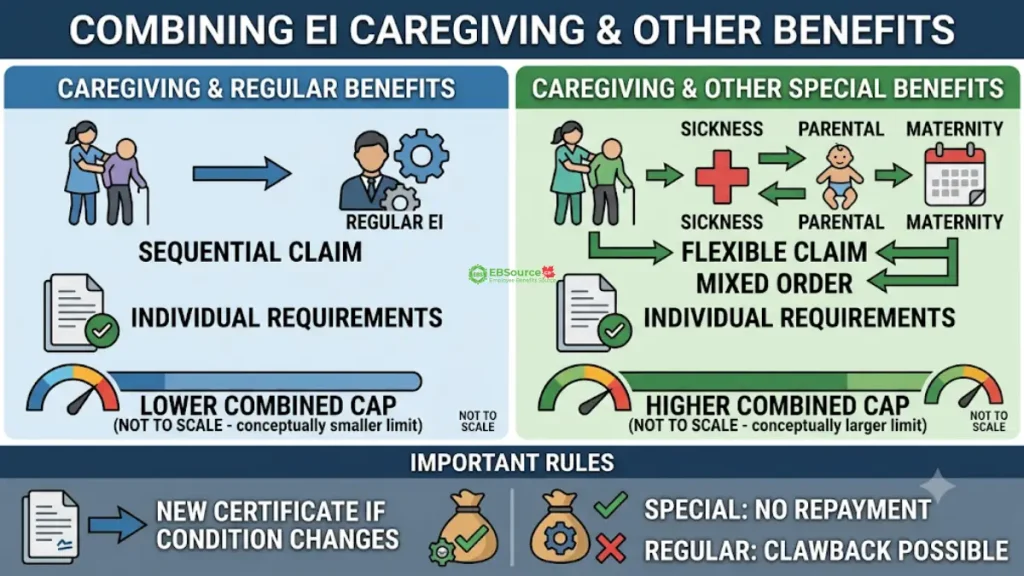
You can be paid different caregiving benefits for the same person, but not at the same time. Once a family caregiver window is open, compassionate care for that person waits until the family caregiver weeks are used up or the 52-week window closes.
That becomes a live question when a critical illness turns into an end-of-life situation partway through a claim. Service Canada confirms you may become eligible for a different caregiving benefit if the person’s state of health changes, or for EI sickness benefits if you fall ill yourself, but you must meet the conditions for each benefit and a fresh medical certificate is needed for the new one. Raise it as soon as the prognosis changes rather than after the weeks run out, because the certificate takes time to obtain.
The combined limits are frequently misstated, so it is worth being exact:
| What was paid in the benefit period | Combined maximum | Benefit period |
|---|---|---|
| Regular and special benefits together | Generally up to 50 weeks when regular and special benefits are combined, subject to specific exceptions such as the rules for regular and extended parental benefits | Standard 52 weeks |
| More than one type of special benefit, with no regular benefits paid | Up to 102 weeks of combined special benefits | Can be extended to a maximum of 104 weeks |
A benefit type that was not paid during the initial benefit period cannot be picked up during the extension. Within a single benefit period, then, weeks already paid do reduce what remains available for anything that follows. Whether another benefit can be paid on the existing claim or requires a new claim depends on the circumstances and the applicable EI rules. Service Canada can confirm how the rules apply before you submit another claim.
Source: Digest of Benefit Entitlement Principles, Chapter 22 – Government of Canada
One thing that does not carry over is the clawback. Caregiving benefits are special benefits and are exempt from the EI benefit repayment, regardless of your income, because the repayment applies only to regular and fishing benefits and only above $86,125 of net income for 2026. The one situation to watch is a tax year containing both regular and caregiving benefits, because the regular portion stays exposed.
What Should You Do After Using the EI Caregiving Benefits Calculator?
Apply as soon as you stop working or your earnings drop. Do not wait for every document, because supporting paperwork can follow the application. Apply as soon as possible after you stop working or your earnings are reduced. You do not need to wait until all supporting documents are ready; you can submit them after the application.
The start of that window depends on the medical certification and when you make the first claim. Depending on when the certificate is issued, Service Canada may use the certificate date, the examination date or an earlier date that the medical doctor or nurse practitioner certifies the required conditions began. Do not assume that the application date or the certificate-signature date will always control the window.
Note: aim to file within four weeks of your last day of work. A longer delay puts benefits at risk, because Service Canada does not backdate a claim on request, and you would need to give a good reason for the whole period of the delay.
You will need the following:
- The medical certificate, on form INS5242B for family caregiver benefits or INS5216B for compassionate care.
- The authorization to release medical information, form INS5257, submitted together with the certificate.
- Only if you are not a family member of the care recipient: an attestation completed by the care recipient (or their legal representative) confirming that they consider you to be like a family member. Family members do not need this document.
- Your Record of Employment. Electronic ones reach Service Canada directly from your employer, while you must obtain and submit paper ones yourself.
After you apply, file your reports every two weeks and declare any work or earnings. If Service Canada decides you are not eligible, you are notified in writing or by telephone, and you can request a formal reconsideration.
If you disagree with an EI decision, you normally have 30 days from the date the decision was communicated to request a reconsideration. If you miss that deadline, submit the request as soon as possible and explain the delay. Service Canada may accept a late request if it considers the explanation reasonable.
One more thing to check before you file: EI caregiving benefits replace income but do not protect your job. Federally regulated employees have leave under the Canada Labour Code, and everyone else falls under provincial or territorial employment standards, where entitlements vary. Where your leave entitlement is shorter than your benefit entitlement, the benefit weeks will outlast your job protection, and that is a conversation to have with your employer in advance.