



Purchasing an employee benefits plan is one of the most consequential decisions a Canadian employer makes for their workforce and their bottom line. Asking the right questions about coverage, pricing, providers, administration, compliance, and enrolment processes helps employers compare options and avoid mismatched plans.
This guide outlines the questions to ask before buying employee benefits and organizes them into six categories so you can walk into any meeting with a benefits provider or broker fully prepared. Whether you are buying for the first time or considering a switch, these questions apply across plan types and business sizes.
Questions to Ask About Coverage and Customization
To prevent coverage gaps, unexpected costs, and employee dissatisfaction after the plan is implemented, employers should understand exactly the coverage included, the flexibility of its design, and potential limitations.
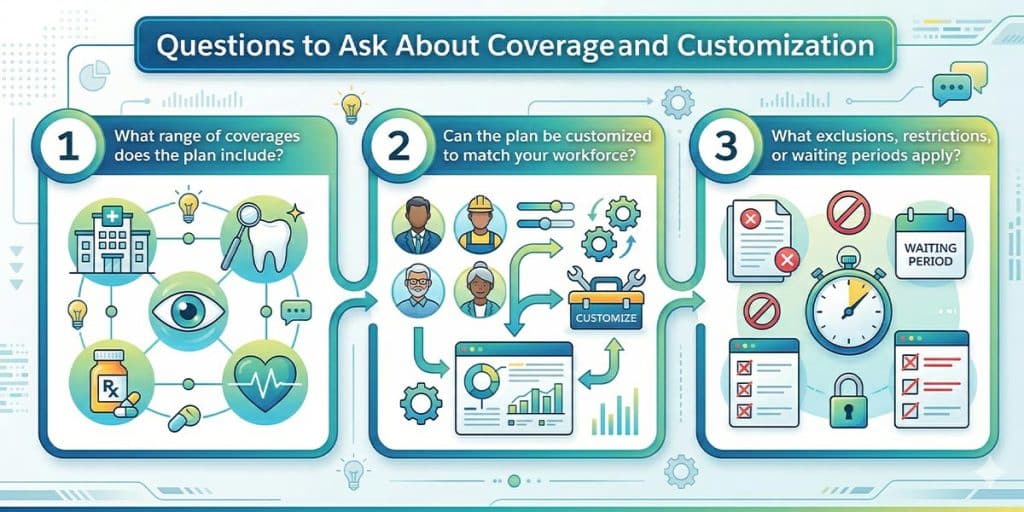
What range of coverages does the plan include?
When you look at a group benefits plan, start by asking for a complete list of coverage categories. Plans in Canada can be very different, and not all have the same basic protections.
Make sure to check if the plan includes extended health, dental, vision care, life insurance, short-term disability, long-term disability, and critical illness coverage. Some plans may also offer wellness programs, mental health support, or virtual care services.
Can the plan be customized to match your workforce?
Check if the plan can be adjusted for different workforce needs. A one-size-fits-all solution often does not work for organizations with different roles, demographics, and health priorities.
Consider the following questions to determine if the plan offers:
- Core coverage options, such as health, dental, and vision.
- Optional benefits, like mental health support or higher prescription drug limits.
- Flexible choices, including Health Spending Accounts (HSAs) or Wellness Spending Accounts (WSAs).
These customization options are especially important for small and mid-size employers, as they allow employers to align benefits with employee needs instead of paying for coverage that may not be widely used.
What exclusions, restrictions, or waiting periods apply?
To protect your budget and manage employee expectations, you must identify the specific boundaries of your benefits plan.
Every group plan in Canada includes certain limitations, such as exclusions for specific treatments, benefit maximums (annual or lifetime caps), and waiting periods for new hires. You should also be aware of Evidence of Insurability (EOI) requirements for higher coverage levels.
To ensure your plan aligns with your business goals, ask the provider:
- Does the plan exclude prior illnesses?
- Are there annual or lifetime caps on expensive treatments like orthodontics or mental health counselling?
- How many days (30, 60, or 90) must a new hire work before accessing benefits?
- Will employees need to submit Evidence of Insurability for higher coverage levels?
Knowing these boundaries upfront prevents “unpleasant surprises” for your bottom line and ensures your employees are not left unprotected when they need it most.
Questions to Ask About Cost Structure and Cost Control
Cost-related questions should focus on how premiums are set, what tools exist to manage drug and disability expenses, and how predictable your year-over-year spending will be.
How are premiums calculated, and how stable are they year to year?
To ensure long-term affordability, you must identify whether your costs are determined through pooled pricing (shared risk) or experience-rated pricing (based on your specific claims). A provider’s renewal track record is often more significant than an aggressive first-year “teaser” rate.
When evaluating the cost structure and stability of a plan, request the following details: Pricing model, renewal history, rate stabilization, and fee transparency. These options help make costs more predictable and lower the chances of sudden premium spikes.
What mechanisms exist to control prescription drug costs?
Prescription drugs are a major expense for extended health benefits in Canada, especially in private drug plans. To manage costs, many plans use a managed formulary, which may promote or require the use of generic drugs when appropriate. In Canada, Health Canada makes sure that generic drugs meet strict standards for effectiveness, safety, and quality, and they usually cost less than brand-name drugs.
Plans must also follow the drug insurance rules of the provinces. In Quebec, it is mandatory to have prescription drug coverage under the RAMQ system. Employees with access to a private plan usually need to enroll in it. Employer-sponsored plans must meet the minimum standards set by the public plan.
How does the plan help manage long-term disability costs?
LTD claims are high-stakes; a single prolonged claim can inflate your premiums for years. To manage these costs, your insurance provider needs to do more than just pay claims. They should focus on proactive claims management. Good plans include quick intervention and structured return-to-work (RTW) programs to shorten the length of claims.
Questions to Ask When Evaluating a Benefits Provider or Broker
Evaluating an employee benefits provider or employee benefits broker requires you to understand who actually underwrites your plan, how the broker is compensated, and whether their client experience matches your industry and company size.
Who is providing the plan, and what do they specialize in?
The structure of your provider affects everything from claim processing speed to premium stability. It is essential to clarify whether you are working directly with an insurer (underwriter) or a third-party administrator (TPA) who manages plans placed with outside carriers.
To evaluate a provider’s suitability for your business, clarify the following:
- Whether they act as a direct insurer or a plan administrator using a multi-carrier approach to “mix and match” coverage.
- Their typical client size and industry, as enterprise-level providers, offer very different structures than those focused on SMEs.
- Who is responsible for the actual adjudication and payment of claims, the company you are speaking with or a third party?
How is the broker compensated, and how do they handle conflicts of interest?
Broker compensation in Canadian group benefits usually follows one of two structures: commission paid by the insurer (embedded in premiums) or a fee-for-service paid directly by the employer. Some brokers use a hybrid model.
It is important to have clear information about how brokers are paid and to get independent advice. This helps ensure that recommendations are unbiased.
Does the broker have relevant industry experience and a strong client track record?
Ask if the broker has worked with organizations like yours before. Knowing the broker’s experience with your industry and company size can help ensure the plan meets your common coverage needs and cost patterns.
Also, check their client retention rates and ask for references. High retention rates usually show that clients are satisfied with their renewals and ongoing support. If the broker can’t provide examples of similar clients, it might raise doubts about their recommendations.
Questions to Ask About Plan Administration and Online Tools
Administration questions should confirm that both you and your employees have efficient digital tools for managing the plan day to day, from enrolment through claims.
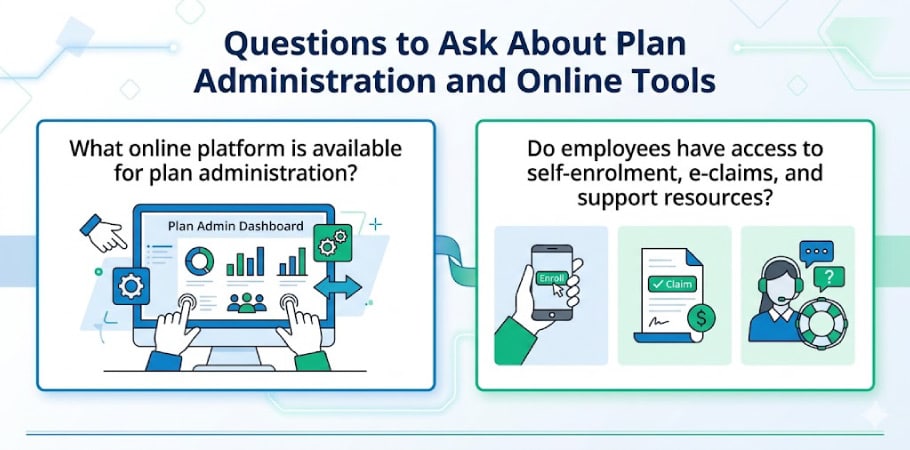
What online platform is available for plan administration?
A well-designed employer portal should reduce the time your HR team spends on routine tasks by offering full self-service capabilities. Before committing, verify that the platform supports real-time updates, such as adding/removing members or adjusting coverage, without requiring manual intervention from the provider.
To evaluate how well the platform works and how secure it is, ask for details about self-service updates, reporting, automated alerts, and compliance and security measures.
Do employees have access to self-enrolment, e-claims, and support resources?
The employee experience affects how often people use their benefits and how many questions they ask HR. A modern, mobile-friendly design helps members easily access their benefits, sign up for programs, and submit claims without hassle.
When evaluating the member-facing experience, confirm the availability of: Digital Enrollment, E-Claims Processing, Support Channels, and Integrated Virtual Care.
Questions to Ask About Regulatory Compliance in Canada
Regulatory requirements for employee benefits vary across provinces and may change over time. Asking compliance-related questions helps ensure your plan remains legally sound and administratively manageable.
What compliance support does the provider or broker offer?
Start by asking what compliance support is available. Some brokers provide regular updates on regulations, help with documents, and reviews of plans, while others expect the employer to monitor these responsibilities. Knowing the difference can help avoid compliance issues.
You should also check if the provider offers help with plan documents, employee notifications, and required disclosures when coverage terms change.
How does the provider handle provincial variation?
Benefits and tax treatments, like sales tax on premiums or taxable benefits, vary widely between provinces. For example, under CRA guidance (T4130), taxable benefits such as group term life insurance may include applicable provincial insurance levies or sales taxes in the benefit calculation, which can vary by province.
A provider needs to know the local rules well, especially for employers with workers in different locations, to avoid fines and breaking insurance laws.
Questions to Ask About Enrolment, Renewal, and Employee Communication
The success of a benefits plan relies on how well it launches and how much control you have when it comes time for renewals. To avoid administrative issues and surprise cost increases, clear communication and structured timelines are very important.
What is the enrolment process and eligibility framework?
Eligibility rules directly affect your participation rates and compliance. You must clarify the specific criteria for employees and their dependents to avoid late-enrollment penalties or coverage gaps.
To audit the enrolment workflow, verify the following: Eligibility Criteria, Dependent Rules, Late Enrolment, and Digital Onboarding.
How are employees educated and notified of changes?
A plan only delivers value if employees understand it. If the provider’s communication is poor, your HR team will become a 24/7 help desk for routine questions. To ensure effective member engagement, confirm: Communication Support, Notification Responsibility, and Self-Service Resources.
What does the annual renewal and negotiation process look like?
The renewal period is your primary opportunity to control costs. You need a structured timeline and a broker who actively advocates for your interests rather than just forwarding an insurer’s letter.
To secure your negotiating leverage, request details on:
- Commitment to receiving renewal terms at least 60 to 90 days in advance to allow for a thorough market review.
- How the broker analyzes claims data versus “target loss ratios” to challenge and negotiate the insurer’s proposed rate increases.
- A standing expectation for the broker to solicit competing quotes from other carriers every 2–3 years to ensure market competitiveness.
- Confirmation of any multi-year rate guarantees and the conditions under which an insurer could adjust rates mid-year.
Choosing an employee benefits plan in Canada is more than a financial transaction; it is a strategic investment in your organization’s most valuable asset, its people. By working through these questions to ask before buying employee benefits, employers can protect their budget from unexpected costs and create a supportive workplace culture. The best benefits plan is not always the most expensive one. It is the plan that best meets your employees’ needs and aligns with your company’s long-term goals.
