
Workplace Retirement Plans in Canada: Plan Types and Setup Preparations



Canadian employers can offer pension, group savings, or hybrid arrangements as workplace retirement plans. Each type works differently, with its own funding commitment, payroll and tax treatment, eligibility rules, and ongoing administration.
Before choosing a plan that fits your business, you need to know which plans you can offer, who should be covered, and what contributions and administrative tasks you can handle. Ignoring these considerations can lead to compliance issues, commitments your business cannot fulfill, or unexpected payroll burdens.
This guide explains the main plan types, how they differ, and four steps to prepare before choosing one, so you can approach providers with confidence.
What Are Workplace Retirement Plans?
Workplace retirement plans are employer-sponsored arrangements that help employees save for retirement, usually through payroll deductions and sometimes with employer contributions. These arrangements are also commonly called employer-sponsored retirement plans or corporate retirement plans.
The term covers several types of arrangements, which differ in how contributions are set, how retirement benefits are paid, and what funding and administrative responsibilities the employer takes on. The main distinction here is between registered pension arrangements and other workplace savings arrangements.
The next section groups them by type so you can see which rules apply to each.
Which Workplace Retirement Plans Can Employers Offer?
Employers can offer pension arrangements, group savings arrangements, or both. Pension arrangements are governed by pension legislation as well as the Income Tax Act, which brings stricter rules on funding, vesting, and locking-in. Group savings arrangements fall mainly under tax rules and the plan contract. That gives you more design flexibility, but employees get fewer protections.
Key terms for this section:
- Vesting: The point at which an employee gains the right to keep the pension benefits earned in the plan, including those funded by the employer.
- Locking-in: Rules that keep pension money in the plan or in a locked-in account so it pays retirement income. It generally cannot be withdrawn as cash before retirement, with limited exceptions.
Below are options under each arrangement:
Pension Arrangements
Within pension arrangements, employers can offer a Registered Pension Plan (RPP), or, where available, a Pooled Registered Pension Plan (PRPP) run by a licensed administrator. Employers in Quebec may also offer, or be required to offer, a Quebec Voluntary Retirement Savings Plan (VRSP).
Registered Pension Plan (RPP): An RPP is a pension plan you set up for your employees. You register it with the CRA and, in most cases, with the pension regulator in the province or territory where members work. Employer contributions are not a taxable benefit for employees, and investment income earned inside the plan is not taxed until benefits are paid out.
RPPs mainly include a defined benefit provision, a defined contribution provision, or a hybrid plan. The choice decides how the pension is designed and who carries the investment risk:
- Defined Benefit (DB) Pension Plans: The plan fixes the retirement income employees will receive. You must fund any shortfall between plan assets and the promised benefits.
- Defined Contribution (DC) Pension Plans (Money Purchase Plans): The plan fixes how much the employer and employees pay into each employee’s account, and the final savings depend on investment returns. Employees carry the risk that returns fall short.
- Hybrid Plan: A combination of DB plans and DC plans.
Pooled Registered Pension Plans (PRPP): A PRPP operates similarly to a DC plan, pooling contributions from many members to reduce investment management and administrative costs. They are managed by a licensed administrator, while employers handle enrolment, payroll, and remittances. PRPPs mainly serve workers without a workplace pension, including employees of small and medium-sized businesses, and employer contributions are optional. Federally regulated employers can find their duties in the OSFI PRPP guide.
Quebec Voluntary Retirement Savings Plans (VRSP): A VRSP allows eligible Quebec workers to save for retirement through payroll contributions managed by an authorized administrator. Quebec employers are required to offer a VRSP or a similar option once they have a certain number of eligible employees.
Group Savings Arrangements
Beyond pension plans, employers can offer a Group Registered Retirement Savings Plan (RRSP), a Deferred Profit Sharing Plan (DPSP), or a Group Tax-Free Savings Account (TFSA) as retirement savings plans. Each one has different tax and payroll treatment for employer contributions.
- Group Registered Retirement Savings Plans (RRSP): A Group RRSP lets employees save for retirement through automatic payroll deductions. For employers, a group RRSP is generally simpler to run than an RPP, has no pension funding obligations, and employer contributions are usually deductible as an employment expense.
- Deferred Profit Sharing Plans (DPSP): A DPSP receives only employer contributions, calculated under profit-based terms. For employers, contributions are generally tax-deductible within CRA limits and are not subject to CPP contributions or EI premiums, and employees pay tax only when they receive the money.
- Group Tax-Free Savings Accounts (TFSA): A Group TFSA offers accessible savings rather than locked-in retirement income. Employee contributions are not tax-deductible, while investment growth and withdrawals are generally tax-free. If the employer contributes, those contributions are usually considered taxable income for the employees.
Related topic: Employee stock ownership plans share company equity through options, shares, or other awards. Treat them as a separate compensation decision, since they do not fund retirement savings.
How to Prepare for Setting Up a Corporate Retirement Plan
Setting up a corporate retirement plan comes down to four steps: confirm which rules apply, shortlist the options that fit, gather your records, and then launch the plan.
Step 1: Confirm Which Rules Apply to Your Business
Before comparing plans, check three things: whether a jurisdiction requires you to offer a qualifying arrangement, who the plan needs to cover (including owners), and what contribution commitment the business can sustain. Any one of these can rule an option out before costs or provider features matter.
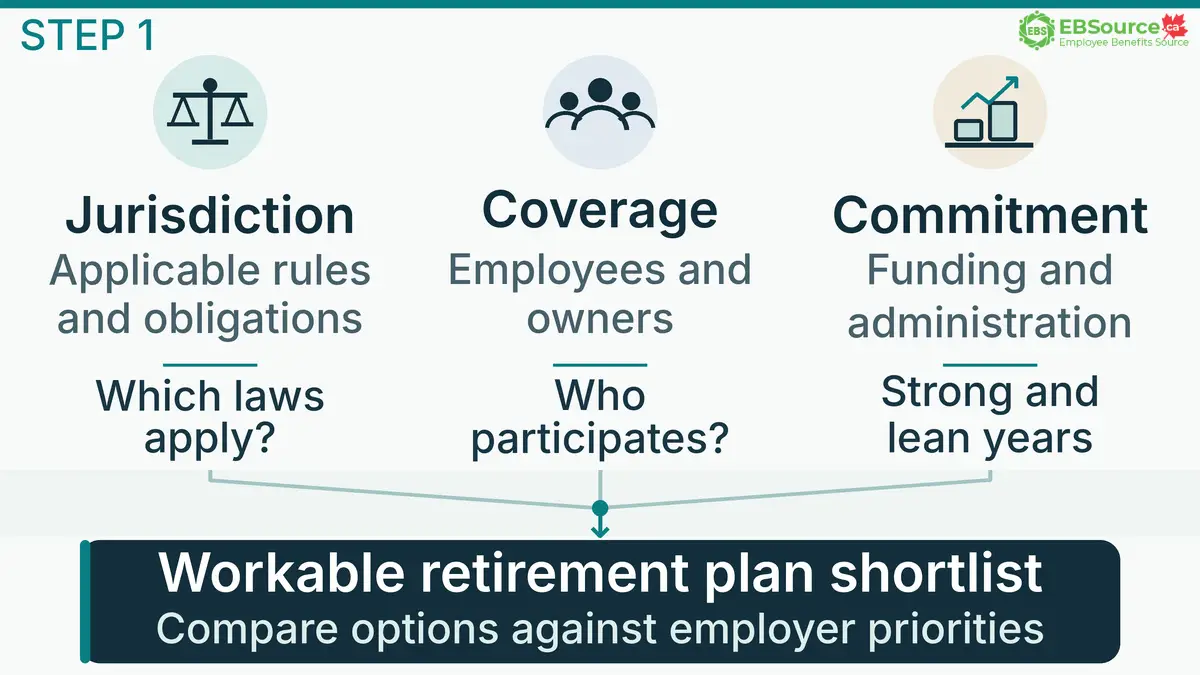
Jurisdiction
For many employers, provincial pension and savings legislation governs their registered pension plans, and the province where members work sets and supervises the rules.
Federally regulated employment and plans covering members in more than one jurisdiction can require additional analysis. Therefore, confirm the governing pension legislation before assuming one province’s rules apply to every member.
Coverage
You need to list the employee groups you want to include and whether owners or their relatives expect to join. Some plans let you choose classes, while others exclude certain people outright.
If owners expect to participate, confirm their eligibility with your accountant or provider. Do not assume that a proposed waiting period, employee class or owner-participation rule is permitted across every plan type.
Contribution commitment
Employers should decide what the business can contribute in both strong and lean years, and how much payroll and administrative work your team can take on.
Step 2: Match Workplace Retirement Options to Employer Priorities
Once the three checks have shortlisted your corporate retirement plan option, match the remaining options to what the business wants the plan to do.
The table below connects common employer priorities with recommended arrangements for consideration, along with the key criteria used to determine suitability:
| Employer priority | Options to investigate | Critical check before selection |
| Facilitate savings without committing employer contributions | Group RRSP, group TFSA, or an available PRPP or VRSP | Jurisdiction, enrolment, and payroll rules, and whether you may add discretionary employer contributions later. |
| Commit to a fixed or formula-based employer contribution | Group RRSP or DC registered pension plan | Payroll-tax treatment, pension adjustments, locking-in and withdrawal rules, registration, and ongoing administrative duties. |
| Link funding to profits | DPSP, possibly combined with a group RRSP | Specified-shareholder and related-person exclusions, eligibility of the intended employees, and profit-sharing terms that meet CRA rules. |
| Allow employees access to savings | Group TFSA or a group RRSP designed for access | Whether employees should have access while employed, withdrawal restrictions, and tax treatment. |
| Provide formula-based retirement income | DB registered pension plan | Funding, actuarial, and governance duties, and the business’s capacity to fund shortfalls. |
Workplace retirement options matched to employer priorities
Terms in this table:
- Pension adjustment (PA): The value of benefits an employee earned in an RPP or DPSP during the year, reported on their T4. It reduces the employee’s RRSP contribution room for the next year.
- Actuarial valuation: A regular review by an actuary to check whether a DB plan’s assets cover the promised benefits. It sets how much the employer must contribute.
Note: Quebec thresholds and compliance dates are time-sensitive. Confirm the current requirement with Retraite Québec before implementation.
Use these options as a starting shortlist, not a final recommendation. Remove an option if it cannot meet a legal requirement, cover the intended employee groups, or support the contribution commitment the business is prepared to make.
In addition, smaller employers and startups face the same checks, but with tighter budget and administrative limits. If you run a small business, our guide to small business retirement plans focuses on arrangements that fit limited resources. If you are a startup still deciding when to introduce a plan, planning retirement benefits for a startup explains when to launch, wait, or revisit the decision as you hire.
Step 3: Gather the Information Providers Will Need
Before implementing a workplace retirement arrangement and choosing a provider, gather the information needed to confirm employee eligibility, contribution design, payroll administration, and the responsibilities your selected provider will take on. Then confirm the plan-specific documents once you know which arrangement you intend to offer.
The table below lists the preparation common to most arrangements.
| What to prepare | Who usually prepares it | Why it matters |
| Business and payroll information | Owner or finance lead, with payroll | Identifies the companies, payroll systems, and work locations the plan will cover. |
| Employee eligibility records | HR or payroll | Hire dates, service history, employee classes, province of employment, and ownership relationships show who can join and which rules apply. |
| Objectives and contribution budget | Owner with advisor input | Sets what the plan must achieve, who contributes, how amounts are set, and what the business can sustain. |
| Expected membership and contributions | Finance lead with HR | Providers price plans partly on the number of members and expected contributions, so giving every provider the same estimates lets you compare quotes fairly. |
| Existing plans and assets | Owner, with HR | Current plan documents and amendments, recent financial reports, and employee booklets show what is already promised and which assets may transfer to a new plan. |
| Provider fees and exit terms | Owner or finance lead | Shows who pays administration and investment fees, and whether leaving a current provider triggers market value adjustments or deferred sales charges. |
| Ongoing responsibilities | Owner, with HR and payroll | Identifies who will handle enrolment, payroll deductions, remittance deadlines, pension adjustment reporting, regulatory filings, employee education, and provider coordination after launch. |
Common preparation before implementing a workplace retirement plan
Terms in this table:
- Market value adjustment (MVA): A reduction that some contracts apply when investments, often guaranteed or fixed-income funds, are moved before they mature, to reflect current market values.
- Deferred sales charge (DSC): A fee charged when certain investments are sold within a set period after purchase. DSCs are less common now, but older contracts may still include them.
Note: These are common preparation steps, not a universal registration checklist.
Step 4: Confirm the Plan and Prepare for Implementation
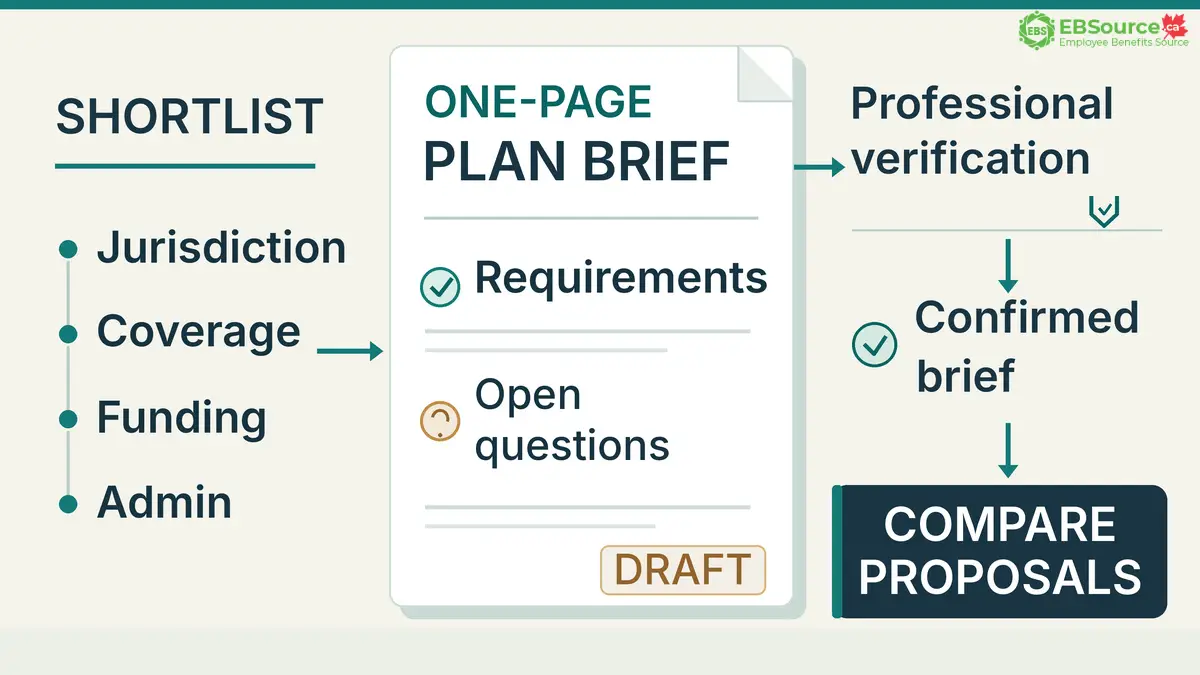
After shortlisting, turn your decisions into a one-page plan brief, so every provider works from the same points. The brief should record:
- Where employees work and which retirement plan obligations may apply
- The employee groups and business owners you intend to include
- The employer contribution you can sustain, including any conditions or limits
- Whether employees need access to their savings before retirement
- The payroll, reporting, and administrative responsibilities your team can support
- The legal, tax, and eligibility questions that still need confirmation
Send the same brief to each provider. Ask them to clarify any specific requirements and outline which responsibilities they will handle versus those that will stay with your business.
Lastly, consult your accountant or a benefits lawyer to ensure you understand the tax, payroll, and pension legislation for each corporate retirement option.
Approve a final design only once the key eligibility, contribution, and payroll questions are confirmed, so no unverified assumptions end up in the final design. You can then compare provider proposals and begin setting up the process.
How Do Workplace Retirement Plans Relate to Government Retirement Programs?
A workplace retirement plan is one part of an employer’s total rewards package. Unlike group insurance, which covers current needs, it supports long-term savings or retirement income.
Government programs such as the CPP and QPP are a separate, mandatory layer of retirement coverage, so present a workplace plan as an addition to them, not a replacement.
Canada’s retirement income system is often described as three pillars:
- Old Age Security and the Guaranteed Income Supplement.
- The mandatory Canada Pension Plan or Quebec Pension Plan, funded by employee and employer contributions.
- Workplace and personal savings, which is where employer plans sit.
Public benefits replace only part of pre-retirement earnings. For many middle and higher earners, the difference between their public benefits and the income they will need in retirement has to come from the third pillar: workplace plans and personal savings.
Sources:
FAQs Related to Workplace Retirement Plans Canada
Do Canadian Employers Have to Offer Retirement Plans?
Outside Québec, there is no general legal requirement for private-sector employers to offer a workplace retirement plan such as a group RRSP, DPSP or pension plan. Employers must deduct and remit CPP or QPP and EI where the employment and employee are subject to those programs. Specific exemptions and non-insurable-employment rules can apply.
Can New Canadians Join A Workplace Retirement Plan?
Citizenship alone generally does not determine whether a new Canadian can participate in a workplace retirement arrangement, but tax and contribution rules depend on the plan. Registered Pension Plan eligibility follows the plan terms and applicable pension legislation.
Check Group RRSP and PRPP contributions against the individual’s available RRSP deduction limit; a newcomer generally cannot deduct first-year RRSP contributions if it is their first Canadian return and they have no previously established room. For a group TFSA, the individual must meet the TFSA residency, age and SIN requirements, and contribution room begins in the year Canadian residency starts. Québec VRSP employees must also meet the applicable employment and service requirements.
Where Are the Official Lists of PRPP and VRSP Administrators?
Regulators publish these lists directly. OSFI’s list of registered PRPPs names five federal plans, administered by The Royal Trust Company, Industrielle Alliance, The Canada Life Assurance Company, The Manufacturers Life Insurance Company and Sun Life Assurance Company of Canada. The page was last modified on 1 March 2023, so confirm the current roster with OSFI before relying on it.
For Québec, Retraite Québec’s list of registered VRSPs also shows each plan’s investment options and fees.
Note that the OSFI list covers only federal PRPPs. A provider’s absence from it says nothing about its group RRSP or DPSP products.