
Group Accident Insurance in Canada: Coverage, Premiums, and Providers


Group accident insurance is a plan sponsored by employers that provides lump-sum benefits for covered accidental injuries and, in some cases, accidental death. The extent of coverage varies depending on the specific contract. Some plans offer coverage 24/7 (both on and off the job), while others are tailored for specific environments or job classifications.
The cost of this insurance varies based on factors such as the number of employees, their age, the industry risk level, chosen benefits, and past claims. In Canada, companies such as Chubb, AIG, Zurich, Berkley, and Cansure typically provide this coverage.
The details below explain what is covered, how premiums are set, which companies offer insurance, and what employers and employees should think about when choosing a plan.
What is Group Accident Insurance?
Group accident insurance is an employer-sponsored benefit that pays lump sum payments when employees suffer accidental injuries or death, regardless of whether the incident happened at work or during personal time. It helps fill the financial gaps caused by accidental injuries by covering out-of-pocket expenses and disruptions to extended health, dental, life, and disability insurance.
The core of most plans is accidental death and dismemberment (AD&D). This provides the largest payout for an accidental death or a catastrophic injury like the loss of limbs. Additional benefits for fractures, hospitalization, and rehabilitation expenses are often included, making this coverage a practical supplement to your existing insurance.
What Does Group Accident Insurance Cover?
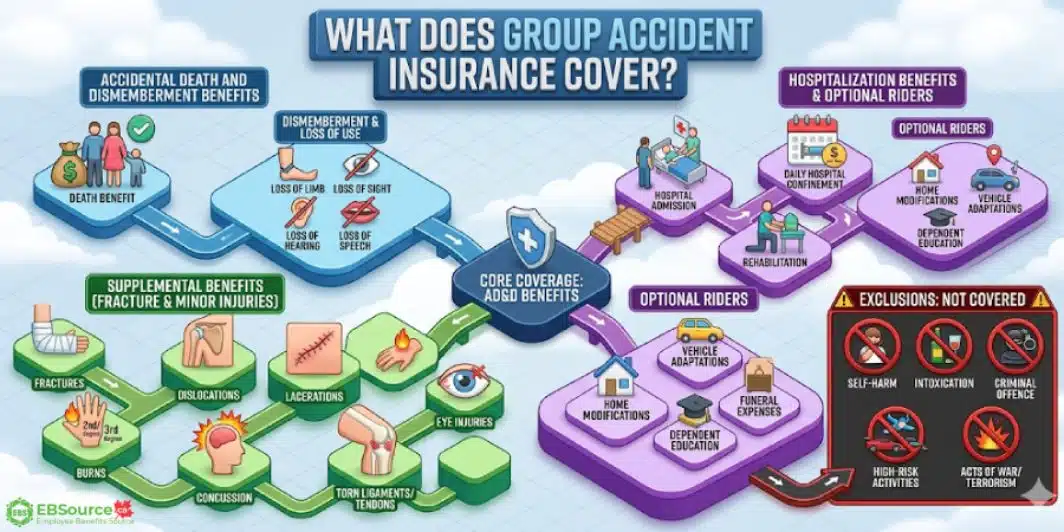
While plans vary, a standard group accident insurance policy generally provides coverage for accidental death and dismemberment, a specified list of injuries and events, and hospitalization. However, it excludes incidents related to self-harm, criminal activity, impaired driving, and certain high-risk activities.
Here are the core components that many Canadian group accident plans consist of:
Accidental Death and Dismemberment Benefits
AD&D coverage offers financial benefits for severe, unexpected incidents. If an employee dies due to an accident, the full accidental death benefit amount is paid to their designated beneficiary. Additionally, the dismemberment and loss of use portion of the policy pays a percentage of the coverage amount depending on the specific loss, such as the loss of a limb, sight, hearing, or speech due to an accident.
Supplemental Benefits (Fracture and Minor Injuries)
Modern group AD&D policies also include a wide range of benefits for less severe injuries to help with immediate costs. Based on typical plan designs from major Canadian insurers, covered injuries may include fractures, dislocations, lacerations, burns, concussions, torn ligaments or tendons, and eye injuries.
Here is what the supplemental benefits cover:
- Fractures: Broken bones (e.g., a broken arm pays a certain amount, a broken hip pays more).
- Dislocations: Joints that are knocked out of place (e.g., shoulder, knee, finger).
- Lacerations: Deep cuts that require stitches.
- Burns: Typically covering second or third-degree burns, with the payout based on size and severity.
- Concussion: A benefit for a diagnosed head injury.
- Torn Ligaments/Tendons: Payments for injuries like a torn ACL or ruptured Achilles tendon.
- Eye Injuries: A benefit for physical damage to the eye.
These benefits have specific dollar caps and conditions that vary by insurer and plan. Generally, the more severe the injury, the higher the compensation.
Hospitalization Benefits and Optional Riders
Enhanced plans also offer add-on coverages beyond the core AD&D benefits, including hospital admission, daily hospital confinement, and rehabilitation services.
The payment structure for these hospitalization benefits and optional riders is as follows:
- Hospital Admission: A lump sum paid upon being admitted to a hospital for an accident.
- Daily Hospital Confinement: A per-diem payment, such as $100 per day, for each day spent in the hospital.
- Rehabilitation: Covers a portion of costs for services like physiotherapy or occupational therapy after an accident.
Some plans also offer additional benefits that extend beyond basic coverage, such as home modifications, vehicle adaptations, a seat belt benefit, educational support for dependent children, and funeral expenses.
Exclusions for Group Accident Coverage
Every group accident insurance policy includes exclusions, and these vary by plan across Canadian insurers. The exact details (including how terms are defined) can differ by insurer, contract, and employee classification.
Common exclusions in nearly every group accident policy include injuries resulting from:
- Self-inflicted harm, regardless of mental state
- Intoxication from alcohol or non-prescribed drugs
- Committing a criminal offence
- Participation in certain high-risk activities like car racing, skydiving, or professional sports
- Acts of war or terrorism
For a benefit to be paid, the event must be a true “accident” – a sudden, unforeseen, and external event. A heart attack, while sudden, is a medical event and would not be covered by accident insurance (it would be covered by group critical illness insurance).
Pre-existing conditions can also complicate an insurance claim. An accident policy is meant to cover injuries from an unforeseen event, not the effects of an ongoing illness. If an insurer believes a pre-existing medical condition was the primary cause of an injury, rather than the accident itself, they may deny the claim.
Note: Treat the examples above as general guidance only, and verify them against your plan booklet or certificate before relying on them.
How Are Premiums Calculated for Group Accident Insurance?
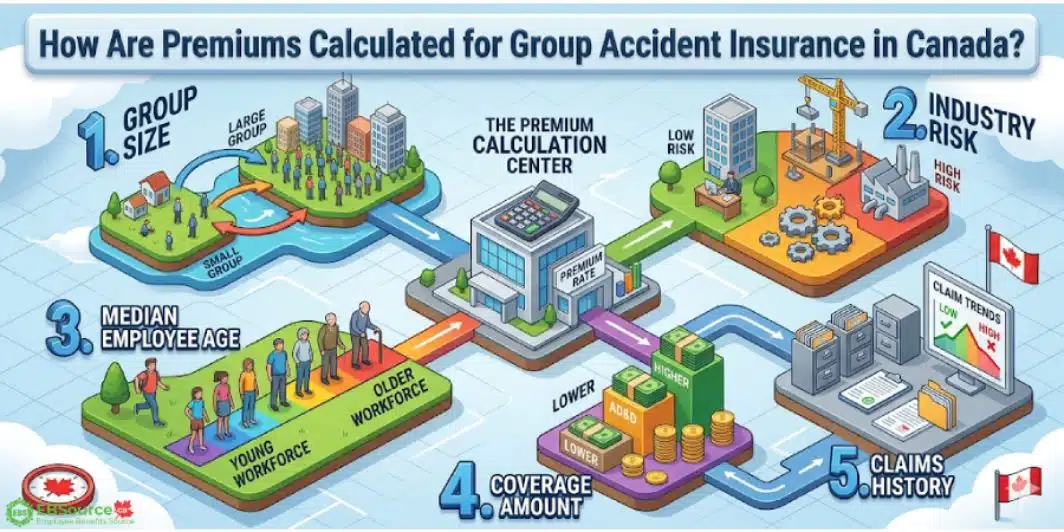
Group accident insurance premium rates depend on group size, median employee age, industry risk classification, coverage amount, and claims history.
Below is how these factors influence the cost of group accident insurance:
Group size: Larger groups generally receive lower per-employee premiums as the insurers can spread risk across more individuals.
Occupation risk: Employees in high-risk industries such as construction, manufacturing, and logging face higher accident rates than office workers. Insurers charge higher premiums for these groups.
Claims history: If a group has a higher-than-expected number or cost of claims, the insurer will view it as a greater risk and likely increase the premium at renewal.
Median age: Older individuals statistically face higher injury rates and longer recovery times. Thus, younger workforces typically receive better rates.
Practical approach: Start with moderate coverage levels and increase based on employee interest and utilization. Adding expensive riders that employees never use wastes premium dollars.
Tax Treatment of Group Accident Insurance Premiums
Employer-paid premiums or contributions to group sickness or accident insurance plans are generally considered taxable benefits, unless they pertain to a wage-loss replacement plan (WLRP) that provides benefits on a periodic basis (not as a lump sum).
For reporting to the CRA, if the benefit is taxable, employers typically report it on the employee’s T4 slip in box 14 and under “Other information” code 40. For former or retired employees, the CRA usually uses T4A with code 028 for reporting.
Similar to other group insurance plans, the tax treatment of group accident insurance in Canada varies depending on who pays the premiums and how the benefits are structured. This funding split also affects how the premiums are treated for payroll tax purposes, so it’s important to confirm the allocation in your benefits contract.
Special Note Regarding Tax Treatment for Group Accident Insurance
For employees taxable in Quebec, it is critical to note that separate provincial rules exist. They also consider the employer’s contribution a taxable benefit, with a similar exception for benefits paid periodically as wage-loss replacement. Because the province has its own tax system, the way these benefits are treated and reported on the Relevé 1 (RL-1) slip might follow its specific rules. Employers in Québec should always check directly with Revenu Québec to ensure they are compliant.
For federal reporting, employers are required to calculate and report this taxable benefit on employees’ T4 by adding it to Box 14 (Employment income) and also listing it in the “Other information” area using code 40.
For retirees or former employees, the CRA requires this benefit to be reported on a T4A slip using the “Other information” area with code 028 (Other income).
Who Offers Group Accident Insurance in Canada?
In Canada, several insurers offer group accident coverage, such as Chubb, AIG, Zurich, Berkley, and Cansure. Group accident insurance is less common than group life insurance, AD&D, or extended health care, as it is mainly provided by specialty accident and health insurers rather than the larger companies that manage most employers’ main benefit plans.
The best providers of group accident insurance in Canada can be:
- Chubb Canada: Offers participant accident and occupational accident coverage for sports, schools, daycares, and nonprofits.
- AIG Canada: Provides participant accident insurance that includes AD&D, paramedical expenses, weekly indemnity, and total disability coverage.
- Zurich Canada: Offers a Group Personal Accident policy with five modular coverages, rated A+ by A.M. Best.
- Berkley Canada: Provides Group AD&D insurance with 12 supplementary benefits, including rehabilitation and dependent education.
- Cansure: Offers group accident coverage starting at $200 for volunteer groups, sports leagues, and childcare centers.
In Quebec, Beneva (formerly SSQ) and iA Financial offer specialized group products that meet the province’s specific regulations. This is important because many national insurers exclude Quebec from their group accident products due to specific licensing and contract language rules in the province.
Group Accident Insurance in Canada: At a Glance
As a recap, here are the essential features of group accident insurance:
What it is: This is an employer-sponsored plan that provides a one-time, lump-sum cash payment for covered accidental injuries or in the case of an accidental death. (24/7 coverage, not limited to work-related incidents).
Who it’s for: Coverage is typically offered to full-time employees, but some plans also include part-time, contract, or seasonal workers, and optional coverage for spouse/dependents.
How It Pays: You receive a tax-free, lump-sum payment. The amount is based on a preset schedule that defines payouts for specific injuries like fractures, burns, or dislocations, as well as for hospital stays and AD&D.
Typical add-ons: Hospital admission/confinement, rehabilitation, coverage for dependents, and optional conversion to individual plans.
Tax treatment: Employer-paid premiums are a taxable benefit (reported on T4 or RL-1), though payouts themselves are non-taxable to the recipient.
What to check: Look at the certificate/booklet for: benefit amounts, exclusions, conversion rights, age limits for dependents, waiting periods, and designated beneficiaries.
What Should Employers and Employees Do Next?
Employers should obtain quotes, review tax compliance, and educate their team about group accident insurance. Simultaneously, employees should read their benefits booklet, designate beneficiaries, and assess their needs.
Here are 3 steps that employers should take regarding group accident insurance:
- Get Quotes: If you’re considering a plan, contact an independent benefits advisor to get quotes from at least three insurers. Compare not just the price, but the benefit schedules and exclusions.
- Review Tax Compliance: Audit your payroll process to ensure you are correctly reporting employer-paid premiums in Box 40 of the T4 slip.
- Educate Your Team: During benefits onboarding and open enrollment, clearly explain how the plan works, what the taxable benefit means, and the critical importance of designating a beneficiary.
Employees should also take 3 key actions regarding group accident insurance:
- Read Your Benefits Booklet: Request a copy of your certificate of insurance. Read it to understand what is covered, what is excluded, the benefit amounts, and your conversion rights.
- Designate Your Beneficiaries: This is vital. If you don’t name a beneficiary, the death benefit may go to your estate, causing lengthy delays and probate fees. Review your designation after major life events like marriage, divorce, or the birth of a child.
- Assess Your Needs: Does the group plan provide enough coverage for your mortgage, debts, and your family’s needs? If not, or if you have high-risk hobbies, consider supplementing with a personal policy.
With a clear understanding of the plan, employers and employees can now decide how to review, adjust, or use their coverage effectively.
What Is the Difference Between Personal Accident and Group Accident Insurance?
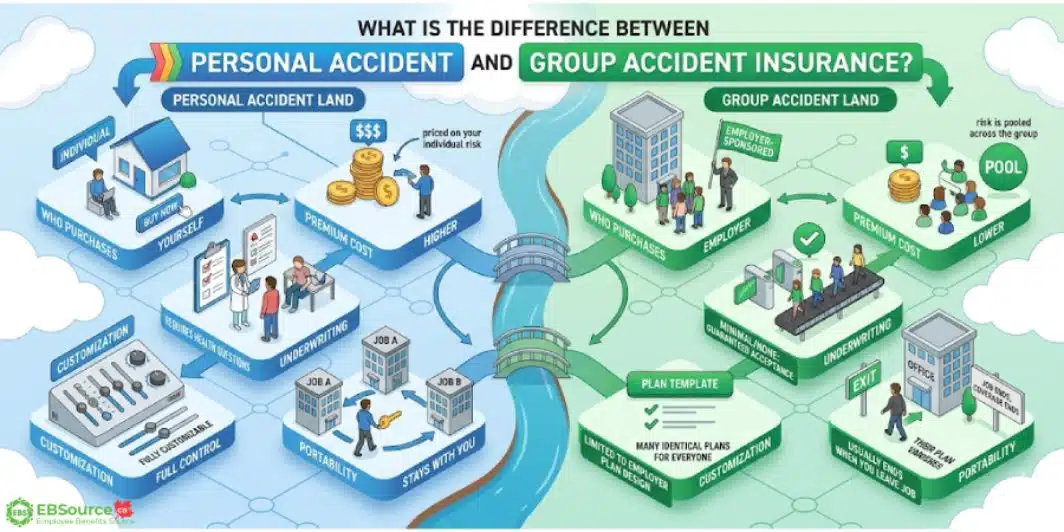
The key difference is that group accident insurance covers multiple employees under a single employer-sponsored policy with shared risk, while personal accident insurance is an individual policy purchased directly by an individual for themselves and their family.
Here’s how the two plans differ in detail:
| Factor | Group Accident Insurance | Personal Accident Insurance |
|---|---|---|
| Who Purchases | Employer | Individual |
| Premium Cost | Lower (risk is pooled across the group) | Higher (priced on your individual risk) |
| Underwriting | Minimal or none (guaranteed acceptance) | Requires health and lifestyle questions |
| Customization | Limited to the employer’s plan design | Fully customizable by the policyholder |
| Portability | Usually ends when you leave your job | Stays with you regardless of employment |
Which option is right for you?
For most employees, group coverage is a good starting point because of its lower cost and guaranteed acceptance. However, if you are self-employed, have a high-risk hobby, or just want a plan that stays with you even if you switch jobs, it is worth considering supplementing your current insurance with personal coverage or purchasing it independently.
FAQs about Group Accident Insurance in Canada
Is group accident insurance the same thing as AD&D insurance?
Not exactly. Accidental Death & Dismemberment (AD&D) is the core component of most group accident insurance plans. However, modern accident insurance plans are broader and include additional benefits for non-catastrophic injuries, such as scheduled payments for fractures, dislocations, hospital stays, and physiotherapy.
Can I have both a group accident policy and a personal accident policy?
Yes, absolutely. The policies are independent of each other. Many people use a personal policy to supplement their group coverage, especially if they have high-risk hobbies or want coverage that isn’t tied to their employment.
When does my coverage officially start after I’m hired?
Coverage does not usually start on your first day of work. There is typically a waiting period (e.g., 30, 60, or 90 days). After you complete the waiting period, your coverage will become effective on a set date.
Do I need to have a medical exam to enroll?
No, for standard enrollment in a group plan, a medical exam is not required. This is one of the major advantages of group insurance: the insurer assesses the risk of the entire group, not each individual, enabling guaranteed acceptance without medical underwriting.
Can I claim for an accident that happens while I’m travelling outside of Canada?
Yes, in most cases. Group accident insurance typically provides 24/7 coverage anywhere in the world. However, you should always confirm this by reviewing your benefits booklet, as some policies may have specific limitations on travel duration or destinations.
Article Sources:
To wrap it up, group accident insurance is a highly affordable financial safety net offered by employers. It is not about replacing your main health or disability coverage; it’s about making sure an unexpected injury, whether a minor fracture or a life-altering accident, does not become a financial crisis.