


EI Economic Region
Total Insurable Earnings From Your Required Best Weeks
Average Insurable Weekly Earnings
Expected Length of Absence
Basic Eligibility Check
Your EI sickness benefits
Sample scenario shown - Use your own numbers to get started!
- This is an estimate only. EI benefits are taxable; amounts shown are before tax.
- For new EI claims starting from March 30, 2025 through October 10, 2026, the usual one-week waiting period is temporarily waived. If your claim starts after October 10, 2026, check the current Service Canada rules because a one-week waiting period may apply unless it is waived or deferred.
Estimated breakdown of your EI sickness benefits
Estimated breakdown of your EI sickness benefits
| Regional unemployment rate | Toronto - 6.8% |
|---|---|
| Standard hours requirement | 600 hours in the last 52 weeks |
| Number of best weeks | 21 weeks |
| Weekly EI sickness benefit amount |
$1,000.00 x 55% = $550.00 The maximum weekly benefit is $729. Since $550.00 is below this limit, you receive $550.00 per week. |
| Weeks included in this estimate |
15 weeks Max 26 weeks |
| Estimated total (gross) | $550.00 x 15 = $8,250.00 |
Data sources: Regional unemployment rates and best-weeks divisors are based on Service Canada’s current EI Program Characteristics table. A notice of violation from a previous EI claim can increase the number of hours required. This calculator uses rules for claims beginning in 2026 and the EI regional data period shown below. It should not be used to recalculate an earlier claim. EI regional data period: September 6, 2026 to October 10, 2026. Last verified by EBSource: September 7, 2026.
EI sickness benefits pay 55% of your average insurable weekly earnings up to a 2026 weekly maximum of $729, and EBSource’s calculator gives you a quick estimate before Service Canada processes your claim.
To produce that estimate, you need to enter four details from your Record of Employment and pay stubs: EI Economic Region, Average Insurable Weekly Earnings, Insurable Hours, and Expected Weeks of Absence, and confirm your eligibility by checking the boxes. The EI sickness benefits calculator then uses your economic region to show how many best weeks Service Canada would use. You then enter your average insurable weekly earnings based on that divisor, and the calculator applies the 55% benefit rate and 2026 maximum.
Remember that this number is an estimate before taxes and has some conditions. Only Service Canada can confirm the exact amount you will get. Then, apply as soon as possible after you stop working, and send your reports every two weeks to avoid delays that could cause you to lose benefits.
What to Enter into EBSource’s EI Sickness Benefits Calculator
To use the EI Sickness Benefits estimate tool, you will need to give four important pieces of information: EI Economic Region, Average Insurable Weekly Earnings, Insurable Hours, and Expected Weeks of Absence, plus four eligibility confirmations.
Before you start, it’s helpful to have your Record of Employment (ROE) or recent pay stubs ready, since two of these inputs come directly from your pay history.
| EI sickness benefits calculator field | What you enter | Where to find it |
|---|---|---|
| EI Economic Region | Your province/territory, then your economic region | Based on where you live |
| Average Insurable Weekly Earnings | Total earnings in your best weeks ÷ number of best weeks | Your ROE or pay stubs (gross pay) |
| Insurable Hours | Total insurable hours in your applicable qualifying period | Your ROE, including box 15A for insurable hours |
| Expected Weeks of Absence | Expected period you cannot work for medical reasons | Your medical certificate (maximum 26 benefit weeks) |
Important Note: The regional figures in this article match the EI Program Characteristics table for the period of September 6 to October 10, 2026. Service Canada refreshes that table roughly every four weeks, so your region's best-weeks number can shift between the day you read this and the day you file. Temporary EI measures can also change the rules mid-year. Recheck any time-sensitive figure, especially the waiting period, at the point you actually apply.
Input 1: EI Economic Region
Your region determines how many of your best weeks are used to calculate your EI sickness benefit amount. So, when you choose your province or territory and EI economic region, the Employment Insurance sickness calculator shows the number of best weeks, which can be between 14 and 22 depending on the unemployment rate where you live.
Your best weeks are the weeks with your highest insurable earnings during your applicable qualifying period. A smaller best-weeks requirement can help when your earnings vary because fewer lower-earning weeks may enter the calculation. That can increase your average insurable weekly earnings and, in turn, your estimated weekly benefit.
The regional data in the EI sickness tool comes from the official EI Program Characteristics table from Service Canada. Here is a selection of current figures:
| Region (unemployment rate) | Best weeks |
|---|---|
| Halifax (5.6%), Winnipeg (5.3%), Victoria (5.7%), Quebec (4.4%), Thunder Bay (5.3%) | 22 |
| Toronto (6.8%), Montreal (6.6%), Vancouver (6.4%), Calgary (6.5%), Edmonton (7.0%), St. John’s (6.6%) | 21 |
| Ottawa (7.4%), Windsor (7.6%), Kitchener (7.9%), Niagara (7.1%), Abbotsford (7.3%) | 20 |
| London (8.7%), Oshawa (8.8%), Northern Alberta (8.8%) | 19 |
| Northwest Territories excluding Yellowknife (10.8%) | 17 |
| Northern Manitoba (28.7%), Northern Saskatchewan (14.5%), Nunavut excluding Iqaluit (14.6%) | 14 |
Watch the capital-city split: Five jurisdictions currently have a separate EI region for their capital or largest capital-region centre: St. John’s, Charlottetown, Whitehorse, Yellowknife and Iqaluit each have a different regional entry from the surrounding province or territory. If you live in one of these cities, do not use your territory’s or province’s general figure.
One caution when reading Service Canada’s table: it also shows a column for qualifying hours ranging from 420 to 700 by region. That column applies only to EI regular benefits. For Employment Insurance sickness benefits, only the best-weeks column matters; the hours requirement is covered under Input 3 below.
Please note that your EI economic region is based on EI regional boundaries, not simply on your province or territory. For instance, Ottawa currently uses 20 best weeks, while Thunder Bay, which is also in Ontario, uses 22. This is why you should use your EI economic region rather than a province-wide figure. Once your weekly benefit rate is established, it will remain unchanged for the duration of that claim. If you are unsure about which region you belong to, the province dropdown will help narrow down the options for you.
Input 2: Average Insurable Weekly Earnings
Your average insurable weekly earnings are the number most likely to affect your estimate, so calculate it in two steps: add up the total earnings from your highest-paid weeks, then divide by that number of weeks. Enter that amount, making sure to use gross pay instead of take-home pay, and do not average all 52 weeks.
Step 1: Total your best weeks
First, check your qualifying period, which is usually the 52 weeks before your claim starts, or since the start of your last claim if that is shorter, and identify your highest-paid weeks, using as many weeks as your region requires. Then, add together the gross insurable earnings from those weeks. Insurable earnings typically include various forms of employment compensation, such as wages, bonuses, commissions and certain tips. For example, employer-controlled tips are generally insurable, while direct tips paid by customers generally are not.
In specific circumstances, the normal qualifying period can be extended, up to a maximum of 104 weeks. An extension is available only for grounds recognized under the Employment Insurance Act, such as being unable to work because of illness, injury, quarantine or pregnancy.
A period without insurable employment does not qualify for an extension on its own. If a longer qualifying period could affect your 600-hour requirement, ask Service Canada whether one of the statutory grounds applies.
Step 2: Divide by your best-weeks number
Next, divide the total earnings from your best weeks by the number of weeks. That result is what you should enter.
In this step, be careful to avoid these two common mistakes:
- Do not use take-home pay: The EI sickness benefits are calculated using gross insurable earnings before deductions. Using your net cheque will understate your benefit.
- Do not automatically average all 52 weeks: Service Canada uses only the required number of highest-paid weeks for your region, normally 14 to 22.
How do you handle biweekly or irregular pay?
For EI purposes, a week runs from Sunday to Saturday, but most payroll runs on biweekly or semi-monthly cycles, so your pay stub will not always line up neatly with an EI week. When your pay is biweekly or irregular, keep these points in mind:
- Use your ROE and payroll records to identify the earnings that belong to each EI week, rather than reading a single figure off one stub.
- Do not assume every biweekly payment can simply be split equally between two weeks, because your stub may not divide evenly across those weeks.
- Bonuses, commissions, and other irregular payments can have their own allocation rules. Depending on why the payment was made, it may be allocated to the period you worked, the week of a specific event, or the period in which you earned it, rather than to the week it appeared on your cheque.
- If the weekly allocation is unclear, use the figures your ROE or Service Canada provides instead of estimating the split yourself.
The EI earnings chart shows that how a payment is treated depends on the reason it was paid, not simply on when it reached your account. When in doubt, rely on your ROE and Service Canada’s determination rather than estimating the weekly amounts yourself.
Input 3: Insurable Hours
In this box, you need to enter the total insurable hours during the applicable qualifying period. To qualify for EI sickness benefits, you need to have 600 insurable hours within the 52 weeks leading up to the start of your claim, or since the beginning of your last claim, whichever period is shorter.
Unlike EI regular benefits, this threshold does not change with the regional unemployment rate. This estimator is designed for employees whose EI sickness eligibility is based on insurable employment and insurable hours. It is not designed to determine eligibility or calculate benefits for self-employed participants or self-employed fishers, who follow different EI rules.
It’s important to note that if you have had a recent EI claim, the relevant window runs from the start of that last claim, not from the end of it. This recent claim may shorten the timeframe in which your 600 hours are assessed and can also influence the number of weeks of sickness benefits available to you. If the Employment Insurance sickness calculator assumes a full 52-week window, treat its eligibility result cautiously and contact Service Canada about your specific claim history.
Input 4: Expected Weeks of Absence
You also need to enter the number of weeks that your treating medical professional expects you to be unable to work. Please note that our EI sickness calculator caps this duration at 26 weeks, which is the maximum allowed by the program.
This figure should come from your medical certificate. If your treating medical professional uses their own form, Service Canada needs it to show both when your illness started and, if known, how long it is expected to last.
For example, if you expect to be off for six weeks, enter 6; you will not automatically get the full 26 weeks. If you get better sooner or need more time off, please tell Service Canada about any changes.
If you use all 26 weeks and are still unable to work, you must accumulate another 600 insurable hours before you can qualify for a further sickness claim. If your medical absence could last for several months, check your employer’s sick-leave, short-term disability and long-term disability rules early rather than waiting until your EI weeks run out.
The Eligibility Checkboxes
Before calculating, the EI sickness tool asks four basic screening questions:
- your regular weekly earnings dropped by more than 40% for at least one week,
- you have or can obtain a medical certificate signed by an accepted treating medical professional,
- you are unable to work for medical reasons, and
- you remain otherwise available for work if not for your condition.
These checkboxes are only a self-screen. Together with the 600-hour rule described under Input 3, they reflect the core requirements for a sickness claim, but Service Canada makes the final determination.
A failed screening question is not an official eligibility decision. The Government of Canada encourages people to apply as soon as possible and let Service Canada decide, and you should not delay your application merely because a supporting document is not yet in hand.
How to Read the Results from EBSource’s EI Sickness Calculator
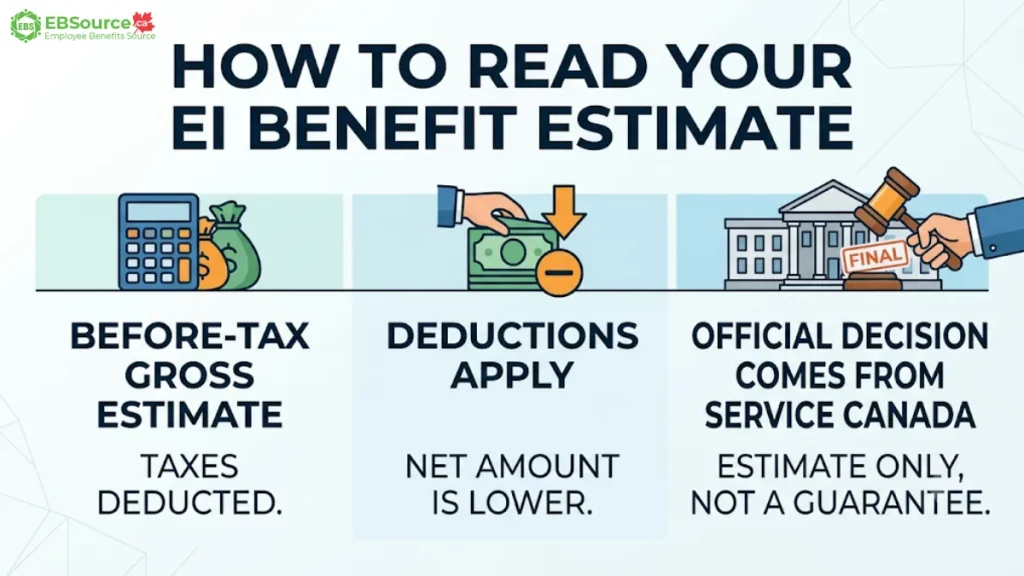
When interpreting the results from the EI sickness benefit calculator, keep three important points in mind. First, consider them as a before-tax estimate rather than a final decision. Moreover, remember that EI benefits are taxable and only Service Canada determines your actual entitlement. Lastly, the usual one-week waiting period is currently waived for new claims that start between March 30, 2025, and October 10, 2026.
Three key factors to keep in mind are:
The Figures Are Before Tax
EI benefits are taxable income, and income tax is deducted from payments. Your net deposit can therefore be lower than the gross weekly estimate, and your final tax position depends on your overall income and deductions.
The Usual Waiting Period Is Currently Waived For New Claims
Normally, there is a one-week unpaid waiting period before benefits begin. However, under a temporary EI measure, this waiting period is waived for all new EI claims that start between March 30, 2025, and October 10, 2026.
For instance, a 10-week claim at $550 per week can total the full $5,500 if all 10 weeks are payable. Claimants may choose to serve the waiting period if it is beneficial for them, especially in the case of a Supplemental Unemployment Benefit (SUB) top-up. Separately, Service Canada says the first payment is generally issued about 28 days after you apply if you are eligible and all required information has been provided.
It Is An Estimate, Not A Decision
Only Service Canada determines actual entitlement, based on your full claim history and circumstances. It means that while EBSource’s Employment Insurance sickness calculator gives you a clean estimate, a few real-world situations can cause Service Canada’s result to differ from the estimate.
| Situation | What the EI sickness calculator may show | What can make the official EI result different |
|---|---|---|
| You have close to 600 insurable hours | Likely passes the initial hours screen | A recent claim can shorten your qualifying window, so the same hours may not all count |
| You worked fewer weeks than your region’s best-weeks number | A lower average, since empty weeks may enter the divisor | Missing weeks can change how the average is built and lower your rate |
| You receive employer-paid sick leave or short-term disability | A weekly estimate may still appear | These payments can affect timing, allocation, or how EI coordinates with them |
| You receive an EI top-up (SUB plan) | The same weekly EI estimate | You may choose to serve the waiting period if it benefits your SUB arrangement |
| You have variable tips or commissions | An estimate that may be too low if you enter net or annual figures | See Input 3 for recent-claim rules, and Input 2 for how irregular pay is allocated |
Worked Example: Estimating Your Weekly EI Sickness Benefit
Take a claimant in a 22-week region such as Halifax or Winnipeg whose gross earnings averaged $1,000 across those 22 best weeks, for a total of $22,000. Here is the EI sickness calculation in five lines:
| Line | What to enter | Example |
|---|---|---|
| A | Total insurable earnings from your best weeks | $22,000 |
| B | Number of best weeks for your region (14 to 22) | 22 |
| C | Average insurable weekly earnings (A ÷ B) | $1,000 |
| D | Raw weekly benefit (C × 0.55) | $550 |
| E | Your estimate (lesser of D or $729) | $550 |
Line B is the one worth pausing on. Your region’s best-weeks number is set by where you live, not by how many weeks you happened to work, and it is the input people most often get wrong. A region with higher unemployment uses fewer weeks, which tends to raise your average, because more of your low-earning weeks drop out of the divisor. A region with lower unemployment uses more weeks, which tends to lower it.
How Do Best Weeks Work When Your Pay Varies
The best-weeks calculation matters most when earnings vary from week to week. Marc works in a region that uses 20 best weeks. During his qualifying period, his weekly earnings varied significantly: roughly $1,300 in strong weeks with overtime and bonuses, and as little as $500 in slow weeks.
Marc lists every Sunday-to-Saturday week, ranks them from highest to lowest, and uses his 20 highest-paid weeks. His slowest weeks fall out of the EI sickness calculation entirely. Those 20 weeks total $24,000, and that is the figure his EI sickness benefit is built from.
- Line A: $24,000
- Line B: 20
- Line C: $24,000 ÷ 20 = $1,200
- Line D: $1,200 × 0.55 = $660
- Line E: lesser of $660 and $729 = $660
If Marc had instead averaged all 52 weeks, his quiet weeks would have dragged his average well below $1,200, and his benefit would have been lower. The best-weeks rule is designed to protect exactly this kind of earner.
What Happens When Your Earnings Reach The Cap
The $729 ceiling is where higher earners stop seeing a bigger benefit. For example, if your average insurable weekly earnings were $1,400 instead of $1,000, Line D would be $770. But because of the 2026 weekly maximum limit, Line E is capped at $729. This is why two people with very different salaries can get the same weekly amount once both go over the limit.
The cap comes from the 2026 Maximum Insurable Earnings (MIE). Because EI only counts earnings up to the $68,900 MIE for 2026, the highest weekly benefit is 55% of $68,900 ÷ 52, which rounds to $729. Anyone earning about $68,900 a year or more reaches this ceiling and receives the maximum.
| Average insurable weekly earnings | Raw benefit (× 0.55) | Weekly estimate after cap |
|---|---|---|
| $700 | $385 | $385 |
| $1,000 | $550 | $550 |
| $1,325 | $728.75 | $729 |
| $1,400 | $770 | $729 |
| $1,800 | $990 | $729 |
What Should You Do After Running the Employment Insurance Sickness Calculator?
Do not disqualify yourself based on a rough estimate from an Employment Insurance sickness calculator. If you think you might qualify for benefits, apply online as soon as possible after you stop working. Delaying your application for more than four weeks after your last day of work could result in a loss of benefits. You do not need to have all your documents ready to submit your application.
After you apply, remember to submit your reports to Service Canada every two weeks and declare any work or earnings you may have. Besides, check if your employer offers paid sick leave, short-term disability, or an EI top-up, as these can affect how your income is managed while you are off work.