


EI Economic Region
Average Insurable Weekly Earnings
Insurable Hours in Your Qualifying Period
Basic Eligibility Check
Family Supplement
If your net family income after tax from the last tax year is no more than $25,921, you have at least one dependent child under 18 in your family, and you or your spouse receives the Canada Child Benefit, you may qualify for the Family Supplement. Please note this low-income top-up is not included in our calculator.
Your EI regular benefits estimate
Sample scenario shown - Use your own numbers to get started!
- This calculation is only an estimate. EI benefits are taxable, and the amounts shown are gross totals before deductions.
- For new EI claims starting from March 30, 2025 through October 10, 2026, the usual one-week waiting period is currently waived. A claimant with an eligible SUB top-up may choose to serve the waiting period if doing so is more advantageous. Check the current Service Canada rule if your claim starts after October 10, 2026.
- Apply as soon as you stop working. Delaying more than 4 weeks may cause you to lose benefits.
- You can apply even if you have not received the Record of Employment (ROE). Submit the ROE once your employer issues it.
Estimated breakdown of your EI regular benefits
Estimated breakdown of your EI regular benefits
| Regional unemployment rate | Toronto - 6.8% |
|---|---|
| Required insured hours | 665 hours |
| Number of best weeks | 21 weeks |
| Weekly EI regular benefit amount |
$1,000.00 x 55% = $550.00 The maximum weekly benefit is $729. Since $550.00 is below this limit, you receive $550.00 per week. |
| Number of payable weeks |
23 weeks Calculated using the official Service Canada duration table based on your region's unemployment rate (6.8%) and your insured hours (1,200). |
| Estimated total (gross) | $550.00 x 23 = $12,650.00 |
Data sources: Regional unemployment rates and best-weeks divisors are based on Service Canada’s current EI Program Characteristics table. A notice of violation from a previous EI claim can increase the number of hours required. This calculator uses rules for claims beginning in 2026 and the EI regional data period shown below. It should not be used to recalculate an earlier claim. EI regional data period: September 6, 2026 to October 10, 2026. Last verified by EBSource: September 7, 2026.
Losing a job often leaves you uncertain about your financial future, and a common first question is this: how much will Employment Insurance (EI) pay, and for how long? To get an estimate, you can use EBSource’s EI Regular Benefits Calculator.
It uses three main inputs, which are your average insurable weekly earnings, your insurable hours, and your EI economic region. Whenever possible, find the earnings and hours figures on your pay stubs and Records of Employment rather than estimating them.
Using these details, the Canada unemployment benefits calculator can estimate your weekly benefit amount and the number of standard benefit weeks you may receive. It can also check whether your insurable hours meet the standard regional threshold, but keep in mind that it cannot determine whether you qualify for EI.
What Information Do You Need for the EI Regular Benefits Calculator?
Before you use our EI regular benefits calculator, gather three pieces of information: your average insurable weekly earnings, your insurable hours, and your EI economic region.
These three inputs are enough to calculate a standard EI regular-benefit estimate. Your actual entitlement can differ because of prior EI claims or violations, seasonal-worker rules, temporary measures, the Family Supplement and Service Canada’s eligibility determination. Your earnings decide the amount, while your hours and region decide how long you get benefits.
Here is what you need before using our Canada unemployment benefits calculator:
| EI regular calculator input | Where to find it |
|---|---|
| Your average insurable weekly earnings, based on your highest-paid weeks (“best weeks”) and including insurable tips, bonuses, overtime, and commissions | Pay stubs or your ROEs, not your current salary. Estimating from your latest pay is a common reason your actual EI payment may differ from the estimate. |
| Insurable hours worked in the last 52 weeks or since your last claim, whichever is shorter | Your ROEs, across all employers, including short-term jobs and second jobs. |
| Your exact EI economic region | The official postal code lookup. Do not select by city name, because one city can straddle two regions with different rules. (*) |
(*) The unemployment rate in your EI economic region greatly affects how long your benefits last. For example:
- If you worked 700 insurable hours in a region with 6.0% unemployment, you would receive about 14 weeks of EI regular benefits. If the regional unemployment rate were between 6.1% and 7%, the same 700 hours would provide about 16 weeks.
- With more hours, the same pattern holds: a worker with 1,400 insurable hours gets more weeks in a higher-unemployment region than in a lower one, because each unemployment band shifts the entitlement in Schedule I of the Employment Insurance Act. Because durations move in steps by band, always check the official hours-and-duration table for your exact rate rather than rounding to a nearby band
Note that the unemployment rate also affects how many hours you need to qualify in the first place, from 700 hours when unemployment is 6% or less to 420 hours when it exceeds 13%. In the current September 6 to October 10, 2026 rate period, the range is from 420 hours in Northern Manitoba (28.7% unemployment) to 700 hours in regions like Halifax, Winnipeg, and Victoria.
In addition, some information matters for your EI claim even though the Employment Insurance regular benefits estimate does not collect it. Do not wait for your Record of Employment before applying: if your employer submits the ROE electronically, Service Canada receives it directly, but if your employer issues a paper ROE, you will need to provide the original to Service Canada after you apply.
The reason your employment ended is not a calculator input, but it can affect whether you qualify for EI regular benefits. The timing of your claim determines which Service Canada regional-rate period applies. Temporary measures use their own date tests, such as the official claim-start date or the separation-earnings allocation date.
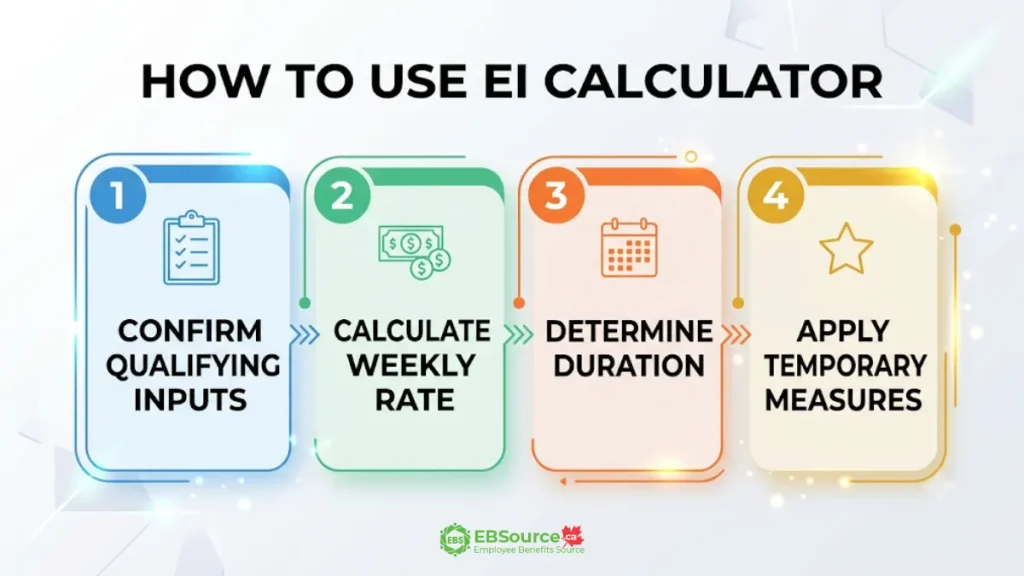
How to Use EBSource’s EI Regular Benefits Calculator
Calculating your EI regular benefit involves four steps: confirming your qualifying inputs, calculating your weekly benefit rate, determining your benefit duration, and finally applying any temporary measures tied to your claim start date.
The following will walk you through each step using the most recent 2026 federal and regional figures:
Step 1: Check Whether You Meet the Basic Requirements
You usually qualify if you lost your job through no fault of your own, have been without work and pay for at least 7 days in a row in the last year, and have worked enough hours during your qualifying period. You also need to be ready, willing, and able to work every day, and actively looking for jobs. Keep a written record of the employers you contact and the dates you reach out to them.
Remember that eligibility continues throughout your claim. To keep receiving payments, you must file EI reports every two weeks, either online or by phone. If you do not file these reports, you could lose your employment insurance benefits.
Insurable hours and the qualifying period
Depending on your regional unemployment rate, you need between 420 and 700 hours of insurable employment during your qualifying period. Higher local unemployment means fewer required hours.
Your qualifying period is determined by the shorter of the following two options:
- The 52 weeks immediately before the start date of your claim, or
- The period since the beginning of your last benefit period, if you had an approved claim within the last 52 weeks.
In some cases, the qualifying period can be extended in specific circumstances recognized under section 8 of the Employment Insurance Act, up to a maximum of 104 weeks. Check the official rule rather than assuming any period without work qualifies. For example, in an area with 6% unemployment, a serious violation raises the required hours from 700 to 1,050.
How much more depends on the violation’s severity. The extra hours are not a simple doubling; they rise in steps with the severity of the violation. For an area with 6% unemployment or less, where 700 hours is the usual requirement, the table below shows how the threshold changes:
| Violation level | Required hours (6% unemployment or less) |
|---|---|
| No violation | 700 |
| Minor | 875 |
| Serious | 1,050 |
| Very serious | 1,225 |
| Subsequent | 1,400 |
The Canada unemployment benefits calculator uses the standard 420-to-700-hour thresholds and does not account for a previous notice of violation. If a violation applies, the number of insurable hours you need to qualify may be higher than the calculator shows.
Step 2: Calculate Your Weekly Benefit Rate
For most people, the weekly payment is 55% of their average insurable weekly earnings, with a cap of $729 per week for 2026. This limit is reached when insurable earnings hit the maximum of $68,900 for 2026, which is about $1,325 per week. So, earning more than this does not increase the Employment Insurance regular benefit.
Note: The $729 maximum applies to claims starting in the week of December 28, 2025, or later (Service Canada states the new maximum is in effect as of January 1, 2026). Claims started before that date will keep the 2025 maximum of $695 for the whole claim.
Your average insurable weekly earnings are calculated using your highest-paid weeks of employment, known as your “best weeks.” Depending on your regional unemployment rate, Service Canada uses between 14 and 22 best weeks. It totals the insurable earnings from those weeks, divides by the required number of weeks, and then applies the 55% benefit rate. A lower regional unemployment rate generally means more best weeks are included; a higher rate means fewer are used.
Using a smaller number means leaving out more low-earning weeks, which can lead to a higher weekly benefit in places with high unemployment, especially if earnings come from fewer, higher-paying weeks.
Example of Calculating Your Weekly Benefit Rate
Once your average insurable weekly earnings are established, the 55% formula produces the following estimates. Across these three earnings examples, the weekly EI regular amount ranges from $385 to the 2026 maximum of $729:
| Average insurable weekly earnings | Weekly EI estimate (55%) | Notes |
|---|---|---|
| $700 | $385 | Below the cap |
| $1,000 | $550 | Below the cap |
| $1,325 or more | $729 | Hits the 2026 maximum |
One rule that surprises many applicants is that once your weekly benefit amount is set, it stays the same for the whole time you claim benefits. This means it will not go up if local conditions get worse, and it will not be changed if you find a higher-paying job during your claim. So, it is very important to have the right best-weeks figure when you start your claim.
Why Your EI Payment Can Differ From Your Benefit Rate
Your weekly benefit rate is the gross amount established for your claim, but it may not be the amount you actually receive. Three main factors can change your payment: the family supplement, earnings while receiving EI and income tax deductions.
Family Supplement
If your net family income is $25,921 or less, you have at least one dependent child under 18, and either you or your spouse gets the Canada Child Benefit, you might qualify for a family supplement that can raise your benefits to up to 80% of your average insurable earnings. This supplement decreases as your income rises and stops completely once you reach the $25,921 limit.
If both spouses are claiming Employment Insurance at the same time, only one can get the supplement, and it usually makes more sense for the spouse with the lower benefit amount to take it. Please note the EI regular benefits calculator does not include this low-income top-up in its estimates.
Earnings While Receiving EI Regular Benefits
Earnings while receiving benefits can affect your payment for a specific week, but they do not change your overall rate. If you work while claiming EI regular benefits, your payment will be reduced by 50 cents for every dollar you earn, up to 90% of the weekly earnings used to establish your claim. Any earnings above this threshold will reduce your benefits dollar for dollar.
You will not receive any benefits for any week in which you work a full work week, regardless of how much you earn. However, those weeks still have to be payable within your benefit period. Therefore, part-time or casual work can lower your payment for a specific week without affecting your overall entitlement. Be sure to report all earnings on your biweekly reports.
Income Tax
Remember that EI benefits are taxable, and both federal and provincial or territorial taxes will be withheld from each payment. Your gross benefit rate stays the same; the amount deposited is smaller. So, when budgeting, use your expected after-tax payment rather than the gross weekly benefit rate. Use EBSource’s income-tax calculator for broader after-tax planning.
Step 3: Determine Your Benefit Duration
Standard EI regular benefits last between 14 and 45 weeks. The length depends on how many insurable hours you have worked and the unemployment rate in your area when you start your claim, not on how much you earned.
One rule can extend your benefits under the standard program. If you are an eligible seasonal worker in one of 13 targeted EI economic regions, you may receive up to five additional weeks of EI regular benefits, subject to the 45-week maximum. The current measure applies to qualifying claims starting September 8, 2024, through October 24, 2026. Eligibility also depends on the claimant’s previous EI claim history.
This EI regular calculator does not assess the seasonal-worker measure. Make sure to check the latest Service Canada rules for your area and work schedule.
Step 4: Check Whether Temporary Measures Apply
Three temporary federal measures can affect your claim: a waived waiting period, severance not deducted, and a long-tenured worker extension. Different dates are used to determine whether each measure applies. The waiting-period waiver and long-tenured-worker extension depend on when the claim starts. For separation earnings, the temporary rule can apply when either the claim or the allocation of the separation earnings starts within the applicable window. The date you submit the application is not itself the test for these measures.
The EI regular benefits calculator does not apply these temporary measures; its results reflect the standard rules only, so treat this step as a manual check on top of your estimate.
Waived Waiting Period
For new EI claims starting from March 30, 2025 through October 10, 2026, the usual one-week waiting period is waived. A claimant with a Supplemental Unemployment Benefit (SUB) top-up may choose to serve the waiting period if doing so is more advantageous. Check the current Service Canada rule if your claim starts after October 10, 2026.
Temporary Treatment of Separation Earnings
Under the normal EI rules, severance pay, vacation pay, or pay in lieu of notice may be allocated beginning with the week of separation. That allocation can reduce or delay EI payments for the affected weeks. For claims established or allocations commencing between March 30, 2025 and October 10, 2026, this counting is paused.
Long-tenured Worker Extension
This is the only temporary measure that increases your maximum number of benefit weeks. Eligible long-tenured workers can get up to 20 extra weeks of EI regular benefits, to a total of up to 65 weeks, for claims that start between June 15, 2025 and October 10, 2026. Your benefit period is extended by 20 weeks as well, so you have time to use the extra weeks.
You do not have to apply for the long-tenured extension. If you qualify, the extra weeks are added to your claim automatically. To receive the extra weeks, you must meet all of the following:
- your claim starts between June 15, 2025 and October 10, 2026
- you have received at least one week of EI regular benefits on the claim
- you received fewer than 36 weeks of EI regular or EI fishing benefits in the three years before your claim starts
- you paid at least 30% of the annual maximum EI premiums in at least 7 of the 10 years before the year your claim starts
Unless the federal government extends the measures, here is what changes:
| Rule | Current temporary rule | After the temporary measure ends* |
|---|---|---|
| Waiting period | Waived for all new EI claims | The one-week waiting period applies again |
| Separation earnings | Not deducted from benefits | Allocated from the week of separation, delaying benefits |
| Long-tenured worker extension | Up to 65 weeks of regular benefits if all four conditions above are met | Standard maximum of 45 weeks |
Source: Temporary EI measures for major economic conditions – Government of Canada
*Unless the government changes or extends the measures.
Step-by-step Calculation Example of EI Benefits in Canada
Consider someone in Calgary who has $23,100 in insurable earnings across their highest-paid weeks and 700 insurable hours during the September 6 to October 10, 2026 rate period. It assumes the worker was laid off, has no prior claims or violations, and does not qualify for the family supplement.
Here is how they would use the Employment Insurance benefits calculator. After confirming their region with the official postal code lookup, they select Alberta, then Calgary, in the tool. Calgary’s 6.5% unemployment rate means only 665 insurable hours are needed to qualify, which this worker’s 700 hours comfortably exceed, and the EI regular estimator displays a divisor of 21 best weeks.
The worker divides $23,100 by 21 to get an average of $1,100 per week, enters $1,100 in the earnings field and 700 in the hours field, confirms the eligibility checkboxes, and clicks Calculate. The result is an estimated weekly benefit of $605 payable for 16 weeks.
The estimated totals are the result of:
- Best-weeks average: $23,100 ÷ 21 = $1,100 per week
- Weekly benefit: 55% × $1,100 = $605
- Standard benefit duration: 16 weeks at 700 insurable hours and a 6.5% regional unemployment rate
- Estimated total gross benefits: $605 × 16 = $9,680
This table shows each step to figure out the estimated EI regular benefit for Calgary in 2026:
| Line item | Amount |
|---|---|
| Best-weeks insurable earnings | $23,100 |
| Regional unemployment rate | 6.5% |
| Hours required to qualify | 665 hours |
| Worker’s insurable hours | 700 hours |
| Best-weeks divisor | 21 weeks |
| Average insurable weekly earnings | $23,100 ÷ 21 = $1,100 |
| Weekly benefit rate | 55% × $1,100 = $605, under the $729 cap |
| Insurable hours | 700 |
| Estimated duration | 16 weeks |
| Estimated total benefits | 16 × $605 = $9,680 before tax |
Why the estimate came out this way
The result above is not just a single number. Each input pushed it in a specific direction, and seeing which input did what helps you spot where your own estimate might differ:
| Result driver | This example | Why it matters |
|---|---|---|
| Postal code | Calgary EI region | Identifies the applicable EI economic region |
| Claim timing | September 7, 2026 | Identifies the relevant regional-rate period and determines whether claim-start-based measures, such as the waiting-period waiver and long-tenured extension, fall within their current windows |
| Regional rate | 6.5% | Sets the 665-hour entrance requirement, the 21-week divisor, and the hours-to-duration column |
| Best-weeks earnings | $23,100 | Produces the $1,100 weekly average |
| Insurable hours | 700 | Produces 16 standard benefit weeks |
| Long-tenured status | Not assessed by the EI benefits estimate | Would decide whether up to 20 extra weeks could apply |
Note: Results are estimates and may vary if you hold multiple jobs, have prior claims within 52 weeks, received a notice of violation, qualify under special rules for fishers, teachers, apprentices, or the self-employed, or if your earnings' insurability is in question.
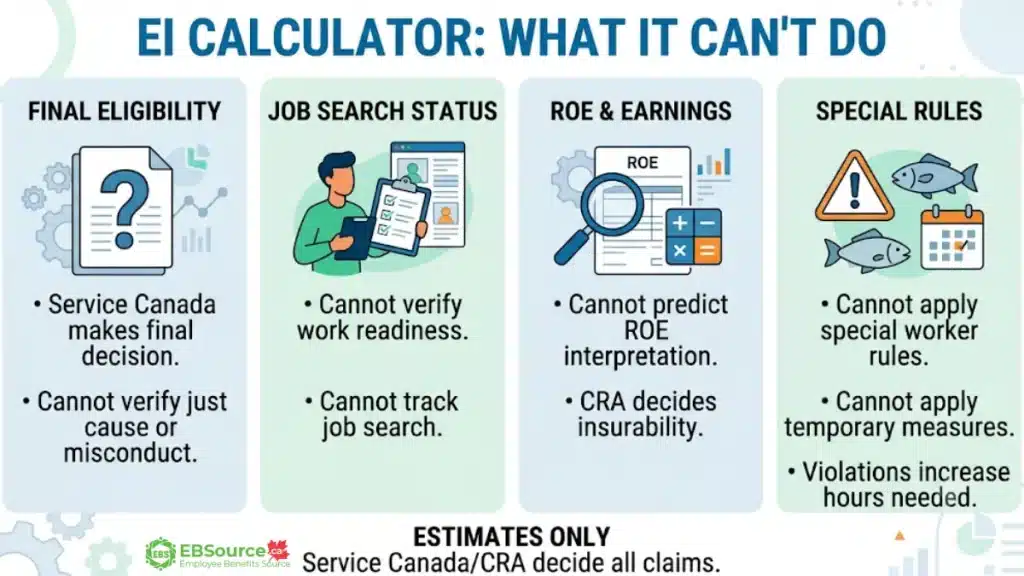
What the EI Regular Benefits Calculator Cannot Determine
The Canada unemployment benefits calculator can help you figure out your weekly benefit amount and how long your benefits will last. But it cannot decide if you qualify. Whether you qualify depends on details that only Service Canada and the CRA can check.
Specifically, this EI regular estimate tool cannot determine:
- whether a quit had just cause or a dismissal constitutes misconduct
- whether you are available for and actively seeking work (keep a written record of the employers you contact and when)
- whether particular earnings are insurable, which the CRA determines
- how Service Canada will interpret your Record of Employment
- whether a notice of violation raises your hours threshold
- whether you qualify under special rules for fishers, teachers, apprentices, farmers, or self-employed workers
- whether the temporary measures (waived waiting period, separation-earnings treatment, or the long-tenured extension) apply to your claim
EI regular benefits are designed for layoffs, shortages of work, and seasonal closures. It can be affected if you voluntarily leave employment without just cause, are dismissed for misconduct, are not capable of or available for work, or are confined in a jail or similar institution. These are fact-specific eligibility questions that the EI regular benefits calculator cannot decide. So when unsure, apply anyway and let Service Canada decide.