


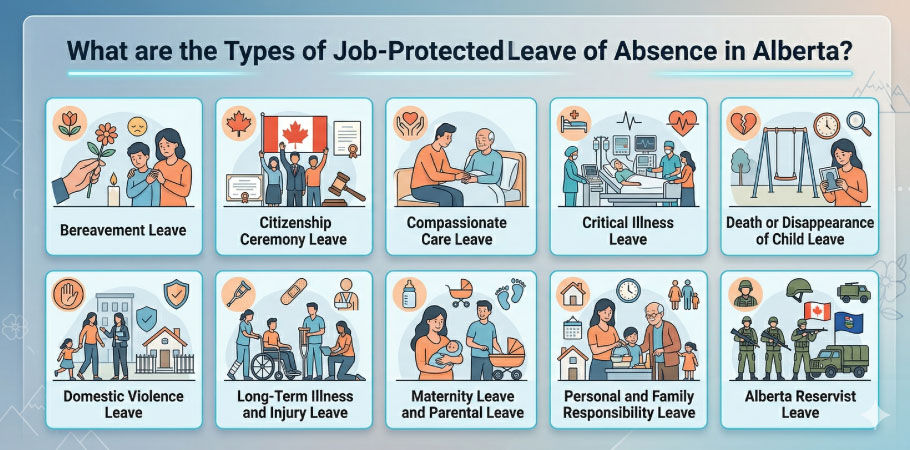
Alberta’s Employment Standards Code provides 10 leave categories for eligible, provincially regulated employees. To qualify, 9/10 of these leaves require you to have worked for your employer for at least 90 continuous days.
However, it is crucial to understand the difference between job protection and pay. None of Alberta’s statutory leaves require your employer to pay your wages. Depending on eligibility and plan terms, income during leave may come from Employment Insurance (EI), paid employer policies, disability benefits or other sources.
As part of our Leave of Absence in Canada series, this guide explains these provincial leave-of-absence types and where to find income support. It applies specifically to employees covered by Alberta’s Employment Standards Code. Federally regulated employees, independent contractors and workers subject to an industry or occupational exception may have different rights.
What Is Different About Leave of Absence in Alberta?
Most Alberta leaves of absence require at least 90 continuous days of employment with the same employer, while reservist leave uses a 12-consecutive-week threshold. Long-term illness and injury leave increased to 27 weeks per calendar year on January 1, 2026.

If you’ve worked elsewhere in Canada or consulted a general employment guide, these specific Alberta rules are important to note.
- Nine of Alberta’s ten leave categories generally use a 90-day same-employer threshold. Employees must also meet the conditions of the specific leave.
- In Alberta, there is no legal requirement for your employer to pay you during any of the 10 statutory leaves or to provide paid sick days.
- Beginning January 1, 2026, Alberta employees can take up to 27 weeks of job-protected medical leave, increased from 16 weeks. A transition rule may affect leaves that began earlier.

Note: Reservist leave is the only type of statutory leave in Alberta that has a different service requirement, in which you must work for the same employer for 12 consecutive weeks.
What Types of Job-Protected Leave Are Available in Alberta?
Alberta provides 10 categories of job-protected leave for eligible employees covered by the province’s Employment Standards Code. These statutory leaves are unpaid, but employees may access separate income sources depending on the circumstances and each program’s eligibility rules.
The table identifies potential income options associated with each leave. Inclusion does not guarantee eligibility or payment; employees must apply separately and meet the rules of the employer plan, insurance policy or government program.
| Leave Type | Income Options |
|---|---|
| Bereavement | Employer-paid bereavement or other paid leave, if offered; Paid vacation if scheduled or approved |
| Citizenship ceremony | Employer-paid personal or other paid leave, if offered; Paid vacation if scheduled or approved |
| Compassionate care | EI compassionate care benefits; An Employer SUB top-up, if a qualifying plan is offered |
| Critical illness | EI family caregiver benefits for an adult or child, depending on the care recipient; Employer SUB top-up, if offered. |
| Death or disappearance of a child | Canadian Benefit for Parents of Young Victims of Crime, subject to separate federal eligibility rules. |
| Domestic violence | Employer-paid leave, if offered; Alberta emergency financial assistance may be available under separate eligibility rules. |
| Long-term illness and injury | Employer sick pay or salary continuation; STD or LTD if covered by the plan; EI sickness benefits if eligible |
| Maternity and parental | EI Maternity Benefits; EI Parental Benefits; Employer SUB top-up. |
| Personal and family responsibility | Employer-paid personal or sick leave, or vacation pay, may be available. |
| Reservist | Canadian Armed Forces (CAF) pay and allowances applicable to the qualifying service or training; Employer top-up, if offered |
Job protection and income support are separate. Qualifying for an Alberta leave does not automatically qualify an employee for EI, disability benefits, employer pay or another income-support program.
Bereavement Leave in Alberta
Employees who qualify can take leave to deal with the loss of a family member or if they’ve experienced a pregnancy loss.
For Alberta bereavement leave, “family member” includes immediate and extended relatives, relatives of a spouse or partner, and someone considered like a close relative. Pregnancy-loss coverage can extend to the pregnant person, their partner, or another person intending to become a parent.

At a glance
- Time available: Up to 3 days in total per calendar year.
- Notice: As soon as reasonably possible.
- Evidence: Not required.
What matters in practice
- The limit is annual, not per death or pregnancy loss. If you take 2 days off after a death, you will have only 1 statutory day left for another loss in the same calendar year.
- If 3 days are not enough, check whether your workplace policy, employment contract or collective agreement provides additional paid or unpaid time.
Source: Bereavement leave | Alberta.ca
Citizenship Ceremony Leave in Alberta
Eligible employees can take leave to attend their Canadian citizenship ceremony and get their certificate.
At a glance
- Time available: Up to one half-day.
- Notice: As soon as reasonably practicable.
- Evidence: Not required.
What matters in practice
- The leave is available only once.
- Plan around the ceremony notice. When Immigration, Refugees and Citizenship Canada sets your ceremony date, inform your employer and keep the notice for future reference.
Source: Citizenship ceremony leave | Alberta.ca
Compassionate Care Leave in Alberta
Employees may take time off to care for a significantly ill family member who is at risk of passing away within the next 26 weeks.
At a glance
- Time available: Up to 27 weeks, taken continuously or in separate periods of at least one week.
- Notice: Provide at least 2 weeks’ notice, including the return date. If that’s not feasible, notify the employer as soon as possible.
- Evidence: A medical certificate from a physician or nurse practitioner is required.
What matters in practice
- Two employees working for the same employer may face a restriction. If two people qualify for leave for the same family member, the employer isn’t required to grant it to both at the same time.
- The family member does not have to live in Alberta.
- To return to work, employees generally need to give a week’s written notice unless agreed otherwise. If they are not returning, they should provide two weeks’ written notice.
- If the family member still needs care after the leave ends, the employee can request another leave with a new medical note.
Source: Compassionate care leave | Alberta.ca
Critical Illness Leave in Alberta
Eligible employees may take leave to provide care/support to a critically ill child or adult family member.
At a glance
- Time available: Up to 36 weeks for a child under 18 or up to 16 weeks for an adult.
- Notice: Provide at least 2 weeks’ notice, including the return date. If that’s not feasible, notify the employer as soon as possible.
- Evidence: A medical certificate from a physician or nurse practitioner is required.

Alberta critical illness leave provides up to 36 weeks when the person receiving care is a child under 18 and up to 16 weeks when caring for an adult. The leave ends at the earliest of the statutory maximum, the end of the care period stated in the medical certificate, when the employee stops providing care, or when the family member dies.
What matters in practice
- You can divide the leave into separate periods. Each period must be at least one week long.
- More than one relative may qualify, but simultaneous leave is not guaranteed. If multiple family members caring for the same person work for the same employer, the employer is not obligated to grant simultaneous leave to more than one.
- If the family member still needs care after the leave is over, the employee can provide a new medical certificate to request additional leave.
Source: Critical illness leave | Alberta.ca
Death or Disappearance of Child Leave in Alberta
Eligible employees can take job-protected leave when a child under 18 dies or goes missing due to a criminal offence.
At a glance
- Time available: Up to 52 weeks after a child disappears or up to 104 weeks after a child dies.
- Notice: Leave can start on the date of death or disappearance. Provide written notice as soon as possible, including the estimated return date if known.
- Evidence: Reasonable verification is required.

When a missing child is found alive, leave ends at the earlier of 14 days after the child is found or 52 weeks after the original disappearance. If the child is later found deceased due to a crime, leave may extend to 104 weeks from that original date.
What matters in practice
- The probable-crime condition is essential. The situation must suggest that a crime under the Criminal Code likely led to what happened.
- An employee charged with the offence is not entitled to the leave. If someone is charged while on leave, their leave ends on the date of the charge.
- The leave may end when it’s unlikely that the death or disappearance was due to a crime.
Source: Death or disappearance of child leave | Alberta.ca
Domestic Violence Leave in Alberta
Eligible employees can take time off to handle the effects of abuse involving themselves, their dependent child, or a protected adult they live with.
The leave must be used for a permitted purpose, such as obtaining medical care, counselling, victim services, relocation, legal assistance or law-enforcement assistance.
At a glance
- Time available: Up to 10 days per calendar year.
- Notice: As soon as reasonably possible.
- Evidence: Not required.
What matters in practice
- The limit is annual, not per incident. Unused days do not carry over.
- Domestic violence includes physical assault, threats, psychological or emotional abuse, forced confinement, coerced sexual contact and stalking.
- The person responsible may be a spouse, partner, co-parent, relative, or another person protected by legislation.
Alberta’s Family Violence Info Line is also available 24/7 at 310-1818, with assistance in more than 170 languages.
Source: Domestic violence leave | Alberta.ca
Long-Term Illness and Injury Leave in Alberta
Employees can take this leave if they’re sick, hurt, or in quarantine and can’t work.
At a glance
- Time available: Up to 27 weeks per calendar year.
- Notice: As soon as reasonably possible, and include the employee’s estimated return date.
- Evidence: A certificate from a physician or nurse practitioner is required.
What matters in practice
- The medical certificate must state the estimated leave duration.
- Employees must notify their employer if their estimated return date changes.
Source: Long-term illness and injury leave | Alberta.ca
Maternity Leave and Parental Leave in Alberta
Maternity leave is for time off during pregnancy and childbirth, while parental leave lets parents care for their new child.
At a glance
- Time available: Up to 16 weeks of maternity leave & up to 62 weeks of parental leave.
- Notice: Give at least six weeks’ notice before taking leave and four weeks’ notice before returning, or if you won’t be back.
- Evidence: A certificate from a physician or nurse practitioner may be required.

Maternity leave may begin within the 13 weeks before the due date but must start by the birth date. A birth mother taking maternity and parental leave may be away for up to 78 weeks in total, while parental leave must be completed within 78 weeks of birth or adoption.
What matters in practice
- If a pregnancy ends within 16 weeks of the due date, the employee may qualify for maternity leave but not parental leave. Bereavement leave may also apply.
- Parents may share parental leave. If both work for the same employer, they can share 62 weeks of leave, but the employer does not have to allow them to take it at the same time.
If you cannot provide six weeks’ notice due to medical reasons or issues related to birth or adoption:
- Maternity leave: You must provide written notice and a medical certificate within two weeks after the last day of work, or as soon as possible.
- Parental leave: You must provide written notice as soon as possible.
Source: Maternity and parental leave | Alberta.ca
Personal and Family Responsibility Leave in Alberta
Eligible employees can take protected time off for their own health or to care for a family member.
At a glance
- Time available: Up to five days per calendar year.
- Notice: As soon as reasonably possible.
- Evidence: Not required.
What matters in practice
- Covered family members include a spouse or partner, parents, children, foster relatives, guardians, siblings, grandparents and grandchildren.
- A person who lives with the employee as a family member may also qualify.
- The five days are a combined annual entitlement for both personal health matters and family responsibilities.
Source: Personal and family responsibility leave | Alberta.ca
Reservist Leave in Alberta
Military reservists can take time off work for certain Canadian Forces operations, annual training, and other related activities.
At a glance
- Who qualifies: Reservists who have been with the same employer for at least 12 weeks in a row.
- Time available: The time necessary to participate in a qualifying operation, annual training or related activity.
- Notice: At least four weeks’ written notice before leave. If that’s not possible because of an urgent deployment, notify the employer in writing as soon as possible.
- Evidence: A document from the employee’s commanding officer, if requested.
What matters in practice
- Qualifying activities include deployment to a Canadian Forces operation outside Canada; deployment inside Canada to assist with an emergency or its aftermath; annual training and related travel; and other prescribed operations.
- Leave days do not have to be consecutive.
- Notify your employer in writing as soon as possible if your leave duration changes.
- For leave lasting four weeks or less, employees must give written return notice as soon as possible. For longer leave, at least four weeks’ written return notice is required.
Source: Reservist leave | Alberta.ca
Can You Receive Income While on an Unpaid Alberta Leave?
Leaves provided under Alberta’s Employment Standards Code are unpaid. That said, you may be able to receive income from an employer-paid leave program, workplace insurance, Employment Insurance (EI), workers’ compensation, or another benefit program.
Each payment has its own qualifying event, application process, medical evidence requirements, payment period, and coordination rules.
What Income Can Come Directly From Your Employer?
Start by checking whether your employment contract, collective agreement or workplace policy provides paid leave, salary continuation, another employer-funded benefit, paid vacation, or hardship programs.
Common employer-related income options include the following; availability and terminology vary by workplace:
- Paid Sick or Personal Leave: Some employers provide a bank of paid sick or personal days under an employment contract, workplace policy, or collective agreement.
- Salary Continuation: Your employer keeps paying some or all of your regular salary for a defined period while you’re off.
- Supplemental Unemployment Benefit (SUB) Top-Up: Some employers top up EI maternity, parental, sickness, or caregiving benefits through a plan called a Supplemental Unemployment Benefit (SUB) plan.
- Paid Vacation or Banked Time: An employee may be able to schedule paid vacation or use an eligible banked-time arrangement.
- Employer Emergency or Hardship Programs: Some employers offer emergency grants, payroll advances, or special paid leave for employees facing financial hardship.
What Income Can Come From Disability Insurance?
If you cannot work because of an illness or injury, short-term disability (STD) or long-term disability (LTD) insurance may replace part of your income. Those benefits may be provided through your employer, union or another workplace plan, but approval depends on the terms of the applicable policy.
Disability income commonly moves through the following stages:
- Waiting period: During this period, you may need to rely on paid sick leave, salary continuation or EI sickness benefits, where available and permitted.
- STD benefit period: If the claim is approved, the STD plan may replace part of eligible earnings for the period and amount permitted by the policy, subject to its definition of disability, exclusions and offsets.
- Transition to LTD: The LTD plan will apply its own definition of disability, medical-evidence requirements and elimination period.
- LTD benefit period: If approved, long-term disability (LTD) benefits may continue after Alberta’s job protection period, depending on the policy’s conditions and medical requirements.

Keep the two timelines separate: Disability insurance determines if you will receive income. Alberta’s job protection rules set a specific timeframe. Approval under one system doesn’t guarantee eligibility under the other, and the end of one period doesn’t end the other.
What Income Can Come From Employment Insurance Special Benefits?
An Alberta leave may also fall within one of the federal EI special-benefit categories. The provincial leave and federal EI benefit must be assessed separately.
The maximum period for EI benefits isn’t the total number of weeks you’ll be paid. Your actual payment duration depends on your eligibility, timing, chosen benefits, and any weeks shared with another eligible person.
What Income Can Come From Workers’ Compensation?
If the illness or injury is work-related, you may be eligible for wage-replacement benefits through the Workers’ Compensation Board of Alberta (WCB-Alberta).
If WCB-Alberta accepts your claim, available support may include:
- Wage-replacement benefits for lost earnings;
- Medical treatment;
- Rehabilitation and return-to-work assistance.
The payment amount and duration depend on the accepted claim, your earnings and your ability to work; they do not follow the maximum period of an Alberta job-protected leave.
Source: About WCB – WCB Alberta
Can You Receive More Than One Income Source During the Same Period?
More than one payer may cover the same period, but each program can apply eligibility, earnings-allocation, offset or repayment rules. Here’s what to watch for across common combinations:
- EI and employer payments: EI may treat certain employer payments as earnings that reduce your weekly benefit.
- STD/LTD offset provisions: A group disability policy may contain offset or integration provisions for income from sources such as EI, CPP disability or WCB.
- SUB plan design: An employer top-up that meets the applicable EI or registered SUB-plan conditions may not be allocated as earnings for EI purposes.
- WCB and EI interaction: Receiving retroactive WCB payments for a period already covered by EI can affect EI entitlement and may create an adjustment or repayment.
- Retroactive approvals: If a benefit is approved for an earlier period that was already paid by another source, you may need to repay or adjust the records.
- Tax treatment: Benefits under an employer-funded wage-loss replacement plan are generally taxable, while benefits from a plan funded entirely by employee contributions may be treated differently.
Tip: When in doubt, ask each payer in writing how other income sources affect your payment, and keep a record of the answer.
Your main goal is to find the right leave for your situation and know what could end it. Some leaves have annual day limits, while caregiving leave stops if care changes or the family member passes away. Keep copies of your notice and documents, and update your employer if your return date changes.
For income, check all potentially applicable sources promptly. For a work-related illness or injury, report it through the WCB process without waiting for another program to decide. Ask the employer, insurer and Service Canada how their application and coordination rules apply. Compare their payment durations with the job protection period, as they may not match. Also, confirm how each benefit considers other income before relying on the totals.
For those seeking information on leaves of absence across Canada, our guides are available: