
Employee Benefits by Industry in Canada: What to Look For


Most Canadian group benefits plans are built around the same core coverage: extended health, dental, drugs, disability, life insurance and mental health support. But the right plan design can look very different from one industry to the next. Who you employ, how you pay them and the work they do all shape what your plan should cover. A plan that works well for one business can leave big gaps in another.
This guide shows you what to look for when designing and reviewing employee benefits in five large industries: health care, retail, professional services, manufacturing, and construction.
| Industry | Employment, Aug 2026 | Workforce characteristics | Benefits to review | Key plan-design issue |
| Health care and social assistance | 3.0159 million | Full-time, part-time, casual and shift-based staff, physical and emotional demands, collectively bargained coverage | Mental health, paramedicals, prescription drugs, STD/LTD, flexible coverage | Eligibility and existing collectively negotiated benefits |
| Wholesale and retail trade | 2.9543 million | Frontline, warehouse, sales, management and office employees; variable schedules and employee classes | Health/dental/drug, paramedicals, disability, EAP/mental health | Designing useful coverage across different store roles and employment classes |
| Professional, scientific and technical services | 2.0268 million | Highly compensated professionals, support employees, partner structures, talent competition | Mental health, flexible benefits, LTD, life and higher-income protection | Partner eligibility and gaps created by compensation or benefit maximums |
| Manufacturing | 1.847 million | Predominantly on-site, permanent/full-time employment, physical/repetitive work, shifts, union/non-union workplaces | Disability, paramedicals, health/dental/drugs, mental health | Employee classes, shift work and collective agreements |
| Construction | 1.6475 million | Field and office employees, project mobility, union/independent structures | Disability, accident/AD&D, health/dental, paramedicals, travel medical | Portability and understanding existing multi-employer coverage |
Note: This table shows what is worth reviewing in each industry, not what most employers actually offer. Two businesses in the same industry can still need different plans based on their size, province, workforce demographics, employee classes, collective agreements, existing coverage and budget.
On this page
Why One Benefits Plan Doesn't Fit Every Industry
While standard group benefit products are broadly similar across industries, the specific challenges they address vary based on five key factors: workforce mix, pay structure, legal requirements, type of work, and budget.
Knowing where your business stands on each one helps you see which parts of your plan need a closer look.
- Who’s on your team: Are your employees full-time, part-time, casual, seasonal, or spread across provinces? Your mix of workers affects who qualifies for coverage, when it starts, and whether people stay covered when their hours or roles change.
- How you pay people: Your benefits plan should match how your employees are paid. Depending on the policy, overtime, bonuses, commissions, and shift premiums may be excluded, averaged or handled separately, so do not assume everything your employees earn is covered. Check how your plan defines earnings.
- The rules you need to follow: Legal, tax, and bargaining frameworks can shape what your plan must include and can include. If your workforce is unionized or part of a multi-employer plan, the collective agreement usually sets minimum coverage levels and limits the changes you can make without negotiating.
- The work your team does: Workplaces facing high psychological strain make mental health support a top priority. Physically demanding roles may need strong paramedical coverage, such as physiotherapy and massage therapy. If you are hiring in a competitive market, flexible perks can help you attract and retain top talent.
- Your budget and cash flow: A sustainable plan protects your team without straining your budget. A grant-funded non-profit, a seasonal business, a small professional practice and a large corporation all manage money very differently, so their plans will look different too.
How Employee Benefits Differ Across Major Industries In Canada
To build a plan that fits, start with how your industry operates. Below, we look at five industries: healthcare, retail, professional services, manufacturing and construction. For each, we cover who typically works there, what matters most to them and what to check before you choose a plan.
Healthcare
Health care and social assistance was Canada’s largest industry group by employment in August 2026, with just over 3.0 million employed people. Statistics Canada’s NAICS framework includes organizations providing health care by diagnosis and treatment, residential care for medical or social reasons, and social assistance such as counselling, child protection, community housing, vocational rehabilitation and child care.
Healthcare organizations often combine full-time employees with part-time, casual and shift-based staff. Some institutional environments are unionized, while smaller clinics may have entirely different employment structures. The work is both physically and emotionally demanding.
Before you decide: Determine eligibility across full-time, part-time, and casual employees. Understand collectively negotiated coverage before identifying gaps.
Read full article: Employee Benefits for Healthcare Organizations in Canada
Wholesale and Retail Trade
Wholesale and retail trade employed approximately 2.95 million people in August 2026, making it Canada’s second-largest Labour Force Survey industry group. Statistics Canada classifies both physical and online retail according to the type of merchandise sold rather than treating e-commerce as a separate retail sector.
A retailer may employ store managers, sales associates, cashiers, stock employees, specialists and head-office staff. A wholesaler may have warehouse employees, drivers or logistics-related roles, sales representatives, technical staff and office employees. Work is predominantly performed on-site, and schedules can include evenings, weekends and extended operating hours.
The physical demands also vary considerably by role. The Canadian Centre for Occupational Health and Safety (CCOHS) identifies prolonged standing, repetitive manual work, awkward positions, and pushing, pulling, and lifting as potential issues in retail work. Its supermarket ergonomics guidance similarly identifies repetitive motion, prolonged standing, bending and reaching in grocery environments.
Before you decide: Don’t build your plan around the word “retail.” Look at your actual people (frontline, warehouse, sales and management) and decide whether each group needs different coverage.
Read full article: Employee Benefits for Retail Businesses in Canada
Professional, Scientific and Technical Services
Statistics Canada describes this sector as one in which human capital is the major input. It includes legal services, accounting and related services, architecture and engineering, computer systems design, management consulting, scientific research and development, specialized design and advertising or public relations services. The workforce may include employees with dramatically different compensation structures and income-protection needs.
Long hours, professional stress and competition for skilled employees can make benefits an important part of total compensation. Higher-income professionals can also face income-protection gaps when standard group disability maximums do not keep pace with earnings, while equity partners may not fit neatly into employee-based coverage structures.
Read full article: Employee Benefits for Professional Services Firms in Canada
Manufacturing
Manufacturing workforces are structurally different from many service industries. Statistics Canada Labour Force Survey, January 2025, stated that 95.3% of private-sector manufacturing employees worked full-time, and the same proportion held permanent jobs, while 21.8% were union members or covered by a collective agreement.
Production and skilled-trade roles may depend heavily on physical capacity. CCOHS identifies repetitiveness, forceful movements, heavy loads, vibration and awkward postures as risk factors for work-related musculoskeletal disorders, while manufacturing environments can also involve shift or extended work.
Read full article: Employee Benefits for Manufacturing Companies in Canada
Construction
Construction can involve physically demanding work, project-based employment, seasonal changes, mobile crews and very different union and non-union benefit environments. In some unionized trades, workers may move among participating employers while receiving benefits through a multi-employer arrangement rather than a conventional employer-specific plan.
A construction worker’s earning capacity may depend heavily on physical ability, while illness or disability can arise from causes not necessarily covered by workplace injury programs. Worker mobility can also make continuity and portability more important than they are in a conventional office workforce.
Read full article: Employee Benefits for Construction Companies in Canada
Source: Statistics Canada. Table 14-10-0355-01 Employment by industry, monthly, seasonally adjusted and unadjusted, and trend-cycle, last 5 months (x 1,000)
Do Some Industries Actually Offer Better Benefits Than Others?
Some industries appear to offer broader or more accessible employee benefits than others, but no official measure names one industry as having the “best” benefits. The answer depends on whether you compare who has access, how high the limits are, how much the employer pays, pensions, disability coverage, or how many benefits are included.
A big part of the difference comes down to the type of jobs. According to Statistics Canada, 66.8% of employees in Canada had medical or dental benefits through their main job in 2024. Coverage was much higher among full-time employees than part-time employees (76.1% versus 20.7%), and among employees covered by a collective agreement compared with those who were not (83.0% versus 59.7%).
An industry with more permanent, full-time or collectively bargained jobs may therefore lọok like it has greater access to workplace benefits, even if individual employers do not offer richer plans.
A “good” benefits plan is one that protects your actual team in ways that matter, at a cost you can keep up. A construction company, a tech firm and a long-term care home can all have excellent plans, even though each one focuses on different things.
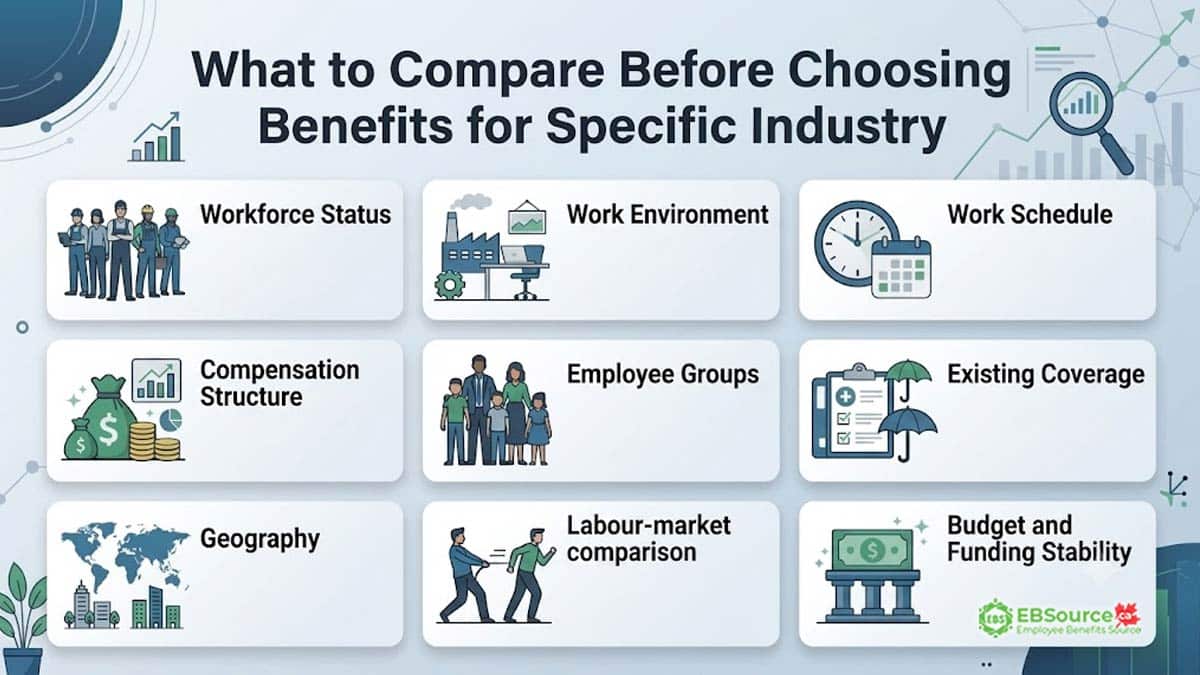
Eight Things to Check About Your Own Workforce
Each factor below affects a different part of plan design:
| Dimension | Evidence employer enters | Decision it affects |
|---|---|---|
| Workforce status | Full-time, part-time, casual, seasonal | Eligibility and participation |
| Compensation | Salary, hourly, overtime, commissions | Insured earnings |
| Existing arrangement | Employer, union, trust, association | Available design control |
| Work location | Office, site, facility, remote | Access and communication |
| Occupational demands | Physical, psychological, travel | Coverage areas to evaluate |
| Geography | One or multiple provinces | Administration and public-plan interaction |
| Financial structure | Stable, seasonal, grant-funded | Funding sustainability |
| Recruitment market | Actual competing employers | Appropriate benchmark group |
How to Benchmark Your Benefits Against Industry Peers
Comparing your plan with others can show whether you’re competitive. But an “industry average” can be misleading if the comparison group is poorly chosen.
- Compare with businesses like yours. Size matters as much as industry. A 12-person dental clinic and a large hospital are both in healthcare, but their teams, budgets and eligibility rules are very different. A small home builder shouldn’t measure itself against a large unionized infrastructure company.
- Spot the differences. Compare what you offer with similar employers in your province and with the employers you compete against for staff.
- Fix what really matters. Not every gap needs fixing. Falling slightly behind on a “nice-to-have” benefit matters far less than a big gap in disability or mental health coverage your people depend on.
What If Your Organization Fits More Than One Industry?
Industry classifications are useful, but real employers do not always fit neatly into one box.
A healthcare organization may also be a not-for-profit. An engineering firm may have both professional office employees and construction-site personnel. A retailer may operate warehouses and distribution centres. A hotel group may employ restaurant workers, administrative employees and maintenance teams. A technology company may have both remote software employees and technicians working in the field.
In these cases, don’t build your plan around your industry label. Instead, identify the different workforce groups inside your organization and ask what makes each one distinct.
For example, an engineering and construction business might need to consider:
- flexible and competitive benefits for salaried engineers
- disability and travel needs for field personnel
- different insured earnings for employees receiving substantial overtime
- whether some workers already participate in collectively negotiated arrangements.
That does not necessarily mean every group needs a separate plan. It means you should avoid assuming that one industry profile accurately describes everyone on your team.
To design employee benefits around your workforce, the most effective approach is to use industry as a lens:
- Understand how work is structured in the sector.
- Identify the health, financial and employment risks most relevant to employees.
- Determine what coverage already exists.
- Compare the plan with genuinely similar employers.
- Prioritize the benefits that address the most meaningful gaps.
- Build a plan the organization can sustain.
Whether you run a medical clinic, construction company, professional firm, retail store or factory, the rule is the same: start with your workforce, then design the benefits around it.
Ready to build a plan that fits your team, not just your industry?
Every workforce is different. If you still don’t have clear answers to the questions in this guide, that’s normal. Most employers don’t. A licensed EBsource advisor can help you sort out what matters most for your team and build a plan that fits how your business actually works.
FAQs about Employee Benefits by Industry
Why can two employers in the same industry offer very different benefits?
Industry is only one plan-design factor. Employers can differ in company size, province, employee demographics, occupation, compensation, union status, workforce mix, budget, existing coverage, and recruitment strategy. Industry benchmarking should be a starting point, not a template to copy.
Should an employer copy competitors’ benefits?
Usually not. Competitor information can identify market expectations, but the employer still needs to determine whether the competitor’s plan fits its own workforce. The better approach is to benchmark first and then ask why each difference matters.
How should benefits work when employees have very different jobs?
Employers may be able to use employee classes to provide different benefit structures to legitimate groups of employees, subject to the terms and requirements of the insurer and plan.
For example, an employer may need to examine differences between executives and general employees, field and office workers, or production and professional employees.
Employee classes should be based on bona fide workforce distinctions rather than created simply to favour selected individuals.
Can part-time and seasonal employees receive employee benefits?
They may be able to, but eligibility depends on the employer’s plan and the applicable insurance contract. The important questions include how the plan defines eligible employees, whether minimum hours or other requirements apply, and how changes in employment status affect coverage. This is particularly important in industries such as healthcare, retail, hospitality, and other sectors with substantial non-standard work arrangements.
How often should employers review their benefits against their industry?
There is no single review frequency that is right for every organization. An industry comparison is particularly useful when:
- the workforce changes materially
- the employer expands into another province
- turnover or recruitment difficulties increase
- the company adds new employee classes
- compensation practices change
- the plan is redesigned
- employees consistently report coverage gaps.
Regular plan reviews can also help employers identify whether their benefits continue to reflect how their workforce actually works.