


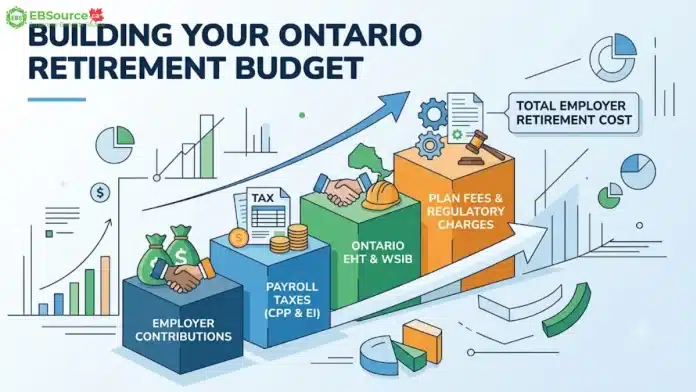
When budgeting for a workplace retirement benefits contribution cost in Ontario, employers should account for costs beyond the plan’s basic contribution rate. To build an accurate budget plan, gather payroll and HR records for all involved employees, along with documents related to your chosen retirement plan, such as contribution terms and fee quotes.
With that information ready, the total comes together from six pieces: your own contributions, CPP and EI, Ontario Employer Health Tax, WSIB premiums, fees you agree to pay, and the funding or regulatory charges that only registered pension plans carry. Some of these pieces add nothing under one plan yet raise the total under another. This is why knowing which ones apply to you matters as much as the figures themselves.
The following sections will cover each component in detail, followed by an example showing how the budget might change for a small employer in Toronto based on different plans.
Which Inputs Do You Need to Gather for an Ontario Workplace Retirement Budget?
Every plan needs dated workforce data, and each structure adds its own plan inputs. If a required input is missing, the result is a provisional estimate rather than a budget figure.
Collect them in two passes: workforce inputs first, because they apply to whatever plan you choose, then the inputs your plan structure adds.
Workforce Inputs for Every Ontario Retirement Plan
The workforce inputs cover four areas: eligibility and earnings, start and exit dates, participation, and reporting location. Because each one is applied person by person, take them from dated payroll and HR records rather than headcount summaries:
- Eligibility and earnings: who is eligible, and on what earnings, for the budget year.
- Start and exit dates: when each person begins and stops receiving employer contributions.
- Participation: who has enrolled, or is expected to, in a voluntary plan.
- Reporting location: where each employee reports for work, which drives EHT.
Build the calculation from people who will actually participate, and use pay periods rather than months where payroll runs biweekly, because the number of pay dates in a year can differ from a monthly split.
Ontario Retirement Plan Inputs by Structure
Retirement plan inputs depend on how the contribution is set: formula terms for contribution-based plans, the registered plan text for a Defined Contribution (DC) Pension Plan, the actuarial valuation for a Defined Benefit (DB) Pension Plan or Individual Pension Plan (IPP), and a written fee quote for every plan.
The table shows what to collect for each:
| Plan | Inputs to collect |
|---|---|
| Group RRSP, DPSP, PRPP, Group TFSA | Contribution formula (employer percentage, matching ratio, cap on matched contributions), earnings base and waiting period. For a Group RRSP, also the withdrawal terms, which decide EI treatment |
| DC Pension Plan | The contribution formula in the registered plan text, any required member contributions and the plan’s definition of pensionable earnings. For a stand-alone DC plan, CRA generally requires an employer contribution of at least 1% of active members’ total pensionable earnings, subject to specific exceptions |
| DB pension plan or IPP | The most recent actuarial valuation report, the plan’s expense budget and, for an eligible plan, its PBGF assessment |
| Every plan | A written fee quote showing which charges the employer pays and which come from member accounts |
Source: CRA’s Registered Pension Plan Guide
Of these, the earnings base matters most, because the same percentage produces a different cost depending on which pay it applies to.
What Counts as the Cost of Workplace Retirement Benefits in Ontario?
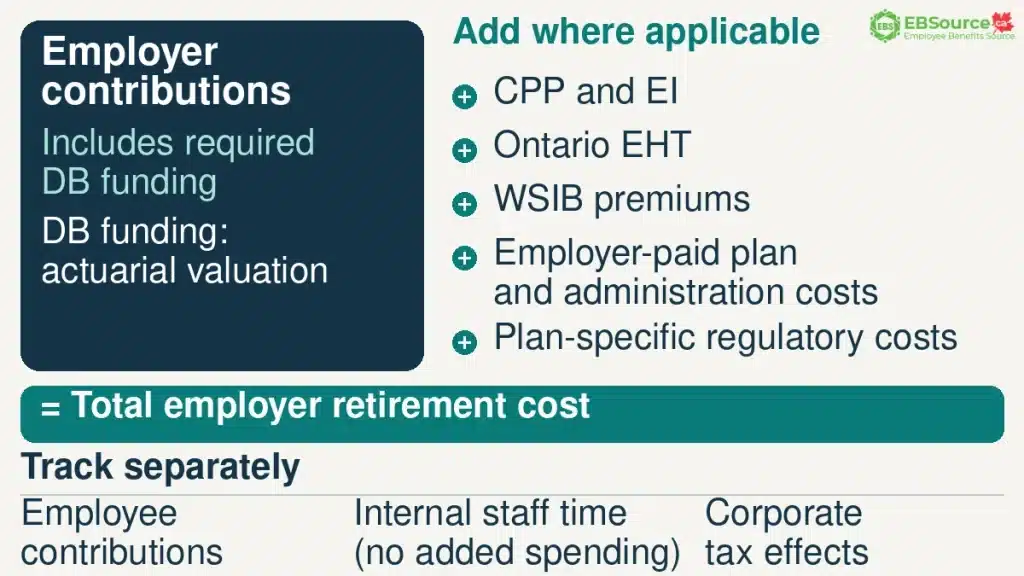
Employer cost in a retirement plan is the required or elected employer contributions, plus whichever payroll costs, Ontario Employer Health Tax (EHT), WSIB premiums, employer-paid administration costs and plan-specific funding or regulatory costs apply to the structure you choose. Not every component applies to every plan, which is why the retirement structure needs to be settled before the budget can be.
Put together, those components give the following working formula:
Employer retirement cost = employer contributions (including required DB funding) + applicable CPP and EI + applicable Ontario EHT + applicable WSIB premiums + employer-paid plan and administration costs + plan-specific regulatory costs
Because each component comes from a different source, the table below shows which plans it applies to and what to verify before it enters the budget as a confirmed figure:
| Cost component | Applies to | What to verify |
|---|---|---|
| Employer contributions | Every plan | Formula, earnings base, participation months, statutory limits |
| CPP and EI on contributions | Group RRSP and Group TFSA only | Withdrawal terms, each employee’s remaining CPP and EI room with your organization |
| Ontario EHT on contributions | Group RRSP and Group TFSA only | Exemption eligibility, associated-employer status |
| WSIB premiums on contributions | Group RRSP and Group TFSA only, where you have WSIB coverage | Coverage, premium rate, each worker’s remaining insurable earnings room |
| Employer-paid fees | Every plan, if the employer pays | Written quote, who pays, and whether the fee is a taxable benefit that adds CPP or Ontario EHT |
| Funding and regulatory costs | Registered pension plans | Actuarial valuation (Defined Benefit), FSRA assessment or exemption*, PBGF where applicable** |
*: Financial Services Regulatory Authority of Ontario (FSRA)
**: Pension Benefits Guarantee Fund (PBGF)
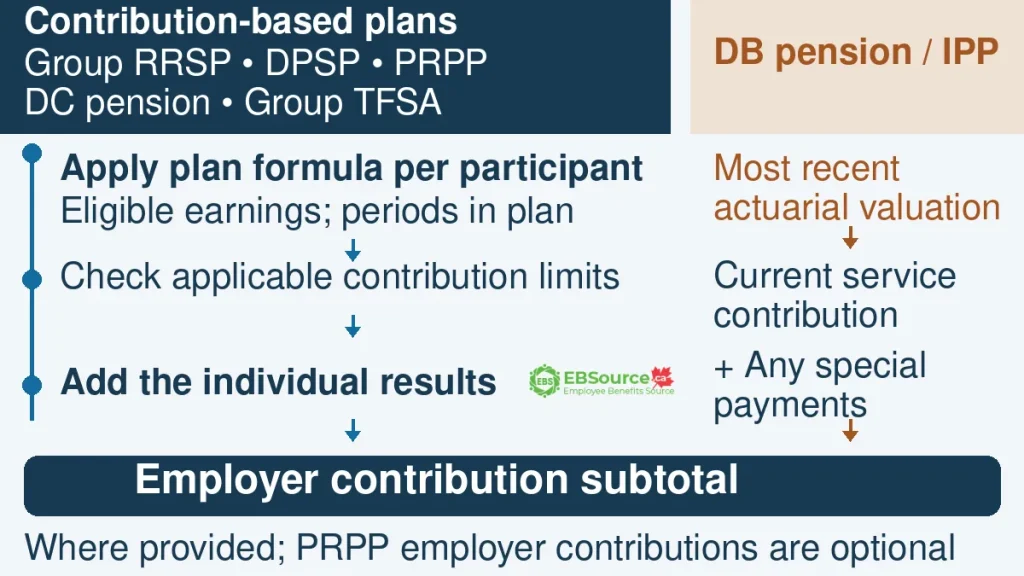
The employer contribution is the starting figure. For contribution-based plans, you calculate it yourself by applying the plan formula to each participant’s eligible earnings, contribution election and participation dates.
A Defined Benefit Plan works differently: the required employer funding comes from the actuarial valuation, not from a payroll formula.
Payroll confirms the statutory charges (CPP, EI, EHT and WSIB), the provider confirms fees, and the actuary or plan administrator confirms pension funding and assessments. Until each confirmation is in hand, the estimate is not complete.
What to Track Outside the Employer Cash Estimate
Employee contributions, internal staff time and corporate tax deductibility sit on separate lines so they do not distort the employer cash estimate. Each is kept out for a different reason:
- Employee contributions: money deducted from pay is the employee’s, even though payroll remits it alongside the employer’s share.
- Internal staff time: enrolment, remittances and reconciliation only become a cash cost if they create new spending, such as an added payroll service charge.
- Corporate tax deductibility: this guide budgets pre-tax cash outlay; the after-tax effect of deducting contributions is a separate tax review.
How to Calculate the Employer Contribution for Each Ontario Retirement Plan
The employer contribution is the one cost line that applies to every plan, if the arrangement provides one. For most contribution-based plans, you calculate it yourself by applying the plan formula to each participant.
For a Group Registered Retirement Savings Plan (RRSP), Deferred Profit Sharing Plan (DPSP), Pooled Registered Pension Plan (PRPP), Defined Contribution (DC) Pension Plan or Group Tax-Free Savings Account (TFSA), the calculation method is the same. Apply the formula to each participant’s eligible earnings for the periods they participate, check the result, then add up the results.
A Defined Benefit (DB) Pension Plan or Individual Pension Plan (IPP) is the exception, because its employer cost comes from an actuarial valuation rather than a payroll formula.
Employer Contribution Formulas for Each Ontario Retirement Plan
What differs between structures is where the formula comes from:
- A Group RRSP or Group TFSA uses a match or contribution rate the employer sets,
- a DPSP uses an allocation formula tied to profits,
- a PRPP uses the rate in the administrator contract, and
- a DC Pension Plan uses the rate written into the registered plan text.
The table below sets out each formula and the plan rules that can move the result:
| Plan | Employer contribution formula | What can change the budget |
|---|---|---|
| Group RRSP | Eligible earnings × employee election (capped at the matched maximum) × employer match ratio | Budget an expected-election subtotal and a full-match subtotal. The match is usually set by plan terms and can often be changed prospectively, subject to contractual or employment commitments. |
| DPSP (alone or with a Group RRSP) | Eligible compensation × the employer’s allocation formula | Contributions come from profits, so none are required in a year without a profit. Vesting within two years of membership can return forfeited amounts to the employer. Specified shareholders and related individuals cannot participate, so an owner-manager is priced under a different arrangement. |
| PRPP | Eligible earnings × the employer contribution rate, if the employer contributes | Employer contributions are optional. The rate, enrolment terms and any employer-side charges come from the administrator contract. Ontario applies the federal framework through the Pooled Registered Pension Plans Act, 2015. |
| DC Pension Plan | Pensionable earnings × the employer rate in the registered plan | The rate is a registered plan term, so changing it requires a plan amendment. An amendment that adversely affects members can also trigger Ontario member-notice requirements. |
| DB Pension Plan or IPP | No payroll formula: the current service contribution and any special payments from the most recent actuarial valuation | Each new valuation can raise or lower the requirement. Plan expenses and regulatory assessments are added separately. |
| Group TFSA | Eligible earnings × the employer contribution or match rate | Employer contributions are taxable cash benefits, so CPP, EI and Ontario EHT can apply on top of the contribution. |
Source: CRA DPSP contribution rules and DPSP overview, OSFI’s PRPP guide for Ontario members, Ontario’s PRPP Act, and FSRA guidance on DC plans and plan amendments.
Contribution Limits that Cap the Ontario Employer’s Cost
Each plan has its own limit, and most depend on the individual’s own room rather than CRA’s dollar limits alone. For 2026:
- Group RRSP: the employee’s available RRSP deduction limit, not the $33,810 RRSP dollar limit, because contributions above available room can create excess-contribution tax.
- DPSP: employer contributions and reallocated forfeitures, within the lesser of 18% of compensation and half the money purchase limit ($17,695).
- DC Pension Plan: employer and member contributions combined, within the lesser of 18% of compensation and the money purchase limit ($35,390).
- PRPP: the member’s available RRSP/PRPP deduction limit, which employer and member contributions share. The money purchase limit is not the PRPP cap.
- Group TFSA: the employee’s available TFSA room. The 2026 dollar limit is $7,000, plus any carried-forward room.
Source: CRA’s 2026 registered plan limits, RRSP deduction limit rules, DPSP contribution rules and PRPP questions and answers for employers.
Prior pension adjustments, carry-forward room and personal contributions mean two employees on the same salary can have very different room, so confirm each participant’s current CRA limit before modelling a higher earner. The worked example below applies these formulas and limits to one employer.
How to Add CPP and EI to the Employer Contribution
Among the plans in this guide, only employer contributions to a Group Registered Retirement Savings Plan or a Group Tax-Free Savings Account can add Canada Pension Plan and Employment Insurance, because those are the contributions taxed as employee benefits. Even then, the result depends on how CRA treats the benefit and on each employee’s earnings
For a Group RRSP, CRA treats the employer contribution as a cash benefit if the employee can withdraw before retiring or leaving employment, ignoring Home Buyers’ Plan and Lifelong Learning Plan withdrawals. Employer contributions to a Group TFSA are generally treated as cash benefits, with no equivalent withdrawal-restriction test.
Cash benefits are pensionable and insurable, and non-cash benefits are pensionable only:
| Plan | Employer CPP | Employer EI | Why |
|---|---|---|---|
| Group RRSP, withdrawable | Yes | Yes | Cash benefit, because the employee can withdraw while employed |
| Group RRSP, withdrawal-restricted | Yes | Generally no, where CRA’s conditions are met | Non-cash benefit, because withdrawals wait until retirement or the end of employment |
| Group TFSA | Yes | Yes | Generally a cash benefit |
| DPSP, qualifying PRPP, DC or DB pension plan | No | No | Not employment income when made; payroll should confirm the setup before the line is marked $0 |
Source: Contributions to savings and pension plans – Government of Canada
Where the line applies, calculate it per employee rather than as one blended rate on the contribution subtotal. The 2026 employer rates are:
- Base CPP: 5.95% on pensionable earnings up to the YMPE of $74,600.
- CPP2: 4% on earnings between the YMPE and the YAMPE of $85,000.
- EI: 2.282% on insurable earnings up to $68,900, which is 1.4 times the employee rate outside Quebec.
An employee whose earnings with you have already reached a ceiling adds nothing further under it, so the same contribution can add payroll cost for one employee and none for another.
How to Add Ontario EHT to Group RRSP and Group TFSA Contributions
Ontario Employer Health Tax also applies only to Group Registered Retirement Savings Plan and Group Tax-Free Savings Account contributions. Additionally, it adds cost only once your total Ontario payroll, including those contributions, exceeds your available exemption. Registered Pension Plan, DPSP and qualifying PRPP contributions are excluded from EHT remuneration regardless.
Unlike CPP and EI, Ontario Employer Health Tax is not calculated per employee. It applies to employees who report for work at, or are attached to, your permanent establishment in Ontario, or who are paid from or through it.
It is calculated on your total Ontario payroll in two steps:
- Find your rate: The rate is set by total Ontario payroll before the exemption is deducted, ranging from 0.98% for payroll up to $200,000 to 1.95% for payroll over $400,000.
- Apply it to taxable payroll: Deduct the exemption from total Ontario remuneration and multiply the result by that rate.
The exemption is currently $1 million for an eligible employer. It is not available where Ontario payroll, including associated employers, exceeds $5 million, unless the employer is a registered charity.
EHT Cost of Group RRSP & Group TFSA Contributions by Exemption Position
What these contributions add depends on which of three positions your payroll falls into:
- Below the exemption: an eligible employer whose total Ontario remuneration stays under its exemption pays no EHT, so the contributions add $0.
- Above the exemption: every added dollar of contributions is taxed at your rate, such as 1.95% once payroll is over $400,000.
- Not eligible for an exemption: all Ontario payroll is taxable from the first dollar, at the graduated rate for your payroll level.
Source: Employer Health Tax (EHT) – Government of Ontario
Because the rate applies to the whole taxable payroll, contributions that push total remuneration into a higher bracket raise the rate on everything, not only on the contributions. An employer just under a bracket threshold should test the budget at the higher rate.
How to Add WSIB Premiums to Ontario Employer Contributions
If your business has WSIB coverage, employer contributions to a Group RRSP or Group TFSA can add WSIB premiums. WSIB counts taxable benefits reported as employment income as insurable earnings, and its policy specifically names employer RRSP contributions. A withdrawal restriction that removes EI does not remove WSIB because the contribution remains a taxable benefit.
Registered pension plan, DPSP and qualifying PRPP contributions are not employment income when made, so they generally add no WSIB premium. Confirm the treatment with payroll before marking the line $0.
Like CPP and EI, WSIB is calculated per worker: add the insurable earnings, then multiply by your premium rate per $100. Insurable earnings stop at the annual maximum of $121,700 for 2026, so a contribution adds nothing for a worker whose earnings with you have already reached it. Because that ceiling sits well above the CPP and EI ceilings, a contribution that adds no CPP or EI for a higher earner can still add WSIB.
Not every person is covered. In industries other than construction, sole proprietors, partners, and executive officers are excluded unless they elect optional insurance, and your premium rate depends on your business classification. Taxable employer-paid fees also count as insurable earnings for covered workers.
Source: Determining Insurable Earnings – WSIB and WSIB 2026 maximum insurable earnings
How to Add Employer-Paid Fees to the Budget
Employer-paid fees can arise under any Ontario retirement plan. The line includes every fee the employer pays under the plan’s fee schedule or contract. Charges vary by provider and contract, so price each one from the employer’s written quote, note who pays it, and note whether payroll treats it as a taxable benefit.
Ontario Retirement Plan Fees to Include in the Budget
Depending on the structure, the fee line can include:
- Provider charges: setup fees, recurring administration fees, per-member fees, and any asset-based fees the employer agrees to absorb.
- Payroll integration: any added charge from your payroll provider for new deductions or remittances.
- Pension administration: fees for a pension administrator or recordkeeper.
- Actuarial work: professional fees for valuations and cost certificates for a Defined Benefit Plan or Individual Pension Plan.
- Sales tax: whether the quote includes applicable sales tax, and whether your tax adviser confirms any of it is recoverable.
Required pension funding and regulatory assessments are not fees, so they sit on separate lines.
Ontario Retirement Plan Fees that Can Add CPP, EHT or WSIB
You need to separate plan-level operating fees from fees the employer pays directly on behalf of employees, because the second type can bring CPP, EHT and WSIB back into the budget even for a plan whose contributions are excluded.
CRA treats administration fees an employer pays directly for its employees as taxable non-cash benefits for RRSPs, TFSAs, RPPs and PRPPs, which means CPP applies, but EI does not.
Ontario EHT remuneration generally includes taxable employment benefits, and Ontario explicitly counts employer-paid TFSA administration fees. Do not assume that an EHT exclusion for the underlying pension contribution also excludes every administration fee. WSIB insurable earnings likewise include taxable benefits.
Match each fee in your quote to one of the three types below to see whether it is an employer cost and which lines it can add:
| Fee type | Employer cash cost | Taxable benefit to the employee | CPP and EI | Ontario EHT and WSIB |
|---|---|---|---|---|
| Plan-level operating fee the employer pays | Yes | Confirm with payroll | Confirm with payroll | Confirm with payroll |
| Administration fee paid directly for employees | Yes | Generally yes for RRSPs, TFSAs, RPPs and PRPPs | CPP generally applies; EI does not | Generally included as a taxable benefit |
| Investment or account fee deducted from member accounts | No | Not an employer cost | Not an employer cost | Not an employer cost |
Source: Employer Health Tax (EHT) – Remuneration – Government of Ontario
Note that a Deferred Profit Sharing Plan (DPSP) is not listed in CRA’s chart, so confirm DPSP fee treatment with payroll.
For each fee, record whether it is one-time or recurring, whether the employer or the member pays it, and whether payroll has confirmed its treatment. A fee you have not yet priced is entered as pending, never as zero.
How to Add Funding and Regulatory Costs for Registered Pension Plans
Registered pension plans bring up to three items that the other structures do not. The first replaces the payroll formula; the other two are added on top:
- a Defined Benefit (DB) Pension Plan funding requirement set by the actuarial valuation,
- a Financial Services Regulatory Authority of Ontario (FSRA) annual assessment, and
- a Pension Benefits Guarantee Fund (PBGF) assessment for eligible DB plans.
Group RRSP, DPSP and Group TFSA budgets carry none of these. For a Pooled Registered Pension Plan (PRPP), the licensed administrator holds the regulatory relationship, so confirm with the administrator whether any regulatory cost is passed to the employer.
The actuary’s bill for preparing a valuation is a service fee, but the contributions that valuation requires and the assessments the Financial Services Regulatory Authority of Ontario charges are obligations of the plan itself.
Each one is budgeted as follows:
| Cost line | Applies to | How to budget it |
|---|---|---|
| DB funding requirement | DB pension plans and IPPs | Use the payment schedule in the most recently filed actuarial valuation, covering the current service cost (less required member contributions) and any special payments for a shortfall. Enter it as the plan’s employer contribution, not as an extra line. Treat any period after the next valuation date as pending, because a new valuation can raise or lower both parts. |
| FSRA annual assessment | Ontario-registered pension plans, including small DC plans | Budget the FSRA assessment as a separate regulatory cost using the current assessment invoice or applicable FSRA schedule. Do not include it in member employer contributions. IPPs and designated plans can elect an exemption if they meet the conditions and filing deadlines in FSRA’s assessment guidance. |
| PBGF assessment | Eligible single-employer DB plans | Take the amount from the administrator or actuary, because it depends on the plan’s own characteristics. DC plans do not pay it. |
Enter each line as pending until the valuation, invoice or administrator confirmation is in hand, and record whether the plan fund or the employer pays it.
Source:
- 2025 Report on the Funding of Defined Benefit Pension Plans in Ontario
- Pensions – Assessments – FAQs – Financial Services Regulatory Authority of Ontario
- Pensions – Pension Benefits Guarantee Fund (PBGF) – FSRA
Worked Example: How Does the Budget Change Across Plan Structures?
Running one employer through every structure shows that the contribution subtotal is often the same while the total cost is not. The difference comes from CPP, EI, EHT, WSIB, and the fixed regulatory costs each structure brings. Every figure is incremental: it shows what the plan adds, not the payroll costs Lakeshore already pays on salaries.
Take an example used only to illustrate the method: Lakeshore Millwork Inc. is a fictional Toronto employer. Its plan terms, salaries and elections are invented and are not a benchmark or a recommended rate.
Its 2026 budget covers five employees at the Toronto location, with total salaries of $385,000:
- Priya: $60,000, elects 4%.
- Marcus: $85,000, elects 2%.
- Elena: $72,000, elects 5% from July 1.
- Tom: $48,000, not enrolled.
- Sara: $120,000, elects 4%.
Lakeshore matches 100% of each employee’s contribution up to 4% of base salary, which gives an expected employer match of $10,340. It is assumed to be an eligible employer claiming the full Employer Health Tax exemption until that is confirmed, so Employer Health Tax is $0 in every scenario below. It is also assumed to have WSIB coverage for all five employees, at a premium rate still to be confirmed.
Under a Group RRSP at current elections, each employee adds the following:
| Employee | Employer match | Added CPP | Added EI | Added WSIB insurable earnings |
|---|---|---|---|---|
| Priya | $2,400 | $142.80 | $54.77 | $2,400 |
| Marcus | $1,700 | $0 | $0 | $1,700 |
| Elena (from July 1) | $1,440 | $85.68 | $0 | $1,440 |
| Tom | $0 | $0 | $0 | $0 |
| Sara | $4,800 | $0 | $0 | $1,700 |
| Total | $10,340 | $228.48 | $54.77 | $7,240 |
The scenarios below change more than the plan type. B, D and E also change who participates or how much is contributed, so part of each difference comes from plan design rather than tax treatment. The last column names the assumption behind each figure.
| Scenario | Employer contributions | CPP and EI | WSIB insurable earnings added | Fees and regulatory | What drives the result |
|---|---|---|---|---|---|
| A: Group RRSP, current elections | $10,340 | $283.25, or $228.48 if withdrawal-restricted | $7,240, rate pending | Pending quote | CPP and EI calculated per employee; each employee’s RRSP room still to be confirmed |
| B: Group RRSP, everyone elects 4% | $13,960 | $441.30, or $342.72 if withdrawal-restricted | $10,860, rate pending | Pending quote | A full-match scenario under current workforce assumptions, not a maximum budget |
| C: Group RRSP paired with a DPSP | $10,340 | $0 | $0 | Pending trustee quote | Depends on a profit in the year and the vesting terms |
| D: PRPP | $10,340 to $12,260 | $0 | $0 | Pending administrator contract | Assumes the administrator permits the stated member rates, Lakeshore matches up to 4%, and contributions begin from each member’s start date. The higher figure adds Tom if he is enrolled and does not opt out. Confirm default rates, opt-outs and each member’s RRSP/PRPP room |
| E: DC pension plan | $13,960 | $0 | $0 | $1,000 FSRA minimum, subject to the assessment cycle, plus pending quote | Illustrative plan terms: a required 4% employer contribution for all five members, with Elena eligible from July 1. Tom participates because membership is a plan condition |
| F: Group TFSA | $10,340 | $283.25 | $7,240, rate pending | Pending quote | Sara’s combined $9,600 exceeds the $7,000 TFSA dollar limit unless she has carried-forward room |
| G: DB pension plan | Not calculable | n/a | n/a | Actuarial, FSRA, PBGF if eligible | Pending until an actuary values the plan |
Three results drive most of the difference:
CPP and EI depend on each employee, not the subtotal. Priya’s $2,400 match adds $197.57: $142.80 in CPP and $54.77 in EI, while Sara’s $4,800 match adds nothing because her salary is already above every CPP and EI ceiling. One blended rate on the whole contribution would misprice the line.
WSIB follows a higher ceiling. Sara’s match adds no CPP or EI, but the first $1,700 of it still falls under WSIB’s $121,700 ceiling. Lakeshore’s premium is the insurable total multiplied by its rate per $100, entered as pending until the rate is confirmed, never as $0.
EHT depends on the exemption. If Lakeshore were not eligible, it would already pay $7,041.65 in EHT on $385,000 in salaries at the 1.829% rate.
On top of that baseline, the contributions would add $189.12 to Scenarios A and F and $255.33 to Scenario B. Scenarios C, D and E add no EHT on qualifying employer contributions; any EHT already payable on salaries remains. Scenario B’s total remuneration of $398,960 is only $1,040 below the $400,000 threshold, so any taxable benefit that pushes it over would require rerunning EHT at 1.95% on the full taxable payroll.
What Must Be Confirmed Before Employer Approves the Retirement Budget?
Before approving the budget, reconcile the contribution forecast with payroll’s incremental charges, the provider’s written fee quote and any pension funding or assessment schedule. Show confirmed amounts and pending items separately, record who pays each charge, and make sure DB funding and plan-paid expenses are counted only once.
Use the table below to give each line a status and an owner:
| Budget line | Status to record | Who confirms |
|---|---|---|
| Employer contributions, including DB funding | Calculated, or pending until the valuation is filed | Payroll; the actuary for a DB plan or IPP |
| CPP and EI | Calculated per employee | Payroll |
| Ontario EHT | Calculated at the confirmed rate and exemption position | Payroll or tax adviser |
| WSIB premiums | Pending until coverage and rate are confirmed | Payroll, from the WSIB account |
| Employer-paid fees | Pending until the written quote is in hand | Plan provider |
| Regulatory assessments | Pending until the invoice or exemption is confirmed | Plan administrator |
Report three totals: the contribution subtotal, confirmed add-ons and pending items. Approving on the first total alone understates the commitment.
FAQs About Workplace Retirement Benefits Contribution Cost in Ontario
How Much Does a Workplace Retirement Plan Cost Per Employee in Ontario?
There is no standard per-employee figure, because the cost depends on each person’s pay, whether they join and which plan you choose. A more reliable number comes from your own budget: divide the total employer cost by the people who actually participate, then show it twice, once for contributions alone and once with every add-on included.
Keep those two figures apart, since fixed charges weigh far more on a team of five than on a team of fifty. If an advisor quotes an average cost per employee without seeing your payroll, use it as a rough guide, not a budget input.
How Do Mid-Year Salary Increases Affect a Retirement Contribution Forecast?
A raise can increase a percentage-based contribution, subject to the plan’s earnings definition and contribution cap, so the forecast should split the year at the date the new salary takes effect. Split eligible earnings at the effective date and calculate contributions using the applicable payroll periods, rather than applying the higher figure to the whole year.
After the increase, check whether the plan counts the extra pay as eligible earnings and whether the larger contribution brings the employee closer to their personal CRA limit. If raises are still undecided, run a scenario using your expected increase pool so the retirement line moves with payroll instead of trailing it.
Which First-Year Costs Should You Separate from Recurring Costs?
Separate any one-time launch costs from the recurring yearly cost. Launching a plan creates work that does not repeat once the plan is running. This can include provider setup charges, payroll configuration, enrolment sessions and, for a registered pension plan, preparing a plan text that meets federal tax rules before registration. Record these on a separate one-time line so they do not inflate your view of the ongoing yearly cost.
A plan that starts mid-year also carries only part-year contributions, so year one can look lighter on contributions while still costing more overall. If you are launching a first plan while revenue and headcount are still changing, the startup retirement benefits guide shows how to size a commitment you can sustain as the business grows.
Does The Cost Change for Employees Who Work Outside Ontario?
Yes, because payroll taxes on retirement contributions follow the province where each employee reports for work, not where your head office is. Staff who report to a location in another province fall outside Ontario EHT, but that province may charge its own employer payroll tax under different rules. Workers’ compensation premiums can also move to that province’s board.
In British Columbia, for example, employer-paid RRSP contributions count toward the provincial Employer Health Tax base, while contributions to registered pension plans and DPSPs are left out. If your team spans several provinces, price each group under its own province’s rules and confirm the exemption that applies there.
How Often Should an Employer Update Its Retirement Benefits Budget?
At least once a year, and again whenever pay, headcount, or plan terms change. Several inputs reset on a yearly cycle: CRA publishes new registered plan limits and a new YMPE each year, and WSIB’s annual maximum for insurable earnings takes effect every January 1.
Outside that cycle, rerun the numbers after a hiring wave, a salary review, a provider fee change or a new actuarial valuation. A short mid-year check against actual payroll also shows whether employees elected what you expected.