


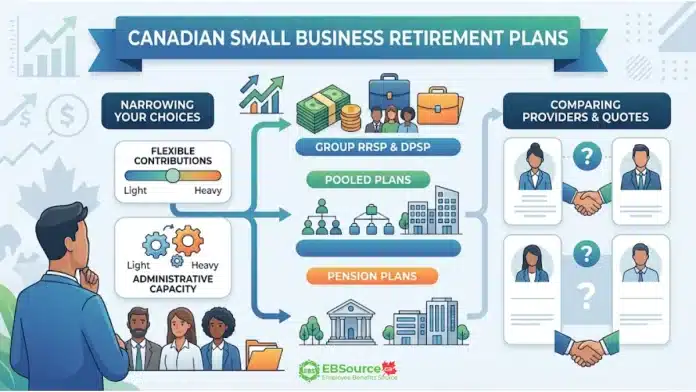
Small business retirement plans in Canada include several options: group Registered Retirement Savings Plans, Registered Retirement Savings Plan/Deferred Profit Sharing Plan combinations, Pooled Registered Pension Plans, Defined Contribution Pension Plans, and Voluntary Retirement Savings Plans. Group Tax-Free Savings Accounts can also be used as a workplace savings option.
When choosing a plan, consider how much you can commit to contributions and how much administrative work you are willing to handle. Remember that headcount alone does not determine which structure is available, although provider products may impose their own membership, contribution or asset minimums.
This guide compares the main plan structures, shows which options fit your situations, and explains what to ask providers before requesting a quote.
What Retirement Plans Can Small Businesses Offer?
For most small employers, the main retirement plan options are a Group Registered Retirement Savings Plan (Group RRSPs), a Group Registered Retirement Savings Plan combined with a Deferred Profit Sharing Plan (RRSP/DPSP combinations), a Pooled Registered Pension Plan (PRPPs), and a Quebec Voluntary Retirement Savings Plan (Quebec VRSPs). A Defined Benefit Pension Plan (DCPP) and a Group Tax-Free Savings Account (Group TFSA) may also be relevant in some situations.
These arrangements differ mainly in who contributes, how fixed the employer commitment is, how contributions are treated through payroll and how easily employees can access the money.
The table below provides a quick overview of small business retirement plan types available in Canada:
| Plan type | Who contributes? | Main distinction |
|---|---|---|
| Group RRSP | Employees; employer contributions optional | Flexible employer contributions |
| Group RRSP & DPSP | Employees into the RRSP; employer into the DPSP | Separates employee savings from employer contributions |
| PRPP | Employees; employer contributions optional | Licensed administrator handles much of the plan administration |
| DC pension plan | Employer and usually employees | Employer contribution rate is set in the plan |
| Defined benefit plan | Employer; employees may also contribute | Retirement benefit is based on a formula |
| Group TFSA | Employees; employer contributions optional | Flexible savings that are not pension-locked |
| Quebec VRSP | Employees; employer contributions optional | Quebec-specific option with different withdrawal rules from a PRPP |
Group Registered Retirement Savings Plan
A group Registered Retirement Savings Plan is one of the simpler structures for a small employer to compare because employees can contribute through payroll and employer contributions are optional. Employees contribute through payroll deduction, and the employer can choose to add a match.
Because there is no pension-regulator amendment process, the employer can adjust or pause the match, subject to any contract or collective-agreement terms.
Employer contributions are a taxable benefit to the employee and are generally pensionable for CPP. Employees can usually withdraw their money unless the plan restricts it. In addition, an incorporated owner who draws a salary can join the corporation as an employee.
Group Registered Retirement Savings Plan/Deferred Profit Sharing Plan Combination
In this combination, employees contribute to the Group Registered Retirement Savings Plan and the employer contributes to a Deferred Profit Sharing Plan. Employer contributions to a DPSP are made from profits. The plan text must state how the employer determines and allocates those contributions, and no contribution is required for a year in which the employer does not make a profit.
The main advantage of this combination is payroll treatment. Deferred Profit Sharing Plan contributions are not included in employees’ current taxable income and do not attract CPP or EI. Employer contributions must vest within two years of plan membership, although a plan can provide earlier or immediate vesting.
Note that a Deferred Profit Sharing Plan cannot include a specified shareholder or a person related to the employer, so many owners cannot join the DPSP side.
Pooled Registered Pension Plan
A Pooled Registered Pension Plan is run by a licensed administrator, which handles much of the administration and investment oversight. Employer contributions are optional, which makes it a practical choice for businesses without dedicated HR or payroll staff.
The trade-off is that money in a Pooled Registered Pension Plan is generally locked in under the pension legislation that applies to the member. Also, under federal rules, both member and employer contributions are locked in, with some legal exceptions. Availability also depends on the province, so employers with staff in several provinces should confirm coverage with the administrator first.
Defined Contribution Pension Plan
A Defined Contribution Pension Plan is a registered pension plan in which the employer contributes, and employees usually do too. The contribution rate is fixed in the plan text, so changing it requires a formal amendment. This makes it the firmest commitment among the contribution-based options.
An owner may participate if eligible under the plan. If the owner is a connected person, the employer must file Form T1007 within 60 days after the connected person joins the RPP or begins or resumes accruing lifetime retirement benefits.
Defined Benefit Plan
A Defined Benefit Plan promises employees a set retirement income based on a formula, rather than an account balance. The employer’s funding obligation is determined actuarially and can change over time, which makes it the most demanding option in cost and administration.
Benefits are locked in. For small businesses, the most relevant form is often the Individual Pension Plan (IPP), a defined benefit variant designed for owners and key employees.
Group Tax-Free Savings Account
A Group Tax-Free Savings Account is a workplace savings option rather than a pension. Employees contribute through payroll, and the employer may contribute as well. It is not pension-locked, so withdrawals are generally permitted, although liquidity depends on the investment and issuer terms.
Employers often add a group TFSA alongside a Group Registered Retirement Savings Plan or Deferred Profit Sharing Plan to give employees a more flexible savings option. Like a group RRSP match, employer contributions to a group TFSA are taxable income to the employee.
Quebec Voluntary Retirement Savings Plan
Québec uses the VRSP framework rather than the provincial PRPP statutes used by participating provinces. Employers can offer a VRSP to eligible Québec employees, and self-employed or other eligible individuals may also enrol directly.
Members can withdraw their own contributions at least once every 12 months, while employer contributions stay locked in until age 55. Self-employed workers can also enrol. Some Quebec employers are required to offer a VRSP or another qualifying plan.
Which Retirement Plan Fits Your Budget and Admin Capacity?
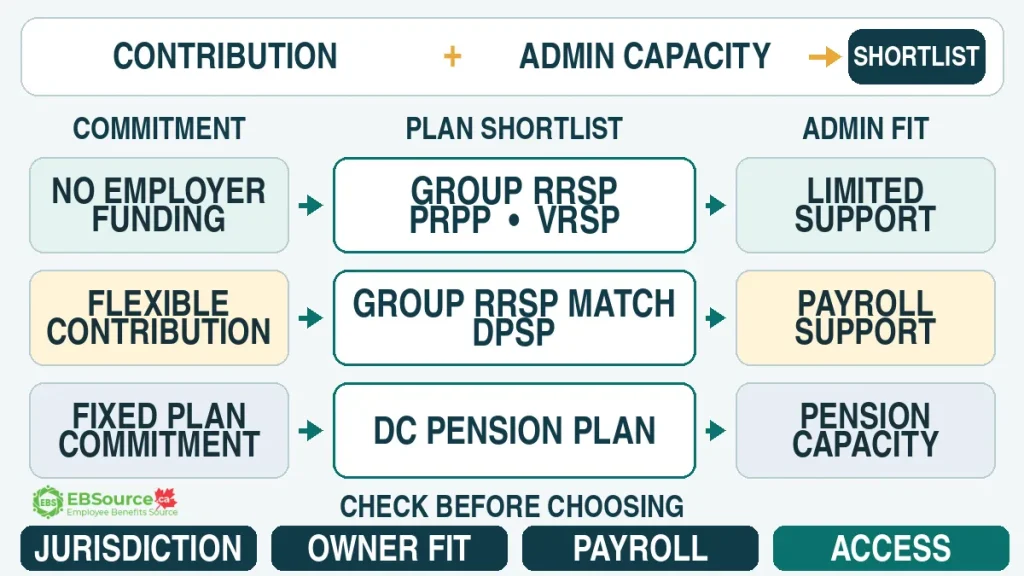
For a small business, to narrow down your retirement plan options, focus on two main questions: How much can you realistically contribute, and how much administrative effort can you manage? Before comparing structures, set clear goals for what the plan should do. Retention, tax-efficient compensation, and simply helping your employees save for retirement lead to different shortlists. Those goals, not headcount, are what turn a packaged product into a customized plan.
As mentioned, the number of employees does not determine your choices. For example, a ten-person company with a dedicated bookkeeper and a payroll system may successfully implement a plan that a thirty-person company without such resources cannot.
If you are not ready to make employer contributions, start by comparing structures that can operate without them, such as an employee-funded group Registered Retirement Savings Plan, a Pooled Registered Pension Plan or a Voluntary Retirement Savings Plan where applicable.
If you want to contribute but keep the amount flexible, consider a matching plan or a Deferred Profit Sharing Plan. On the other hand, a Defined Contribution Pension Plan creates a more formal employer contribution commitment because the contribution rate is set in the registered plan terms.
The following table outlines four common starting points, what each option includes, and the constraints that might eliminate certain choices:
| Your situation | What to shortlist | When it may not fit |
|---|---|---|
| Not ready to contribute yet | Group RRSP with payroll deduction only, or a PRPP or VRSP | A stand-alone defined contribution money purchase provision generally requires an employer contribution of at least 1% of active members’ total pensionable earnings, subject to specific registered-plan exceptions. |
| Want to contribute but keep the commitment adjustable | Group RRSP match, or a DPSP drafted so the contribution can follow profit | Avoid writing a rate into a pension plan text you would need a regulatory process to change. |
| Want employer contributions that are not included in employees’ current taxable income and generally do not attract CPP or EI | DPSP, CRA-registered PRPP or VRSP, or DC pension plan | A group RRSP or TFSA match will show up in box 14 and code 40 |
| No dedicated HR or payroll staff | PRPP or VRSP, or a small-business product with payroll file integration | Any plan still leaves you deducting, remitting and enrolling on schedule |
| Employees in several provinces, or any in Quebec | Confirm jurisdiction before shortlisting, and confirm whether your Quebec employees are already covered by a qualifying arrangement | A federally registered PRPP can operate across the provinces participating in the current PRPP Agreement. QC employees under provincial jurisdiction are instead covered through the VRSP regime. AB, PEI and NL are not current parties to that multilateral agreement, so employers should confirm local availability and registration requirements with the administrator before assuming one PRPP can cover those employees. |
| Wants to participate alongside staff | Group RRSP, DC pension plan, PRPP depending on jurisdiction, VRSP in Quebec | A DPSP cannot include a person related to the employer, or a person who is or is related to a specified shareholder of the employer or a related corporation. Additional rules apply to partnerships and trusts. |
| Want to offer employees flexible savings alongside retirement savings | Group TFSA added to an RRSP or DPSP, an unrestricted group RRSP, or a VRSP for the employee-funded portion | A PRPP locks in employee contributions under the federal regime. A group RRSP may restrict access to employer-funded amounts before retirement or termination, which can change the EI treatment of the employer contribution. That contractual restriction is not the same as pension-law locking-in. |
The payroll-tax difference becomes important once the employer starts contributing. Employer contributions to a group Registered Retirement Savings Plan are taxable benefits and are generally pensionable for CPP purposes. EI treatment depends on the plan’s withdrawal rules. If employees can withdraw the employer-funded amounts before retirement or termination, the contributions are generally insurable. If the group RRSP prevents those withdrawals, apart from permitted Home Buyers’ Plan or Lifelong Learning Plan withdrawals, the employer contribution is generally non-insurable for EI; CPP can still apply.
On the other hand, money put into a Deferred Profit Sharing Plan is not counted as income and does not require insurance payments, so more of the budget goes straight into employee accounts. When considering withdrawal restrictions, assess the payroll implications alongside your plan’s savings objectives and the access employees will retain. Make those restrictions clear during enrolment.
Group RRSP vs. DPSP: What the Same $18,000 Employer Contribution Delivers
The example below shows how allocating the same $18,000 under two different plan structures leads to distinct outcomes: a 3% contribution into a group Registered Retirement Savings Plan or a 3% contribution through a group Registered Retirement Savings Plan combined with a Deferred Profit Sharing Plan.
Rivet and Fold is a hypothetical Hamilton print shop with 14 non-owner employees and an eligible payroll of $600,000. The corporation’s sole shareholder also works in the business and draws a salary, but her compensation is excluded from the $600,000 used in this illustration. The employer is comparing a 3% contribution for the fourteen employees under two structures.
Assume the fourteen employees each earn approximately $42,857, all work outside Quebec, none has reached the annual CPP or EI maximum, and the entire employer Group Registered Retirement Savings Plan contribution is pensionable and insurable.
Under those assumptions, a $18,000 employer group RRSP contribution would add about $1,071 in employer CPP and $411 in employer EI at 2026 rates, for a total employer outlay of about $19,482 before plan fees.
The table shows how the same employer contribution produces different payroll, tax, participation and vesting outcomes:
| Group RRSP with a 3% match | Group RRSP plus DPSP at 3% | |
|---|---|---|
| Employer contribution | $18,000 | $18,000 |
| Employee tax position | Added to income in box 14 and code 40, offset by the RRSP deduction where the employee has room | Not income to the employee |
| Employer payroll cost | Actual payroll cost depends on each employee’s earnings and contributions to date. Once an employee reaches the applicable CPP, CPP2 or EI annual maximum, the marginal employer cost changes | No CPP or EI on the DPSP contribution; the outlay is $18,000 |
| Effect on employee RRSP room | The match uses the employee’s current-year room, the same as if they had contributed it themselves | Pension adjustment reduces the following year’s room by the amount contributed; current-year room is unaffected |
| Owner participation | Owner can receive the match | Owner is a specified shareholder in this scenario and cannot participate in the DPSP side |
| If the employer needs to reduce contributions | Match can be reduced or paused, subject to contract and collective-agreement terms | Contribution can follow profit if the plan text is drafted that way |
| Employee who leaves at 18 months | Keeps everything | Assume this DPSP uses a two-year vesting period. An employee who leaves after 18 months would therefore forfeit the unvested employer contributions; the trustee would generally report the resulting pension adjustment reversal where applicable |
| Admin load | One account type and one contribution file | Two account types, plus pension adjustment reporting in boxes 50 and 52 |
Which Option Costs the Employer Less: Group RRSP Match or DPSP?
Under the assumptions in this illustration, the DPSP produces the lower employer payroll cost because the employer contribution does not attract CPP or EI. However, the shareholder-owner in this example cannot participate in the DPSP, so owner eligibility may outweigh the payroll-cost difference when choosing between the two structures. If this owner must receive the same employer-funded benefit as employees, the group Registered Retirement Savings Plan match is the structure in this comparison that can include her.
If she can sit outside it, the Deferred Profit Sharing Plan avoids about $1,480 of employer CPP and EI, so the same $18,000 costs less to deliver. With total outlay steady at roughly $19,500, the Deferred Profit Sharing Plan route could put around 8% more into employee accounts, provided the plan formula and member limits allow it.
How Do Vesting and Withdrawal Rules Affect Your Plan Design?
For owners and HR leaders, the comparison involves more than payroll cost. In the illustration above, the group Registered Retirement Savings Plan match belongs to the employee immediately, while access to withdrawals depends on the plan’s terms. The illustrated Deferred Profit Sharing Plan uses a two-year vesting period, so employees who leave before vesting would forfeit the unvested employer contributions. Assess how these differences fit your retention objectives, workforce turnover and benefits communication needs. Your employee communications should also explain how the Deferred Profit Sharing Plan pension adjustment affects the following year’s Registered Retirement Savings Plan contribution room.
The payroll numbers assume the matched amounts stay under each employee’s annual CPP, CPP2, and EI limits. With fourteen employees earning $600,000 total, this is possible, but your actual cost depends on how you divide contributions and on earnings so far this year. Confirm the current rates and maximums in the CRA payroll deductions formulas (T4127) before relying on the figures.
Why This Example Uses $600,000 in Payroll and a 3% Contribution
The figures in the Rivet and Fold example are illustrative, but each one was chosen so the two structures can be compared on equal terms:
- 3% contribution: A common starting point for small business plans. On $600,000 of eligible payroll, it produces a round $18,000 that is easy to follow through the comparison.
- $600,000 payroll: Spread across fourteen employees, it gives an average salary of about $42,857. This is a realistic wage for a small print shop, and it keeps every employee below the annual CPP and EI maximums, so the same employer rates apply to the full contribution.
- Owner’s salary excluded: As a specified shareholder, the owner cannot join the Deferred Profit Sharing Plan, so leaving her out keeps both structures covering the same group. A shareholder who controls more than 40% of the voting shares is also generally not in insurable employment for EI.
To apply the comparison to your own business, multiply your eligible payroll by the contribution rate you are considering, then check whether any employee is likely to reach the annual CPP, CPP2 or EI maximum during the year.
What Should You Compare in a Small Business Retirement Plan Quote?
We suggest small businesses send every provider the same business profile and the same questions, because quotes built on different assumptions cannot be compared, however clearly each one is written.
Give each provider the same five inputs: the provinces your employees work in, eligible headcount, eligible payroll, your intended contribution rate and design, and your payroll platform.
Then ask each of them the same six questions as below:
- Participation: what take-up rate is this quote based on, and what changes if fewer employees join?
- Eligibility: do we meet your minimum employees, contributions or assets; how is each minimum measured, and what happens to our pricing or eligibility in a year we fall below it?
- Fee split: which fees do we pay, which come out of member accounts, and what does a member pay to withdraw, transfer or leave?
- Plan design: can we restrict withdrawals of employer contributions, what does that do to our EI cost, and for a Deferred Profit Sharing Plan, what can we change in the contribution formula without a CRA amendment?
- Payroll: is our platform integrated, or do we upload a file each cycle? Who is accountable for correcting contribution errors, and on what timeline?
- Exit: what does it take to move providers or wind the arrangement down, and what does that cost our members and us?
When Is a Consultation With Outside Experts Worth It?
Once more than one jurisdiction, a connected person or a locked-in design is involved. Some products are sold only through a licensed advisor, so the conversation may not be optional. Give the experts you engage the same five inputs you gave every provider, and ask them to confirm the pension jurisdiction that applies to each employee group before you sign anything.
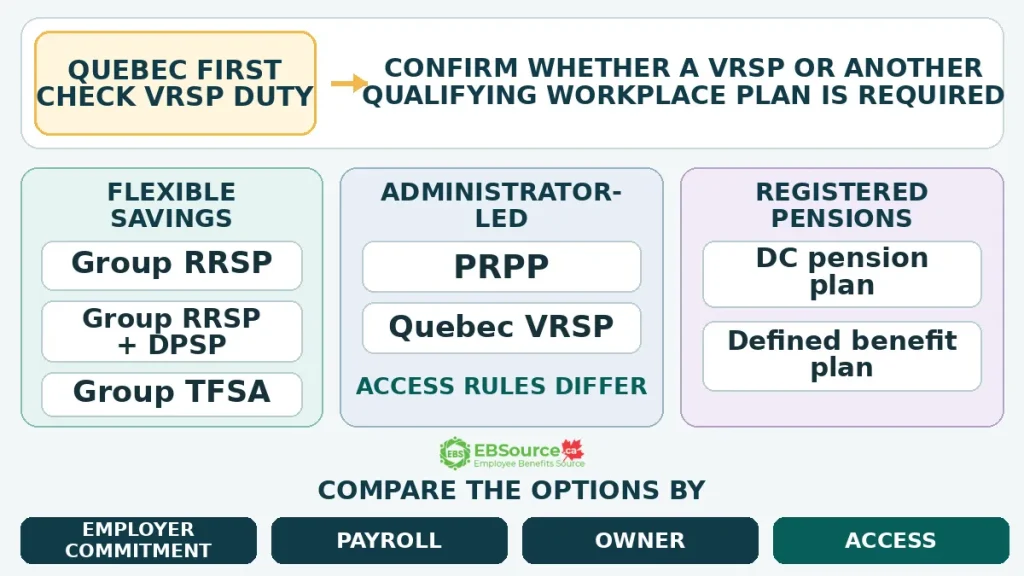
Quebec Employers: Check VRSP Obligations Before Comparing Plans
In Quebec, some employers are required to offer a Voluntary Retirement Savings Plan or another qualifying workplace savings or pension arrangement. Check that obligation before comparing voluntary plan designs. The Voluntary Retirement Savings Plans Act requires some employers to offer a plan, and the CNESST enforces the obligation rather than Retraite Québec.
First, an employer must offer a plan by 31 December 2026 if it had at least 5 eligible employees on 31 December 2025 and 10 or more on 30 June 2026. In addition, an eligible employee is at least 18, is an employee within the meaning of the Act respecting labour standards, and has one year of uninterrupted service. Part-time status alone does not exclude an employee. However, an employee who has not yet completed one year of uninterrupted service does not yet meet the Voluntary Retirement Savings Plan eligibility test.
If the employer has fewer than 10 eligible employees on June 30, the December 31 obligation is not triggered for that year under the current threshold. Recheck the employee count and current CNESST rules each year.
So, start by confirming whether an existing qualifying arrangement already covers your eligible employees. That answer may eliminate some options before you begin comparing voluntary plan designs.
Source: 2026 Benefit Amounts and Key Data – Retraite Québec
FAQs Related to Small Business Retirement Plans Canada
Do Canadian Employers Have to Offer Retirement Plans?
Outside Quebec, there is no general legal requirement for private-sector employers to offer a workplace retirement plan such as a group RRSP, DPSP or pension plan. Every employer must deduct and remit CPP (or QPP in Quebec) and EI contributions, which fund the public retirement and income-support programs. Even where no law applies, an employment contract or collective agreement may require the employer to provide a retirement plan, so check those terms as well.
Can New Canadians Join A Workplace Retirement Plan?
Yes. Eligibility for a workplace plan depends on employment and the plan’s own terms, such as a waiting period or minimum hours, not on citizenship. A newcomer on payroll with a Social Insurance Number can generally join on the same basis as other employees. In Quebec, VRSP eligibility requires one year of uninterrupted service.
Does Business Size Rule Out Any of These Retirement Plans?
No. None of the seven arrangements has a statutory minimum size, so employee headcount is not what decides this. The questions that narrow the list are where your employees work, how firm a commitment you are prepared to make, who will do the administrative work, and whether the owner needs to be in the plan. Quebec employers have one extra step before any of that.
What Happens to the Group Retirement Plan When the Business Is Sold?
It depends on how the sale is structured. The plan may end, transfer to the buyer, or continue with the buyer as the new employer, so address it during the sale rather than after.
Ending a plan involves formal steps. To close a DPSP, the employer or trustee must send the CRA a letter or board decision showing when and how plan assets will be paid to beneficiaries. Winding up a DC pension plan must follow the pension rules for each employee group, including notifying members and filing with regulators. Where several employers share a plan and only one leaves, the plan can stay registered for the others.
Confirm the details with the CRA and the relevant pension regulator before finalizing the purchase agreement.
Where Are the Official Lists of PRPP and VRSP Administrators?
Regulators publish these lists directly. OSFI’s list of registered PRPPs names five federal plans, administered by The Royal Trust Company, Industrielle Alliance, The Canada Life Assurance Company, The Manufacturers Life Insurance Company and Sun Life Assurance Company of Canada. The page was last modified on 1 March 2023, so confirm the current roster with OSFI before relying on it.
For Quebec, Retraite Québec’s list of registered VRSPs also shows each plan’s investment options and fees.
Note that the OSFI list covers only federal PRPPs. A provider’s absence from it says nothing about its group RRSP or DPSP products.
Which Options Can Reduce the Small Business Retirement Plan Setup Work?
Two are worth asking every provider about. A financial institution can have a Deferred Profit Sharing Plan specimen plan approved by the CRA in advance, and an employer adopting that specimen does not file its own plan text or trust agreement with the application.
In Quebec, a Simplified Pension Plan (SIPP) is another small-business option in which an authorized financial institution handles much of the plan administration. It should not be presented as a Canada-wide equivalent.