


When your employment in Canada ends, your group life insurance doesn’t have to end with it. The group life insurance conversion privilege allows you to convert your workplace coverage into a personal policy, often without needing a medical exam.
You become eligible for this conversion option when your workplace coverage ends, most commonly due to resignation, retirement, or job loss. The key benefit is that when you convert your policy into a personal one, you have guaranteed approval, meaning no medical exam is required.
Premiums for a converted policy are calculated based on your current age, sex, and smoking status, rather than the discounted group rate you previously enjoyed.
As a result, the cost is higher, and for healthy individuals, a new, medically underwritten policy may be more affordable. Understanding this trade-off between guaranteed eligibility and higher costs is key to deciding if conversion is the right choice for your financial security.
On this page
What is Group Life Insurance Conversion?
Group life insurance conversion is the contractual privilege that lets a departing employee transform group life coverage into an individual policy without providing evidence of insurability.
This privilege exists to protect employees who would otherwise lose all life insurance coverage the moment their employment ends or their eligibility for the group plan lapses.
The term “conversion privilege” refers to a standard provision included in most group life insurance contracts in Canada. This provision requires the insurer to allow the insured to switch to an individual policy upon termination from their group insurance coverage without submitting evidence of good health.

The conversion window for group life insurance is typically 31 days from the date group coverage ends, with no extensions or grace periods.
Once the 31-day deadline passes, the right to convert life insurance is permanently lost. The only remaining path is applying for a new individual policy on the open market with full medical underwriting.
Who is Eligible for Group Life Insurance Conversion?
Any employee whose group life insurance ends due to job loss, departure, retirement, reduced hours, or loss of plan eligibility is generally eligible to convert, and dependents may also qualify.
Specifically, the following events generally make an employee eligible for group life insurance conversion:
- Employment or membership in the plan terminates, including involuntary termination or layoff
- Voluntary resignation or departure for a new job with a different employer
- Retiring from full-time employment, whether early or at standard retirement age
- Transitioning to part-time or contract work that falls below the plan’s eligibility threshold for hours
- The employer terminates the group plan entirely or switches to a different insurance carrier
In each case, the central requirement is the same: the group life insurance coverage terminates because employee’s employment or membership in the plan ends or because the employee no longer qualifies for coverage.
In most Canadian group plans, employees can typically convert:
- Basic employer-paid life insurance
- Optional employee-paid life insurance, if included in the contract
- Dependent life insurance, where conversion rights are available
However, coverage that was not in force at the time of separation cannot be converted. If an employee is still in a probationary period and has not yet been enrolled in the group life plan, or if the employee has declined coverage during enrollment, the conversion privilege does not apply.
How Group Life Conversion Premiums Are Calculated in Canada
Every conversion premium in Canada is built on a concept called attained-age rating. This means your premium is based on your demographics at the time you convert, rather than the age when you first enrolled in the group plan. Insurers generally consider:
- Your age at the time of conversion
- Your sex
- Your smoking status
This is a fundamental shift from your group plan, where a blended rate smoothed across all employees kept your costs low. Instead, upon conversion, you are assessed individually.
However, a crucial detail of attained-age rating is the “nearest age” rule. Insurers often calculate your age based on your nearest birthday. If you are more than six months past your last birthday, they will round you up to your next age. This can lock you into a noticeably higher premium for the entire life of the policy, so timing your application carefully can save you money.
The Premium Calculation Formula
Canadian insurers commonly calculate conversion premiums using a rate per $1,000 of coverage.
The basic formula is: Rate per $1,000 × Number of $1,000 Coverage Units = Annual Premium
While this formula sets your base premium, your final cost is determined after factoring in additional charges like policy fees, a billing multiplier for monthly payments, and varying provincial taxes. These include:
- Policy Fees: A flat annual or monthly fee is typically added, especially for term products.
- Monthly Billing Factor: If you choose to pay monthly, insurers don’t just divide the annual premium by 12. Instead, they use a multiplier (e.g., 0.0892) that accounts for administrative costs, which leads to slightly more expensive monthly payments over a year.
- Provincial Taxes: This can be a two-part system where a Provincial Premium Tax (PPT) is first applied, and then some provinces add a Retail Sales Tax (RST). This creates significant cost differences based on where you live. For example, Quebec has a combined tax layer of over 11%, while Alberta and BC have rates of only 2-3%.
Worked Example of a Conversion Premium
The following example illustrates the calculation method using hypothetical rates. Because actual rates vary by insurer, you should always contact them for a precise quote.
Scenario:
- Person: 52-year-old male
- Location: Ontario
- Coverage Amount: $75,000
- Policy Type: Term insurance until age 65
Here is a step-by-step breakdown of the calculation, using a sample rate of $14.00 per $1,000 of coverage:
Step 1: Calculate the Annual Premium (Before Tax)
First, we multiply the rate by the amount of coverage (in thousands).
- $14.00 (rate) x 75 (for $75,000 of coverage) = $1,050 per year
Step 2: Add Provincial Tax:
Ontario has a 2% premium tax. To get the final annual premium, the pre-tax amount is divided by 0.98 (which is 1 minus the 2% tax rate).
- $1,050 / 0.98 = $1,071.43 per year
Step 3: Determine the Monthly Payment
Finally, we divide the annual premium by 12.
- $1,071.43 / 12 months = $89.29 per month
Note: It’s common for insurers to add a flat annual policy fee (e.g., $50), which would increase the total cost slightly.
How Much Does Group Life Insurance Conversion Cost in Canada?
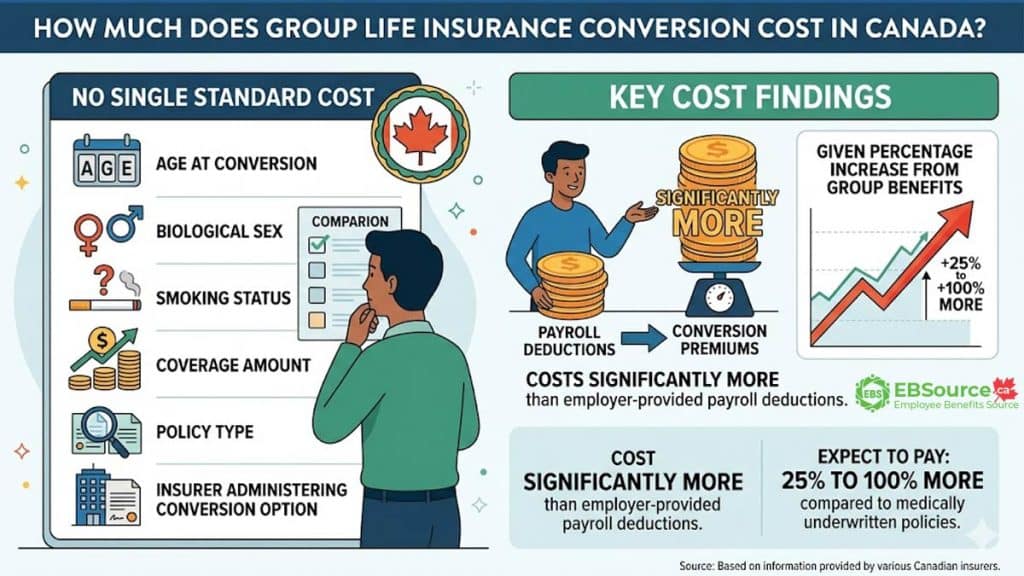
There is no single standard cost for group life insurance conversion in Canada. Your premium depends on your age at conversion, biological sex, smoking status, the coverage amount you choose, the policy type you select, and the insurer administering your group plan’s conversion option.
However, most departing employees discover that conversion coverage costs significantly more than what they were paying (or thought they were paying) through payroll deductions under their employer’s group benefits plan. Generally, expect to pay from 25% to 100% more compared to medically underwritten policies.
How Costs Vary by Policy Type
The type of policy you select at conversion has a larger impact on your cost than any other variable within your control. Typically, the group life policy is convertible to either a one-year convertible term policy (for employees under the age of 65), a term to age 65 policy or a regular plan of permanent insurance.
Each operates on fundamentally different pricing logic and serves a different strategic purpose:
| Policy Type | Relative Cost | Coverage Duration | Can It Be Converted Further? | Best For |
|---|---|---|---|---|
| One-Year Convertible Term | Lowest | One year only | Yes, to Permanent or Term-65, no medical exam | Almost everyone as a first step, preserves all options at minimum cost |
| Non-Convertible Level Term to Age 65 | Moderate | Until age 65 | No, terminates permanently at 65 | Employees under 55 who need stable, predictable coverage but not lifelong protection |
| Permanent Life (Whole Life) | Highest | Lifetime | N/A, already permanent | Those with serious health conditions who cannot obtain coverage elsewhere |
The long-term financial impact of this choice is huge. Choosing a permanent policy might mean paying 40-60% more annually for the same amount of coverage. Over 10 or 20 years, that difference can easily grow to tens of thousands of dollars.
While the right long-term solution depends on your personal situation: your health, financial obligations, and goals, you don’t have to make that permanent choice under the pressure of a 31-day deadline.
This is why the One-Year Convertible Term is often the most strategic initial move. It accomplishes two critical goals:
- It secures your insurance coverage at the lowest possible cost.
- It gives you time to properly assess your needs and find the best long-term solution without losing your conversion privilege.
Typical Group Life Conversion Cost Examples
While actual premiums are unique to each person and insurer, the examples below provide a clear picture of typical group life conversion costs in Canada. You will see how the final premium is influenced by key factors like age, coverage amount, policy type, and provincial taxes.
To make these as practical as possible, all three scenarios use actual pricing data from Manulife’s GL3413 conversion form. This helps illustrate how different policy choices affect your bottom line:
Example 1: Permanent Life, Male, Age 60, $30,000 Coverage (Newfoundland & Labrador):
| Component | Calculation | Amount |
|---|---|---|
| Rate per $1,000 | $41.63 | – |
| Annual Premium Before Tax | $41.63 × 30 units | $1,248.90 |
| Annual Premium After Tax | $1,248.90 ÷ 0.95 (NL 5% premium tax) | $1,314.63 |
Example 2: One-Year Convertible Term, Female, Age 62, $40,000 Coverage:
| Component | Calculation | Amount |
|---|---|---|
| Rate per $1,000 | $18.85 | – |
| Annual Premium | $18.85 × 40 units | $754.00 |
| Annual Policy Fee | Flat fee | $50.00 |
| Approximate Annual Cost | $754 + $50 | $804/year (~$67/month if paid annually) |
Example 3: One-Year Convertible Term, Female, Age 62, $40,000 Coverage:
| Component | Calculation | Amount |
|---|---|---|
| Rate per $1,000 | $18.85 | – |
| Annual Premium | $18.85 × 40 units | $754.00 |
| Monthly Premium | $754.00 × 0.0892 | $67.26 |
| Monthly Policy Fee | Flat fee | $6.00 |
| Total Monthly Cost | $67.26 + $6.00 | $73.26/month |
| Effective Annual Cost | $73.26 × 12 | $879.12/year |
While the premiums vary across these examples, two factors consistently drive the cost: the type of policy selected and the premium payment method. In more detail, our three scenarios reveal two critical patterns:
- Product type matters most: Permanent life coverage is significantly more expensive than term. In our examples, the rate for the permanent policy ($41.63 per $1,000) was more than double the rate for the term plan ($18.85 per $1,000).
- Billing method also adds up: Opting for monthly payments comes with a surcharge for convenience. In our scenario, paying monthly for the same term policy increased the total annual cost from $804 to over $879, an increase of more than 9%.
That said, in many cases, the type of policy selected has a greater impact on the premium than the coverage amount itself. So, it is important to understand the available options before choosing a converted policy.
How Much Group Life Insurance Can You Convert?
Most group insurers in Canada cap guaranteed conversions at $200,000, or your actual coverage amount, whichever is less.
This $200,000 figure is a standard across the industry, established by the Canadian Life and Health Insurance Association (CLHIA) to ensure all insurers follow a consistent practice. The notable exception is Quebec, where the law permits a higher conversion maximum of $400,000 (Source).
Insurers may also enforce their own conversion limits or restrict available policies, particularly for larger amounts. Therefore, employees need to review their conversion package carefully to determine the exact amount eligible for conversion.
The table below summarizes the conversion caps, application deadlines, and health requirements offered by major Canadian group insurance carriers:
| Insurer | Conversion Type | Maximum Cap | Deadline | Health Requirements |
|---|---|---|---|---|
| Canada Life (Source) | Guaranteed Conversion | $200,000 | 31 days | None – guaranteed issue |
| Canada Life | Non-conversion (individual application) | No fixed cap | 31 days | Yes – full underwriting, but if declined, a conversion policy is issued instead |
| Manulife | Guaranteed Conversion | $200,000 (Basic + Optional combined) | 31 days | None – guaranteed issue |
| Manulife (Quebec) | Guaranteed Conversion | $400,000 (Basic + Optional combined) | 31 days | None – guaranteed issue |
| Sun Life (Source) | Guaranteed Conversion | $200,000 | 31 days | None – guaranteed issue |
| Sun Life | My Life Choice (Rollover) | $1,000,000 | 60 days | Yes – a few simple health questions; if declined, it falls back to guaranteed conversion |
When to Convert vs. When to Buy a New Individual Policy
Group life insurance conversion is the stronger choice for employees with pre-existing health conditions or uncertain insurability, while healthy employees will often find lower premiums and better coverage by shopping for a new individual policy.
The right decision depends on your health, age, employment situation, and coverage needs, and in some cases, the best approach is to pursue both options simultaneously.
The five scenarios below outline when conversion makes sense, when buying new coverage is the better path, and when a hybrid approach is worth considering:
Scenario 1: Healthy employee under 45, and moving to a new job with a new group plan
This is the most common and straightforward scenario. You are in good health and moving to a new company that also offers group life insurance.
Key Considerations: The biggest risk you face is a coverage gap. Most new employers have a waiting period of 30 to 90 days before your benefits, including life insurance, become active. If something were to happen during this gap, your family would be left with nothing. Conversion allows you to build a temporary bridge and ensure you remain protected.
What to do: Immediately file for a One-Year Convertible Term conversion. This is the lowest-cost conversion option and is perfectly suited to serve as a bridge policy. Once your life insurance at the new job is officially active, you can simply cancel the converted policy. There is no need to shop for a new individual policy unless the new group plan is insufficient for your needs. If it is, your excellent health and age will secure you the best possible rates on the open market.
Scenario 2: Healthy Employee Under 50, Leaving for Self-Employment or Gig Work
This scenario is increasingly common in Canada, which saw a 44% surge in the number of digital gig workers in 2024. This transition requires a shift in mindset because employees are now 100% responsible for their own safety net.
Key Considerations: The coverage provided by a typical group plan (e.g., 1x or 2x salary) is often inadequate for individuals with financial obligations, such as a mortgage or dependents. As a result, this is the perfect moment to secure a policy that matches your actual financial obligations, and your good health gives you the leverage to obtain the best possible rates.
What to do: Employ a two-track strategy. First, file for conversion within the 31-day window to act as a guaranteed backup. Simultaneously, work with an independent broker to shop for a fully underwritten individual term policy. By doing this, you will find the open market offers substantially more coverage for your money. Finally, once your new, properly sized policy is approved and in force, you can cancel the converted one.
Scenario 3: Employee Aged 50–60 With Controlled Health Conditions
This is where the decision becomes trickier. Even if your health conditions, like high blood pressure or cholesterol, are under control, they can make the insurance underwriting process unpredictable.
Key Considerations: The main concern is that a new policy might come with a “rating” (an increased premium due to your health history), which can wipe out any potential savings. Also, because every company evaluates risk differently, the same condition could result in a standard price from one insurer but a significant surcharge from another. For this reason, you need to find out what an insurer might offer you before you let your guaranteed conversion option go.
What to do: The safest approach is to convert your policy first. With that in place, ask an independent broker to make informal inquiries on your behalf. This allows you to see what kind of offers you might receive without submitting a formal application. If the feedback shows you can get a better policy at a good price, you can then apply with confidence. If not, you simply keep the converted policy you already have, knowing you are protected.
Scenario 4: Employee With a Serious Medical Condition Diagnosed During Employment
If you were diagnosed with a significant illness like cancer or heart disease while employed, the conversion privilege is likely the only way you can secure individual life insurance.
Key Considerations: Conversion allows you to get a new individual policy with guaranteed acceptance. There are no medical exams or health questions. This feature is invaluable when your health history would lead to an automatic decline on the open market. Furthermore, a converted policy has no new two-year contestability period, which means your pre-existing conditions are covered from day one.
What to do: There is only one correct course of action: convert your policy immediately. Applying elsewhere risks a formal decline on your record, which only creates future problems. The premium will be higher than your old group rate, but the alternative is being uninsurable or settling for a limited “guaranteed issue” policy.
Scenario 5: Employee Over 60, Regardless of Health Status
At this stage, age itself becomes the single most important factor in the underwriting equation. Your options on the open market begin to narrow considerably, while premiums rise sharply.
Key Considerations: Many insurers stop issuing new term policies to applicants over 65 or 70. The conversion privilege guarantees you access to individual coverage precisely when the open market is starting to close its doors. Even if you are in perfect health, the underwriting process becomes far more rigorous after 60, and the cost of a new policy may be prohibitive.
What to do: Convert your policy immediately. Only after this guaranteed policy is securely in place should you even consider exploring the open market. Never let the 31-day window expire while you shop around.
Scenario 6: Employee Who Has Previously Been Declined for Individual Life Insurance
A past decline in life insurance is a red flag that follows you. Every insurer you apply to will see it in the Medical Information Bureau (MIB) database, making each subsequent application harder to get approved.
Key Considerations: Group life insurance conversion completely bypasses the underwriting process. Your history, including what’s in the Medical Information Bureau (MIB) file, is irrelevant. The insurer is contractually obligated to issue you a policy. This is a rare second chance to get the coverage you were previously denied.
What to do: Convert immediately. Do not file another open-market application, which could add another decline to your record. For someone with a prior decline, the conversion privilege is an irreplaceable opportunity to secure protection for your family.
FAQs about Group Life Insurance Conversion
Let’s review some of the most common questions about group life insurance conversion:
Can I convert my group life insurance at any time?
No, conversion is only an option when leaving a job or losing eligibility for your employer’s group plan for another reason. Insurers do not allow conversion to get a lower premium.
Does my dependents’ coverage convert, too?
Most group life insurance plans also allow you to convert coverage for dependents. Their certificates of coverage will outline specific conversion details. Dependents can convert whether or not you decide to convert your policy.
Can I increase the coverage amount when converting?
Usually, you cannot increase the amount of insurance when converting your group policy. The individual policy amount will be equal to or less than your group life benefits. However, some group plans may allow a small increase in coverage.
What is the time limit for converting coverage?
You must apply for conversion and pay the first premium within 31 days of your group insurance termination. After 31 days, you lose the conversion option. A few plans provide more extended conversion periods, such as 60 days.
What if I don’t want to convert but need new life insurance?
You always have the option to apply for life insurance on your own if you’re in good health. While conversion is guaranteed, new individual policies often have lower premiums and better features if you medically qualify based on underwriting.