
Employee basic life insurance is one of the most common components of group life insurance in Canada, which pays a one-time death benefit to a named beneficiary if the employee passes away while covered under the plan.
The coverage applies to the employee only, with benefit amounts typically set as a multiple of salary or a flat dollar amount. Eligible employees are covered automatically without a medical exam up to a non-evidence maximum.
However, for most employees, basic life insurance alone is not enough. Adequate coverage is generally seven to ten times annual income, and basic life insurance rarely meets that threshold. To fill the gap, employees can look into optional group life insurance, individual policies, or use the conversion privilege to convert their group coverage into a personal policy when they leave their employer.
This guide explains how employee basic life insurance works, what it covers, and how to determine whether your workplace coverage is sufficient to protect the people who depend on you.
What is Employee Basic Life Insurance?
Employee Basic Life Insurance provides a set death benefit to a designated beneficiary if the covered employee dies while enrolled. It is a foundational component of many employee benefits in Canada, which provides affordable coverage to employees, often at little or no cost.
One of the most significant advantages of basic life insurance is guaranteed acceptance. Since eligible employees don’t require a medical exam or have to answer any health questions to prove insurability, employees receive automatic coverage, even if they have existing health issues.
For most Canadian employees with dependents or significant financial obligations, basic coverage alone is unlikely to be sufficient, making it important to assess personal needs and consider supplemental or individual life insurance to close the gap.
To summarize, employee basic life insurance provides important financial protection through five key features:
- Guaranteed coverage with no medical questions or exams, up to a set limit
- Low premium costs, often paid entirely by the employer
- Pre-determined death benefit amount based on earnings or a flat rate
- Annual renewable term insurance (policy renews each year)
- Coverage duration tied to length of employment
What Employee Basic Life Insurance Covers?
Employee basic life insurance covers the death of an employee by providing a one-time, lump-sum payment to their designated beneficiary. In Canada, this payment, known as the death benefit, is received tax-free.
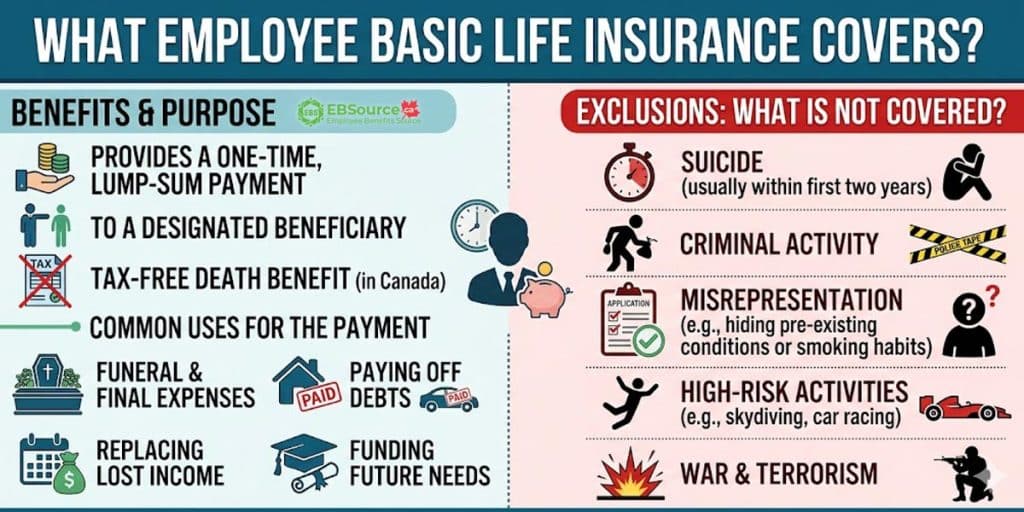
The core purpose of this coverage is to offer financial protection to the employee’s loved ones, which helps them manage expenses after the employee’s passing. The death benefit provides financial relief and can be used for anything the beneficiary needs. Four common uses include:
- Covering funeral and other final expenses.
- Paying off debts like a mortgage or car loan.
- Replacing a portion of the deceased’s lost income to cover daily living costs.
- Funding future needs, such as a child’s education.
However, basic life insurance does not cover every situation. Most policies include exclusions for cases such as suicide within the first two years, death during criminal activity, misrepresentation on the application, certain high-risk activities, and events related to war or terrorism. Here’s how these exclusions typically apply:
- Suicide: A claim will typically be denied if the death is by suicide within the first two years of the policy’s start date.
- Criminal Activity: If the death occurs while the insured is committing a crime, the benefit is usually not paid.
- Misrepresentation: If you provide inaccurate information, for instance, by not mentioning a known medical issue or hiding a smoking habit, the insurer may have the right to cancel the policy and deny any future claims.
- High-Risk Activities: Some policies may exclude deaths resulting from participation in known high-risk hobbies like skydiving or car racing.
- War and Terrorism: Death resulting from acts of war or terrorism may be excluded.
How Coverage Amounts Are Determined
Employers calculate the specific amount of your basic life insurance coverage using either a flat dollar amount for all employees in a class or a multiple of the employee’s annual earnings.
To be specific, employers choose between two main structures for the death benefit:
- Flat Amount: All employees in a specific group (e.g., all full-time staff) receive the same fixed amount, such as $25,000 or $50,000.
- Earnings-Based: The coverage is a multiple of the employee’s annual salary, such as one or two times their earnings. With an earnings-based plan, your coverage amount can change if your salary changes.
The final coverage amount is often limited by both a non-evidence maximum (NEM) and an overall plan maximum.
In practical terms, these two caps mean that employees should not assume their coverage equals a simple multiple of salary. Reviewing the certificate of insurance or asking HR to confirm the NEM and the plan maximum is the most reliable way to know the exact benefit amount.
How Your Basic Life Insurance Works
For most employees, getting basic life insurance coverage through an employer is an automatic and simple process. Once you are eligible, you may need to complete a short waiting period before coverage begins, after which you are typically enrolled automatically without needing a medical exam for the standard coverage amount. Here’s a breakdown of how it works:
Key Eligibility Requirements
Before your coverage can begin, you must meet a set of conditions set by the plan, usually related to your employment status, minimum working hours, and being actively at work. While these can vary between employers, they usually include:
- Employment Status: You generally need to be a permanent employee, working either full-time or in a part-time role that qualifies for benefits.
- Minimum Hours: Many plans require you to work a minimum number of hours per week, often between 20 and 30, to be eligible for coverage.
- Actively at Work: This is a standard insurance term meaning you must be physically and mentally capable of performing your regular job duties at your usual place of business for your standard pay. This requirement helps protect against high-risk situations. If you are on a leave of absence (for reasons other than a scheduled vacation) on the day your coverage is set to start, it will be delayed until the day you return to active work.
The Waiting Period
Many group plans include a waiting period, also known as a probationary period, which is a set amount of time a new employee must work before they become eligible for benefits. This period can range from zero days to several months.
However, some employers provide coverage immediately. At the University of British Columbia (UBC), for instance, eligible employees are automatically enrolled in Basic Life Insurance on their date of hire. (Source)
The Enrolment Process
Once you have met the eligibility criteria, enrolment in a basic life insurance plan is typically mandatory and automatic. You do not need to fill out an application or answer health questions for the basic coverage amount.
Your primary responsibility in this process is to name a beneficiary. This is a critical step to ensure the death benefit is paid to the person or entity you choose.
A beneficiary is the person, people, or entity you designate to receive the life insurance payment. You’ll name a primary beneficiary who is first in line for the payout. It is also wise to name a contingent beneficiary (or secondary beneficiary) who will receive the payment if the primary beneficiary has passed away. You can also name several beneficiaries and decide what percentage of the money each person should get.
Why is naming a beneficiary so important? Simply put, it ensures the right people get the money without any hassle. If you don’t name a beneficiary, the payment goes into your estate. This can tie up the funds in a slow and costly legal process, reducing the amount your loved ones receive and causing long delays. By naming a beneficiary, the money goes directly to them, quickly and privately.
Is Basic Life Insurance Enough on Its Own?
For most Canadian employees with dependents, a mortgage, or significant financial obligations, basic life insurance alone is unlikely to provide sufficient long-term protection.
These limitations usually fall into three main areas: the coverage amount may not be enough, the policy is tied to your job, and the benefit does not last for your entire lifetime.
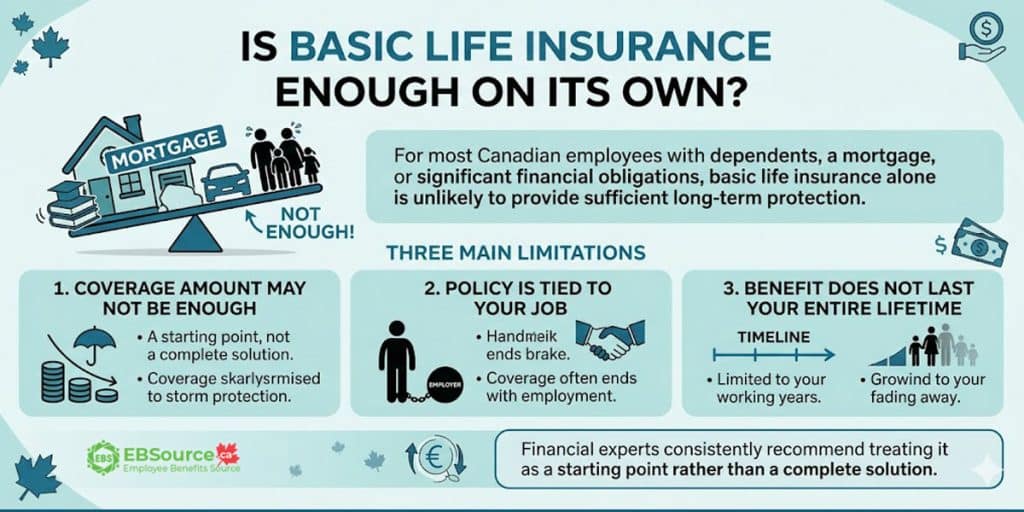
Understanding the three core limitations helps explain why financial experts consistently recommend treating it as a starting point rather than a complete solution.
The Coverage Amount is Often Too Low
Typically, these plans offer a death benefit that is a multiple of the employee’s salary, often one to two times their annual income. In contrast, many financial experts recommend a coverage amount of 7 to 15 times your annual income to adequately provide for your family’s needs.
To put this into perspective, an employee earning $70,000 a year with a typical 2x salary benefit would have $140,000 in coverage. While this is a helpful sum, it may not be sufficient to cover long-term expenses such as a mortgage, outstanding debts, and future education costs for children, all while replacing years of lost income.
Lack of Portability Between Jobs
Employee Basic Life insurance ends when employment ends, so it may not be enough coverage, and you lose it if you leave your job.
Often, an employee who changes jobs must rely on either the conversion privilege (with its higher costs and strict 31-day deadline) or the new employer’s plan (which may have a waiting period before coverage begins). During any transition, the employee’s family may be left without coverage entirely. For employees who change jobs multiple times during their career, this creates repeated periods of vulnerability.
Coverage Reduces and Eventually Terminates with Age
Most Canadian basic life insurance coverage automatically reduces the death benefit beginning at age 65 and terminates coverage entirely at age 70 or 71. This reduction occurs at precisely the stage of life when obtaining new, affordable individual coverage becomes most difficult and most expensive.
Employee basic life insurance is a valuable benefit and a good starting point. However, it’s not designed to be a long-term solution. A study from Blue Cross found that 50% of Canadian households would face financial hardship within a single year of losing the main breadwinner. This highlights the risk of relying only on a plan that reduces over time.
Employee Basic Life Insurance vs. Employee Optional Life Insurance
Because basic group life insurance is often not enough to cover all financial needs, many employers offer employee optional life insurance. These policies allow employees to purchase extra insurance at group plan rates, which are typically lower than what they would pay for an individual policy.
Here’s a simple comparison of employee basic life insurance and employee optional life insurance, including how they differ in enrolment, benefit amounts, costs, and underwriting requirements:
| Employee Basic Life Insurance | Employee Optional Life Insurance | |
|---|---|---|
| Enrolment | Automatic for eligible employees, often based on your employment class (e.g., full-time) and after a waiting period | Optional so employee must elect coverage |
| Benefit Amount | Lower, set by the employer | Higher benefit options available |
| Cost | Paid wholly or partly by the employer | Employee pays all premiums via payroll deduction |
| Underwriting | Guaranteed issue up to non-evidence maximum | May require medical underwriting above certain limits |
Employee optional life insurance can expand the amount of life insurance protection for employees who want more than the basic plan provides. It offers higher benefit amounts, convenient payroll deduction, and may include a guaranteed issue amount that allows employees to obtain additional coverage without medical underwriting.
For employees with a mortgage, dependents, or greater income replacement needs, combining basic and optional life coverage can be an effective way to build a more complete level of protection without the cost of a fully individual policy.
That said, employee basic life insurance on its own still plays an important role. It gives employers a way to provide affordable, guaranteed coverage to all eligible staff. And while the death benefit may be modest, it offers an immediate layer of financial security, one that employee optional life insurance can build on when more coverage is needed.
Frequently Asked Questions About Basic Employee Life Insurance
How much does basic employee life insurance cost?
Premiums are very affordable, since costs are spread across the group. Employers often cover the full premium. If employees contribute, deductibles range from $10-30 monthly for coverage up to $100,000 or more.
Is Basic Employee Life Insurance guaranteed?
Yes, group policies are guaranteed issue up to the non-evidence maximum. No health questions or exams are required during initial enrollment.
Can Basic Employee Life Insurance be converted?
Yes, in most cases, you can convert your Basic Employee Life Insurance into a personal policy when you leave your job.
However, the two most important things to be aware of are the deadline and the cost. You typically have a very limited window of time, often just 30 or 60 days after your last day of work, to make the switch. After that deadline, the option is gone for good.
It's also important to know that the premiums for a converted policy are almost always more expensive than the group rates you had as an employee.
Because every plan has different rules, your best bet is to check your plan documents to find the exact deadline and understand your specific options. This will help you decide if converting is the right move for you.
Are Basic Employee Life Insurance benefits taxable?
No, the life insurance payout that is passed to your beneficiaries is not considered taxable income.
However, in Canada, the premiums your employer pays for your group life insurance are considered a taxable benefit for you. The value of this benefit is calculated based on Canada Revenue Agency (CRA) rules, and it can vary depending on factors like your age.
You will see this amount reported on your year-end tax documents. It is listed under code 40 on a T4 slip for current employees or code 119 on a T4A slip for those who are former or retired employees.
When do Basic Employee Life Insurance reductions start?
Most plans reduce basic life benefits at age 65, often by 50%. Coverage then ends at retirement or age 70 in most cases.