


Canadian small businesses can offer retirement savings plans without having such risks of a traditional defined benefit pension. The right choice usually depends on your budget, the provinces your employees work in, and how much administration you can manage.
However, plans that look similar can differ in employer contributions, payroll treatment, fees and administration. And sometimes, they commit your business to an ongoing cost that is hard to reverse. Quotes from providers can also be confusing due to differing assumptions about participation and fees.
This guide will help you understand which small business retirement plans suit you best, what questions to ask providers to compare them fairly, and when to seek outside advice.
Which Retirement Plans Suit a Canadian Small Business?
For most small businesses, the six main retirement plan options to choose from are:
- Group Registered Retirement Savings Plan (Group RRSP): In a Group RRSP, each employee holds an individual RRSP inside an arrangement your business sets up with a provider. Employees save through payroll deductions, and you can add employer contributions if you choose.
- Deferred Profit Sharing Plan combined with a Group Registered Retirement Savings Plan (RRSP/DPSP combinations): In an RRSP/DPSP combination, employees contribute to the RRSP while the employer contributes to the DPSP. This plan may provide for a vesting period of up to two years.
- Pooled Registered Pension Plan (PRPP): This option is designed for employees of small and medium-sized businesses. Choose it if you have no HR staff and your employees fall under federal or participating-province rules; as a licensed administrator runs the plan and manages its investments, making payroll deductions easy to handle.
- Defined Contribution Pension Plan (DC pension plan): Offer this plan to your employees if you want a formal, fixed employer commitment. It lets you establish an employer contribution formula. Therefore, your contribution rate can be predictable, but total spending still depends on pensionable payroll, plan fees and administration requirements.
- Group Tax-Free Savings Account (Group TFSA): A Group TFSA can be added as optional savings to a retirement plan. It costs little to add, and employees can withdraw tax-free at any time, which often suits lower-income staff better than an RRSP deduction.
- Québec Voluntary Retirement Savings Plan (Québec VRSPs): Choose this option if you have Québec employees and need a qualifying plan.
If you run an early-stage company whose headcount and funding may change within a year, our guide to retirement benefits for Canadian startups shows how to test a plan design against secured funding and your hiring plan before you commit.
In contrast, a Defined Benefit Pension Plan (DB pension plan) promises each retiree a fixed income for life. If the plan does not have enough funds, the employer has to cover the gap and pay an actuary to assess the plan’s finances regularly. For many small businesses, this unpredictable expense is too risky.
Employee Stock Ownership Plans and similar equity arrangements serve ownership and succession goals rather than retirement savings.
What Should You Compare in a Small Business Retirement Plan Quote?
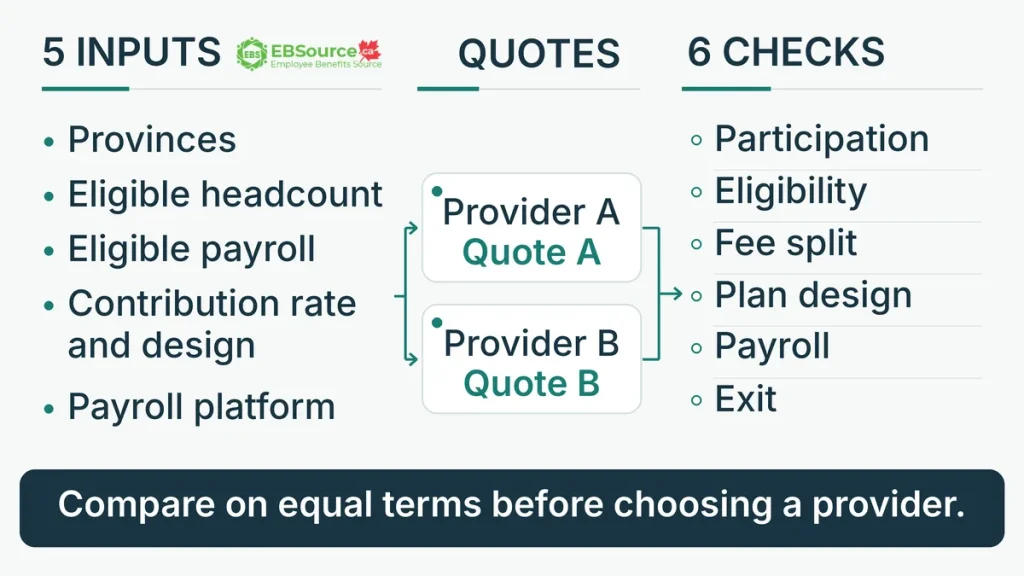
We suggest sending each provider the same business profile and questions. Otherwise, differences in participation, contributions or fees may make the quotes difficult to compare fairly.
In general, give each provider the same five inputs: the provinces your employees work in, eligible headcount, eligible payroll, your intended contribution rate and design, and your payroll platform.
Then ask each of them the same six questions as below:
- Participation: What take-up rate is this quote based on, and what changes if fewer employees join?
- Eligibility: Do we meet your minimum employees, contributions, or assets; how is each minimum measured, and what happens to our pricing or eligibility if we fall below it in a year?
- Fee split: Which fees do we pay, which come out of member accounts, and what does a member pay to withdraw, transfer or leave?
- Plan design: Can withdrawals of employer-funded amounts be restricted, and how would that affect payroll treatment? For a DPSP, which contribution changes can be made under the existing plan terms, and which require an amendment?
- Payroll: Is our platform integrated, or do we upload a file each cycle? Who is accountable for correcting contribution errors, and on what timeline?
- Exit: What does it take to move providers or wind down the arrangement, and what does that cost our members and us?
Also confirm whether the provider has a pre-approved Deferred Profit Sharing Plan (DPSP) template from the CRA to simplify setup.
When to Get Professional Advice Before Choosing a Small Business Retirement Plan
Once more than one jurisdiction, a connected person or a locked-in design is involved. Some products are sold only through a licensed advisor, so the conversation may not be optional. Give the experts you engage the same five inputs you gave every provider, and ask them to confirm the pension jurisdiction that applies to each employee group before you sign anything.
If your employees work in Ontario, see how to price a workplace retirement plan in Ontario, line by line, once you have a shortlist.
What Should You Do Before Committing to a Small Business Retirement Plan?
The right corporate retirement plan is one your business can afford, administer and keep offering as its workforce changes. Start by confirming any legal obligations, the employer contribution you can sustain and which arrangements are available to your employees.
Once you have a shortlist, send every provider the same five inputs and six questions. Compare not only the quoted price but also employer and member fees, contribution rules, administration duties and exit costs.
Before committing, confirm the final plan terms in writing, and get professional advice if your plan involves more than one jurisdiction, an owner or connected person, or locked-in contributions.
Québec Employers: Check VRSP Obligations Before Comparing Plans
In Québec, some employers are required to offer a Voluntary Retirement Savings Plan or another qualifying workplace savings or pension arrangement. Check that obligation before comparing voluntary plan designs. The Voluntary Retirement Savings Plans Act requires some employers to offer a plan, and CNESST, not Retraite Québec, enforces the obligation.
First, an employer must offer a plan by 31 December 2026 if it had at least 5 eligible employees on 31 December 2025 and 10 or more on 30 June 2026. In addition, an eligible employee is at least 18, is an employee within the meaning of the Act respecting labour standards, and has one year of uninterrupted service. Part-time status alone does not exclude an employee. However, an employee who has not yet completed one year of uninterrupted service does not yet meet the Voluntary Retirement Savings Plan eligibility test.
If the employer has fewer than 10 eligible employees on June 30, the December 31 obligation is not triggered for that year under the current threshold. Recheck the employee count and current CNESST rules each year.
So, start by confirming whether an existing qualifying arrangement already covers your eligible employees. That answer may eliminate some options before you begin comparing voluntary plan designs.
Source: 2026 Benefit Amounts and Key Data – Retraite Québec
FAQs Related to Small Business Retirement Plans Canada
Does Business Size Rule Out Any of These Retirement Plans?
Headcount alone does not create a single Canada-wide minimum that determines which of these arrangements a small employer can use. However, pension legislation, jurisdiction, plan terms and provider eligibility rules can still affect availability.
What Happens to the Group Retirement Plan When the Business Is Sold?
It depends on how the sale is structured. The plan may end, transfer to the buyer, or continue with the buyer as the new employer, so address it during the sale rather than after.
Ending a plan involves formal steps. To close a DPSP, the employer or trustee must send the CRA a letter or board decision showing when and how plan assets will be paid to beneficiaries. Winding up a DC pension plan must follow the pension rules for each employee group, including notifying members and filing with regulators. Where several employers share a plan and only one leaves, the plan can stay registered for the others.
Confirm the details with the CRA and the relevant pension regulator before finalizing the purchase agreement.
Which Options Can Reduce the Small Business Retirement Plan Setup Work?
Two are worth asking every provider about. A financial institution can have a Deferred Profit Sharing Plan specimen plan approved by the CRA in advance, and an employer adopting that specimen does not file its own plan text or trust agreement with the application.
In Québec, a Simplified Pension Plan (SIPP) is another small-business option in which an authorized financial institution handles much of the plan administration. It should not be presented as a Canada-wide equivalent.