


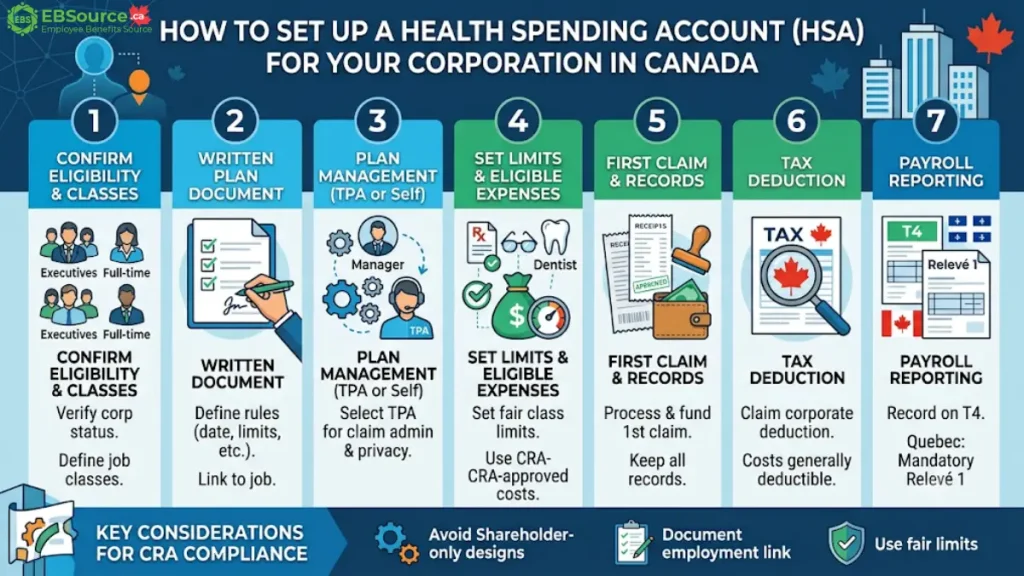
Setting up a Health Spending Account (HCSA/HSA) for your corporation involves seven steps: confirm the corporation’s eligibility and define covered employee classes, write the plan document, decide how the plan will be managed, set reasonable limits, run the first claim, claim the corporation’s tax deduction, and report the benefit correctly on payroll.
For those who decide to work with a provider, remember to ask them questions about how they handle claims, protect private information, clearly disclose fees, and report payroll in Quebec. After that, work through the one-page readiness checklist near the end of this guide to confirm everything is in place.
What's different about this guide: We focus on making the plan strong against audits by addressing employee-class design, owner-only shareholder-benefit risk, first-claim paperwork, CRA PHSP qualification, and required Quebec Relevé 1 reporting.
Note: In this guide, HSA means a Canadian Health Spending Account or Health Care Spending Account. It is not the U.S. Health Savings Account, which is a personal tax-advantaged savings and investment account.
How Do You Set Up an HSA for Your Corporation in Canada?
To set up a Health Spending Account for your corporation, check who is eligible and which employee groups are eligible, create the plan document, decide how it will be managed, set fair limits, handle the first claim, claim the corporation’s tax deduction, and report the benefit correctly on payroll, including the mandatory Relevé 1 reporting for Quebec employees.
Below are the detailed steps on how to set up an HSA for your corporation in Canada:
Step 1: Confirm corporate eligibility and pick covered employee classes
First, your company needs to decide who is included. Then, group employees into clear categories, because different groups may have different annual limits.
Common classes include:
- executives or senior managers;
- full-time employees;
- part-time employees;
- union and non-union employees, where relevant;
- employees in a defined occupation or location; or
- employees with a particular level of responsibility.
Important note: Different employee classes may have varying annual limits, but these differences must align with the employer’s compensation policy and be applied consistently. Avoid using labels such as “shareholders,” “owners,” or “family members of shareholders,” as they suggest that benefits are based on ownership rather than employment.
Before heading to the next step of setting up a corporate HSA, answer these five questions to determine which parts of this guide matter most to you:
- Are you incorporated? An HSA of the kind described here is a corporate arrangement. Unincorporated self-employed individuals fall under different rules (section 20.01 of the Income Tax Act) and should not follow this guide.
- Do you have arm’s-length employees, or is the plan owner-only? If the plan covers only a controlling shareholder and family, read the “Common Mistakes” section before anything else; a self-insured owner-only plan likely does not qualify as a PHSP.
- Are there any employees in Quebec? If yes, Relevé 1 reporting in Step 7 is mandatory, and your provider must be able to support it.
- Will the arrangement be insured, self-insured, cost-plus, or administrative services only? This determines both your deduction (Step 6) and your PHSP risk (Step 3 and the Common Mistakes section).
- Is the covered owner a controlling shareholder? If yes, document why each limit you set in Step 4 is reasonable as part of that person’s employment compensation.
How risky is your corporation type before you start?
Your answers to the five questions above place you on a range of risk related to CRA. The table below outlines how these risks typically vary among different types of corporations, helping you decide how carefully to follow the rest of this guide:
| Corporation type | PHSP qualification risk | Shareholder-benefit risk | Best next step |
|---|---|---|---|
| Owner-only, paid by dividends only | High | High | Get independent tax advice before proceeding; read the Common Mistakes section first |
| Owner-only, paid a T4 salary | Medium-high | Medium-high | Compare genuine insured options and document the employment basis of every benefit |
| Owner plus arm’s-length employees | Medium | Medium | Use role-based classes with consistent limits (Steps 1 and 4) |
| Multi-employee corporation, no dominant shareholder coverage issue | Lower | Lower | Focus on the written plan, a capable administrator, and correct payroll reporting |
| Any of the above with Quebec employees | Adds reporting risk | Unchanged | Confirm Relevé 1 support in writing before launch (Step 7) |
Please use the ratings as general guides, not as a final CRA classification, since the real classification depends on your specific situation.
The number of plan members does not, by itself, determine PHSP status. A corporation with one employee can be eligible, but the arrangement must still meet all PHSP requirements, including the nature-of-insurance test and, where applicable, the employee-versus-shareholder analysis. The problem arises specifically when the plan’s only member is a non-arm’s-length controlling shareholder.
Note: If you land in the top two rows, the shareholder-benefit and insurance-risk discussions in the Common Mistakes section are the core of your setup decision.

Why the first row is the riskiest case: An owner who receives only dividends has weaker evidence that an HSA benefit forms part of employment remuneration, but dividend-only compensation does not by itself determine PHSP status or whether the individual is acting as an employee. For a controlling shareholder, document the employment duties, compensation rationale and why the benefit is provided in the person's capacity as an employee rather than as a shareholder.
Step 2: Write the plan document
A corporate HSA needs a written plan because the CRA does not register or approve PHSPs in advance. The CRA determines whether it qualifies based on the facts, typically during an audit or after-the-fact review.
A corporate Health Care Spending Account should have a written plan that explains the following seven main points:
- when it starts,
- who can join,
- annual limits,
- which expenses qualify,
- rules for saving unused funds,
- how to file claims, and
- how to end the plan.
You can provide proof of employment with an employment agreement, benefits policy, offer letter, or board decision. This method links the benefit to the employee’s job rather than share ownership, which helps establish that the benefit was provided because of employment.
What a corporate HSA plan document looks like in the real world
The example below shows how the seven points turn into a clear, simple plan document. Note that this is a guide to adjust with your accountant, not a form to copy exactly, since your classes, limits, and administrator will be different.
| Plan document section | Sample wording |
|---|---|
| Plan name and sponsor | The Private Health Services Plan of [Corporation Name] Inc. (the “Plan”), sponsored by [Corporation Name] Inc. (the “Company”). |
| Effective date | The Plan takes effect on [January 1, 20XX]. No expense incurred before this date is eligible. |
| Eligible employees | Active employees designated under the Plan. Where an eligible employee is also a shareholder, the Company should document why the benefit is provided as part of employment compensation rather than because of share ownership. |
| Employee classes and annual limits | Class A (executives / senior managers): $[5,000]. Class B (full-time general staff): $[2,000]. Class C (part-time staff): $[750]. Limits are tied to role, not to shared ownership, and are applied consistently within each class. |
| Eligible expenses | Only medical expenses that qualify for the medical expense tax credit under section 118.2(2) of the Income Tax Act, plus connected expenses within a reasonable period. Cosmetic and non-prescription items without proper proof are excluded. |
| Claims process | The employee submits a receipt and claim form to [Administrator] within [30] days of payment. [Administrator] adjudicates the claim and reimburses the employee from Company funds. |
| Unused funds/carry-forward | Unused amounts may be carried forward for up to [12] months, after which they expire if the plan’s written terms provide for a carry-forward. No amount is convertible to cash or transferable to a non-health benefit. |
| Amendment and termination | The Company may amend or terminate the Plan prospectively by board resolution and written notice, subject to the Plan’s contractual terms. No amendment or termination will retroactively eliminate a valid claim for an eligible expense incurred before the effective date of the change. For a sole employee-shareholder arrangement, an employer’s unrestricted ability to amend or terminate the plan may weaken the argument that the arrangement contains a reasonable element of insurance risk. |
Step 3: Select a third-party administrator versus self-administration
While some employers self-administer their plans, many use a third-party administrator (TPA) to adjudicate claims, manage records, and limit employer access to medical information.
A TPA can handle claims, adjudicate expenses, protect employee medical privacy, and maintain records. For owner-only corporations, a TPA may improve the file, but it does not automatically make a one-person self-insured arrangement a qualifying PHSP.
Note that this choice also shapes how your deduction works later. Whether the arrangement is insured or self-insured determines both the amount and the timing of what the corporation can deduct, which we cover in Step 6.
Which corporate HSA providers should you shortlist in Canada?
The 8 providers listed below are commonly considered by Canadian corporations, based on the information available on their websites as of July 19, 2026. Note that this list is meant to help you start your own research and review, not to rank or recommend them:
- Aya Care: Uses a prepaid Visa card for benefits. Employers pay in advance, so employees do not have to pay out of pocket. Receipts need to be sent through the Aya app. Prices vary; ask for a quote to learn more.
- BeniPlus: Combines an HSA with wellness and insurance choices. Employers pay for what is used plus a service fee; available for groups starting with just one person.
- Coastal HSA: Affordable option with per-claim fees and a one-time setup fee, but no annual fees. Check the latest prices and which provinces/territories are included.
- EasyHSA: Provides simple pricing per claim with no setup fees, yearly fees, or long contracts. Check the current per-claim rate directly.
- Frontier HSA: Newer provider with per-claim fees and quick reimbursements. Confirm their fees and compliance documentation since they are new to the market.
- myHSA: Started in 2011, it offers different products with claim fees that vary by plan. Check prices and make sure they support Quebec’s Relevé 1 reporting.
- National HealthClaim: Operating since 2002, it charges per-claim fees and offers optional insurance extras. Claims need to be sent to other insurers before using this service.
- Olympia Benefits: Started in 1997, it offers different services. Check all fees directly. They suggest paying a T4 salary instead of dividends, only to achieve better tax benefits.
Important note: Verify the current fees, plan terms, and Quebec payroll reporting support directly with each provider before signing.
Step 4: Set reasonable annual limits and define eligible expenses
The expenses that a corporate Health Care Spending Account can reimburse must qualify under the medical expense guidelines outlined in Section 118.2(2) of the Income Tax Act. While limits on these expenses should be reasonable for the specific role, no fixed percentage can be deemed appropriate. Therefore, do not forget to check the current CRA guidance and obtain appropriate advice before adopting a specific plan limit.
For example, costs for prescription drugs, dental care, vision care, and paramedical services, when applicable, follow the rules for the medical expense tax credit. However, expenses for most cosmetic procedures and non-prescription items without proper proof should not be reimbursed through the PHSP.
Here’s how common claims usually fit into eligible and ineligible groups under the rules for the medical expense tax credit:
| Typically eligible (METC) | Typically not eligible |
|---|---|
| Prescription drugs recorded by a pharmacist | Over-the-counter vitamins and supplements without a prescription |
| Dental work and orthodontics | Purely cosmetic procedures, for example, teeth whitening (for expenses incurred after March 4, 2010, when the statutory exclusion took effect) |
| Prescription eyeglasses and contact lenses | Non-prescription reading glasses |
| Physiotherapy, psychology, and other paramedical services by an authorized practitioner | Gym memberships and general wellness spending |
| Medical devices and equipment prescribed by a practitioner | Elective cosmetic surgery that is not medically necessary (both surgical and non-surgical procedures aimed purely at enhancing appearance are excluded) |
Check specific items against the CRA list before relying on them, since eligibility might require a prescription or proof of medical need.
How the “all or substantially all” test applies to insured versus self-insured plans
The CRA applies the “all or substantially all” test (generally 90% or more) differently depending on whether the plan is insured or self-insured. For an insured plan, the test generally examines the premiums paid. For a self-insured plan or HSA, the focus is on the benefits paid to employees in a calendar year. In the case of self-insured HSAs, contributions for each employee are not included in the calculation; only the total benefits paid to all employees matter.
For most employer HCSAs, CRA looks at the self-insured group plan as a whole. In that case, the 90% test is based on benefits paid to all employees in the calendar year for METC-eligible medical expenses. However, CRA says that in rare cases each HCSA may be treated as a separate insurance plan. If that happens, the 90% test may need to be applied account by account.
The table below shows how the “all or substantially all” test works for insured and self-insured plans:
| Plan type | How the test is measured |
|---|---|
| Insured plan (employer pays premiums under a contract of insurance) | 90% or more of the premiums paid under the plan in the year must be for METC-eligible medical expenses. The benefits paid to employees during the year do not count. A plan can still qualify even if, for example, only 88% of the benefits paid were METC-eligible, as long as the premium rule is met. |
| Self-insured plan/HSA | At least 90% of the benefits paid to all employees in the calendar year must be for METC-eligible medical expenses. |
For examples from the CRA, see the sections on Premiums and Contributions to Insurance Plans and Medical Expenses. Make sure to check your own plan against current CRA rules, as mistakes in applying this test are common.
Edge cases: expenses that are eligible only under certain conditions
Most adjudication disputes come from a few specific expenses that only qualify under certain conditions. These are the claims your administrator should check carefully, and you should compare them to CRA guidelines before approving coverage for an employee:
| Expense | Eligible? | The condition that decides it |
|---|---|---|
| Medical cannabis | Sometimes | Medical cannabis may qualify only if the patient has the required medical document and purchases the product for medical purposes from the licence holder with whom the patient is registered. Cannabis bought from a regular legal retailer does not automatically qualify |
| Therapy by a social worker or counsellor | Depends | The practitioner must be authorized to practise in the province/territory where the service is provided; rules vary by province/territory and profession |
| Travel for medical treatment | Sometimes | Distance thresholds apply (generally 40 km one way for transportation, 80 km one way for additional travel costs such as meals and accommodation), and equivalent care must not be available locally |
| Fertility treatments | Often | Many procedures and related medications qualify, but details depend on the treatment and the provider; keep detailed documentation |
| Gluten-free food | Sometimes | Only the incremental cost over comparable regular products, and only with documented celiac disease certified by a medical practitioner |
If a provider tells you any of these are simply “covered” or “not covered” without mentioning the conditions, treat that as a red flag when you reach the provider questions later in this guide.
Step 5: Run the first claim, fund it, and keep records
The first claim does not determine when the plan becomes effective. Instead, it tests whether the plan operates as documented from its stated effective date. Handling one legitimate claim correctly sets a standard for future claims and creates the evidence file that the CRA needs.
When a TPA handles the claim, the administrator should keep the detailed medical receipt and related health information. The company should keep the plan document, the approved amount, the administrator’s bill, proof of payment, and any needed payroll records, without gathering more medical information than needed.
Once the first claim has been paid and documented, the setup work shifts from the plan itself to its tax treatment. The final two steps cover what the corporation can deduct and how the benefit must appear on payroll.
Step 6: Claim the corporation’s tax deduction
Corporate HSA costs are generally deductible if they are reasonable, incurred to earn business income, and relate to an employment benefit rather than a shareholder benefit. The structure you chose in Step 3 generally affects both the amount you can deduct and when you can deduct it.
- Insured Plan: The employer can deduct the premiums paid or owed for the year, plus reasonable administrative costs.
- Self-Insured Plan: The company should deduct only reasonable amounts that align with the plan, relate to employee pay, and are truly owed. Check with the company’s accountant about the right time to take the deduction, and do not assume any unused amount can be deducted automatically.
For controlling shareholders, see “Common Mistakes” below for the separate shareholder-benefit analysis.
Step 7: Apply federal and Quebec payroll reporting correctly
The final step is making sure the benefit appears correctly on payroll slips, and the rules differ sharply between the federal level and Quebec. Therefore, employer-paid and employee-paid amounts must be handled separately.
If the arrangement qualifies as a PHSP, an employer-paid contribution is usually non-taxable to the employee for federal income tax purposes. Quebec has different provincial rules and treats the same employer contribution as taxable for provincial tax purposes, so a Quebec employee pays provincial, but not federal, income tax on it.
Case 1: Employer-paid contributions, federal reporting
At the federal level, if the arrangement qualifies as a PHSP, employer-paid contributions are not a taxable benefit to the employee and are not included on the T4. There is no requirement to report the employer contribution in Box 85.
Case 2: Employee-paid premiums, federal reporting
If an employee pays their own PHSP premiums, that amount may be reported using code 85 on the T4. Using code 85 is optional. If you do not use it, the CRA may ask the employee for supporting documents. Reporting it is generally recommended because it supports the employee’s medical expense claim.
For former or retired employees receiving a T4A, the equivalent is Code 135, “Recipient-paid premiums for private health services plans,” which is also optional and supports the individual’s medical expense claim.
Case 3: Quebec reporting (mandatory)
For Quebec employees, confirm the Relevé 1 treatment with Revenu Québec’s current RL-1 and taxable-benefit guidance before filing. Employer-paid HSA amounts may require Quebec reporting that differs from federal T4 treatment, including Relevé 1 boxes and codes. Do not rely on federal T4 treatment alone for Quebec payroll.
Depending on the employee’s situation, the value of the benefit may need to be included in Box G (salary that counts toward the QPP pension). So confirm the full payroll configuration with your provider or accountant, not just Boxes A and J.
Quebec employers should also prepare for Quebec’s tax on insurance premiums. This tax applies to payments made under private health service plans and affects the actual cost per claim. Some administrators include this tax in their fees, while others charge it separately. To see how it appears on invoices, be sure to ask your provider. For more information, see Revenu Québec guide IN-253-V (Taxable Benefits).
Quebec is not the only province to tax these arrangements. In Ontario, for example, payments under uninsured benefit arrangements may be subject to Retail Sales Tax and a premium tax. Ask your administrator how provincial premiums and sales taxes are applied to invoices for your province/territory, not just for Quebec.
Questions to Ask an HSA Provider Before You Sign
The administrator you choose in Step 3 handles many important tasks to ensure your plan complies with the rules. This includes reviewing claims, managing receipts, and generating the required payroll numbers. Because of this, choosing a provider is one of the most essential decisions during the setup process.
To help you tell the difference between a reliable administrator and just a marketing front, look over the due diligence checklist below before signing any agreements:
- Do you adjudicate claims under the CRA’s eligible medical expense rules, reject ineligible claims, and retain evidence of adjudication?
- If we have Quebec employees, do you provide the values needed for Relevé 1 reporting, including Boxes A/J where applicable, code 235 where relevant, possible Box G treatment, and Quebec insurance premium tax?
- Can you explain whether the arrangement is insured, self-insured, administrative services only, or cost-plus?
- Who keeps the employees’ medical receipts, and how do you protect their privacy?
- Are the fees for setup, administration, and claims listed separately on invoices, and are taxes included in the administration fee?
- How do you manage unused amounts for later use, and are carry-forward rules limited and clearly documented? (Confirm the plan carries forward either credits or expenses, not both.)
- Do you provide a written plan document, an employee class schedule, and confirmation of the effective date?
- Do you support owner-only corporations? If yes, what structure do you use, and what tax risks remain for a sole employee-shareholder plan?
- What happens when a claim is denied?
- What is your typical reimbursement turnaround after a claim is approved?
- Do you recommend independent tax advice for sole employee-shareholder corporations?
- Can you show a sample year-end report that your clients receive?
As you work through these questions, the answers themselves tell you as much as the features do. This table summarizes what strong and weak answers sound like on the five topics that matter most:
| Topic | Green flag | Red flag |
|---|---|---|
| CRA eligibility | Explains PHSP status and the medical expense tax credit rules, and describes how non-eligible claims are rejected | Says “everything medical is covered” |
| Owner-only plans | Discloses the CRA’s position on sole employee-shareholder plans and recommends independent tax advice | Says the plan is “100% guaranteed deductible” for any corporation |
| Quebec | Provides the values and explanations needed for Quebec RL-1 reporting, including Box A and Box J where applicable, code 235 where relevant, possible Box G treatment, and Quebec insurance premium tax | Says Quebec is handled “normally” or “the same as other provinces/territories” |
| Fees | Separates setup, administration, claim, and tax amounts on invoices | Blends fees into one unexplained figure |
| Privacy | Keeps medical receipts with the administrator, away from the employer | Sends detailed medical receipts to the employer |
A provider who lands in the green column, especially on adjudication, privacy, and Québec reporting, is one you can build on for the rest of your corporate HSA setup. Vague answers on any of them are a reason to keep looking.
Which Health Spending Account Structure Works Best for Your Corporation
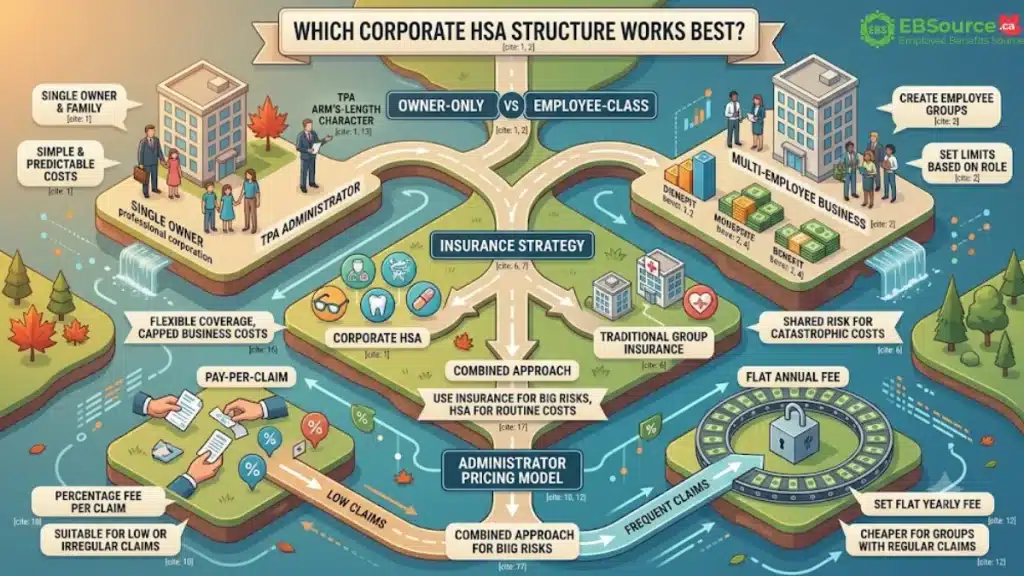
The best plan setup depends on whether you work alone or have employees and how you want to handle costs and pricing.
Plans for individual owners usually focus on being simple, while plans for several employees use groups to keep spending fair. Choosing a setup comes down to two main options: whether the HSA should replace group insurance or be used alongside it, and whether to pay your administrator for each claim or with a flat yearly fee.
The two subsections below work through each decision in turn:
HSA alongside or instead of traditional group insurance
A corporate HSA can either replace group insurance or work alongside it, depending on how much control you want over costs. The best choice depends on the type of risk you want to manage: a corporate HSA, group insurance, or both.
Here’s a comparison of the three approaches:
- Corporate HSAs: Provide flexible coverage for a range of CRA-approved expenses with predictable, limited costs for the company.
- Group Insurance: Spreads risk across many people to cover high, unexpected costs, such as costly medications.
- Combined Approach: Uses insurance for major risks while using a corporate HSA for regular and uncovered expenses.
Choosing among these options depends mostly on how many employees you have and where they work. The table below shows common business situations and the setup that usually works best for each:
| Business type | Often, the better fit | Main risk | What to confirm |
|---|---|---|---|
| Owner-only professional corporation | Genuine insured plan where available; otherwise, obtain advice before using a cost-plus or self-insured HSA | Lack of insurance risk / shareholder-benefit treatment under subsection 15(1) | Review the structure with a tax adviser and get the provider’s written position on sole employee-shareholder plans |
| 2 to 5 employees | HSA with employee classes | Unreasonable or share-based limits | Role-based class schedule, written plan document, and documented limit rationale (see Step 4) |
| 6 to 10 employees | HSA with employee classes, and a review of whether pooled insurance is worth adding | Gaps in catastrophic coverage as claims grow | Whether major, unpredictable risks should start to be pooled through insurance |
| More than 10 employees | Group insurance plus an HSA | Gaps in catastrophic coverage if limits are not coordinated | Coordinate insurance coverage and HSA limits so major risks stay pooled |
| The workforce is concentrated in Quebec | HSA with a deliberate payroll process | Relevé 1 error (Boxes A and J, code 235, possible Box G) | Written confirmation that the provider produces the Relevé 1 values, and a budget for the insurance premium tax |
From the table, we can see that as the number of employees grows and potential costs increase, group insurance and the HSA become more valuable. On the other hand, smaller companies often choose an HSA because costs are capped and administration is simpler. One-person corporations should be more cautious and should compare insured options, cost-plus options, and the shareholder-benefit risk before proceeding.
Pay-per-claim versus flat annual fee pricing
Providers generally price in one of two ways, and the better fit depends on how often you expect to make claims. Pricing methods differ by provider, so use the information below as general advice rather than exact prices. Choosing the right model between pay-per-claim and a flat annual fee when setting up is important because it will affect your company’s costs for the year.
- Pay-per-Claim: Compare each provider’s expected annual cost using your projected claims, enrolled employees, fixed fees, per-claim fees, funding charges and applicable taxes. No pricing model is automatically cheaper without a current quote and expected-use assumptions.
- Flat Annual Fee: This option means paying a set amount each year, which usually works better for groups with more or regular claims. Plans covering many employees and with frequent claims often find this choice cheaper because the cost per claim declines as the number of claims increases.
To make an informed decision when setting up a corporate HSA, estimate how many claims you expect each year, then compare the two pricing options based on that number. It’s also worth reviewing your choice if the number of employees or claims changes. Make sure to talk about this with any administrator before signing, along with any other important checks.
Common Mistakes When Setting Up A Corporate HSA
Three recurring risks appear in CRA guidance and relevant cases: an owner-only plan that is not genuinely in the nature of insurance, limits that are too generous or arbitrary for a shareholder-employee, and missing or incomplete plan paperwork.
Each of these problems can cause you to lose tax deductions or create taxable benefits. Where a benefit is received in the recipient’s capacity as a shareholder, the result can be an adverse two-sided tax outcome: the benefit is taxable to the recipient, and the corporation may lose its deduction. The main issue is that the plan starts to look like a way for a shareholder to pay personal expenses through the company rather than a real employee benefit.
Below, we will break down each mistake in detail, explain why the CRA considers it a problem, and outline typical solutions:
Mistake 1: Treating a One-Person, Self-Insured Plan as Insurance
A one-person, self-funded health plan that only reimburses the owner’s medical bills likely does not qualify as a PHSP under subsection 248(1) of the Income Tax Act, which defines a PHSP as a contract or plan of insurance; the CRA’s long-standing position (Interpretation Bulletin IT-339R2) is that this means the plan must be “in the nature of insurance.”
The CRA’s position on this issue has shifted several times before settling, which is a large part of why providers still give different answers. The CRA said it would accept such plans under certain conditions.
However, in 2014 (document 2014-0521301E5), the CRA stated that a cost-plus plan for a sole employee-shareholder would likely not be considered an insurance plan. In 2022 (document 2022-0928901C6), the CRA confirmed this view about a self-insured HSA covering a sole employee-shareholder and their family.
The CRA pointed out two warning signs: there is little real risk that the employee will not get fully reimbursed for the yearly amount, and the employer can end the plan at any time.
Solution for Mistake 1
A TPA can help with documentation, privacy, and adjudication of eligible expenses, but it may not fix the fundamental issue if the plan still lacks insurance risk. A genuine insurance plan is usually more defensible for an owner-only corporation because it involves an actual transfer of risk to an insurer, which makes it look like real insurance rather than a basic expense account.
Note also that even where PHSP status is not the issue, a sole employee-shareholder who receives benefits in their capacity as a shareholder must include them in income under subsection 15(1). PHSP qualification and shareholder-benefit treatment are two separate hurdles, and an owner-only plan must clear both.
Mistake 2: Setting Unreasonable or Arbitrary Limits for a Shareholder-Employee
Benefits should be provided to the owner as an employee, with pay and coverage that match the work they do.
The risk is not theoretical. In Spicy Sports Inc. and Steve Cousins v. The Queen (2004 UDTC 123, Tax Court of Canada, informal procedure), a corporation reimbursed a 51% shareholder-employee for a knee surgery performed in the US costing about $35,996 under a cost-plus PHSP, with no evidence the plan was available to arm’s-length employees on comparable terms. The court found the benefit was received in the individual’s capacity as a shareholder rather than as an employee.
Solution for Mistake 2
Avoid setting limits as an arbitrary percentage of salary or as amounts designed mainly to maximize shareholder benefit. Instead, document why each limit is reasonable in light of the employee’s role, duties, and pay. Where a meaningful comparator exists, assess whether the benefit is broadly consistent with what an arm’s-length employee performing similar services could receive.
Mistake 3: Missing or Incomplete Plan Documentation
A corporate Health Care Spending Account is a contractual arrangement, so it is tied to employment matters. This documentation helps establish that the benefit was provided because of employment rather than share ownership. It does not, by itself, determine PHSP qualification or the corporation’s entitlement to a deduction. Without that link, the CRA is more likely to view the benefit as flowing to a shareholder rather than an employee.
Solution for Mistake 3
Keep a complete documentation trail that ties the benefit to employment. Here is a list of documents to retain:
- The written plan document.
- The board resolution approving the plan.
- The employment agreement or benefits policy that references the plan.
- Definitions of employee classes and the annual maximum schedule.
- Claim forms and original receipts.
- Proof of reimbursement from the corporation.
- Invoices from the administrator, showing setup, administration, and claim fees separately.
- Notes on eligible expense adjudication.
- Payroll reporting records, including figures from Relevé 1, Box A and Box J, for any Quebec employees.
- The plan’s effective date and enrollment records.
- Evidence that expenses incurred before the effective date were not reimbursed.
- Records of denied claims, where applicable, are to be shown to demonstrate that claims were actually adjudicated.
These records help establish the factual basis for the arrangement, but documentation alone does not determine PHSP qualification, deductibility or the tax treatment of the benefit.
Disclaimer: This article provides general information and should not be considered tax advice. It explains how corporate HSAs are usually handled under the Income Tax Act and current rules from the CRA. This is not legal, accounting, or financial advice and does not take into account your personal situation. Some details may vary depending on the individual case, especially for owner-only corporations. Before setting up or using a plan, you should check with the CRA and talk to a qualified tax expert.