




As a small business owner in British Columbia, you have to build your own retirement plan, and your business is usually at the centre of it. The right approach depends on whether your business is incorporated, how you pay yourself, and how much you can save without weakening operations.
This guide shows you how to estimate your retirement funding gap, work out affordable contributions, compare personal and corporate savings options, and plan for retirement even if your business sells later or for less than expected.
What Are Key Funding Vehicles for British Columbia Small Business Owners?
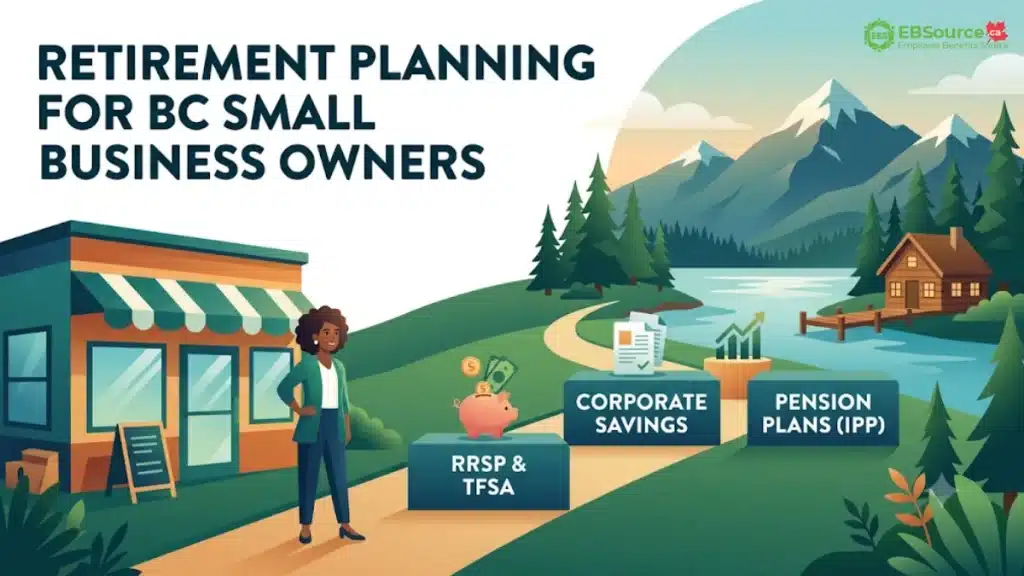
In British Columbia, no single workplace retirement plan is best for every small business owner. So it helps to compare four main options: a Registered Retirement Savings Plan (RRSP), a Tax-Free Savings Account (TFSA), a corporation-sponsored Individual Pension Plan (IPP), and savings kept inside the corporation.
RRSPs and TFSAs are personal savings accounts, an IPP is a pension plan your corporation sponsors, and investments held in a corporation remain corporate assets. Which options are open to you depends first on whether you are incorporated and how you pay yourself.
The table below compares the four options on what an owner usually weighs first:
| Option | Tax treatment | What to check first |
|---|---|---|
| RRSP | Deductible personally; withdrawals taxed as income | Your current RRSP deduction limit, including carry-forward |
| TFSA | Not deductible; qualifying withdrawals generally not taxed | Available room, including amounts withdrawn last year |
| IPP | Employer contributions set by the plan’s actuarial funding; pension paid out is taxable | Actuarial projection and the company’s ongoing funding commitment |
| Savings kept in the corporation | Investment income is taxed inside the corporation, and high passive income can reduce the corporation’s access to the small business rate | Cash the business needs, and how funds will come out later |
The key connection between these options is earned income. Salary and qualifying net self-employment income count as earned income and build RRSP contribution room. However, dividends from your corporation do not. Therefore, how you pay yourself is both a retirement and a tax decision.
How Does Your Business Affect Your Retirement Plan?
Your business supports your retirement in three key ways: it provides income today, contributes to your savings, and may help finance your retirement through a future sale. A plan that ignores any one of these can look sound on paper and still fall short.
The table below lists the four resources most BC owners use for retirement, the key question to answer for each, and who can help.
| Resource to assess | Question for your plan | Who can help you answer it |
|---|---|---|
| Personal registered savings | How much retirement funding am I building separately from the business? | Accountant or planner |
| Corporate investments | How much is genuinely available for retirement rather than needed for business commitments? | Accountant |
| An existing or proposed IPP | How would its funding and benefits fit my compensation and exit plans? | Actuary |
| Business-sale proceeds | How dependent is my retirement on the sale price and timing? | Accountant and tax adviser |
How Can Your Small Business Fund Your Retirement Without Weakening Operations?
BC small business owners often struggle to save for retirement because business income rises and falls while bills keep arriving on schedule. To determine how much your business can contribute, first assess what’s left after covering all commitments, using figures from a slower year rather than your highest-earning year. Once you have that figure, compare it to your funding gap to establish a sustainable range for contributions.
The four actions below help you save in a way the business can maintain:
Estimate Your Retirement Funding Gap
Your funding gap is the difference between what you expect to spend in retirement and what your existing sources are likely to provide. Work it out before you decide how much to save, so your contributions aim at a target rather than at whatever is left over.
- Retirement spending: an estimate of yearly spending in today’s dollars, separating fixed costs such as housing from flexible costs such as travel.
- Expected income: CPP, Old Age Security (OAS), any IPP pension, and what your current registered and corporate savings are projected to provide.
- Timeline: the age you plan to reduce work, the age you plan to retire fully, and how long your savings need to last.
Leave the business sale out of this first calculation. You will add it later when you test sale scenarios, so you can see how much of your plan depends on it. Then ask your planner to turn the gap into the amount you need to save each year to close it by your retirement date.
Separate Business Commitments From Potential Retirement Funding
Just because there is a healthy bank balance does not mean all that money can be allocated for your own retirement savings in British Columbia. Therefore, before deciding on a retirement contribution amount, deduct what the business has already committed to pay:
- Payroll and remittances: wages, source deductions and other amounts due on a fixed schedule.
- Tax payments: sales tax, corporate tax instalments and any balance owing at year-end.
- Debt payments: loan and lease payments, including any large payments or renewals coming up.
- Planned spending: equipment, hiring or expansion you have already decided to fund.
- A cash buffer: a reserve sized to how much your own revenue tends to swing.
The remaining cash is the starting point for retirement funding, not necessarily the amount you can contribute personally. If your business is incorporated, your accountant should determine how much can be paid to you after tax, how much may remain invested in the corporation, and whether any employer-sponsored pension contribution is appropriate.
Test Your Savings Capacity Against a Slower Year
Determine your retirement savings capacity based on what your business can afford if revenue declines. This approach ensures that a slow year will not force you to choose between sustaining the business and planning for your retirement.
For example, Ellie runs a catering company in Nanaimo that is busy in summer and quiet in winter. As she plans for 2027, she finds the business can spare about $600 a month, even in its slowest months, or $7,200 a year. She records that as her baseline savings capacity. In a strong year, she decides on any extra contribution after year-end and keeps a separate record of it. (Figures are illustrative.)
If your savings capacity is limited or unpredictable, favour flexible options before taking on ongoing pension-funding commitments.
Compare Affordable Savings With Your Funding Gap
Set your baseline savings capacity against your funding gap. If affordable savings will close the gap by your planned retirement date, your plan has a sound base. If they will not, adjust your plan now rather than rely on a future sale.
The table below outlines aspects you can reconsider if your affordable savings fall short:
| What you can revisit | What changes | Question to ask your adviser |
|---|---|---|
| Spending assumptions | The size of the gap | Which retirement costs are fixed, and which can you reduce? |
| Retirement timing | The number of years you save, and the years you draw income | How much does working one or two years longer reduce the gap? |
| Savings commitments | The share of business surplus directed to retirement | Can the business carry a higher baseline without weakening operations? |
| Reliance on the sale | How much of the gap the sale is expected to fill | Does the plan still work if the sale is later or brings in less? |
How Should You Coordinate Pay and Retirement Savings?
Once you know what the business can afford, decide where to save it. This involves four decisions, including: how you pay yourself, which funding paths leave you the most after tax, whether an IPP is worth assessing, and how much to keep invested in the corporation.
Review Your Own Compensation Before Setting Retirement Contributions
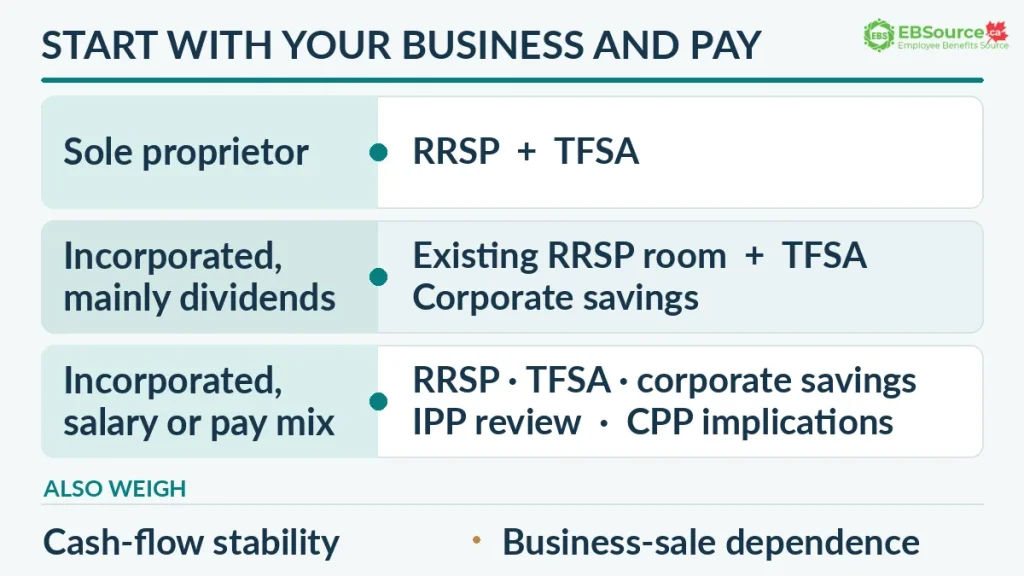
Your pay mix decides how much RRSP room you build, whether you contribute to the Canada Pension Plan (CPP), and whether an IPP is realistic. Your compensation mix does not determine your TFSA contribution room.
Generally, your RRSP deduction limit reflects 18% of your previous year’s earned income, up to an annual maximum. It also accounts for any unused contribution room and deducts any pension adjustments. For planning, use the deduction limit on your latest CRA notice of assessment rather than the 18% calculation.
The table below shows how each way of paying yourself affects these three outcomes:
| How you are paid | New RRSP room | CPP contributions | IPP |
|---|---|---|---|
| Sole proprietor (net self-employment income) | Yes, based on net income after expenses | Yes, on net self-employment earnings | Generally not available |
| Incorporated, paid a salary | Yes, reduced by any pension adjustment | Yes, shared between you and the corporation | Possible through the corporation |
| Incorporated, paid only dividends | No new room, but existing room can still be used | No | Generally not, because an IPP is usually built around salary |
Important note: Many BC small business owners use a combination of salary and dividends, which can create complex effects. Because the tax, CPP and cash-flow effects vary widely from one owner to another, have your accountant model your mix with your own numbers.
Compare Your Savings Options on an After-Tax Basis
When evaluating different funding paths, remember that each is taxed at different stages, so comparing them based on a single tax rate can be misleading. Compare the after-tax result from the moment the business earns the income to the moment you spend it in retirement.
- Money kept in the corporation: it is taxed inside the corporation first, then taxed again personally when it is paid out to you as salary or dividends.
- RRSP contributions: they reduce your personal tax now, and you pay the tax later when you withdraw the money in retirement.
- TFSA contributions: they are made from after-tax income, and qualifying withdrawals are generally not taxed.
British Columbia’s corporate and personal tax rates affect what you retain under each option, so compare your retirement options using the combined federal and provincial rates. To estimate the personal tax side, use the EBSource BC income tax calculator.
Decide Whether an IPP Assessment Is Worth Commissioning
An IPP is a Defined Benefit Pension Plan your corporation sets up for you. For some salaried owners, it can allow larger tax-deductible contributions than an RRSP. However, the company’s contributions are set by actuarial valuation, an actuary’s calculation of what the plan needs to pay the promised pension, rather than by your yearly savings choices.
So the key question is whether your business can carry that commitment and whether it fits your exit plan.
Before you commission an assessment, answer three questions:
- Could an IPP suit you? It generally suits owners who draw a steady, high salary from their corporation and have several working years left. Owners paid mainly in dividends are usually not good candidates.
- Can the business sustain the funding? The plan terms and pension rules set the company’s annual contribution, even in a weak year. Decision flag: If your cash flow is irregular, stay with flexible contributions until you are confident the business can carry a formal pension commitment.
- What happens when you sell or retire? Someone must sponsor the plan after a sale or wind-up, and you need to know how you will receive your benefits. After you turn 71, the plan must pay at least a minimum annual amount. You receive the greater of your formula pension and that minimum, which can raise your taxable income.
Check How Corporate Investments Affect the Wider Plan
Investment income earned in your corporation can reduce the corporation’s access to the small business rate. The rule uses a tax measure called adjusted aggregate investment income. Your accountant must calculate it across your Canadian-controlled private corporation (CCPC) and any associated corporations.
- Below $50,000: the business limit is not reduced.
- Between $50,000 and $150,000: the business limit is reduced gradually.
- Above $150,000: none of the business limit remains.
BC follows the federal limit, so a smaller limit also means less income is taxed at BC’s 2% rate. If your corporation’s investment income is nearing $50,000, ask your accountant to model the effect before you decide how much to keep invested in the company.
By the end of this step, decide how much to direct to personal accounts, any IPP and corporate investments. Note any checks still open, such as an IPP assessment.
Will Your Retirement Still Work if Your BC Small Business Sells Later or for Less?
Many owners plan to sell their business to fund retirement, but a sale can take longer than expected or bring in less money than you hope. This section outlines three steps to keep your retirement plan viable, even after debt, taxes, and fees:
- Test three sale outcomes: see how your plan holds up if the sale goes as expected, happens later or brings in less.
- Plan for pre-sale years: work out how you will cover your bills between reducing your hours and receiving the sale proceeds.
- Settle company assets early: deal with your corporate investments and any IPP before you finalize a sale.
Compare Expected, Delayed and Lower-Value Sale Scenarios
Your plan should not depend on a single sale price and date. Run your plan three times, once for each outcome below:
| Scenario | What changes | What to check |
|---|---|---|
| Expected sale | The price and timing you are planning for | Whether savings and sale proceeds together cover your full timeline |
| Later sale | The same sale, two or three years later | How you would cover the extra years before the proceeds arrive |
| Lower sale | A sale at a reduced price | How much of your spending target the lower proceeds still support |
For each version, use the amount you would actually receive, not the sale price. The tax depends on how the sale is structured, so ask your tax adviser:
- whether you expect a share sale or an asset sale, and
- whether your shares may meet the tests for qualified small business corporation shares, which may qualify for the lifetime capital gains deduction.
If your plan only works when the sale goes as expected, do not count on the sale to fix the shortfall. Go back to the options for closing a gap covered earlier (spending, timing, savings and reliance on the sale) and adjust them now. The aim is a plan where the sale adds to your retirement rather than deciding it.
Plan Income Between Reduced Work and the Sale
As business owners gradually reduce their involvement, their income also changes. This can create gaps when business income drops before other sources, like sale proceeds and public pensions, start.
For every stage, decide which sources will cover your spending:
- Reduced hours: a lower salary or dividends from the business, topped up from personal savings if needed.
- Advisory role: a smaller and possibly irregular income from the company, or none if it has been sold.
- Full retirement: registered savings, any IPP pension, corporate savings, sale proceeds and public pensions.
Add the CPP and Old Age Security to the same timeline, starting at the age you expect to begin each one. For most BC owners, these cover only part of their spending, so treat them as one income source rather than the foundation of your plan.
For example, David owns a trucking company in Prince George. He plans to work three days a week from 2030, then retire fully when he sells. His timeline shows several years in which his business income drops, but neither his public pensions nor his sale proceeds have started. He builds up TFSA savings to cover that gap, and his later-sale scenario shows how much more he would need if the sale were delayed.
Resolve Corporate Assets and Any Company Pension Before Exit
Deal with assets tied to the company early in the sale or wind-up process, not after. For corporate investments, find out how they will be affected by the sale and how you will access the funds. This can impact the after-tax value you expect.
If your company has an IPP, confirm early who will sponsor it, whether it will continue, and how you will receive your benefits. Check with your actuary and plan administrator for your options before finalizing any deals.
What Should You Bring to Your Retirement Planning Meeting?
In a retirement planning meeting for small business owners in BC, bring records showing how your business is set up, how you have paid yourself, how much registered room you have left, and what your plan depends on. With these, your accountant or planner can compare your options on the same facts and help you leave with clear decisions.
Here are things to gather before the meeting:
- Business structure: incorporation documents, share ownership and any associated companies.
- Tax records: recent personal returns, notices of assessment and corporate financial statements.
- Pay history: salary and dividend amounts for recent years, with your T4 slips.
- Registered plans: RRSP, TFSA and any pension statements, including the pension adjustment in T4 box 52.
- Corporate investments: current balances held in the company and the investment income they earn.
- Business commitments: debts, cash needs, your target retirement timeline and expected sale terms.
Do not leave out the T4 because it seems routine. The pension adjustment in box 52 reduces your RRSP room for the following year, so your adviser needs it to confirm what you can actually contribute.
Aim to leave the meeting with decisions, not just information:
- Pay mix: the salary and dividend split for the coming year, and its effect on RRSP room and CPP.
- Contribution plan: a regular amount for each account that the business can fund in a slower year.
- Corporate savings: how much surplus stays invested in the company and how it is expected to come out.
- IPP decision: whether an actuarial comparison is worth ordering, or why it is not.
- Sale scenarios: the expected, later and lower sale versions your plan has been tested against.
- Review date: when you will revisit the plan once year-end figures are final.
Your next step: Book a single planning discussion and ask your accountant or planner to compare the options using one set of assumptions. Involve an actuary before deciding whether an IPP fits.
This guide focuses on funding your own retirement as a business owner. If you also want to provide retirement savings benefits to your employees, see our small business retirement plans guide for employer-sponsored arrangements, contribution design, and provider comparisons.