
Canada Free Income Tax Calculator for 2026: Estimate Your Federal & Provincial Tax


Our Canadian income tax calculator helps you estimate your annual and per-pay-period take-home pay by accounting for federal tax, provincial or territorial tax, CPP contributions, EI premiums, and common income adjustments. Just enter your gross income, pay frequency, and any other earnings or deductions, and it will use current CRA rates to calculate your income tax.
Note that your province or territory affects how much tax you pay, as each has different tax rates and credits. If you paid more tax than needed during the year, the CRA will give you a refund after you file your return. But getting large refunds often means your TD1 form is outdated or you missed some credits, which could have left more money in your pocket throughout the year.
The tool will show you your detailed income tax calculation, how the calculator works, how provincial and federal taxes interact, and how to resolve common withholding issues so that you can budget confidently before tax season.
What Are the Input and Output Components of the Income Tax Calculator?
EBSource’s Canadian income tax calculator helps you estimate your taxes and take-home pay based on the updated guidelines from the CRA.
On the input side, you need to start by entering your total earnings, province or territory of employment, and pay frequency (such as weekly, bi-weekly, or monthly). You can also add details about other incomes, bonuses, tax credits and additional deductions, such as RRSP contributions, to get a more accurate result.
On the output side, the calculator will show you your federal and provincial taxes, as well as contributions to CPP/QPP and EI premiums. It subtracts these from your earnings to estimate your take-home pay, factoring in the BPA, which lets you earn some money tax-free.
Remember that the estimates are for planning purposes only; your actual amounts will come from your employer and the CRA.
What Does This Canadian Income Tax Calculator Do?
This Canada income tax calculator provides a payroll and take-home pay estimate by taking your gross employment income and your province or territory of employment, applying both federal and provincial tax brackets, and subtracting applicable credits and payroll deductions.
To use our calculator, you need to select your province or territory and fill in your earnings, pay period, other income, and deductions for the year. It then applies the relevant federal and provincial/territorial tax brackets to produce a combined result. It also factors in the basic personal amount, CPP contributions, and EI premiums, giving you your net pay rather than just the income tax amount.
Employees can use our calculator for many reasons:
- planning their budgets,
- ensuring pay stubs match expected deductions,
- comparing job offers across provinces, and checking whether pay stub deductions seem correct,
- estimate how bonuses or vacation pay affect earnings,
- get ready for tax season to avoid surprises.
Please note: In Quebec, the payroll system includes the QPP, the QPIP, a reduced EI rate, and distinct provincial withholding rules managed by Revenu Québec. For payroll calculations in Quebec, the CRA T4127 does not replace the calculations required by Revenu Québec.
Important Note for Northwest Territories and Nunavut: Our calculator currently estimates income tax, CPP/QPP, CPP2 (where applicable), and EI/QPIP (where applicable). However, it does not include the extra 2% payroll tax that applies to wages in the Northwest Territories and Nunavut. If you work in either territory, your actual take-home pay may be less than the amount shown here.
What are the Key Tax Changes that Affect Your Canadian Income Tax Calculation?
The CRA payroll update starting July 1, 2026, does not change the federal tax brackets; it mainly updates payroll calculations and some provincial details. On the payroll side, the contribution limits for the CPP, the new CPP2, and EI have all risen, meaning most employees will see slightly higher payroll deductions than in 2025.
Below is a detailed overview of the updated federal tax brackets, the basic personal amount, and the new payroll deduction thresholds that apply to your income tax calculation for 2026:
- The lowest federal tax rate used in CRA payroll formulas is 14%;
- Federal tax bracket thresholds increased for 2026;
- The federal basic personal amount is up to $16,452 for 2026 and is gradually reduced for higher-income individuals, reaching the minimum amount of $14,829 at the top federal threshold;
- The Canada Employment Amount is $1,501;
- The EI maximum employee premium outside Quebec is $1,123.07;
What Changed for Payroll on July 1, 2026?
The CRA has released updated payroll deduction formulas that will start on July 1, 2026, as explained in the 123rd Edition of the T4127 guide. We start using these updated CRA payroll deduction tables or formulas with the first payroll in July 2026.
Specifically, the federal tax brackets for 2026 remain unchanged, but mid-year provincial changes will be applied by adjusting payroll rates for the last six months of 2026 to balance them with those used in the first half of the year. This means some July 1 payroll withholding figures are prorated, not the final annual tax-return rates.
Three major payroll changes are:
- British Columbia: For pay dates on or after July 1, 2026, CRA payroll formulas use a prorated rate of 6.14% for payroll deductions in the first bracket. Also, the basic reduction has increased to $805 for the last six months of the year.
- Newfoundland and Labrador: For payroll deductions on pay dates on or after July 1, 2026, CRA uses an adjusted basic personal amount of $15,000 for the last six months. Employees who already submitted a TD1NL form with the lower amount do not need to submit a new one.
- Prince Edward Island: For PEI payroll withholding on pay dates on or after July 1, 2026, CRA formulas use a prorated 21% rate for the highest bracket to balance the first-half and second-half withholding.
Source: Current year tax rates and income brackets (2026) – Government of Canada
Federal Income Tax Rates and Brackets
Canada uses a progressive income tax system with five federal tax brackets. This means that employees pay higher tax rates only on the income that exceeds the limits of each bracket, not on their whole income. For the full 2026 tax year, the lowest federal income tax rate is 14%, down from 14.5% in 2025 and 15% before the mid-2025 cut.
For the 2026 tax year, the federal tax brackets are:
- 14% on taxable income up to $58,523;
- 20.5% on the portion over $58,523 up to $117,045;
- 26% on the portion over $117,045 up to $181,440;
- 29% on the portion over $181,440 up to $258,482;
- 33% on the portion over $258,482.
In addition to federal taxes, each province and territory in Canada imposes its own income tax with distinct brackets and rates. For most people, the province or territory where you live on December 31 of the tax year decides the provincial or territorial tax rates for that year’s tax return.
Provincial and Territorial Rates for Individuals in Canada at a Glance
Your location significantly impacts the amount of income tax you owe each year, as each province or territory has its own progressive tax rates that increase with your income. These provincial and territorial rates can vary significantly, with a starting rate as low as 4% in Nunavut and a top rate as high as 25.75% in Quebec.
The main factors influencing these differences are the tax bracket structure, surtax regulations (particularly in provinces with multi-layered systems), and the provincial/territorial basic personal amount.
The table below is a high-level comparison only. Provincial and territorial tax systems may include surtaxes, reductions, health premiums, payroll taxes, or credits that are not fully captured by looking only at the lowest and highest marginal rates.
| Province / Territory | Tax Rate | Top Bracket Threshold | Distinctive feature |
|---|---|---|---|
| Alberta | 8% – 15% | $370,220 | No PST; K5P supplemental credit; 2% indexation cap |
| British Columbia | 5.60% – 20.50% | $265,545 | Bracket indexation paused 2027-2030 |
| Manitoba | 10.80% – 17.40% | $101,200 | Top rate applies at just $101,200; brackets and BPA frozen at 2024 levels |
| New Brunswick | 9.40% – 19.50% | $193,861 | Low-income reduction with a 3% clawback band |
| Newfoundland and Labrador | 8.70% – 21.80% | $1,141,275 | Highest combined top rate (about 54.80%); BPA increased to an annualized $13,094 for 2026, with a prorated $15,000 applied to pay dates on or after July 1, 2026 |
| Northwest Territories | 5.90% – 14.05% | $172,346 | A separate 2% territorial payroll tax applies on top |
| Nova Scotia | 8.79% – 21% | $157,124 | First-ever indexation in 2025 (continued at 1.6% for 2026); BPA clawback eliminated |
| Nunavut | 4% – 11.50% | $181,439 | Lowest rates in Canada (4% bottom, 11.50% top, 44.50% combined) |
| Ontario | 5.05% – 13.16% | $220,000 | Top thresholds unindexed since 2014; Ontario Health Premium applies |
| Prince Edward Island | 9.50% – 20% | $200,000 | For payroll withholding after July 1, 2026, the CRA uses a 21% prorated rate on income of $200,000 and over |
| Québec | 14% – 25.75% | $132,245 | Highest provincial top rate (25.75%); separate system via Revenu Québec’s WebRAS |
| Saskatchewan | 10.50% – 14.50% | $155,805 | Simple 3-bracket system; BPA boosted by the Saskatchewan Affordability Act |
| Yukon | 6.40% – 15% | $500,000 | Top bracket starts at the highest threshold in Canada; unique fertility and surrogacy tax credit |
When reviewing these rates, pay attention to three key factors: how quickly rates increase across tax brackets, how high the top rate is, and the income level at which the top rate applies. For example, a province with a low starting rate but a low cap on its top tax rate will cause middle earners to pay higher taxes sooner than a province where the top tax rate only starts at a much higher income level.
Example of How Provincial and Territorial Tax Differences Affect Your Net Pay
To show how provincial and territorial rates affect take-home pay, we compare the estimated annual net income for a gross salary of $75,000 across all 13 provinces and territories.
Note that this comparison uses only the standard basic personal credit, CPP, EI, and federal plus provincial/territorial income tax. It does not account for variations in each jurisdiction’s unique credits, deductions, bonuses, additional income, or special levies unless otherwise noted.
The table below shows how estimated net income can vary by province and territory in Canada:
| Province / Territory | Gross Income | Province / Territory Tax | Net Income |
|---|---|---|---|
| Alberta | $75,000 | $4,010 | $57,362 |
| British Columbia | $75,000 | $3,837 | $57,535 |
| Manitoba | $75,000 | $6,337 | $55,035 |
| New Brunswick | $75,000 | $6,270 | $55,102 |
| Newfoundland and Labrador | $75,000 | $6,469 | $54,903 |
| Nova Scotia | $75,000 | $7,949 | $53,423 |
| Northwest Territories | $75,000 | $3,609 | $58,705 |
| Nunavut | $75,000 | $2,553 | $60,304 |
| Ontario | $75,000 | $4,446 | $56,926 |
| Prince Edward Island | $75,000 | $7,056 | $54,316 |
| Québec | $75,000 | $7,768 | $54,625 |
| Saskatchewan | $75,000 | $5,566 | $55,806 |
| Yukon | $75,000 | $3,717 | $57,655 |
Note for NWT and Nunavut: The net income figures shown for the Northwest Territories and Nunavut do not include the separate 2% payroll tax that may be withheld from employees’ pay in those territories. At a $75,000 salary, this could reduce take-home pay by about $1,500.
If you earn $75,000 in Canada, your net pay can vary by over $6,000 depending on where you work. Nunavut offers the highest take-home pay at about $60,304 due to low tax rates. Other provinces with good net pay include the Northwest Territories ($58,705), Yukon ($57,655), British Columbia ($57,535), Alberta ($57,362), and Ontario ($56,926, though accounting for an extra $750, the Ontario Health Premium drops it to around $56,176).
In contrast, Nova Scotia ($53,423) and Prince Edward Island ($54,316) have the lowest net pay due to higher tax rates and lower basic personal amounts. Quebec ($54,625) also ranks among the lower-net-pay provinces because of its higher provincial tax rates and additional payroll deductions through Revenu Québec, including the QPP (at 6.3%, versus 5.95% for CPP) and the QPIP employee premium of 0.430%.
Disclaimer: This table provides a simple yearly estimate and should not be treated as an exact calculation of CRA payroll deductions. Some jurisdiction-specific amounts are not fully included. Your actual pay stub may differ because of payroll taxes, health premiums, surtaxes, additional TD1 credits, taxable benefits, employer deductions, or other personal circumstances.
How Provincial and Territorial Taxes Add to Your Pay Stub
The federal government calculates tax using its brackets, and then your province or territory applies a separate set of progressive brackets to the same taxable income. The total income tax you owe is the sum of both calculations.
When using our 2026 Canada income tax calculator, it is crucial to select the correct province or territory, as doing so affects the entire second layer of your tax calculation. Each province and territory has different tax rates, credits, and premiums, meaning your net pay can differ by thousands of dollars, even with the same salary. If you are comparing job offers across provinces, running the calculator for each location with the same gross salary will quickly show you the differences in net pay.
Additionally, some provinces or territories, such as Quebec and Ontario, have distinctive levies or surtaxes on top of the standard rates. They may not be included in basic estimates, but are important to consider for accurate financial planning.
Disclaimer: Please note that we calculate payroll deductions based on the province or territory where the employee is employed. Therefore, this should not be considered a final personal income tax return calculator.
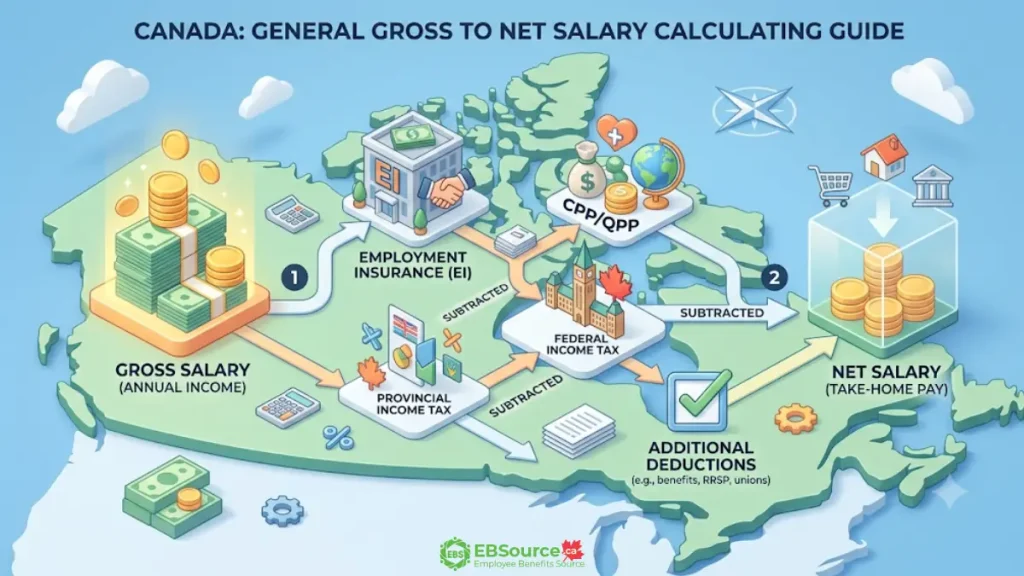
General Gross to Net Salary Canada Calculating Guide
The gross-to-net pay calculation in Canada, which does not involve any specific levies or surtaxes, is based on how your earnings interact with the annual contribution caps for EI and the CPP.
The differences depend on your income level and the contribution caps you reach. As your income goes up, EI contributions reach their maximum at $68,900 of insurable earnings, CPP contributions at $74,600 (YMPE), and CPP2 contributions apply to earnings between $74,600 and $85,000 (YAMPE). Once you reach these limits, your contributions are a fixed amount instead of a percentage of your earnings.
At its core, the general formula that applies to all income levels is:
Net Pay = Gross Income – (EI Premiums + CPP Contributions + Federal Income Tax + Provincial/Territorial Income Tax) – Other Applicable Payroll Deductions
Before diving into detailed calculations for different income levels, here’s a quick overview of how payroll deductions change as your gross income increases:
| Income Range | What Changes | Effect on Your Calculation |
|---|---|---|
| 0 to $3,500 | EI applies, but CPP does not yet apply because of the CPP basic exemption | EI is calculated from the first dollar of insurable earnings; CPP is zero until pensionable earnings exceed $3,500 |
| Over $3,500 to $68,900 | EI applies, and CPP applies to pensionable earnings above $3,500 | EI = 1.63% of insurable earnings; CPP = 5.95% of pensionable earnings over $3,500 |
| Over $68,900 to $74,600 | EI has reached its annual maximum, but CPP continues | EI is capped at $1,123.07; CPP continues at 5.95% up to the YMPE |
| Over $74,600 to $85,000 | EI and regular CPP have reached their annual maximums, and CPP2 begins | EI is capped at $1,123.07; regular CPP is capped at $4,230.45; CPP2 applies at 4% |
| Over $85,000 | EI, first-tier CPP, and CPP2 are capped | EI, CPP, and CPP2 become fixed annual maximums for the rest of the year |
Payroll deductions change as income crosses the EI, CPP, and CPP2 thresholds
Here are 4 cases, ranging from income over $3,500 to over $85,000, outlining how to calculate take-home pay, accounting for relevant contributions and caps. Note that the guide below focuses on regular employment income above the $3,500 CPP basic exemption. If annual employment income is $3,500 or less, EI premiums may still apply, but CPP contributions are generally not required.
Case 1: Income from over $3,500 to $68,900
If your annual gross income is between $3,500 and $68,900, your EI premiums and CPP contributions are both calculated as a simple percentage of your earnings, as you have not yet reached the annual maximum for either. Note that EI applies from the first dollar of insurable earnings (there is no EI basic exemption), while CPP contributions only apply to earnings above the $3,500 basic exemption.
The table below outlines the steps used to determine your income tax and net pay within this income range:
| Step | Description | Details |
|---|---|---|
| 1 | Determine your gross income | See the pay amount that appears on your pay stub |
| 2 | Determine the required gross annual pay | Multiply the amount that users entered by the chosen pay period (Step 1 x pay periods) |
| 3 | Calculate EI | EI Employee Contribution Rate (1.63%) x Step 2 |
| 4 | Calculate CPP contributions | CPP Employee Contribution Rate (5.95%) x (Step 2 – $3,500 CPP Basic Exemption) |
| 5 | Calculate CPP enhanced contribution (deduction) | (Step 2 – $3,500) x 0.0100 |
| 6 | Calculate the Taxable Income | Step 2 + Other income in a year + Vacation pay + Bonus – Tax deductions in a year – Step 5 |
| 7 | Calculate federal income tax | Step 7.1 – Step 7.2 |
| 7.1 | Basic federal tax | Calculate tax on Step 6 using federal brackets |
| 7.2 | Federal tax credits | 14% x (Step 7.2.1 + Step 7.2.2 + Step 7.2.3 + Step 3) |
| 7.2.1 | Federal basic personal amount | $16,452 (maximum; reduced for net income above $181,440) |
| 7.2.2 | CPP base contributions | (Step 2 – $3,500) x 0.0495 |
| 7.2.3 | Canada employment amount | $1,501 |
| 8 | Calculate provincial/territorial income tax | Step 8.1 – Step 8.2 |
| 8.1 | Basic provincial/territorial tax | Calculate tax on Step 6 using provincial/territorial brackets |
| 8.2 | Provincial/Territorial tax credits | Calculate tax from (Step 8.2.1 + step 7.2.2 + step 3 + step 8.2.2) |
| 8.2.1 | Provincial/Territorial basic personal amount | Depends on each province/territory (see above) |
| 8.2.2 | Territorial CEA | Just Yukon has this amount ($1,501) |
| 9 | Total annual payroll deductions | Step 3 + Step 4 + Step 7 + Step 8 |
| 10 | Net income for the year | Step 2 – Step 9 |
| 11 | Net income for the pay period | Step 10 / pay period |
Case 2: Income from over $68,900 to $74,600
When your gross income is between $68,900 and $74,600, your EI payments will have hit their yearly limit of $1,123.07. But your CPP payments will continue to add up because you have not yet reached the YMPE of $74,600. This is a middle-income range where one payroll deduction stops increasing while the other continues to increase.
Consequently, the gross-to-net pay in Canada, excluding Ontario and Quebec, is calculated as follows:
| Step | Description | Details |
|---|---|---|
| 1 | Determine your gross income | See the pay amount that appears on your pay stub |
| 2 | Determine the required gross annual pay | Multiply the amount that users entered by the chosen pay period (Step 1 x pay periods) |
| 3 | Calculate EI | $1,123.07 (maximum reached) |
| 4 | Calculate CPP contributions | CPP Employee Contribution Rate (5.95%) x (Step 2 – $3,500) |
| 5 | Calculate CPP enhanced contribution (deduction) | (Step 2 – $3,500) x 0.0100 |
| 6 | Calculate the Taxable Income | Step 2 + Other income in a year + Vacation pay + Bonus – Tax deductions in a year – step 5 |
| 7 | Calculate federal income tax | Step 7.1 – Step 7.2 |
| 7.1 | Basic federal tax | Calculate tax on Step 6 using federal brackets |
| 7.2 | Federal tax credits | Calculate tax from (Step 7.2.1 + step 7.2.2 + step 7.2.3 + step 3) |
| 7.2.1 | Federal basic personal amount | $16,452 (maximum; reduced for net income above $181,440) |
| 7.2.2 | CPP base contributions | (Step 2 – $3,500) x 0.0495 |
| 7.2.3 | Canada employment amount | $1,501 |
| 8 | Calculate provincial/territorial income tax | Step 8.1 – Step 8.2 |
| 8.1 | Basic provincial/territorial tax | Calculate tax from step 6 using provincial/territorial brackets |
| 8.2 | Provincial/Territorial tax credits | Calculate tax from (Step 8.2.1 + step 7.2.2 + step 3 + step 8.2.2) |
| 8.2.1 | Provincial/Territorial basic personal amount | Depends on each province/territory |
| 8.2.2 | Territorial CEA | Just Yukon has this amount ($1,501) |
| 9 | Total annual payroll deductions | Step 3 + step 4 + step 7 + step 8 |
| 10 | Net income for the year | Step 2 – Step 9 |
| 11 | Net income for the pay period | Step 10 / pay period |
Case 3: Income over $74,600 to $85,000
If your gross income is between $74,600 and $85,000, you have reached the maximum contribution limits for both EI and CPP base contributions. At this point, CPP2 contributions apply at 4% for every dollar you earn above the YMPE of $74,600, up to the YAMPE of $85,000.
Here is how gross-to-net pay is calculated in Canada (not including special levies from Ontario and Quebec):
| Step | Description | Details |
|---|---|---|
| 1 | Determine your gross income | See the pay amount that appears on your pay stub |
| 2 | Determine the required gross annual pay | Multiply the amount that users entered by the chosen pay period (Step 1 x pay periods) |
| 3 | Calculate EI | $1,123.07 (maximum reached) |
| 4 | Calculate CPP contributions | $4,230.45 (maximum reached) |
| 5 | Calculate the CPP additional contribution | $711 (maximum reached) |
| 6 | Calculate CPP2 | 0.04 x (Step 2 – YMPE) |
| 7 | Calculate the Taxable Income | Step 2 + Other income in a year + Vacation pay + Bonus – Tax deductions in a year – 711 – Step 6 |
| 8 | Calculate federal income tax | Step 8.1 – Step 8.2 |
| 8.1 | Basic federal tax | Calculate tax from step 7 |
| 8.2 | Federal tax credits | Calculate tax from (Step 8.2.1 + step 8.2.2 + step 8.2.3 + step 3) |
| 8.2.1 | Federal basic personal amount | $16,452 (maximum; reduced for net income above $181,440) |
| 8.2.2 | CPP base contributions | $3,519.45 (maximum base portion) |
| 8.2.3 | Canada employment amount | $1,501 |
| 9 | Calculate provincial/territorial income tax | Step 9.1 – Step 9.2 |
| 9.1 | Basic provincial/territorial tax | Calculate tax from step 7 |
| 9.2 | Provincial/Territorial tax credits | Calculate tax from (Step 9.2.1 + step 8.2.2 + step 3 + step 9.2.2) |
| 9.2.1 | Provincial/Territorial basic personal amount | Depends on each province/territory |
| 9.2.2 | Territorial CEA | Just Yukon has this amount ($1,501) |
| 10 | Total annual payroll deductions | Step 3 + Step 4 + Step 6 + Step 8 + Step 9 |
| 11 | Net income for the year | Step 2 – Step 10 |
| 12 | Net income for the pay period | Step 11 / pay period |
Case 4: Income over $85,000
When your income exceeds $85,000 per year, the calculation follows the same method as in Case 3; however, the CPP2 contribution is capped at its annual maximum of $416. All other parameters remain unchanged, including the maximums for EI ($1,123.07) and CPP ($4,230.45).
At this point, additional employment income no longer increases CPP, CPP2, or EI deductions for the year. However, additional income may still increase your federal and provincial or territorial income tax.
What Happens if Too Much Tax is Taken from Your Paycheque?
If too much tax is withheld from your pay, you might face short-term cash flow problems, but you will get a refund later. The CRA sends back any extra deductions after your annual return is processed. Most people who file online and use direct deposit get their refunds in about two weeks, while paper returns can take eight weeks or longer. If you often see too much tax taken off, it could mean your TD1 form needs updating. Remember to claim all credits you qualify for, like spousal, dependent, or tuition amounts, since these can lower your withholdings immediately.
Getting a large refund means you have given the government an interest-free loan. You might want to adjust your tax deductions to keep more money each month. Aim for a small refund or a small amount owing to make the most of your take-home pay.
If your income changes during the year, it can affect the amount of tax taken from your pay. For example, if you lose your job, take unpaid leave, or work fewer hours, you might end up paying too much tax. To get back any extra tax, file your tax return as soon as you can.
Why Does Your Pay Stub Not Match Our Calculator?
If your actual pay stub does not line up with our estimate, it almost never means either figure is wrong. 5 factors affect your pay stub differently from our estimate, including extra TD1 credits, taxable benefits, additional voluntary tax, changes made during the year, and employer-specific deductions.
The list below outlines the most common reasons your pay stub may differ from our estimate, and what is happening behind each one:
TD1 credits beyond the basic personal amount: Our calculator assumes you claim only the basic personal amount. If you claimed the spousal, eligible dependent, tuition, disability, age, or caregiver amount on your federal or provincial TD1, less tax is withheld than our estimate shows. An outdated TD1 has the opposite effect.
Taxable benefits: Employer-paid perks such as group insurance, employer-provided parking, or a company vehicle are added to your income, raising the amount on which tax is calculated.
Additional voluntary tax: If you asked your employer to withhold a fixed extra amount each pay, your stub will show more tax than our estimate, which does not account for your opting in.
Mid-year changes: Changes to salary, job status, or pay frequency can disrupt steady-income calculations, leading to discrepancies on your pay stubs.
Other employer-specific deductions: Garnishments, benefit premiums, professional dues, or charitable donations taken through payroll reduce your take-home pay without changing the tax calculation.
If your stub differs consistently rather than just once, it is worth checking that your TD1 form is current, asking your payroll department for a breakdown of any taxable benefits, and using the CRA’s PDOC for the closest possible match to your employer’s own software.