
Government Benefits in Canada: Federal, Provincial & Territorial Programs Explained


Working in Canada provides you with access to a wide range of government benefits funded and managed at both the federal and provincial or territorial levels. Understanding how these two levels of benefits work together is important, as it helps ensure you do not miss out on the support you may be eligible for.
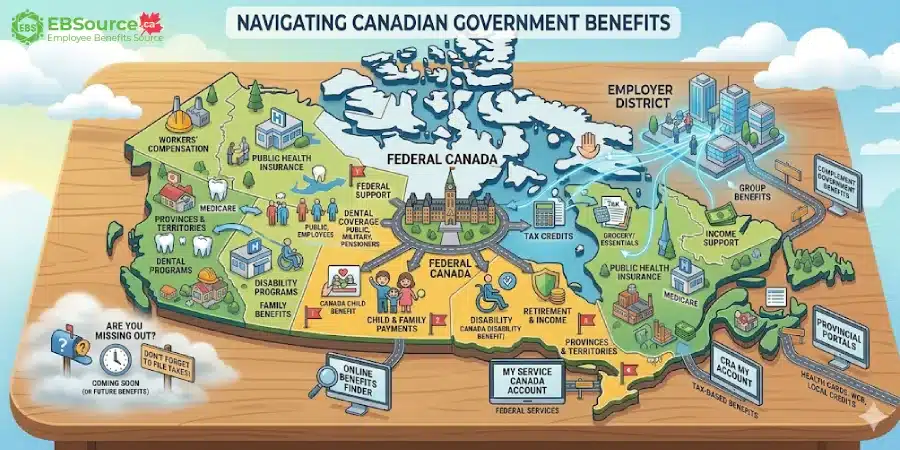
The federal government offers benefits like dental coverage, tax credits, monthly payments for families and children, disability support, and programs that protect your income during retirement or significant life changes.
In addition, each province and territory adds its own layer of benefits, such as workers’ compensation, public health insurance, family and child payments, and targeted tax credits or income assistance for residents who need extra help.
The guide below provides an overview of each program, allowing you to see exactly where you stand.
What are Government Benefits in Canada?
Government benefits in Canada are publicly funded programs provided by federal, provincial, or territorial authorities. They provide income support, health coverage, family payments, and tax credits based on factors such as your employment status, income level, residency, age, family situation, or disability status. As an employee, you can access 2 main types of government benefits: federal and provincial or territorial programs.
The following sections will explain some key benefits available through both federal and provincial/territorial programs.
What Federal Benefits are Available to Canadian Employees?
Canadian employees have access to 5 main types of federal support: dental coverage, tax credits and rebates, child and family benefits, disability benefits, and retirement and income protections. These programs help address common financial challenges, such as healthcare costs, everyday expenses, raising children, managing a disability, and planning for retirement. Additionally, Canada provides other federal support options, such as housing assistance, student aid, veterans’ benefits, survivor benefits, and after-death benefits.
Below are federal benefits available to you as a Canadian employee:
Federal Dental Coverage Plans
The federal government offers dental coverage through various programs for different groups of Canadians, including the Canadian Dental Care Plan, the Public Service Dental Care Plan, the Canadian Forces Dental Services, and the Pensioners’ Dental Services Plan. Each plan has specific eligibility criteria based on your employment status and current dental coverage.
Below are the 4 key federal dental plans for the general public, federal employees, military members, and retirees:
- Canadian Dental Care Plan (CDCP): supports eligible residents without employer-sponsored dental insurance and whose family’s net income is below a certain threshold.
- Public Service Dental Care Plan (PSDCP): provides coverage for federal public service employees and their eligible dependents.
- Canadian Forces Dental Services (CFDS): offers dental care to active members of the Canadian Armed Forces across Canada and abroad.
- Pensioners’ Dental Services Plan (PDSP): extends dental benefits to eligible public service pensioners and their eligible family members.
Why is federal dental coverage highlighted here?
In 2025, the private sector spent about 22.1 billion Canadian dollars on dental care, while the public sector spent about 1.4 billion Canadian dollars. Thus, there is a significant gap in dental care between provincial and territorial public health insurance plans in Canada and the private sector.
To address this, the federal government has implemented several dental programs tailored to various groups. Therefore, highlighting them helps you find options to lower your dental expenses, which are among the most common uninsured health expenses in Canada.
Federal Tax Credits and Rebates
The income tax system offers different credits that can lower the amount of tax you owe or provide you with a refund on your yearly tax return. The 4 main credits are the Disability Tax Credit, the Canada Workers Benefit, the Canada Training Credit, and the Canada Groceries and Essentials Benefit.
As a Canadian employee, you may be eligible for the credits listed below, depending on your situation:
- Disability Tax Credit (DTC): a non-refundable tax credit that helps people with a severe and prolonged impairment, or a supporting family member, reduce the amount of income tax they owe.
- Canada Workers Benefit: a refundable credit that supplements the earnings of low-income workers and helps encourage workforce participation.
- Canada Training Credit: a refundable credit that helps workers aged 26 to 65 pay for tuition and training costs.
- Canada Groceries and Essentials Benefit (CGEB): a tax-free quarterly payment for eligible low- and modest-income individuals and families, starting in July 2026 to replace the GST/HST credit.
If you live in Quebec, Alberta, or Nunavut, the standard Canada Workers Benefit eligibility thresholds and maximum amounts may differ due to separate arrangements with the federal government. Make sure to check the CRA’s CWB page for information specific to your region.
Note: Non-refundable credits can reduce your tax payable, but do not result in a refund on their own. On the other hand, refundable credits can provide a payment even if you owe no tax.
Practical tip: If you have a simple tax situation and low income, you might qualify for the CRA’s free SimpleFile service, with no forms or fees needed. It is important to file even if you have zero income, as it can help you access benefits like the Canada Child Benefit, the Canada Worker Benefit, provincial credits, and RRSP contribution room.
Canada Child Benefit
The Canada Child Benefit, which helps families cover the costs of raising children under 18, is a tax-free monthly payment from the CRA. This benefit is income-tested, meaning that families with lower AFNI receive higher payments, and the benefit declines as income rises.
Canada Disability Benefit
The Canada Disability Benefit (CDB) is a monthly payment for low-income working-age Canadians with disabilities. It is available to those aged 18 to 64 who have a Disability Tax Credit certificate and have filed their taxes.
Retirement Benefits and Income Protections
The federal government has programs like CPP/QPP, OAS/GIS, and EI that help support your income during retirement, disability, the death of a family member, or temporary job loss. These programs are mainly funded by payroll taxes or tax revenue, and you need to apply for benefits when you are ready to start receiving them.
Some of the largest federal benefit programs are:
- Canada Pension Plan (CPP)/Quebec Pension Plan (QPP): These are contributory programs funded through payroll deductions that provide monthly benefits when you retire, become disabled, or when your survivors and dependent children need support.
- Old Age Security (OAS): This is a monthly pension available to Canadians aged 65 and older that works with CPP.
- Guaranteed Income Supplement (GIS): This is an additional non-taxable monthly payment for low-income seniors aged 65 and older who already receive OAS.
- Employment Insurance (EI): This is a federal insurance program funded through payroll premiums that offers temporary income replacement when your work is interrupted. It includes regular benefits for job loss as well as special benefits for sickness, maternity, parental leave, and caregiving.
Note that employees in Quebec pay a lower EI premium because the province operates its own parental benefit plan, the Quebec Parental Insurance Plan (QPIP), which provides maternity, paternity, parental, and adoption benefits separately.
What Provincial and Territorial Benefits are Available to Canadian Employees?
Beyond federal programs, each province and territory in Canada offers its own set of benefits tailored to meet the specific needs of residents. These programs focus on 6 main areas: workers’ compensation, health insurance, disability support, dental programs, family and child benefits, and various tax credits and income support.
Here are 6 key types of Canadian provincial and territorial programs for employees that you should be aware of:
Workers’ Compensation Boards by Province and Territory
Canadian workers’ compensation is a provincial and territorial insurance system that helps pay for lost wages and medical bills without charging workers for work-related injuries or illnesses. Benefits can include partial lost pay while recovering, long-term disability payments for permanent injuries, retirement income for people over 65, and coverage for healthcare and rehabilitation expenses.
Although the rules differ by province or territory, they all create a WCB, list employee benefits, explain how to make claims, and show how to appeal decisions.
Health Insurance by Province and Territory (Medicare)
Each province and territory in Canada has its own public health insurance plan run by its health ministry. While core hospital and doctor services are covered everywhere, details like plan names, health cards, wait times for newcomers, and coverage for ambulance services and prescription drugs can vary.
Tip: For a full overview, the federal government offers a page that explains provincial and territorial health cards and includes links to each ministry.
Disability Support Programs by Province and Territory
Besides, various disability support programs are available for residents in each province and territory in Canada who have severe disabilities and limited income and assets, regardless of their contributions to the CPP.
Five notable examples include:
- Ontario Disability Support Program (ODSP): offers monthly financial aid for living costs, employment assistance, and health benefits for qualifying residents with disabilities in Ontario.
- Alberta’s Assured Income for the Severely Handicapped (AISH): offers financial and health benefits to eligible adults in Alberta who have a permanent medical condition preventing them from working.
- British Columbia Persons with Disabilities Designation: provides financial assistance, health-related supplements, and transportation support to eligible adults with disabilities.
- Saskatchewan Assured Income for Disability (SAID): provides a Living Income for basic needs, a Disability Income based on the impact of the disability, and Exceptional Needs benefits for unexpected costs.
- Manitoba Supports for Persons with Disabilities: offers financial assistance to Manitobans with severe and long-term disabilities for daily living expenses and connects individuals to community services and supports.
Note: While these programs aim to provide similar support, there can be significant differences in their application processes, income thresholds, and benefit amounts.
Dental Programs by Province and Territory
Provincial and territorial dental coverage is aimed at specific groups, such as children, seniors, and low-income residents. These programs help address gaps created by the lack of employer-sponsored coverage and may work alongside the federal CDCP.
Here are selected provincial and territorial dental programs:
- RAMQ Dental Coverage: covers certain dental services for children under 10, children with disabilities under 18, those receiving financial assistance, and hospital-based oral surgeries for all residents under the Quebec Health Insurance Plan.
- Healthy Smiles Ontario: provides free preventive, routine, and emergency dental care for children and youth 17 and under from low-income families.
- Ontario Seniors Dental Care Program (OSDCP): offers free routine dental services for low-income seniors aged 65 and older who lack other dental benefits.
- Manitoba SMILE Plus Children’s Dental Program: offers dental care for children up to 18 years old in low-income families.
- Nova Scotia Children’s Oral Health Program: provides basic dental care for children aged 14 and younger with a valid MSI health card. Services include checkups, cleanings, fluoride treatments, fillings, and extractions.
- Saskatchewan Supplementary Health Benefits: offers dental coverage for residents receiving social assistance through the Saskatchewan Income Support or SAID programs. Children get full dental coverage right away, while working-age adults start with emergency-only coverage for six months before accessing full benefits.
Tip: If you live in a province or territory not listed above, contact your local health authority or social services to check for dental benefits. In addition, as coverage varies and some programs may not be well-known, visit your local health ministry’s website for accurate information.
Family and Child Benefits by Province and Territory
Alongside the CCB, most provinces and territories offer their own child benefits. Some are administered by CRA, while others are administered by provincial/territorial agencies. The CRA uses your tax return to calculate these amounts and combines them with your monthly CCB payment. You do not need to apply for these separately; simply filing a tax return initiates the calculation.
Here are the family and child benefits offered by different provinces and territories:
- British Columbia Family Benefit
- Alberta Child and Family Benefit
- Manitoba Child Benefit
- Ontario Child Benefit
- Quebec Family Allowance
- New Brunswick Child Tax Benefit
- Newfoundland and Labrador Child Benefit
- Nova Scotia Child Benefit
- Prince Edward Island Child Benefit
- Nunavut Child Benefit
Note: Because the exact amounts and rules change with each provincial budget, check your province or territory’s finance or revenue website for the latest information before depending on any specific numbers.
Other Tax Credits and Income Support Programs by Province and Territory
Provinces and territories also provide income assistance programs for residents who are unable to fully support themselves through employment. Many provincial and territorial credits are managed by the CRA and may appear on your bank statement as “Canada FPT deposit,” which stands for Federal-Provincial-Territorial.
They differ in what they cover and how much they offer, providing rent and property tax relief, sales tax discounts, extra help for low-income people, and special credits for seniors, caregivers, and tradespeople. As a result, their structures, including monthly benefit amounts and eligibility criteria, vary across jurisdictions.
For instance, guides available for key provincial programs that outline these supports include:
- Ontario Works (OW): a provincial social assistance program that provides financial aid for basic living costs like food and shelter, along with help finding jobs.
- Ontario Guaranteed Annual Income System (GAINS): a provincial program that offers monthly payments to low-income seniors to supplement their federal OAS and GIS benefits.
- Ontario Trillium Benefit (OTB): a refundable tax credit that combines 3 smaller benefits into a single payment to help with energy costs, sales tax, and property tax.
- British Columbia Renter’s Tax Credit: a tax credit available since 2023 that gives low- and moderate-income renters up to $400 per year if they rent an eligible unit for at least six months.
- Quebec Social Assistance and Social Solidarity Programs: The Social Assistance Program helps adults and families who are not severely limited in their ability to work, while the Social Solidarity Program is for those with significant, long-term limitations.
- Saskatchewan Income Support (SIS): Saskatchewan’s main income assistance program for residents out of financial options. SIS provides basic needs support, including an Adult Basic Benefit for living costs and a Shelter Benefit for housing.
How to Apply for Government Benefits in Canada
There are three main ways to apply for government benefits: My Service Canada Account for federal service-based benefits, CRA My Account for tax-based federal benefits, and separate provincial portals for provincial or territorial programs.
Below is an overview of how each method can assist you in applying for government benefits in Canada:
Apply via My Service Canada Account
With a My Service Canada Account, you can view or manage many Service Canada programs like the CDCP, EI, CPP, OAS, the Canada Disability Benefit, your Social Insurance Number, and the National Student Loans Service Centre (NSLSC). MSCA lets you apply for CPP and OAS, check your EI claim status, see your CPP contributions, get your EI and CPP tax slips, and update your personal details.
Apply via CRA My Account
CRA My Account is an online portal where you can see and manage your personal income tax and benefit information. This covers the CCB, the GST/HST credit (or the Canada Groceries and Essentials Benefit, starting July 2026), the CWB, and provincial or territorial credits administered by the CRA. You can also check your Notice of Assessment, tax return history, and upcoming benefit and credit payments on the Benefits and Credits page.
Apply via the official portal of your province or territory
Health cards, workers’ compensation claims, and provincial tax credits are handled through each province or territory’s own portal, not through MSCA or CRA My Account. The ministry of health in your area manages health cards, the local workers’ compensation board handles injury claims, and provincial credits are included in your annual tax return. If you live in Quebec, there are additional portals for Quebec-only programs, available only to Quebec residents.
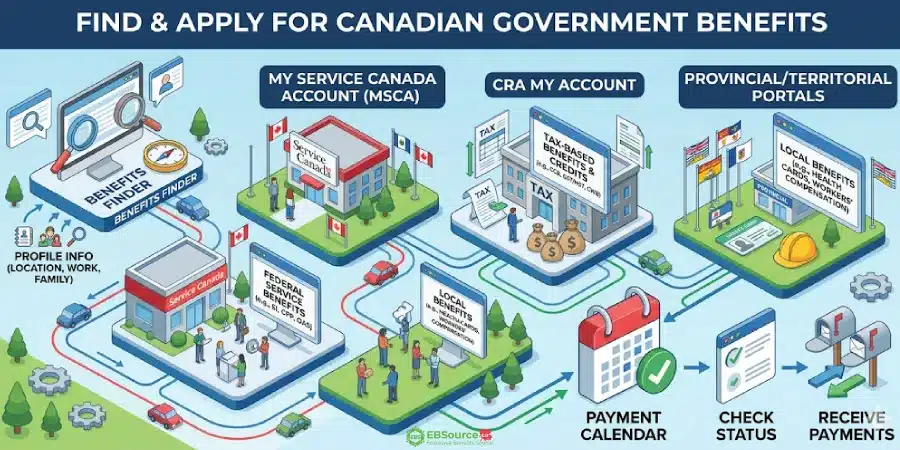
Tips to find Canadian government benefits: To identify federal benefits you may be eligible for, use the Government of Canada’s online Benefits Finder tool. You should answer a few questions about your employment, location, and family size to receive a list of programs you may qualify for. Similarly, for provincial or territorial benefits, visit the CRA’s provincial and territorial programs page or your province’s website for more information.
How Do Government Benefits and Group Plans Work Together in Canada?
Government benefits and group plans are designed to complement each other, even though they have different purposes, provide different coverage, and are funded through different methods. Government programs provide a foundational level of coverage, while employer-sponsored group benefits enhance it by filling gaps.
For instance, in Canada, provincial or territorial health cards cover about 70% of healthcare costs, leaving 30% for services like prescription drugs, eye care, therapy, and dental care, which may not be fully covered. In this case, employer-sponsored extended health and government dental benefits can reduce out-of-pocket expenses and improve access to care.
The same complementary pattern applies to retirement income. Federal income-support programs might not fully replace your income or ensure long-term financial stability, even though they can assist you if you stop working, retire, or get sick. To be specific, EI sickness benefits offer temporary support for up to 26 weeks, and CPP retirement benefits only replace a portion of your previous income. In such cases, having a workplace disability plan or a group retirement plan can provide additional protection when public benefits are insufficient.
Therefore, by reviewing your group insurance alongside your government benefits, you understand where you are covered and where you may need to plan ahead.
Why Do Many Eligible Canadians Miss Out on Government Benefits?
Simply being aware of government benefits and employee-related plans is not enough; you also need to file your taxes on time to access most of them. In the 2025 tax year, it is estimated that 28% of Canadian individuals did not file their taxes. Those who fail to file may be unable to obtain certain government benefits that are distributed through the tax system.
In addition to the issue of non-filing, many Canadians are unaware of the benefits for which they qualify. Although many work hard and pay their taxes, a surprising number fail to claim the government benefits they are entitled to. Credits such as the Canada Caregiver Credit, the Home Buyers’ Amount, and the Medical Expense Tax Credit are some of the most commonly overlooked. This is particularly true for those caring for an elderly parent or an adult child.
Even after benefits are disbursed, some funds remain uncollected. To find out if you have any uncashed government cheques, log into your CRA My Account and check for the “uncashed cheques” link. You can also use the Bank of Canada’s unclaimed property search tool at unclaimedproperties.bankofcanada.ca. Signing up for direct deposit through CRA My Account is a great way to make sure you do not miss any payments.
Note: The federal government is set to launch Automatic Federal Benefits beginning in the 2026 tax year. This will help up to 5.5 million low-income Canadians automatically receive benefits they qualify for by the 2028 tax year. This development is important because it may prevent many Canadians from missing out on these benefits in the coming years.
Will automatic tax filing mean I no longer need to apply for government benefits?
Starting in the 2026 tax year, the CRA is expanding an automated and simplified tax filing system to connect low-income households with the government tax benefits they are entitled to. While automated filing will help ensure that tax-based benefits are received, you still need to apply separately for programs that require proof, medical certification, or provincial/territorial enrollment.
Which Government Benefits Should Employees Apply for First in Canada?
Many statutory government benefits, such as EI and CPP/QPP, are automatically set up through payroll deductions when you start working. Others, including the Canada Child Benefit, the Canada Groceries and Essentials Benefit, the Canada Workers Benefit, and various provincial or territorial credits, are calculated from your tax return and do not require a separate application beyond filing your taxes each year.
However, several important government benefits do require you to take action and apply directly based on your current situation, including provincial or territorial health insurance, the Canadian Dental Care Plan, the Disability Tax Credit, and Workers’ Compensation.
The following list outlines these benefits in order of priority:
Medicare
As soon as you start working in a new province or territory, make sure to apply for your provincial or territorial health card, commonly known as Medicare. It grants you access to publicly funded hospital and doctor services. Keep in mind that some provinces may take up to 3 months for public health insurance to begin. Therefore, newcomers and those moving between provinces may need to obtain temporary private coverage during this waiting period.
Canadian Dental Care Plan
If you do not have employer-sponsored dental insurance and your family’s net income is below the program’s eligibility threshold, you may qualify for the CDCP. Dental costs can add up quickly, so checking your eligibility early can help you minimize high out-of-pocket costs.
Disability Tax Credit
If you or a dependent has a severe and prolonged impairment, apply for the DTC as early as possible. Approval for the DTC also unlocks access to other programs, including the Canada Disability Benefit, the Registered Disability Savings Plan, and the disability supplement under the Canada Workers Benefit.
Workers’ Compensation Board
If you are injured or become ill because of your work, report it to your employer and file a claim with your provincial or territorial workers’ compensation board immediately. Be aware that delays in reporting can affect your eligibility for wage replacement and medical coverage.
FAQs about Government Benefits in Canada
Can I receive provincial social assistance while also getting federal disability benefits?
In many cases, yes. However, the provincial assistance you get may be reduced depending on the federal disability benefits you are receiving. Each province has specific rules.
What federal benefits are available for veterans?
Veterans Affairs Canada offers a full range of programs, with payment rates adjusted for inflation starting January 1, 2026. The monthly or one-time income and injury programs include compensation for pain and suffering, extra pain and suffering payments, income replacement, critical injury support, caregiver recognition, and disability benefits.
Additionally, support and service programs include education and training benefits, rehabilitation and job assistance, Canadian Forces income support, war veterans allowance, veterans independence program, and allowances for clothing, attendance, and treatment.
Here you’ll find the latest payment schedules for major programs of government benefit.