


The Ontario calculator complies with CRA rules, the 2026 tax brackets, and 2026 Ontario payroll deduction guidance, with the date modified on June 17, 2026.
Ontario workers who want to understand what makes Ontario different from most other provinces can use our Ontario income tax calculator. The key reason is that it has additional charges on top of the usual federal tax rates, such as provincial taxes, surtaxes, and the Ontario Health Premium.
To handle these details correctly, our calculator works in three steps. First, it calculates CPP and EI contributions based on total earnings before deductions. Then, it computes federal and provincial income taxes, including eligible credits, to reduce the total tax withholding. After that, the surtax and Ontario Health Premium are added as charges that increase in steps.
Below, we will provide a detailed explanation of all the rates, thresholds, and credits involved and guide you through the complete Ontario gross-to-net calculation.
What is the Purpose of our Ontario Income Tax Calculator?
This Ontario income tax calculator is a free online tool that estimates your income taxes and take-home pay based on your gross income. It is useful for employees checking their pay stubs, job seekers comparing offers across different provinces, or anyone planning an RRSP contribution to see the tax impact right away.
By applying current federal and provincial tax rates, this tool provides a detailed breakdown when you enter simple information such as your yearly salary and where you live. It then shows a summary that includes federal income tax, Ontario provincial tax, CPP payments, EI fees, and your after-tax income.
The main reason your Ontario take-home pay can surprise you is that the province adds two extra charges after the basic tax is calculated: the Ontario surtax and the Ontario Health Premium. Our ON income tax calculator includes these extra charges, along with CPP, CPP2, EI, federal credits, Ontario credits, and payroll limits, so users get a more accurate estimate of yearly and per-paycheque take-home pay.
What Key Factors Distinguish Ontario Income Tax from Other Canadian Regions?
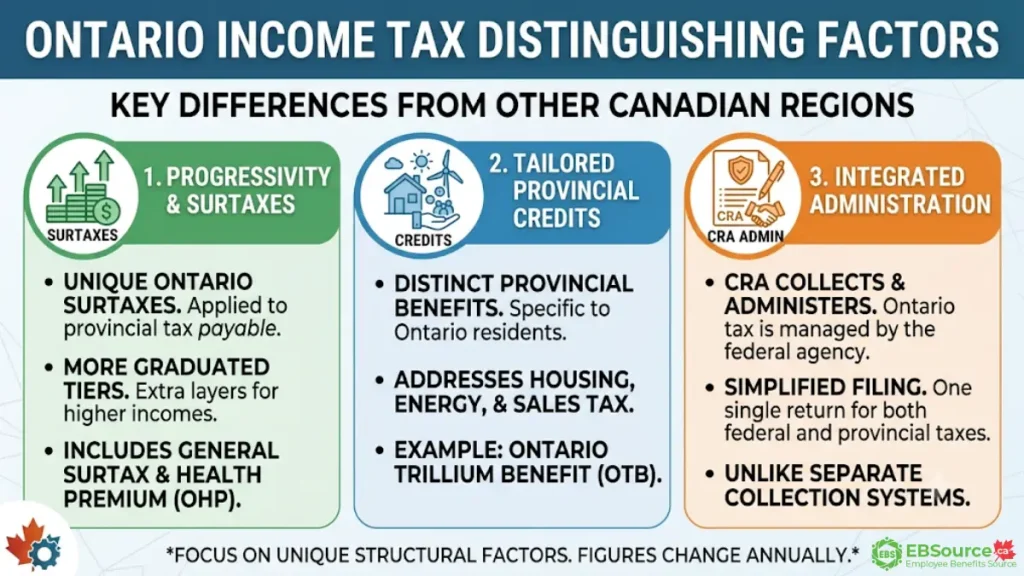
Ontario has specific levies that go beyond the standard income tax brackets, which can significantly affect your tax bill and result in changes of hundreds or even thousands of dollars. These factors include the distinctive Ontario Provincial Tax Brackets, the Ontario Surtax, and the Ontario Health Premium.
Here are the components you need to consider when working out your after-tax income in Ontario:
Ontario Provincial Tax Brackets
Your income in Ontario is divided into 5 tax brackets, each with its own marginal rate, as specified by the Ontario government. This means that if your income increases and you enter a higher tax bracket, only the portion of your income that falls within that new bracket is taxed at the higher rate.
The five tax brackets for Ontario in 2026 are as follows:
- 5.05% on the first $53,891 of taxable income
- 9.15% on income from $53,891 to $107,785
- 11.16% on income from $107,785 to $150,000
- 12.16% on income from $150,000 to $220,000
- 13.16% on income over $220,000
Ontario Surtax
The Ontario surtax is an additional tax applied to your basic provincial tax rather than directly on your income. It significantly increases the effective tax rate for middle- and upper-income earners.
For the year 2026, a 20% surtax applies to basic provincial tax over $5,818, with an additional 36% surtax on amounts over $7,446. This results in a combined surtax of 56% at the highest tier, raising the top Ontario marginal tax rate from 13.16% to 20.53%.
The surtax in Ontario is shown in the table below:
| Basic Ontario tax | Surtax |
|---|---|
| Up to $5,818 | No surtax |
| Over $5,818 to $7,446 | 20% of basic Ontario tax over $5,818 |
| Over $7,446 | 20% of basic Ontario tax over $5,818, plus 36% of basic Ontario tax over $7,446 |
Because the surtax is charged on your tax rather than your income, it behaves like a multiplier on the top brackets. Once your basic Ontario tax passes $7,446, every additional dollar of Ontario tax is multiplied by 1.56, which is exactly why the top combined marginal rate (53.53%) sits so far above the 13.16% top bracket rate.
Our online tax calculators automatically include the surtax in the results. However, if you use a basic bracket table showing only the five Ontario tax rates (5.05% to 13.16%), be aware that these rates do not reflect your actual provincial tax burden once the surtax is applied.
Example of Ontario’s Surtax
Let’s say your basic Ontario tax for the year is $10,000. In this case, you would pay $326 on the first level and $1,430 on the second level, for a total of $1,756 added to your tax bill. As a result, your provincial tax would go up from $10,000 to about $11,756 because of the surtax, even though your tax rate stays the same.
Ontario Health Premium
The Ontario Health Premium is an additional charge based on income, paid through the income tax system. You are required to pay this premium if your taxable income exceeds $20,000. Importantly, the $20,000 threshold is not adjusted for inflation, meaning that as wages rise, more workers will be subject to this charge each year.
The premium increases in tiers as your income rises. According to the CRA’s T4032-ON payroll deductions table, the 2026 schedule is as follows:
| Taxable income | Ontario Health Premium |
|---|---|
| $20,000 or less | $0 |
| Over $20,000 to $25,000 | 6% of taxable income over $20,000 |
| Over $25,000 to $36,000 | $300 |
| Over $36,000 to $38,500 | $300 + 6% of taxable income over $36,000 |
| Over $38,500 to $48,000 | $450 |
| Over $48,000 to $48,600 | $450 + 25% of taxable income over $48,000 |
| Over $48,600 to $72,000 | $600 |
| Over $72,000 to $72,600 | $600 + 25% of taxable income over $72,000 |
| Over $72,600 to $200,000 | $750 |
| Over $200,000 to $200,600 | $750 + 25% of taxable income over $200,000 |
| Over $200,600 | $900 |
For employees, the premium is typically included automatically in payroll tax deductions. As a result, your actual take-home pay may be slightly lower than it would be if you excluded it entirely from marginal rate displays.
One detail worth knowing: the Health Premium is collected through the “provincial tax” line on your pay, but it is not bracketed tax. In the CRA’s own step-by-step formula, it is added after the surtax and is not reduced by most provincial credits or the Ontario tax reduction. That is why two people with the same Ontario tax credits can still owe different amounts for the Ontario Health Premium.
Source: Payroll Deductions Tables – CPP, EI, and income tax deductions – Ontario – Government of Canada
Combined Federal and Ontario Marginal Tax Rates
Ontario’s marginal tax rates indicate the tax on the next dollar earned, instead of a single rate for all income. The following table shows the combined federal and Ontario marginal tax rates for ordinary income in 2026. These rates include the Ontario surtax where applicable but do not include the Ontario Health Premium, which is charged separately.
| 2026 taxable income range | Ontario provincial rate before surtax | Combined federal and Ontario marginal rate | What this means |
|---|---|---|---|
| $0 to $53,891 | 5.05% | 19.05% | Most lower-income earners are taxed at Ontario’s lowest rate before credits reduce the tax payable. |
| Over $53,891 to $58,523 | 9.15% | 23.15% | The 2nd Ontario bracket starts before the 2nd federal bracket begins. |
| Over $58,523 to $94,907 | 9.15% | 29.65% | Federal tax rises to 20.5%, increasing the combined marginal rate. |
| Over $94,907 to $107,785 | 9.15% plus surtax impact | 31.48% | Ontario surtax begins for a person claiming only the BPA. |
| Over $107,785 to $111,814 | 11.16% plus surtax impact | 33.89% | The 3rd Ontario bracket applies, and the surtax continues to raise the effective rate. |
| Over $111,814 to $117,045 | 11.16% plus higher surtax impact | 37.91% | The 2nd Ontario surtax threshold begins, adding another layer to provincial tax. |
| Over $117,045 to $150,000 | 11.16% plus surtax impact | 43.41% | Federal tax moves into the 26% bracket, creating a larger jump in combined tax. |
| Over $150,000 to $181,440 | 12.16% plus surtax impact | 44.97% | Ontario’s 4th bracket applies to income above $150,000. |
| Over $181,440 to $220,000 | 12.16% plus surtax impact | 47.97% | Federal tax moves into the 29% bracket. |
| Over $220,000 to $258,482 | 13.16% plus surtax impact | 49.53% | Ontario’s top provincial bracket begins. |
| Over $258,482 | 13.16% plus surtax impact | 53.53% | The top federal bracket applies, creating Ontario’s highest combined marginal rate. |
For calculator users, marginal tax rates show how much tax is paid on an additional dollar of income, like a bonus or overtime, but they are not the same as the average tax rate. For example, someone earning $120,000 does not pay 43.41% on every dollar. Instead, different portions of their income are taxed at different rates, with credits and other deductions applied to determine their final take-home pay.
A small change in 2026 affects these rates: the lowest federal tax rate dropped to 14% for the whole year (it averaged 14.5% in 2025). Since non-refundable credits like the basic personal amount and tuition are based on the lowest rate, each credit is now worth a little less per dollar than in 2025. It slightly reduces the benefit of the rate cut, but most calculators do not show this.
Ontario Tax Credits and Deductions
Most of these Ontario tax credits are non-refundable, which means they can reduce your tax liability to zero but generally do not generate a refund on their own. When calculating payroll, employers use Form TD1ON to determine which Ontario personal credits to include when estimating provincial tax deductions from employee pay.
The table below lists the main Ontario personal tax credit amounts for 2026 that commonly affect payroll deductions and yearly tax calculations.
| Ontario credit or deduction item | 2026 amount or rule |
|---|---|
| Basic personal amount | $12,989 |
| Age amount | Up to $6,342 |
| Pension income amount | Up to $1,796 |
| Disability amount | $10,494 |
| Spouse or common-law partner amount | Up to $11,029 |
| Amount for an eligible dependent | Up to $11,029 |
| Ontario caregiver amount | Up to $6,122 |
| Amounts transferred from spouse or common-law partner | Depends on unused amounts |
| Amounts transferred from a dependent | Depends on the unused disability amount |
| RRSP contributions, child care expenses, employment expenses, charitable donations, and tuition carried forward | Depends on eligibility and the amount claimed |
Lower-income workers should also know about the Low-Income Individuals and Families Tax (LIFT) Credit. It can reduce or eliminate your Ontario tax (excluding the Health Premium) by up to $875, or 5.05% of your employment income if that is lower. It is then reduced by 5% of the greater of adjusted individual net income over $32,500 or adjusted family net income over $65,000. For a single worker who reaches the $875 maximum, the credit is fully phased out at an adjusted individual net income near $50,000.
What is our Ontario After-tax Income Calculator Procedure?
Calculating your Ontario gross-to-net income starts with one core formula:
After-tax employment income estimate = Total annual cash income (= regular employment income + cash bonus + cash vacation pay + other cash income included in the result) - CPP - CPP2 - EI - federal tax - basic Ontario tax - Ontario surtax - Ontario Health Premium - other cash payroll deductions
In Ontario, workers have three types of deductions. First, there are payroll contributions, such as EI and CPP payments, including additional CPP for higher earnings. Second, income taxes are calculated using federal rates, which credits can reduce. Finally, Ontario adds a tiered Health Premium based on income.
Be aware that EI and CPP deductions differ based on income level, which is divided into 5 categories.
- $0 to $3,500: EI applies from your very first dollar of insurable earnings, but CPP has not started yet because of the $3,500 basic exemption. In this range, CPP is zero.
- Over $3,500 to $68,900: EI is 1.63% of insurable earnings, and CPP is 5.95% on the portion of your pensionable earnings above $3,500.
- Over $68,900 to $74,600: EI has reached its yearly limit of $1,123.07 and stops increasing, but CPP keeps adding up at 5.95% until you reach the YMPE of $74,600.
- Over $74,600 to $85,000: EI ($1,123.07) and regular CPP ($4,230.45) have both reached their maximums, and CPP2 starts at 4% on every dollar between the YMPE ($74,600) and the YAMPE ($85,000).
- Over $85,000: EI, first-tier CPP, and CPP2 have all reached their yearly maximums, so they stay fixed. From this point on, only your income tax, surtax, and Health Premium can increase with additional pay.
Because of these limits, the Ontario calculation is split into four cases explained below. Each case shows how EI, the CPP, federal tax, Ontario tax, the surtax, and the Ontario Health Premium work together to determine your take-home pay. These steps assume you have regular employment income over the $3,500 CPP basic exemption. If you earn $3,500 or less in a year, you might still pay EI premiums, but usually you will not pay into CPP.
Each case is explained in detail below:
Case 1: Income from $3,500 to $68,900
For residents of Ontario with an annual gross income between $3,500 and $68,900, both EI and CPP contributions are calculated as a percentage of earnings, as neither has reached its annual cap. In addition to the standard federal and provincial tax brackets, Ontario also includes a provincial surtax and the Ontario Health Premium, which are taken into account in the following steps:
| Step | Description | Details |
|---|---|---|
| 1 | Determine your gross income | Annualize the pay-period amount based on the number of pay periods |
| 2 | Calculate EI premiums | 1.63% × annual insurable earnings |
| 3 | Calculate total CPP contribution | 5.95% × (annual pensionable earnings − $3,500) |
| 4 | Base CPP | 4.95% × (pensionable earnings − $3,500) |
| 5 | First additional CPP | 1.00% × (pensionable earnings − $3,500) |
| 6 | Calculate taxable income | Gross income + other taxable income + vacation pay + bonus − eligible deductions − first additional CPP |
| 7 | Calculate basic federal tax | Apply 2026 federal brackets to taxable income |
| 8 | Subtract federal non-refundable credits | 14% × (federal BPA + Canada Employment Amount + base CPP + EI) |
| 9 | Federal tax payable | Basic federal tax − federal credits |
| 10 | Calculate basic Ontario bracket tax | Apply 2026 Ontario brackets to taxable income |
| 11 | Subtract Ontario non-refundable credits | 5.05% × (Ontario BPA + base CPP + EI) |
| 12 | Calculate basic Ontario tax payable | Basic Ontario bracket tax − Ontario credits |
| 13 | Add Ontario surtax, if any | Apply surtax only to basic Ontario tax payable after credits: 0%, 20%, or 20% + 36% depending on whether basic Ontario tax payable exceeds the surtax thresholds |
| 14 | Add Ontario Health Premium | Calculate from taxable income using the Ontario Health Premium schedule |
| 15 | Apply Ontario tax reduction or LIFT, if applicable | Apply only where the taxpayer qualifies; LIFT reduces Ontario personal income tax but not the Ontario Health Premium |
| 16 | Total annual payroll deductions | EI + CPP + federal tax + Ontario tax including surtax and Health Premium |
| 17 | After-tax annual income | Gross income − total annual payroll deductions |
| 18 | After-tax income per pay period | After-tax annual income ÷ number of pay periods |
Case 2: Income from over $68,900 to $74,600
Once your earnings exceed $68,900 but remain at or below $74,600, your EI is done for the year at $1,123.07, but CPP continues to come off your pay because you have not yet reached the YMPE of $74,600. It is an in-between stretch where one deduction has frozen, and the other is still climbing, so your take-home pay grows a little faster than it did lower down the scale. The surtax and the Ontario Health Premium will still apply, as detailed in the table below:
| Step | Description | Details |
|---|---|---|
| 1 | Determine your gross income | Annualize the pay-period amount based on the number of pay periods |
| 2 | Calculate EI premiums | EI maximum = $1,123.07 |
| 3 | Calculate total CPP contribution | 5.95% × (annual pensionable earnings − $3,500), until the YMPE is reached |
| 4 | Base CPP | 4.95% × (pensionable earnings − $3,500) |
| 5 | First additional CPP | 1.00% × (pensionable earnings − $3,500) |
| 6 | Calculate taxable income | Gross income + other taxable income + vacation pay + bonus − eligible deductions − first additional CPP |
| 7 | Calculate basic federal tax | Apply 2026 federal brackets to taxable income |
| 8 | Subtract federal non-refundable credits | 14% × (federal BPA + Canada Employment Amount + base CPP + EI) |
| 9 | Federal tax payable | Basic federal tax − federal credits |
| 10 | Calculate basic Ontario bracket tax | Apply 2026 Ontario brackets to taxable income |
| 11 | Subtract Ontario non-refundable credits | 5.05% × (Ontario BPA + base CPP + EI) |
| 12 | Calculate basic Ontario tax payable | Basic Ontario bracket tax − Ontario credits |
| 13 | Add Ontario surtax, if any | Apply surtax only to basic Ontario tax payable after credits: 0%, 20%, or 20% + 36% depending on whether basic Ontario tax payable exceeds the surtax thresholds |
| 14 | Add Ontario Health Premium | Calculate from taxable income using the Ontario Health Premium schedule |
| 15 | Apply Ontario tax reduction or LIFT, if applicable | Apply only where the taxpayer qualifies; LIFT reduces Ontario personal income tax but not the Ontario Health Premium |
| 16 | Total annual payroll deductions | EI + CPP + federal tax + Ontario tax including surtax and Health Premium |
| 17 | After-tax annual income | Gross income − total annual payroll deductions |
| 18 | After-tax income per pay period | After-tax annual income ÷ number of pay periods |
Case 3: Income over $74,600 to $85,000
When your income falls between $74,600 and $85,000, EI and first-tier CPP have reached their annual maximums. The additional deduction in this band is CPP2, which applies at 4% on pensionable earnings above the YMPE and below the YAMPE.
The step-by-step process is:
| Step | Description | Details |
|---|---|---|
| 1 | Determine your gross income | Annualize the pay-period amount based on the number of pay periods |
| 2 | Calculate EI premiums | EI maximum = $1,123.07 |
| 3 | Calculate total CPP contribution | 5.95% × (annual pensionable earnings − $3,500), until the YMPE is reached |
| 4 | Calculate first-tier CPP contribution | First-tier CPP maximum = $4,230.45 |
| 5 | Split CPP for tax purposes | Base CPP = $3,519.45; first additional CPP = $711 |
| 6 | Calculate CPP2 | 4% × (pensionable earnings − $74,600), up to the CPP2 maximum |
| 7 | Calculate taxable income | Gross income + other taxable income + vacation pay + bonus − eligible deductions − $711 first additional CPP − CPP2 |
| 8 | Calculate basic federal tax | Apply 2026 federal brackets to taxable income |
| 9 | Subtract federal non-refundable credits | 14% × (federal BPA + Canada Employment Amount + base CPP + EI) |
| 10 | Federal tax payable | Basic federal tax − federal credits |
| 11 | Calculate basic Ontario bracket tax | Apply 2026 Ontario brackets to taxable income |
| 12 | Subtract Ontario non-refundable credits | 5.05% × (Ontario BPA + base CPP + EI) |
| 13 | Calculate basic Ontario tax payable | Basic Ontario bracket tax − Ontario credits |
| 14 | Add Ontario surtax, if any | Apply surtax only to basic Ontario tax payable after credits |
| 15 | Add Ontario Health Premium | Calculate from taxable income using the Ontario Health Premium schedule |
| 16 | Apply Ontario tax reduction or LIFT, if applicable | Apply only where the taxpayer qualifies; LIFT reduces Ontario personal income tax but not the Ontario Health Premium |
| 17 | Total annual payroll deductions | EI + first-tier CPP + CPP2 + federal tax + Ontario tax including surtax and Health Premium |
| 18 | After-tax annual income | Gross income − total annual payroll deductions |
| 19 | After-tax income per pay period | After-tax annual income ÷ number of pay periods |
Note: Do not treat the $711 first additional CPP amount as an extra payroll deduction beyond the $4,230.45 first-tier CPP maximum. The $4,230.45 already includes both base CPP and first additional CPP. For tax purposes, base CPP is used in the credit calculation, while first additional CPP and CPP2 reduce taxable income.
Case 4: Income over $85,000
If your income goes over $85,000, the process to calculate your take-home pay is the same as in Case 3. However, at this point, the CPP2 contribution hits its annual maximum of $416. The EI premiums, totalling $1,123.07, the regular CPP contributions of $4,230.45, and the CPP2 of $416 are all set amounts. This means earning more will not raise your CPP, CPP2, or EI contributions.
What can still increase is your tax bill: higher income leads to more federal tax, increased Ontario tax, a larger surtax, and, in the higher income brackets, an increased Ontario Health Premium.
Ontario Worked Examples by Income Levels
The example below shows how a calculator can be used to find take-home pay for six common income levels from $40,000 to $200,000. It provides a summary of earnings after all deductions, including EI, CPP, federal tax, Ontario tax, surtax, and Ontario Health Premium, and shows the after-tax income for 2026.
It also compares these income levels to the average wage in Ontario, which is about $70,800 per year, according to Statistics Canada. As income increases, the deductions for some contributions reach their limits, so the main increase in deductions comes from taxes and the Health Premium.
Note that our example assumes a single person with a standard job and only basic deductions, so actual take-home pay may vary. It also accounts for the Ontario LIFT credit where applicable. At $40,000 of gross employment income, the LIFT credit is partly phased out, so the estimated LIFT amount is about $518 rather than the full $875.
Here are some examples of gross-to-net salary calculations and their positions in an Ontario context:
| Gross income | After-tax income | How it compares to the average Ontario wage |
|---|---|---|
| $40,000 | about $33,332 | Below the Ontario average of about $70,800, roughly full-time work is slightly above minimum wage. |
| $60,000 | $47,340 | A little below the Ontario average, a common single-earner full-time wage. |
| $80,000 | $60,303 | Modestly above the average Ontario pay level. |
| $100,000 | $74,206 | Upper-income territory; well above what a typical Ontarian earns. |
| $150,000 | $104,320 | Roughly double the average Ontario wage. |
| $200,000 | $131,278 | Near the top of the income scale, among the highest individual earners in the province. |
These results show that, at lower incomes, much of what is taken from your pay is CPP and EI. Still, once those contributions hit their yearly limits around $80,000, every extra dollar you earn is mostly affected by federal tax, Ontario tax, the surtax, and the Health Premium. This is also why your overall deduction rate rises gradually rather than jumping suddenly, from about 16.7% at $40,000 to around 34.4% at $200,000.
Step-by-step Example: $150,000 After-tax Pay in Ontario
Suppose you enter $12,500 as your monthly income; that amounts to an annual income of $150,000. This means your payroll deductions are fixed because you have reached the maximum for EI and CPP contributions. Your deductions are $1,123.07 for EI, $4,230.45 for total first-tier CPP, and $416 for CPP2. Any additional CPP contributions reduce your taxable income to approximately $148,873.
Next, federal and Ontario taxes are calculated based on taxable income of $148,873. Ontario basic tax after credits is about $11,348. Since this amount exceeds both Ontario surtax thresholds, the surtax is about $2,511. The Ontario Health Premium is $750.
The table below shows how each piece contributes to the final result:
| Component | Formula | 2026 amount | Notes |
|---|---|---|---|
| Gross annual income | $12,500 × 12 | $150,000 | $12,500 per period × 12 monthly pay periods |
| Taxable income | $150,000 − $711 first additional CPP − $416 CPP2 | $148,873 | First additional CPP and CPP2 reduce taxable income |
| EI premiums | Maximum annual EI premium | -$1,123.07 | Maximum reached; frozen for the year |
| CPP contributions | Maximum first-tier CPP contribution, including base CPP and first additional CPP | -$4,230.45 | Maximum reached at the YMPE of $74,600 |
| CPP2 | Maximum CPP2 contribution | -$416 | Maximum reached at the YAMPE of $85,000 |
| Federal income tax | Federal tax on $148,873 − federal credits | -$25,302.14 | Calculated on taxable income after credits |
| Ontario basic tax after credits | Ontario bracket tax on $148,873 − Ontario credits | -$11,347.83 | Ontario credits are applied before surtax |
| Ontario surtax | 20% × ($11,347.83 − $5,818) + 36% × ($11,347.83 − $7,446) | -$2,510.62 | Both Ontario surtax tiers apply |
| Ontario Health Premium | Flat amount for taxable income over $72,600 and not over $200,000 | -$750 | Added after Ontario tax and surtax |
| Total Ontario tax | $11,347.83 + $2,510.62 + $750 | -$14,608.45 | Includes Ontario basic tax, surtax, and Health Premium |
| Total income tax (federal + Ontario) | $25,302.14 federal + $14,608.45 Ontario | -$39,910.59 | Combined federal and Ontario tax |
| Total deductions | $39,910.59 tax + $4,230.45 CPP + $416.00 CPP2 + $1,123.07 EI | -$45,680.11 | All payroll deductions combined |
| After-tax annual income | $150,000 − $45,680.11 | About $104,319.89 | Take-home pay after all deductions |
Spread over 12 pay periods, this comes to about $8,693 per month in take-home pay. The Ontario surtax and Health Premium together add about $3,261, which is why a $150,000 Ontario earner keeps less than a simple five-bracket provincial tax table would suggest.
FAQs about the Ontario income tax calculator
Why do different Ontario income tax calculators give different results?
Different calculators may produce different results based on different assumptions. Some calculators include the Ontario surtax, the Ontario Health Premium, CPP contributions, and credit reductions, while simpler tools may only consider federal and provincial tax rates. Also, your results can change depending on whether you enter RRSP deductions, taxable benefits, bonus pay, union dues, tuition, or different TD1 claim amounts.
How much CPP does a self-employed Ontario worker contribute?
With very few exceptions, every person over the age of 18 who works in Canada (outside of Quebec) and earns more than $3,500 per year is required to contribute to the CPP. If you are self-employed, you are responsible for making the entire contribution.
The contribution rate for pensionable earnings is 11.9%, which consists of 9.9% for the base CPP and an additional 2% for the first component of the CPP enhancement. This rate is split equally between the employee and the employer.
For self-employed workers, since they pay both portions, their effective contribution rate is 11.9% on earnings from $3,500 up to the YMPE, which is $74,600. In addition, they pay CPP2 at 8% on earnings between $74,600 and $85,000, up to a maximum of $832, for a combined maximum CPP contribution of roughly $9,293 in 2026
What forms do Ontario residents use to calculate their provincial tax when filing their annual return?
Residents of Ontario use Form ON428 (Ontario Tax) to calculate the provincial taxes and credits to report on their tax return. Additional forms include Form ON-BEN for the Ontario Trillium Benefit and the Ontario Senior Homeowners’ Property Tax Grant, Schedule ON428-A for the Low-Income Individuals and Families Tax Credit, and Schedule ON479-A for the Ontario Childcare Access and Relief from Expenses Tax Credit.
Why is Ontario income tax harder to calculate than in other provinces?
ON income tax is harder to calculate because the province uses regular tax brackets plus a surtax and the Ontario Health Premium. The surtax is based on Ontario tax payable, while the Health Premium is based on taxable income. This means a simple provincial bracket table may not show the full tax cost.
Why did my Ontario take-home pay rise later in the year?
Your contributions to the CPP or EI likely reached their annual maximums. Once you hit the EI maximum insurable earnings or the CPP contribution limits, those deductions stop for the remainder of the year, leading to an increase in your take-home pay.
Disclaimer: The calculator is only an estimate and should not replace a filed tax return or payroll advice. Your final tax might be different if you have RRSP deductions, union fees, taxable benefits, investment earnings, self-employment income, moving costs, tuition fees, medical costs, charitable gifts, spouse or dependent claims, or other federal and Ontario credits.