


Revised on June 21, 2026, the Saskatchewan calculator verifies provincial credits and tax estimates in accordance with CRA rules and the latest available 2026 rate information.
If you work in Saskatchewan, this SK income tax calculator helps you quickly estimate your take-home pay, whether you are a salaried worker, an hourly employee, a commission earner, or have recently moved to the province.
To create your estimate, the calculator only needs basic information that affects your final pay: your income, how often you get paid, any extra income, RRSP contributions, and payroll deductions. It then calculates the right federal and Saskatchewan taxes.
However, it does not include details from tax returns, like province-specific credits such as the Saskatchewan Low-Income Tax Credit, the Active Families Benefit, and the Graduate Retention Program, which you claim when you file your taxes.
Read on to see who the calculator is for, what each input means, what results to expect, and which Saskatchewan tax credits to watch for at filing time.
Who is the EBSource Saskatchewan Income Tax Calculator for?
Our Saskatchewan income tax calculator is built for Saskatchewan residents with regular employment income. It works effectively in some situations, but only partially or not at all in others.
Across the six profiles mapped out here, the results show that the closer your income matches one T4 slip, the more accurate the estimate will be. People with salaries or hourly pay can expect reliable results; those who earn commissions or have recently moved will find the estimates useful. Self-employed contractors and farmers, on the other hand, may find that the calculations do not fit their needs.
Here is how each situation lands and what to do about it:
| Your Situation | Will This Calculator Work? | What to Do |
|---|---|---|
| Salaried employee, T4 income | Yes | Compare the result with your pay stub or CRA PDOC if you have taxable benefits, bonuses, commission income, multiple jobs, or year-to-date CPP/CPP2/EI limits. |
| Hourly employee | Yes, with caution | Enter realistic annual hours, since irregular shifts can change the estimate. |
| Commission employee | Partly | Your employer may use Form TD1X to account for commission expenses, so the result is an approximation. |
| Self-employed contractor | No | You may owe tax by instalments and pay both the employee and employer portions of CPP, so use a self-employment or instalment calculator. |
| Farmer or small-business owner | No | Business income generally requires Form T2125 and may involve multi-jurisdiction allocation. |
| Recently moved to or from Saskatchewan | Partly | Your tax province is generally based on where you lived on December 31, 2026, so confirm that first. |
Note: The calculator assumes you were a Saskatchewan resident on December 31, 2026, because that residency date determines which province taxes your income for the whole year.
What inputs does our Saskatchewan income tax calculator need?
A Saskatchewan income tax calculator requires 4 inputs: employment income and pay frequency, other income, RRSP contributions, and other payroll deductions. They help our tool calculate your federal and provincial Saskatchewan taxes and show your estimated take-home pay after accounting for credits.
The following explains why each factor plays a key role in our SK income tax calculator:
Income and pay period
To get started, enter your income for each pay period and your pay frequency (weekly, biweekly, semimonthly, or monthly). Our calculator will then multiply these two numbers to calculate your gross annual income, which serves as the basis for all subsequent figures. If you are filing your taxes, you can find your employment income amount in Box 14 of your T4 slip.
Other income types in Saskatchewan
While regular employment income is the most common source of taxable earnings, additional income types, such as self-employment income, capital gains, dividends, interest income, scholarships, bursaries, grants, rental income, and royalties, must also be reported and taxed.
Be aware that this is for the year-end tax context only. Knowing other sources of taxable income in Saskatchewan can help ensure you accurately calculate your income tax.
The 7 common income types that you need to consider in the other income box are:
| Income Type | Enter It in This Calculator? | Amount to Enter |
|---|---|---|
| Self-employment income | No, use a self-employment calculator instead | Not applicable |
| Capital gains | Yes, for a year-end estimate only | Taxable portion only |
| Eligible dividends | Yes, with caution | Taxable grossed-up dividend amount from your T5 slip |
| Interest income | Yes, for a year-end estimate | Full amount earned |
| Scholarships, bursaries, and grants | Yes, if taxable | Amount not covered by an exemption |
| Rental income | Yes, for a year-end estimate | Net rental income after eligible expenses |
| Royalties | Yes, for a year-end estimate | Full amount received |
Note: Capital gains, dividends, interest, rental income, and royalties usually do not affect the amount taken from your paycheque because your employer does not know about them. However, they do affect your total taxes when you file your tax return at the end of the year. If you want an annual tax estimate that includes all income sources, be sure to add these to the calculator.
RRSP Contributions
Contributions to a Registered Retirement Savings Plan lower your taxable income on a dollar-for-dollar basis. This means that, for tax purposes, each dollar you contribute is treated as if you never earned it until you withdraw the funds in retirement. For 2026, the RRSP deduction limit is $33,810 or 18% of your income earned in 2025, whichever is less. You can carry forward any unused contribution room from previous years.
Other Payroll Deductions in Saskatchewan
In addition, mandatory and optional payroll deductions will also be reflected in your paycheque in Saskatchewan. Being familiar with them can help you budget and plan your finances more accurately.
The deductions, or reductions, that you may consider when inputting into our Saskatchewan income tax calculator are:
- Wage Garnishments: deductions from a person’s paycheque to pay off debts. They are often used for things like child support and unpaid taxes. In Saskatchewan, they can reduce the amount of money an employee takes home until the debt is paid off.
- Union dues: mandatory fees taken from union members’ pay. They help support negotiations and other union activities, and they are generally deductible when you file your return.
Note: Do not put deductions and non-refundable credits together in one entry. Use one field for deductions that lower payroll taxable income, and a different step for federal and Saskatchewan non-refundable tax credits that lower tax after taxable income is calculated.
Which Saskatchewan-only credits should you not miss?
A Saskatchewan payroll calculator shows your withholding, but several Saskatchewan credits are claimed on your tax return and can change your refund. As a result, you should keep proof for every credit since the CRA generally expects you to keep your records for six years from the end of the tax year they relate to, and the most valuable credits are often lost because filers remember the expense but cannot produce the receipt or certificate.
The credits and benefits worth checking before you file in Saskatchewan are:
Saskatchewan Low Income Tax Credit
The Saskatchewan Low-Income Tax Credit is a fully refundable, non-taxable benefit for Saskatchewan residents with low and modest incomes. You do not apply separately. When you file your income tax and benefit return as a Saskatchewan resident, the CRA determines whether you qualify. Since it is a benefit and not a deduction, you usually will not see it on your pay stub, and because it is calculated from your filed return, you simply need to keep the income records that support it.
The credit amounts increase over two benefit years, with the maximum family benefit rising from $1,196 to $1,282. In addition, the income level at which benefits start to decline will rise from $38,590 to $39,345. Plus, the Saskatchewan Affordability Act provides a 5% annual increase to the benefit (on top of indexation) for 2025 through 2028.
Here is how the two benefit years compare:
| SLITC Component | July 1, 2025 to June 30, 2026 | July 1, 2026 to June 30, 2027 |
|---|---|---|
| Maximum per family | $1,196 | $1,282 |
| Per adult | $429 | $460 |
| Per child | $169 | $181 |
| Maximum for two children | $338 | $362 |
| Reduction rate | 2.88% of family net income over the threshold | 2.88% of family net income over the threshold |
| Income threshold where reduction begins | $38,590 | $39,345 |
Source: Low-income tax credit – Government of Saskatchewan
Active Families Benefit
The Active Families Benefit is a refundable credit for families with children enrolled in sport, culture, or recreation activities. Starting in 2025, it doubled to up to $300 per child, or $400 for a child eligible for the federal Disability Tax Credit, and the income threshold rose so that families with an adjusted income of $120,000 or less can claim it. You claim it on Form SK479 when you file, so keep your receipts from the sport, culture, or recreation provider.
Fertility Treatment Tax Credit
The Fertility Treatment Tax Credit, which also includes related prescription drug costs, provides a 50% refundable tax credit for eligible fertility treatments. You can claim up to $20,000 in expenses, which means you could get back up to $10,000. However, it can only be claimed once in your lifetime, so make sure to keep your paid clinic bills and prescription receipts to prove your claim.
Home Renovation Tax Credit
The Home Renovation Tax Credit has been reintroduced for the 2025 tax year and beyond. A non-senior may claim up to $4,000 of the remaining eligible expenses, producing a maximum provincial tax credit of $420 at the 10.5% rate. An eligible senior may claim up to $5,000 after the $1,000 base amount, producing a maximum credit of $525. In practical terms, reaching the maximum generally requires $5,000 of qualified expenses for a non-senior or $6,000 for an eligible senior.
If you are 65 or older by the end of the year, you can add another $1,000 in expenses, bringing your total credit to around $525. Just remember to keep your contractor bills, receipts, and permits to claim them.
Graduate Retention Program
The Graduate Retention Program comes as a tuition rebate from the province. Eligible graduates generally must have completed an approved program, live in or be moving to Saskatchewan, file Saskatchewan income tax and have graduated within the last seven years.
This credit offers a tuition refund of up to $24,000, recently raised from $20,000 (a 20% increase). The maximum refund depends on the type of degree or certificate you earned, and the credit reduces the provincial taxes you owe. It is delivered over seven years after you graduate. Keep your Graduate Retention Program eligibility certificate and your tuition receipts (Form T2202) as proof of eligibility.
So file your documents as you incur the cost, because the credit you cannot prove is the credit you lose.
Are there other Saskatchewan credits the calculator may not capture?
Yes, in addition to the return-time credits mentioned earlier, several Saskatchewan credits depend on personal circumstances that a payroll calculator cannot account for, such as volunteer work, disabilities, caregiving, age, or pension income.
They can lower the tax you owe when you file, yet each credit has its own rules, amounts, and income limits. So it is best to check them yourself before filing your taxes rather than just relying on your Saskatchewan take-home pay estimate.
Here’s how each of these three credits works and what you need to claim them:
Volunteer First Responder Credit
If you are a volunteer firefighter, search-and-rescue volunteer, or volunteer emergency medical first responder, the 2026 budget has doubled the non-refundable credit from $3,000 to $6,000, as long as you complete a minimum volunteer service requirement during the year. You claim this credit when you file your tax return, not through your payroll.
Three common questions come up about this credit: Does it change your paycheque? What proof do you need? How does it work with the federal version?
Below are the answers to each question in more detail:
| Reader question | Useful answer |
|---|---|
| Will this lower each paycheque? | Usually, no. It is generally a return-time credit, not a standard payroll withholding adjustment. |
| What proof do I need? | You will generally need certification of your eligible volunteer service hours. |
| Can I combine it with federal credits? | Provincial and federal tax treatments can differ, so confirm your situation with a tax professional. |
Disability and Caregiver Amounts
Saskatchewan is increasing non-refundable tax credit amounts for disability and care cases in 2026, with each amount getting a 10.5% lowest provincial rate. All four of these amounts start from the same base of $14,266 for 2026, but they work differently. The disability payment, plus the extra amount for people under 18, applies in full. However, caregiver and infirm-dependent amounts begin to decline once the dependent’s net income exceeds a set limit.
Here are the details about the amounts and their threshold breakdown:
| 2026 amount | Value and threshold |
|---|---|
| Disability amount | $14,266 |
| Disability supplement for dependents under 18 | $14,266 |
| Caregiver amount | $14,266, with a net income threshold of $33,756 |
| Infirm dependent amount | $14,266, with a net income threshold of $22,363 |
As can be seen, these amounts were increased by 25% for 2025 under The Saskatchewan Affordability Act, with indexation added for 2026. Employees with caregiving costs often underestimate their credits because a basic payroll calculator does not ask about dependents.
Seniors and Pension Income
If you are 65 or older or get pension income, several amounts in Saskatchewan can lower your 2026 tax. These are the senior supplement, age amount, pension income amount, and medical expense credit, each with its own rules.
Each one, with its attached limit, appears below:
| 2026 amount | Value and threshold |
|---|---|
| Senior supplement, age 65 or older on December 31, 2026 | $2,569 |
| Age amount | $5,901, with a net income threshold of $43,927 |
| Maximum pension income amount | $1,000 |
| Medical expense tax credit | Reduced by 3% of net income, up to a ceiling of $2,735 |
Note that you can claim the $2,569 senior supplement even if your age amount is zero. If you get a pension, comparing your taxes before and after pension splitting can affect both your federal and Saskatchewan taxes.
What results does our income tax calculator in Saskatchewan provide?
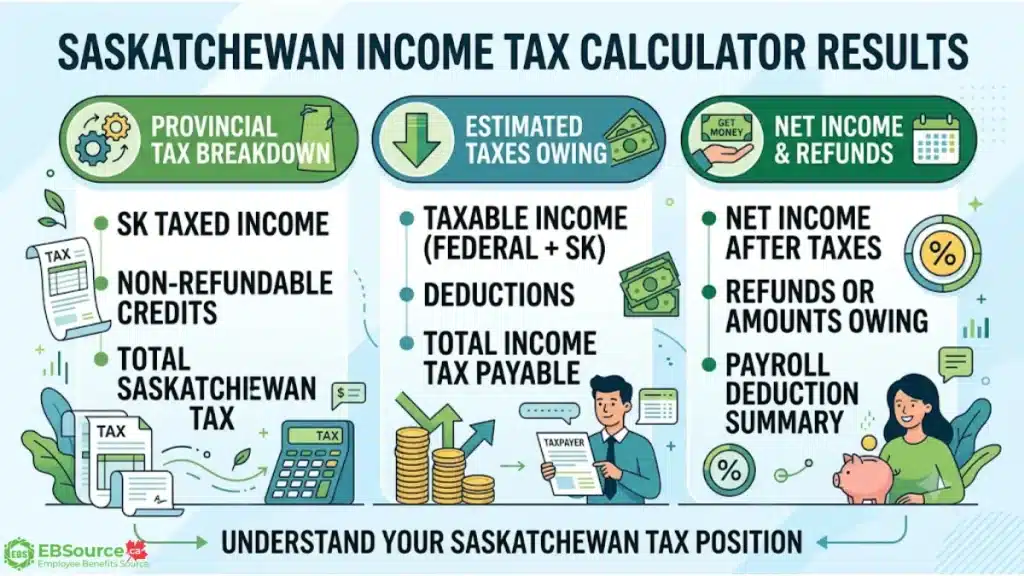
After you enter your income, deductions, and credits, the Saskatchewan income tax calculator gives you four main results.
It first calculates your CPP contributions and EI premiums, which are deducted from your pre-tax earnings. Then it applies federal and Saskatchewan provincial tax rates and combined marginal tax rates to your taxable income, adjusting for any non-refundable credits. Lastly, the calculator shows your after-tax income by subtracting these deductions from your gross annual income, and it provides a breakdown by pay period.
The key factors that are shown in our results section are:
CPP Contributions and EI Premiums
From your gross income, two main deductions are taken:
- EI: 1.63% of your insurable earnings, up to a maximum of $1,123.07 on insurable earnings up to $68,900.
- CPP: 5.95% on income above $3,500, with a maximum contribution of $4,230.45. If your income is between $74,600 and $85,000, there’s a CPP2 of 4% on earnings in that range. Once your income exceeds $85,000, CPP2 stops at $85,000, for a maximum of $416.
For payroll-style calculations, taxable income may be reduced by eligible deductions such as RRSP contributions and by the deductible CPP additional contribution amounts. The base CPP contribution is treated as part of the non-refundable credit calculation, while first additional CPP and CPP2, where applicable, are handled separately.
Federal income tax
All Canadian provinces and territories are subject to the same federal income tax brackets and rates. For federal income tax in 2026, the rates are 14% for income up to $58,523, rising in stages to 33% for income above $258,482.
You can reduce your gross federal tax with non-refundable credits based on the basic personal amount, CPP contributions, EI premiums, and the Canada Employment Amount. The total of these credits is subtracted from your gross federal tax to find your net federal tax payable.
Provincial income tax
In addition to federal taxes, Saskatchewan employees must pay SK provincial income tax, which funds programs and services within the province.
Saskatchewan’s provincial tax in 2026 has three brackets:
- 10.5% on the first $54,532,
- 12.5% on income between $54,532 and $155,805,
- 14.5% on income over $155,805.
Provincial non-refundable credits are based on the basic personal amount, which is $20,381 for 2026, and similar deductions.
Combined marginal tax rate in Saskatchewan
Federal and Saskatchewan taxes are calculated separately, but they both apply to the same dollar of income simultaneously. Your combined marginal tax rate is the sum of these two; it shows the tax you pay on your next dollar of income. This rate matters because it tells you how much of a raise, bonus, or extra shift you actually keep.
Because the federal tax brackets ($58,523 / $117,045 / $181,440 / $258,482) and the Saskatchewan tax brackets ($54,532 / $155,805) begin at different income amounts, your combined rate will go up as you pass each limit.
Here’s how these brackets line up for regular employment income in 2026:
| 2026 taxable income band | Combined marginal rate | How to calculate |
|---|---|---|
| Up to $54,532 | 24.5% | 14% + 10.5% |
| Over $54,532 to $58,523 | 26.5% | 14% + 12.5% |
| Over $58,523 to $117,045 | 33% | 20.5% + 12.5% |
| Over $117,045 to $155,805 | 38.5% | 26% + 12.5% |
| Over $155,805 to $181,440 | 40.5% | 26% + 14.5% |
| Over $181,440 to $258,482 | 43.5% | 29% + 14.5% |
| Over $258,482 | 47.5% | 33% + 14.5% |
It’s important to know this is different from your average tax rate. Your marginal rate only applies to the income in your highest tax bracket, not your whole income. So, earning one more dollar will never lower your total take-home pay; it just means that extra dollar is taxed at your highest combined rate.
A practical takeaway: most employees in Saskatchewan pay taxes ranging from 24.5% to 33%, depending on taxable income. So, a simple rule is that a usual raise is taxed at about one-quarter to one-third before you get it. These tax rates apply to regular income, such as salary, wages, and interest. On the other hand, capital gains and Canadian dividends are taxed at lower rates under special rules, such as the capital gains inclusion rate and the dividend tax credit.
After-tax income in Saskatchewan
To find your total annual deductions, add together your federal tax, provincial tax, EI premiums, and CPP contributions.
If the total is negative, treat it as zero. Next, subtract these deductions from your gross annual income to calculate your after-tax income for the year. Finally, divide your after-tax income by the number of pay periods to determine your after-tax salary per paycheque.
For example, if an employee in Saskatchewan earns $75,000 before taxes (paid every two weeks over 26 pay periods), with usual tax credits and no RRSP contributions, they can expect to take home about $55,806 a year. The total deductions for CPP, CPP2, and EI are around $ 5,369. Saskatchewan provincial tax is about $5,566, and federal tax is around $8,259.
How does the calculation work for a Saskatchewan employee earning about $39,500?
To see exactly where each dollar goes, take a Saskatchewan employee paid $3,200 per period across 12 monthly pay periods, with $320 in vacation pay, a $260 annual bonus, and $520 of other income. That adds up to about $39,500 in total gross income for the year, which places them in Saskatchewan’s lowest provincial bracket of 10.5%.
Here is how that gross income breaks down into take-home pay:
| Income item | Amount | How it is calculated |
|---|---|---|
| Gross income | $39,500 | ($3,200 × 12) + $320 vacation + $260 bonus + $520 other income |
| CPP contributions | -$2,111 | 5.95% of ($38,980 – $3,500 basic exemption) |
| EI premiums | -$635 | 1.63% of $38,980 insurable earnings |
| Federal income tax | -$2,632 | 14% on taxable income, less basic personal and other credits |
| Saskatchewan provincial tax | -$1,719 | 10.5% on taxable income, less the $20,381 basic personal amount and other credits |
| After-tax income | $32,402 | Gross income minus all deductions above |
At this income level, the employee remains below the $74,600 ceiling at which CPP2 begins, so CPP2 does not apply. Their taxable income after the deductible portion of CPP contributions is roughly $39,145, which is taxed at 10.5% provincially and 14% federally, then reduced by non-refundable credits including the federal basic personal amount and Saskatchewan’s $20,381 basic personal amount. Spread across 12 monthly paycheques, the $32,402 after-tax income works out to about $2,700 in take-home pay each month.
Because the whole amount falls inside the first bracket, this employee’s combined marginal rate is 24.5% (14% federal plus 10.5% Saskatchewan), so any raise, extra shift, or larger bonus would be taxed at that rate until their income crosses the next threshold.
How do you file your Saskatchewan income tax?
Our SK tax calculator estimates your pay after taxes, but remember that filing your tax return is a separate step. People living in Saskatchewan need to file a federal T1 Income Tax and Benefit Return with the CRA. Form SK428 calculates Saskatchewan tax and applicable provincial tax credits. Form SK479 is used to claim certain refundable Saskatchewan credits when applicable.
For provincial Saskatchewan residents, there are two forms that handle the provincial tax calculations:
- Form SK428 – Saskatchewan Tax: This form figures out your Saskatchewan provincial tax and non-refundable tax credits using the provincial rates and personal amounts.
- Form SK479 – Saskatchewan Credit: This form lets you claim some refundable Saskatchewan credits, like the Active Families Benefit.
Important deadlines for the 2025 tax year are as follows:
| Filing situation | File your return by | Pay any balance owing by |
|---|---|---|
| Most individuals | April 30, 2026 | April 30, 2026 |
| Self-employed individual, or spouse or common-law partner is self-employed | June 15, 2026 | April 30, 2026 |
Our SK income tax calculator provides estimates of payroll and take-home pay in 2026. Please note this is not a full T1 personal tax return calculation. Your final tax refund or amount owed may change depending on factors such as where you live, TD1/TD1SK claims, RRSP contributions, taxable benefits, bonuses, commissions, having more than one job, medical costs, tuition fees, investment income, capital gains, dividends, or self-employment income.
How does income tax in Saskatchewan compare with that in Alberta and Manitoba?
Saskatchewan sits between its two neighbouring provinces in terms of the amount you can earn before any provincial tax applies in 2026. This matters when comparing job offers across Western Canada. Alberta lets you earn the most tax-free, Manitoba the least, and Saskatchewan falls in the middle.
To be specific, Alberta has the highest BPA in Canada and the lowest starting tax rate, which is 8% starting in 2025 and applies to the first $61,200 of income in 2026. Saskatchewan’s BPA keeps rising each year due to inflation and the Saskatchewan Affordability Act. Manitoba, however, stopped raising its BPA and tax brackets in 2025, so inflation slowly pushes more income into higher tax brackets, a process called bracket creep.
The three provinces also use different tax rates once you cross that threshold:
| Province | Basic personal amount | Provincial tax rates |
|---|---|---|
| Alberta | $22,769 | 8%, 10%, 12%, 13%, 14%, and 15% |
| Saskatchewan | $20,381 | 10.5%, 12.5%, and 14.5% |
| Manitoba | $15,780 | 10.8%, 12.75%, and 17.4% |
Example: take-home pay at different salary levels in Alberta, Saskatchewan, and Manitoba
To explain the real differences in take-home pay, here is a comparison of estimated annual after-tax pay across four salary levels, including $50,000, $75,000, $100,000, and $150,000, assuming standard tax credits and no RRSP contributions. Across all four income levels, the ranking of take-home pay stays the same: Alberta has the highest pay, Manitoba the lowest, and Saskatchewan is in the middle.
See the table below for a deeper understanding of how take-home pay differs in these provinces:
| Gross salary | Alberta take-home pay | Saskatchewan take-home pay | Manitoba take-home pay |
|---|---|---|---|
| $50,000 | $40,541 | $39,699 | $39,075 |
| $75,000 | $57,362 | $55,806 | $55,034 |
| $100,000 | $74,459 | $72,288 | $71,455 |
| $150,000 | $107,458 | $104,037 | $100,884 |
Expert advice: Take-home pay is just one factor in a relocation decision. Consider sales tax, housing costs, and other provincial credits to see the complete picture, rather than focusing solely on the tax rate.
Example assumptions include regular employment income reported on a T4 in Saskatchewan, claim code 1, no taxable benefits, no RRSP contributions deducted directly, no commission expense changes, and no credits that apply only to final tax returns. Use CRA PDOC or payroll software to check actual paycheque deductions.
Can taxable employee benefits affect this calculation?
Yes. Some of what your employer provides counts as taxable employment income, which means it can raise the income figure your tax is calculated on, while other benefits are tax-free and change nothing. The distinction matters for what you enter in this calculator and for what shows up when you file.
The rule the CRA applies is whether the benefit gives you personal value beyond your regular pay. When it does, your employer adds the value to your taxable income and reports it on your T4. Most of these amounts appear in Box 40 and are then folded into the total employment income in Box 14, so they are already inside the number you are taxed on before you ever see your slip.
Here is how the most common benefits are treated:
- Employer-paid group life insurance premiums are a taxable benefit. The premium your employer pays on your behalf is added to your income and reported in Box 40. Group life, AD&D, and critical illness premiums are generally handled the same way.
- Employer-paid health and dental premiums are usually treated differently. When the plan qualifies as a PHSP, the premiums your employer pays are not a taxable benefit federally, so they do not raise your Saskatchewan or federal income.
- A WSA and an HSA do not share the same tax treatment. An HCSA reimburses CRA-defined medical and dental expenses under PHSP rules, so it is non-taxable. A WSA covers broader lifestyle expenses that the employer defines, such as gym memberships or fitness programs, so the amount you use is a taxable benefit added to your income.
Note: This calculator works from your cash employment income and the amounts you enter. It does not automatically add taxable benefits such as employer-paid group life premiums or a WSA. If your T4 shows a Box 40 amount, that value is already part of your Box 14 employment income, so use your Box 14 figure to reflect those benefits in your estimate.
FAQs about the Saskatchewan income tax calculator
What does our Saskatchewan income tax calculator assume?
Our SK income tax calculator assumes:
- you lived in Saskatchewan on December 31, 2026;
- your income is from regular employment;
- it includes common credits;
- payroll deductions and filing credits are considered separately;
- and it estimates yearly limits for CPP, CPP2, and EI instead of tracking them for each paycheque.
If you earn commission or are self-employed, you will need to use the calculator differently.
How does a Saskatchewan tax calculator calculate provincial tax differently from federal tax?
Saskatchewan uses the “Tax on Income” (TONI) system, meaning provincial tax is calculated separately using its own tax rates applied to your taxable income (line 26000). The provincial tax isn’t based on the federal tax. Both tax levels use the same taxable income figure but have different rates and credits.
How do RRSP contributions lower Saskatchewan provincial tax in the calculator?
RRSP contributions lower your total income used to calculate after-tax income and taxable income for taxes in Saskatchewan. Since Saskatchewan taxes are based directly on taxable income, contributing to an RRSP reduces the income that’s taxed.
Can first-time homebuyers add a Saskatchewan credit?
Yes. The Saskatchewan First-Time Homebuyers’ Tax Credit gives eligible buyers a non-refundable provincial credit of up to $1,575 for 2026. The base amount used to calculate the credit rose from $10,000 to $15,000 for the 2025 and subsequent tax years, so the maximum credit is 10.5% of $15,000, or $1,575.