


This New Brunswick calculator follows CRA tax deduction rules and uses the latest available 2026 federal and New Brunswick rate information, reviewed as of July 19, 2026.
Estimate your 2026 New Brunswick income taxes at no cost by entering your gross pay, frequency, and any RRSP contributions or other eligible deductions from taxable income in our calculator. The tool instantly breaks down federal and provincial taxes, CPP, EI, and your final take-home pay.
Overall, New Brunswick has four provincial tax rates: 9.40% on the first $52,333 of taxable income, increasing to 19.50% on income over $193,861. When combined with federal rates, your marginal tax rate on regular income can reach as high as 52.50%. Keep in mind that mistakes such as forgetting the CPP2, not reporting all income on Line 15000, or using the wrong BPA can leave you with a surprise balance owing or an unclaimed refund.
The article below will guide you through each step of the calculator, explain the current tax rates and limits, and point out mistakes that can affect your New Brunswick income tax calculation.
How to Use Our New Brunswick Income Tax Calculator
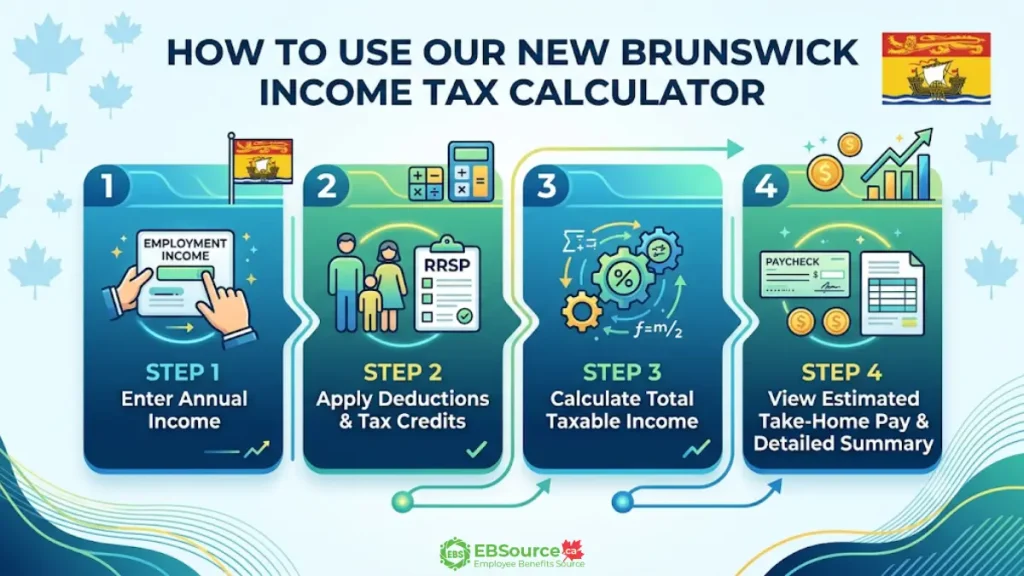
To see what your 2026 take-home pay looks like, you need to enter your total income before taxes (based on how often you get paid) and add any bonuses or extra earnings, if you have them. Then, check the results to see your income tax, deductions, and take-home pay. Please remember that the result is an estimate and should not be used as a substitute for your T1 return or a T4 slip from your employer.
To help you enter the right numbers, the table below shows what to do in common situations:
| Situation | What you should enter |
|---|---|
| You earn a salary only | Enter your gross employment income for one pay period, then select the number of pay periods in the year |
| You are paid hourly | Multiply your hourly wage by the hours worked in the pay period, then enter that amount as employment income for the selected pay period |
| You changed jobs during the year | Combine income from all employers |
| You worked in another province but lived in NB on December 31 | Use NB for your final tax estimate, but note that payroll deductions may differ |
| You have RRSP contributions | Enter your deductible RRSP contributions to reduce taxable income |
| You received taxable benefits | Add them to employment income if they are not already included |
Note: This calculator does not currently estimate the New Brunswick Low-Income Tax Reduction or every personal tax credit. If you may qualify for a low-income credit, use the CRA Payroll Deductions Online Calculator or confirm your result when you file your return.
What to Consider When Using Our New Brunswick Income Tax Calculator
If you moved between provinces during the year, do not assume this calculator can determine your final provincial tax. CRA residency is fact-specific. For a general estimate, use your province or territory of employment for payroll deductions and review your province or territory of residence on December 31 when preparing your tax return.
If you have a second job or get taxable benefits not shown on your main T4, add them together. It helps the calculator place your NB income tax into the correct tax brackets.
Also, if you changed your TD1 or TD1NB personal tax credit claims during the year, but the calculator still uses the default code, your estimated take-home pay could be wrong by several hundred dollars.
What are the Income Tax Rates in New Brunswick?
New Brunswick has a clear four-bracket structure, with tax rates ranging from 9.40% to 19.50%, placing it in the mid-range among Atlantic provinces.
The New Brunswick provincial tax brackets and rates in 2026 are:
- 9.40% on the first $52,333
- 14% on income from over $52,333 to $104,666
- 16% on income from over $104,666 to $193,861
- 19.50% on income over $193,861
Compared to 2025, there are no changes to the personal income tax rate structure in New Brunswick for 2026. However, the provincial income thresholds and personal amounts are indexed to inflation using the federal indexation factor, which is 2.0% for 2026.
What are the Combined Federal and New Brunswick Marginal Tax Rates?
In 2026, the New Brunswick provincial marginal tax rates range from 9.4% to 19.5%, resulting in combined federal-plus-provincial rates on regular income ranging from 23.40% to 52.50%.
The table below displays the combined federal and New Brunswick marginal rate on regular employment income for 2026:
| 2026 taxable income band | Combined federal + NB marginal rate |
|---|---|
| Up to $16,452 | 0% |
| $16,452 to $22,358 | 14% |
| $22,358 to $49,592 | 26.40% (includes 3% Low-Income Tax Reduction clawback) |
| $49,592 to $52,333 | 23.40% |
| $52,333 to $58,523 | 28% |
| $58,523 to $104,666 | 34.50% |
| $104,666 to $117,045 | 36.50% |
| $117,045 to $181,440 | 42% |
| $181,440 to $193,861 | 45.29% |
| $193,861 to $258,482 | 48.79% (federal 29.29% including BPA phase-out + NB 19.50%) |
| Over $258,482 | 52.50% (federal 33% + NB 19.50%) |
How New Brunswick Income Tax Compares to Other Atlantic Provinces in Canada
New Brunswick’s top combined rate of 52.50% is more competitive than Newfoundland and Labrador’s (54.80%) and Nova Scotia’s (54%), but is slightly lower than Prince Edward Island’s 53%.
What sets New Brunswick apart is where its lowest rate ends. You can earn up to $52,333 before moving out of the 9.40% bracket. That ceiling is far higher than in Nova Scotia ($30,995), PEI ($33,928), or Newfoundland and Labrador ($44,678), so a larger share of your income is taxed at the lowest rate before any higher rates apply.
This table will summarize how the four Atlantic provinces compare for the 2026 tax year:
| Province | Brackets | Lowest rate (first bracket ceiling) | Top rate (starts at) | Provincial BPA | 2026 indexation approach |
|---|---|---|---|---|---|
| New Brunswick | 4 | 9.40% (up to $52,333) | 19.50% (over $193,861) | $13,664 | Federal factor, 2.0% |
| Nova Scotia | 5 | 8.79% (up to $30,995) | 21.00% (over $157,124) | $11,932 | Own factor, 1.6% |
| Prince Edward Island | 6 | 9.50% (up to $33,928) | 20.00% (over $142,520) | $15,000 | Budget increase of 1.8% to thresholds (no automatic formula) |
| Newfoundland and Labrador | 8 | 8.70% (up to $44,678) | 21.80% (over $1,141,275) | $13,094 (a prorated $15,000 payroll claim amount for paycheques issued on or after July 1, 2026) | Provincial inflation rate, 1.1% |
Two details in this table are worth understanding more closely: how each province protects against inflation, and how much tax-free room its basic personal amount provides.
Inflation protection (indexation): Each province adjusts its tax brackets for inflation differently. New Brunswick uses the 2.0% federal factor, providing stronger protection than Nova Scotia (1.6%), PEI (1.8%), or Newfoundland and Labrador (1.1%). It means that in New Brunswick, your cost-of-living raises are less likely to be affected by higher tax brackets than in other provinces in the region.
Basic personal amount: This non-refundable credit amount is the highest in PEI at $15,000. New Brunswick is close behind with $13,664. These savings are much higher than those in Nova Scotia and Newfoundland and Labrador.
What Does a $70,000 Salary Pay in Provincial Tax Across Atlantic Canada?
The clearest way to see these differences is to run the same salary through all four provinces. Using the $70,000 example from earlier in this article, each calculation follows the same method: start with provincial taxable income of $69,335, using the same $70,000 salary assumptions as the New Brunswick example, then subtract credits for the BPA, base CPP ($3,291.75), and EI ($1,123.07) at each province’s lowest rate.
Here is the provincial income tax on a $70,000 salary in each Atlantic province for 2026:
| Province | Gross provincial tax | Credits at the lowest rate | Net provincial tax | Marginal rate at $70,000 (combined) |
|---|---|---|---|---|
| New Brunswick | $7,299.58 | -$1,699.41 | $5,600.17 | 34.50% |
| Newfoundland and Labrador | $7,462.25 | -$1,523.27 | $5,938.98 | 35.00% |
| Prince Edward Island | $8,102.50 | -$1,844.41 | $6,258.09 | 37.10% |
| Nova Scotia | $8,582.61 | -$1,436.89 | $7,145.72 | 37.17% |
At this income level, New Brunswick comes out the lowest among the four Atlantic provinces, even though it has neither the lowest bottom rate nor the highest BPA. The reason is its wide 9.40% first bracket. A New Brunswick worker earning $70,000 pays just 9.40% on the first $52,333 of income. A Nova Scotia worker on the same salary has already cleared two brackets and is paying 16.67% on every dollar above $61,991.
How a $70,000 Salary Converts to Take-home Pay in New Brunswick
To clearly explain a real salary in New Brunswick, look at a detailed example of an employee making $70,000 a year in Moncton, New Brunswick. Note that this example assumes the person works in New Brunswick all year, claims a single basic TD1 and a TD1NB, does not contribute to an RRSP, receives no taxable benefits, and has no dependents.
Here are four steps to calculate the take-home pay from a gross salary of $70,000 in New Brunswick:
Step 1: Calculate mandatory payroll deductions
In this case, the employee pays a base CPP rate of 5.95% on earnings over $3,500; no CPP2 is payable. The EI premium is based on a maximum insurable earnings ceiling of $68,900, which is below the $70,000 salary, so EI is capped at the maximum.
Here is how to calculate the mandatory payroll deductions:
| Line | Calculation | Amount |
|---|---|---|
| Total CPP deducted from pay | ($70,000 – $3,500) x 5.95% | $3,956.75 |
| CPP (base) | ($70,000 – $3,500) x 4.95% | $3,291.75 |
| First additional CPP | ($70,000 – $3,500) x 1% | $665 |
| CPP2 | $70,000 is below the YMPE of $74,600 | $0 |
| EI | min($70,000, $68,900) x 1.63% | $1,123.07 |
| Total payroll deductions | $5,079.82 | |
| Taxable income | $70,000 – $665 | $69,335 |
Step 2: Calculate federal income tax
Federal tax is calculated on the entire $69,335 of taxable income and is then reduced by non-refundable credits at the lowest federal rate of 14%.
The way to calculate federal income tax is:
| Line | Calculation | Amount |
|---|---|---|
| Bracket 1: first $58,523 at 14% | $58,523 x 14% | $8,193.22 |
| Bracket 2: next $10,812 at 20.5% | $10,812 x 20.5% | $2,216.46 |
| Gross federal tax | $10,409.68 | |
| Less: BPA credit | $16,452 x 14% | -$2,303.28 |
| Less: CEA credit | $1,501 x 14% | -$210.14 |
| Less: CPP credit | $3,291.75 x 14% | -$460.85 |
| Less: EI credit | $1,123.07 x 14% | -$157.23 |
| Net federal tax | $10,409.68-$2,303.28-$210.14-$460.85-$157.23 | $7,278.19 |
Step 3: Calculate New Brunswick provincial income tax
In New Brunswick, tax is calculated on taxable income of $69,335, reduced by non-refundable credits, at the lowest provincial tax rate of 9.40%. It is important to note that New Brunswick does not provide a provincial Canada Employment Amount, so this credit is not included in the provincial tax calculation. The BPA for New Brunswick is $13,664, which is used here instead of the federal BPA of $16,452.
Here is the provincial income tax in New Brunswick:
| Line | Calculation | Amount |
|---|---|---|
| Bracket 1: first $52,333 at 9.40% | $52,333 x 9.40% | $4,919.30 |
| Bracket 2: next $17,002 at 14.00% | $17,002 x 14.00% | $2,380.28 |
| Gross NB tax | $7,299.58 | |
| Less: BPA credit | $13,664 × 9.40% | -$1,284.42 |
| Less: CPP credit | $3,291.75 × 9.40% | -$309.42 |
| Less: EI credit | $1,123.07 × 9.40% | -$105.57 |
| Net NB tax | $7,299.58 − $1,284.42 − $309.42 − $105.57 | $5,600.17 |
Step 4: Calculate the after-tax income of a $70,000 gross income
At an income of $70,000, your average tax rate (including federal and provincial income tax) is about 18.4%. However, the tax rate on the next dollar you earn is 34.5%. This means that if you get a $1,000 raise at this salary, your take-home pay will increase by about $610.53 rather than $815, because the raise is taxed at a higher rate.
If you make a deductible $5,000 RRSP contribution and remain in the same 34.5% combined marginal-tax band, it may reduce your estimated income tax by about $1,725. Your cash available after making the contribution is still lower by the take-home amount you contribute, unless your employer adjusts payroll withholding or you receive the tax savings after filing.
The after-tax income in this scenario would be:
| Deduction | Annual | Monthly (12 months) | Biweekly |
|---|---|---|---|
| Federal income tax | $7,278.19 | $606.52 | $279.93 |
| NB provincial income tax | $5,600.17 | $466.68 | $215.39 |
| CPP | $3,956.75 | $329.73 | $152.18 |
| CPP2 | $0.00 | $0.00 | $0.00 |
| EI | $1,123.07 | $93.59 | $43.20 |
| Total deductions | $17,958.18 | $1,496.51 | $690.70 |
| Take-home pay | $52,041.82 | $4,336.82 | $2,001.61 |
Note: This example calculates annual taxes as if they were paid in a single lump sum. In reality, payroll withholding is prorated for each pay period, which might lead to slightly different results due to rounding. Once CPP and EI contributions reach their annual limits partway through the year, your biweekly take-home pay will increase for the remaining pay periods.
Common Income Tax Calculation Mistakes to Avoid in New Brunswick
In New Brunswick, incorrectly calculating your income tax can be caused by three main reasons, including missing mandatory payroll deductions, leaving income off Line 15000, and using the wrong BPA for provincial credits. Each one can cost you money, either as a surprise balance owing or a refund you never claim.
Here is a closer look at each mistake and how to avoid it.
Mistake 1: Skipping Mandatory Payroll Deductions Before Calculating Taxable Income
Before any taxes are calculated, mandatory federal payroll deductions are taken from your income. EI premiums are deducted at 1.63% of insurable earnings, up to a maximum of $68,900, with a maximum annual premium of $1,123.07. CPP contributions are 5.95% on earnings over the $3,500 basic exemption, capped at $4,230.45. The CPP2 applies a 4% rate to earnings between $74,600 and $85,000, up to a maximum of $416. Missing the CPP2 deduction is a common payroll error among mid- to high-earners.
Here are the CPP, CPP2, and EI thresholds for employees in New Brunswick:
| Threshold | 2026 amount | What happens to a New Brunswick paycheque |
|---|---|---|
| EI maximum insurable earnings | $68,900 | You stop deducting EI when the employee reaches their annual premium maximum. |
| CPP YMPE | $74,600 | Base CPP reaches its annual earnings ceiling |
| CPP YAMPE | $85,000 | CPP2 applies only between $74,600 and this level |
| Maximum CPP employee contribution | $4,230.45 | You stop deducting CPP and CPP2 (if applicable) once the employee reaches their annual contribution maximum. |
| Maximum CPP2 employee contribution | $416 | No more CPP2 after the annual maximum is reached |
| Maximum EI employee premium | $1,123.07 | No more EI after the annual maximum is reached |
| CPP basic exemption | $3,500 | No CPP deducted on the first $3,500 |
Mistake 2: Omitting All Income Sources from Line 15000
When calculating total income for Line 15000, remember that it is not limited to employment earnings reported on your T4 slip. It also includes EI benefits, investment income, pension income, and other sources of income. Be sure to report every slip.
For example, if you forget to report some income, like $3,000 in EI benefits while earning $70,000, you might have to pay extra taxes. With a total tax rate of 34.5%, unreported income would mean you would owe about $1,035 in taxes. The CRA will check your T4E slip against your tax return and find any mistakes, which may result in interest charges on the unpaid amount.
Mistake 3: Using the Wrong Basic Personal Amount for Provincial Credits
The federal and New Brunswick basic personal amounts are different. Mixing them up can lead to an incorrect calculation of your provincial credit. When calculating New Brunswick non-refundable credits, you should use the provincial BPA of $13,664 at the provincial rate of 9.40%, rather than the federal BPA.
If you mistakenly use the federal BPA of $16,452 instead, your provincial credit will be approximately $262 too high. This is calculated as follows: ($16,452 – $13,664) x 9.40% = $262. As a result, your provincial tax will be understated by $262, and you will owe that difference when you file your taxes.
FAQs about the New Brunswick income tax calculator
Does New Brunswick have a provincial income surtax?
No. New Brunswick does not levy a provincial surtax. Its four-bracket structure (topping out at 19.5%) already incorporates higher rates for high earners, so no additional surtax is applied on Form NB428.
What is the capital gains tax rate for residents of New Brunswick?
The capital gains inclusion rate will stay at 50% for the 2025 and 2026 tax years. For 2026 planning, confirm the current capital gains inclusion rate using CRA or Department of Finance guidance before filing. New Brunswick does not add a separate provincial capital gains inclusion rule; taxable capital gains are included in income under the federal calculation and then taxed using federal and New Brunswick rates.
Disclaimer: This New Brunswick income tax tool estimates payroll deductions based on the employee’s province or territory of employment. Please note it is not meant to calculate final tax returns. The actual provincial tax owed may differ from the payroll deductions, especially if the employee lives in a different province on December 31 than the one where they work.