


This Nova Scotia calculator follows CRA payroll rules and the newest rates available as of July 2026, last updated on July 19, 2026.
Your after-tax income breakdown in Nova Scotia shows how much of your gross pay you actually take home after deductions for income taxes, CPP contributions, and EI premiums. To calculate your income tax in Nova Scotia, follow these 3 steps. First, calculate your gross annual income. Next, calculate your CPP and EI contributions. Finally, apply the relevant federal and provincial tax rates and subtract the applicable basic personal amount credits.
The sections below will guide you through each part of the process with detailed breakdowns and rates to help you check your payroll calculations in Nova Scotia.
How Your Inputs Impact Your Income Tax Estimate in Nova Scotia
How accurate your income tax estimate is depends on how you enter your financial details into the NS tax calculator. Four main things affect the calculation: money from your job, other income sources, RRSP contributions, and deductions and credits. Each one changes your tax differently. So, it is important to enter this information precisely so the calculator can apply the appropriate tax rates to different parts of your income.
Here’s how each input impacts the final result in the Nova Scotia income tax calculator:
Employment Income
This part covers your salary, wages, bonuses, and taxable benefits shown on your T4 slip. Earning more from employment puts you in higher federal and provincial tax levels, which raises your overall tax rate.
This amount also determines your Canada Pension Plan and Employment Insurance deductions, as both are calculated as a percentage of your earnings.
Even a small error in this figure can affect your income tax in Nova Scotia, so ensure that this amount matches your pay stubs or T4 exactly.
Other Income, Vacation Pay, Bonus in a year
This section covers employment-related amounts, such as bonuses, taxable benefits, commissions, tips, and vacation pay, if they are not already included. Do not enter OAS, rental income, interest, dividends, or self-employment income unless the calculator has separate fields for them.
Since these amounts are added to your employment income, they are often taxed at your highest marginal rate. For example, a $5,000 bonus might be taxed at a higher rate than the first $5,000 of your salary. Separating these amounts from your regular income lets our calculator apply the correct combined federal and provincial tax rates to each part.
RRSP Contributions
Contributions to an RRSP can lower the income you pay tax on, up to the amount you are allowed to contribute. For 2026, the limit is $33,810 or 18% of your earnings last year, whichever is less.
Your deduction limit also includes any unused contribution room from previous years, after accounting for pension adjustments. Make sure to enter only the amount you plan to deduct for this tax year, since contributions and deductions can happen in different years.
Other Deductions from Taxable Income
Three factors you should distinguish are: Tax deductions lower your taxable income, while tax reductions directly lower the provincial tax owed. In addition, non-refundable tax credits decrease your tax burden, but cannot create a refund if they exceed your tax owed.
A quick note that may confuse payroll users: for payroll estimates, extra CPP contributions lower your expected yearly taxable income, while regular CPP and EI lower your tax by using non-refundable credits instead of lowering your total employment income.
Important note: This calculator does not estimate the Nova Scotia Low-Income Tax Reduction or all provincial personal credits. If you may qualify for a low-income reduction, your final Nova Scotia tax may be lower than this estimate.
Steps to calculate the income tax in Nova Scotia
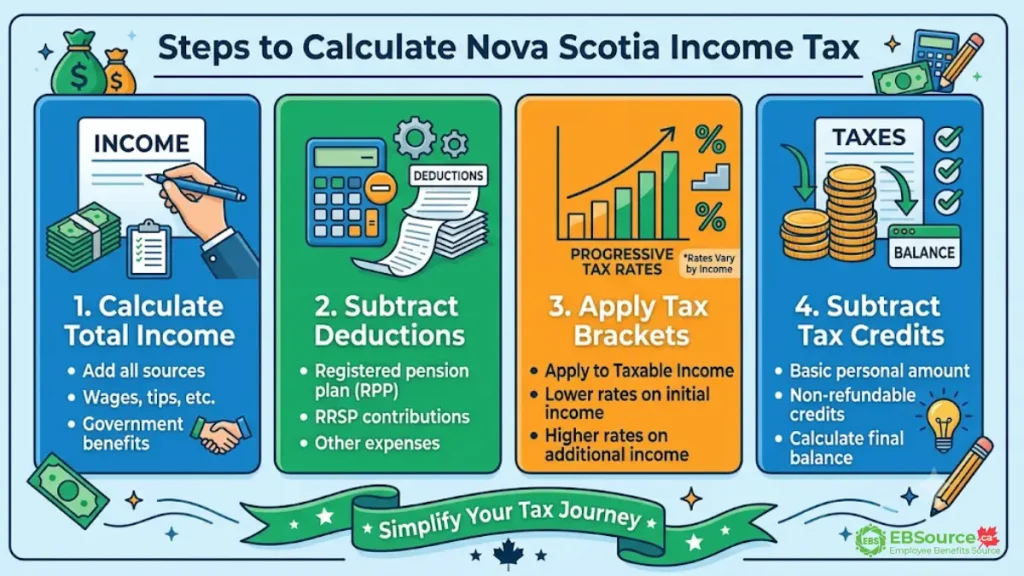
To calculate your income tax in Nova Scotia, you need to follow 3 steps. Start by determining your total annual income, including any additional compensation, such as bonuses. Next, calculate your mandatory CPP and EI contributions, and subtract the deductible enhanced portion of CPP to arrive at your taxable income. Then, reduce the tax amounts by their respective basic personal amount credits. Sum the taxes owed to determine your total income tax for the year.
Below are the steps you can follow to calculate your income tax in Nova Scotia:
Step 1: Know your gross annual income
The first step is to find your total yearly income. Start by multiplying the amount you earn each pay period by the number of pay periods in a year. This shows your total income before any money is taken out. Once you have this number, you can calculate all the required deductions that reduce your total income.
Step 2: Subtract mandatory deductions and calculate taxable income
Two required federal payments are:
- EI: You pay 1.63% of your eligible earnings, up to $68,900 in 2026, with a maximum payment of $1,123.07 per year.
- CPP: You contribute 5.95% on earnings above $3,500, up to $74,600, for a maximum of $4,230.45. For earnings between $74,600 and $85,000, you pay CPP2 at 4%, up to a maximum of $416. Earnings above $85,000 are not subject to any further CPP.
For payroll purposes, only the enhanced portion of CPP (the 1% slice of the 5.95% rate, plus all of CPP2) is subtracted from your gross income to arrive at taxable income. Base CPP and EI reduce your tax later, as non-refundable credits, rather than reducing your taxable income. Your taxable income also includes other annual earnings such as vacation pay, bonuses, and other forms of compensation.
Step 3: Calculate your income tax
Next, figure out your income taxes for 2026. The federal and NS provincial tax rates in 2026 are:
Federal Tax:
- 14% on income up to $58,523;
- 20.5% on income between $58,523 and $117,045;
- 26% on income between $117,045 and $181,440;
- 29% on income between $181,440 and $258,482;
- and 33% on income over $258,482.
These amounts are lowered by credits such as the basic personal amount ($16,452) and the Canada Employment Amount ($1,501).
Nova Scotia Tax:
- 8.79% on the first $30,995;
- 14.95% from $30,995 to $61,991;
- 16.67% from $61,991 to $97,417;
- 17.5% from $97,417 to $157,124;
- and 21% on income over $157,124.
Provincial credits may include a basic personal amount of $11,932, which, since 2025, applies in full to every Nova Scotia filer regardless of income.
To see how much tax you owe, add up your federal and NS provincial taxes, then subtract any credits you qualify for. Then subtract these taxes, plus EI and CPP, from your total income to get your take-home pay. To find your pay for each period, divide that yearly take-home pay by how many paychecks you get in a year.
Source: Payroll Deductions Tables – CPP, EI, and income tax deductions – Nova Scotia – Government of Canada
What is the Combined Marginal Tax Rate in Nova Scotia?
The most useful number when you are weighing a raise, a bonus, or an extra shift is your marginal rate, the tax on your next dollar. Knowing which tax bracket your income falls into lets you predict the tax on a raise, a bonus, or an extra shift before the money ever reaches your account, and it shows exactly where each tax rate jump occurs as your income grows.
The table below combines federal and Nova Scotia ordinary-income rates for each 2026 tax band, from the first tax-free dollars to the combined top rate of 54%. The lower bands reflect the interaction of the basic credits and the Nova Scotia low-income tax reduction.
| Taxable income band | Combined federal + Nova Scotia marginal rate |
|---|---|
| $0 to $15,220 | 0% |
| $15,221 to $16,452 | 13.79% |
| $16,453 to $21,000 | 27.79% |
| $21,001 to $30,995 | 22.79% |
| $30,996 to $58,523 | 28.95% |
| $58,524 to $61,991 | 35.45% |
| $61,992 to $97,417 | 37.17% |
| $97,418 to $117,045 | 38% |
| $117,046 to $157,124 | 43.50% |
| $157,125 to $181,440 | 47% |
| $181,441 to $258,482 | 50.29% |
| Over $258,482 | 54% |
Note: The amounts below about $21,000 are estimates for a single person claiming only the basic personal amounts. They include the low-income tax reduction clawback, which is why the rate briefly rises to 27.79% before returning to 22.79%. They do not include the CAE.
This is why a $5,000 bonus can feel like it’s taxed more heavily than the first $5,000 of your salary: the bonus sits on top of your income and is taxed at your marginal rate, not your average rate.
How to Use the Nova Scotia Calculator for Common Scenarios
A strong way to use the calculator is to try several scenarios rather than just entering your base salary. There are three common cases to test: estimating the after-tax amount of a bonus, comparing a job offer in another province, and checking tax withholding if you have two jobs.
Here’s how to use our calculator:
Estimating a bonus: Enter your regular salary first. Then add the bonus amount and compare the take-home pay difference. The difference shows the estimated after-tax value of the bonus. Keep in mind that the tax taken from a bonus might not exactly match your final tax bill because bonuses can be calculated differently from regular pay.
Comparing a job offer: If you are comparing a Nova Scotia job offer with a job in another province, run the same gross salary through each province’s calculator. Your federal tax may be similar, but provincial tax can change your annual take-home pay by thousands of dollars.
Checking two-job withholding: If you have two employers, be careful with your TD1 and TD1NS claim amounts. If both employers use the full basic personal amount, you might have too little tax taken off during the year and owe money when you file your taxes.
Example of Calculating the Take-Home Pay in Nova Scotia
Imagine a person living in Nova Scotia named Alex who makes $75,000 a year in 2026. He only uses the usual tax credits, the basic personal amounts for both federal and provincial taxes, and the CEA. Since his salary exceeds the $74,600 CPP limit, he also has to pay a small CPP2 contribution.
The easiest way to understand how the rates, payments, and credits work together is to follow a full calculation from Alex’s total salary down to his monthly take-home pay. The table below goes through Alex’s numbers step by step: it begins with the adjusted CPP amount that determines his taxable income, then calculates his CPP, CPP2, and EI payments, applies the federal and Nova Scotia tax rates, and subtracts the basic personal amount and related credits at each step.
Here is how his after-tax salary in NS is calculated:
| Item | Calculation | Amount |
|---|---|---|
| Taxable income | $75,000 – [enhanced CPP: ($75,000 – $3,500) x 1% = $715, capped at $711] – [CPP2: $16] | $74,273 |
| CPP | ($74,600 – $3,500) x 5.95% | $4,230.45 |
| CPP2 | ($75,000 – $74,600) x 4% | $16 |
| EI | $68,900 x 1.63% | $1,123.07 |
| Federal income tax (after BPA + CEA) | Total federal tax credits: Base ($16,452) + CEA ($1,501) + CPP Base ($3,519.45) + EI ($1,123.07) = $22,595.52; Federal Tax Reduction: $22,595.52 x 14.0% = $3,163.37; Gross Federal Tax: $58,523 x 14% + ($74,273 – $58,523) x 20.5% = $11,421.97; Net federal tax: $11,421.97 – $3,163.37 = $8,258.60 | $8,258.60 |
| Nova Scotia income tax (after BPANS) | Total NS provincial tax credits: Base ($11,932) + CPP Base ($3,519.45) + EI ($1,123.07) = $16,574.52; NS Provincial Tax Reduction: $16,574.52 x 8.79% = $1,456.90; Gross NS Provincial Tax: $30,995 x 8.79% + ($61,991 – $30,995) x 14.95% + ($74,273 – $61,991) x 16.67% = $9,405.77; Net NS provincial tax: $9,405.77 – $1,456.90 = $7,948.87 | $7,948.87 |
| Total deductions | CPP + CPP2 + EI + taxes (federal tax + provincial tax) | $21,576.99 |
| Estimated annual take‑home pay | $75,000 – total deductions | $53,423.01 |
| Estimated monthly take‑home pay | Annual / 12 | $4,451.92 |
This means that for an employee making $75,000 in Nova Scotia in 2026, and using standard payroll rules without extra deductions, the estimated yearly deductions are about: federal tax: $8,258.60, Nova Scotia tax: $7,948.87, CPP: $4,230.45, CPP 2: $16, and EI: $1,123.07. So, Alex’s estimated yearly take-home pay would be around $53,423.01.
Take-Home Salary Examples for Common Income Levels in Nova Scotia
These estimates are based on 2026 employment income only, a full-year employee, standard federal and Nova Scotia credits, the Canada Employment Amount, no RRSP deduction, and no other deductions or taxable benefits. Use them as estimates, not as a replacement for the CRA’s PDOC or your employer’s year-to-date payroll system.
The table below uses the full 2026 calculation for seven common salary levels, from $45,000 to $250,000, showing federal tax, Nova Scotia tax, CPP, EI, total deductions, yearly take-home pay, and the combined tax rate at each level.
| Gross salary | Federal tax | NS tax | CPP (include CPP2) | EI | Total deductions | Annual take-home pay | Marginal rate |
|---|---|---|---|---|---|---|---|
| $45,000 | $3,338.19 | $3,462.30 | $2,469.25 | $733.50 | $10,003.24 | $34,996.76 | 28.95% |
| $60,000 | $5,338.29 | $5,595.62 | $3,361.75 | $978 | $15,273.66 | $44,726.34 | 35.45% |
| $75,000 | $8,258.60 | $7,948.87 | $4,246.45 | $1,123.07 | $21,576.99 | $53,423.01 | 37.17% |
| $85,000 | $10,226.60 | $9,549.19 | $4,646.45 | $1,123.07 | $25,545.31 | $59,454.69 | 37.17% |
| $100,000 | $13,301.60 | $12,061.78 | $4,646.45 | $1,123.07 | $31,132.90 | $68,867.10 | 38% |
| $150,000 | $25,302.14 | $20,811.78 | $4,646.45 | $1,123.07 | $51,883.44 | $98,116.56 | 43.50% |
| $250,000 | $53,524.01 | $41,522.99 | $4,646.45 | $1,123.07 | $100,816.52 | $149,183.48 | 50.29% |
Keep in mind that these examples should be treated as estimates, not exact payroll results. Actual paycheque deductions can vary depending on pay frequency, bonus timing, TD1 claims, pension contributions, taxable benefits, union dues, and employer payroll configuration.
Why Nova Scotia Take-Home Pay Can Be Lower Than Expected
Nova Scotia’s provincial tax rates rise more quickly than those of some other provinces. The first provincial bracket ends at $30,995, and income above that level is taxed at 14.95% until the next bracket begins. Once taxable income passes $61,991, the provincial marginal rate rises to 16.67%, then to 17.5% above $97,417.
This does not mean your entire salary is taxed at the highest rate you reach. Nova Scotia also does not have an extra-provincial tax, so the rates above are the full provincial tax; there is no additional charge added on top, as in Ontario and Prince Edward Island before 2024.
Most of the surprise on payday comes from a handful of predictable triggers rather than from the brackets themselves, and each one has a specific mechanical cause you can anticipate. The table below lists the six most common situations in which withholding or final tax is higher than expected, along with the reason for each.
Still, Nova Scotia workers may feel a stronger tax effect in these situations:
| Situation | Why it matters |
|---|---|
| Your salary is about $62,000 | Your next dollars fall into Nova Scotia’s 16.67% provincial bracket, which begins at $61,991 of taxable income |
| Your salary is about $97,000 | Your next dollars fall into Nova Scotia’s 17.5% provincial bracket, which begins at $97,417 of taxable income |
| You receive a bonus | The bonus is added on top of regular income and may be taxed at your marginal rate |
| You earn over $74,600 | CPP2 begins on income above the 2026 YMPE |
| You earn over $157,124 | Nova Scotia’s top 21% provincial rate begins |
| You have more than one job | CPP, EI, and TD1 credits may not line up across employers |
For this reason, the most useful number is often not just NS annual take-home pay. It is the combined marginal tax rate, because that tells you how much tax applies to your next dollar.
Why a Nova Scotia Paycheque Is Still Taxed Heavily
Indexation, which Nova Scotia introduced in 2025 and applies using the 12-month average change in the consumer price index ending in August, resulting in a 1.6% adjustment for 2026, has halted bracket creep. Still, it has not transformed Nova Scotia into a low-tax province.
There are two main reasons for this:
First, the province has one of the lowest basic personal amounts in the country, set at $11,932, which is less than Alberta’s $22,769 and the federal amount of $16,452. This means more of your income is taxed.
Second, the tax rates rise quickly, with the highest rate of 21% starting at $157,124, which is lower than in most other provinces. With a combined top tax rate of 54%, Nova Scotia is among the highest-tax jurisdictions in Canada: Alberta’s top rate is 48%, Saskatchewan’s is 47.5%, Ontario’s is 53.53%, and only Newfoundland and Labrador, at 54.8%, has a higher combined top rate.
On a positive note, there is some tax relief in 2026, but it does not include payroll taxes. The Harmonized Sales Tax (HST) was lowered from 15% to 14% starting April 1, 2025, the first sales tax cut in 14 years. This, together with the adjusted tax brackets, gives significant tax relief for the first time in over ten years. Since the HST is a tax on what you buy, it will not show up in your paycheck deductions but will affect the overall cost of goods and services.
FAQs about the Nova Scotia income tax calculator
What is the Nova Scotia provincial age amount that a senior should enter into an income tax calculator?
Nova Scotia has an age amount of approximately $5,826 for 2026 for individuals 65 or older on December 31, 2026. This amount decreases by 15 cents for every dollar of after-tax income over approximately $30,828 and is fully eliminated at around $69,668 in after-tax income. The credit is calculated at an 8.79% tax rate, providing a maximum tax reduction of about $512.11. To claim it, use Form NS428, Part B.
How does the low-income tax reduction in Nova Scotia work?
The Nova Scotia low-income tax reduction reduces the provincial tax you owe directly, rather than through the usual credit system. A single person with taxable income up to about $15,220 usually pays no provincial income tax. The basic reduction is $300, and once your adjusted family income exceeds that amount, the benefit decreases by about 5% of the income above that limit, disappearing completely at about $21,000. You can also add $300 for a spouse or eligible dependent, and $165 for each dependent child when figuring your reduction.
How is the Nova Scotia political contribution tax credit calculated?
The Nova Scotia political contribution tax credit lets taxpayers claim 75% of the total donations made to recognized Nova Scotia political parties or candidates running for the Nova Scotia House of Assembly. The maximum credit you can get is $750. This means a donation of $1,000 produces the full $750 credit; contributing more than $1,000 does not increase the credit. To claim the credit, people should complete line 86 on Form NS428 and retain official receipts for their donations.
How much tax does an RRSP contribution save in Nova Scotia?
Contributing to an RRSP can lower the amount of income you pay taxes on. The amount you save depends on your tax rate; if your income is higher, you save more with each dollar you contribute.
At a taxable income of $45,000, with a combined highest rate of about 28.95%, a $5,000 contribution saves about $1,447.50. At $100,000 of taxable income, a $5,000 RRSP contribution saves about $1,880. At $250,000, where the rate reaches 50.29%, a $10,000 contribution saves about $5,029.
Why might I owe tax if I have two jobs in Nova Scotia?
If you work two jobs, each employer might take out taxes as if that job is your only income. This can happen unless you update your TD1 and TD1NS forms. As a result, both employers may claim the full tax credits, which can lead to double counting. To avoid this, you should claim your tax credits on only one job’s forms. Ask the second employer to take out taxes at a higher rate or not to claim the credits.
Disclaimer: Our Nova Scotia income tax calculator is intended for general information and estimates of payroll deductions from employment income. It should not replace CRA payroll tools or a full personal income tax return. Results may vary based on factors such as the employee's province, payroll setup, bonus timing, TD1 claims, CRA-approved deductions, and any year-end credits or deductions.