


This Newfoundland and Labrador calculator, modified on July 2, 2026, reflects CRA payroll treatment and the latest federal & provincial tax rates as of July 2026.
To work out your take-home pay in Newfoundland and Labrador, start by understanding your income tax. This includes federal and provincial taxes, CPP contributions, and EI premiums.
Our Newfoundland and Labrador income tax calculator breaks the process down into six steps. It starts with your taxable income and goes through both federal and provincial tax rates, so you can see how your money is divided. Once you have that estimate, you can also lower your taxable income by using deductions such as RRSP contributions and eligible work expenses.
Starting with how to estimate your after-tax income and concluding with strategies to increase your earnings.
On this page
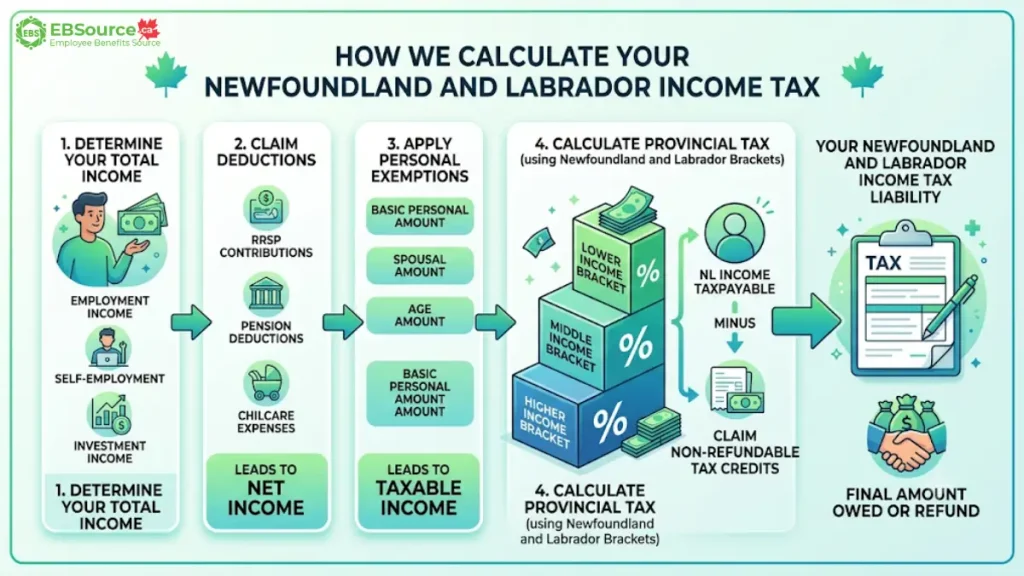
How We Calculate Your Newfoundland and Labrador Income Tax
Our Newfoundland and Labrador income tax calculator allows you to estimate your combined federal and provincial income tax in six straightforward steps. These steps include determining your taxable income, calculating your CPP contributions and EI premiums, applying the federal tax brackets, applying the Newfoundland and Labrador provincial tax brackets, identifying your combined marginal rate, and finally, calculating your after-tax income.
Note: Our Newfoundland and Labrador income tax calculator does not include the Newfoundland and Labrador Low Income Tax Reduction or all provincial personal credits. If you qualify for a low-income tax reduction, your final NL tax might be less than this estimate.
Here are the six steps our tool uses to estimate your final result:
Step 1: Determine your taxable income in Newfoundland and Labrador
To find your taxable income, we start with your employment income and add employment-related amounts, such as bonuses. Then we subtract eligible payroll deductions, such as RRSP contributions deducted at source, to find the taxable income used for both federal and provincial calculations.
Step 2: Calculate CPP contributions and EI premiums
In 2026, the employee and employer contributions are 5.95% on earnings above $3,500, up to a maximum of $4,230.45 each. An additional CPP2 rate of 4% applies to earnings between $74,600 and $85,000, with a cap of $416.
For EI in 2026, the premium is 1.63% of earnings up to $68,900, with a maximum employee premium of $1,123.07. Employers contribute 1.4 times that amount, totalling a maximum of $1,572.30.
Step 3: Calculate federal income tax
Our tool uses five federal tax rates based on the amount of income you have to pay tax on. We first figure out the total federal tax, then subtract the basic personal tax credit.
For 2026, the federal tax rates are as follows:
- 14% on the first $58,523,
- 20.5% on income between $58,523 and $117,045,
- 26% on income between $117,045 and $181,440,
- 29% on income between $181,440 and $258,482,
- and 33% on income over $258,482.
The basic personal amount is $16,452 for lower-income earners and gradually decreases for higher earners, reaching a minimum of $14,829. It begins when after-tax income exceeds $181,440 and reaches its minimum at the highest federal tax rate of $258,482.
Step 4: Calculate Newfoundland and Labrador provincial income tax
Next, apply the eight Newfoundland and Labrador provincial tax brackets to taxable income. After calculating gross NL provincial tax, subtract applicable NL non-refundable tax credits. For a standard employee, these generally include the NL basic personal amount or TD1NL claim amount, base CPP contributions, and EI premiums, each multiplied by the lowest NL tax rate of 8.7%.
The first additional CPP contribution and CPP2 contribution reduce taxable income instead of being treated as non-refundable credits. Other NL credits, such as spouse, age, disability, or caregiver credits, may also reduce provincial tax if the taxpayer qualifies.
Here are the Newfoundland and Labrador thresholds, which were indexed by 1.1% for 2026:
- 8.70% on the first $44,678
- 14.50% on income from over $44,678 to $89,354
- 15.80% on income from over $89,354 to $159,528
- 17.80% on income from over $159,528 to $223,340
- 19.80% on income from over $223,340 to $285,319
- 20.80% on income from over $285,319 to $570,638
- 21.30% on income from over $570,638 to $1,141,275
- 21.80% on income over $1,141,275
Note: Newfoundland and Labrador uses eight provincial tax brackets in 2026, which creates smaller rate steps across a broad range of incomes. These brackets apply to the 2026 tax return, which is filed in 2027. Payroll withholding from July 1, 2026 onward uses CRA’s July 2026 payroll formulas, including the prorated NL basic personal amount described below.
Important update on the NL basic personal amount for July 1, 2026
Newfoundland and Labrador has raised the provincial basic personal amount from $11,188 to $13,094, starting January 1, 2026. Because payroll tables used the lower amount for the first six months, the CRA’s July 2026 payroll tables show a prorated claim amount of $15,000 for paycheques from July 1, 2026 onward.
When calculating your 2026 tax return, use the annual amount of $13,094. For payroll after July 1, see the CRA’s July 2026 T4032-NL or PDOC. Most workers will see this amount automatically factored into their payroll deductions, with adjustments made when filing taxes. As a result, we use $13,094 for the 2026 annual tax return in this tool.
The table below maps which NL basic personal amount applies and when:
| Period | NL basic personal amount | Where it applies |
|---|---|---|
| Jan 1 – Jun 30, 2026 payroll | $11,188 | Payroll withholding before the July update |
| Jul 1 – Dec 31, 2026 payroll | $15,000 (prorated) | Payroll withholding after the July update |
| Annual 2026 tax return | $13,094 | The amount used when you file for 2026 |
Step 5: Calculate combined federal and NL marginal tax rates
Your combined marginal tax rate, which helps you find out how much of each extra dollar from a raise, overtime, or bonuses you get to keep after taxes, increases gradually, rather than in large increments. In 2026, these rates range from 22.70% to 54.80%.
The table below lists the federal and provincial tax rates for different income levels in 2026:
| 2026 taxable income band | Combined federal + NL marginal rate |
|---|---|
| Up to $44,678 | 22.70% |
| Above $44,678 to $58,523 | 28.50% |
| Above $58,523 to $89,354 | 35% |
| Above $89,354 to $117,045 | 36.30% |
| Above $117,045 to $159,528 | 41.80% |
| Above $159,528 to $181,440 | 43.80% |
| Above $181,440 to $223,340 | About 47.10% |
| Above $223,340 to $258,482 | About 49.10% |
| Above $258,482 to $285,319 | 52.80% |
| Above $285,319 to $570,638 | 53.80% |
| Above $570,638 to $1,141,275 | 54.30% |
| Above $1,141,275 | 54.80% |
Note: These are combined federal and NL marginal income-tax rates on regular employment income only.

In the income range where the higher federal basic personal amount starts to decrease, the actual tax rate you pay may be a bit higher than the combined federal and provincial tax rates. This is why some rates between $181,440 and $258,482 might seem higher than the sum of the federal and provincial rates.

Also, these rates do not include CPP, CPP2, EI, benefit reductions, refundable credits, dividend adjustments, capital gains rules, or other changes that may affect your tax return.
Step 6: Determine your after-tax income in Newfoundland and Labrador
To estimate your after-tax income, we use a simple after-tax estimate formula:
After-tax income = Gross income – Federal tax – NL tax – CPP (- CPP2 if applicable) – EI premiums
Note that this guide focuses mainly on regular employment income; it is not the same as a full tax return. Your final tax result may differ if you have self-employment income, dividends, capital gains, rental income, RRSP deductions, childcare expenses, medical expenses, refundable credits, or income-tested benefits.
How to Reduce Taxable Income in Newfoundland and Labrador
The best way to lower your taxable income in Newfoundland and Labrador is to ensure you claim all eligible deductions. Deductions reduce the income subject to tax, while tax credits reduce the amount of tax payable after tax is calculated.
Be careful to understand the difference between total income, after-tax income, and taxable income. Line 15000 shows total income. Many deductions are taken after total income is reported, reducing after-tax income or taxable income before the final tax is calculated.
5 deductions that lower taxable income (not just the amount of tax owed) include:
- RRSP Contributions: These are deducted on line 20800, which helps reduce both your federal and Newfoundland and Labrador provincial tax owed.
- Employment Expenses: You can claim them on the T777 form, provided your employer certifies them with a T2200.
- Self-Employment Expenses: These should be reported on Form T2125 to lower your business or professional income on line 13500.
- Labour Mobility Deduction: This deduction is available to eligible tradespeople and apprentices who work away from their principal residence.
- Rental Property Expenses: Report these on Form T776 to offset rental income on line 12600.
If you live in a prescribed northern or intermediate zone in Labrador for the required period, you may be eligible to claim the federal Northern Residents Deductions. These include a residency deduction for living in a prescribed northern or intermediate zone and a deduction for eligible travel benefits.
After determining your taxable income, non-refundable credits are applied to reduce the tax payable. You can lower your tax owed with non-refundable credits like the basic personal amount, CPP contributions, EI contributions, and the Canada Employment Amount.
Newfoundland and Labrador also applies its own provincial tax with eight separate tax rates. Provincial tax credits, based on the 2026 basic personal amount (blended to $13,094 for 2026), along with your CPP and EI contributions, help reduce the provincial tax payable.
A Worked Example: After-tax Income on $117,000 of Gross Earnings
Consider an employee in Newfoundland and Labrador who earns $9,000 per month, totalling $108,000 a year. They also receive $7,000 from other income, $1,000 in vacation pay, and a $1,000 bonus, bringing their gross income to $117,000. After a $3,000 RRSP contribution and $200 in other deductions, their taxable income is $113,800.
On the payroll side, they contribute $4,230.45 to CPP, with an additional $416 from CPP2, and pay $1,123.07 in EI premiums. After applying federal tax brackets and credits, they owe about $16,135 in federal tax. For provincial tax in Newfoundland and Labrador, the calculations lead to approximately $12,506.
Putting it together with the Step 6 formula:
After-tax income = $117,000 – $16,131 (federal) – $12,341 (NL) – $4,646 (CPP and CPP2) – $1,123 (EI) = about $82,759
The table below summarises how this example breaks down:
| Income item | Amount |
|---|---|
| Gross Income | $117,000 |
| Income Tax (Federal + Provincial) | -$28,471 |
| CPP Contributions (including CPP2) | -$4,646 |
| EI Premiums | -$1,123 |
| Take-home Income | $82,759 |
This means an effective tax rate of about 24.3% and take-home pay of about 70.7% of total income. The RRSP contribution reduces the taxable amount from $117,000 to $113,800.
How Newfoundland and Labrador Taxes Capital Gains and Dividends
With capital gains, only a portion of your profit is included in your taxable income, so the tax you pay is about half your usual rate. For Canadian dividends, a system that increases the amount reported and then gives tax credits lowers the tax you actually pay, especially for eligible dividends from large public companies.
The two sections below break down each case in detail:
Tax Treatment of Capital Gains in Newfoundland and Labrador
If you sell an asset like stocks or a second property for more than you paid, only part of your profit is taxable. For 2026, the capital gains inclusion rate is 50% for all individuals. The federal government’s previously proposed increase, which would have applied a two-thirds (66.67%) inclusion rate to gains over $250,000, was cancelled in 2025 and never took effect, so the long-standing one-half rate continues to apply.
For example, if you have a $20,000 capital gain, $10,000 is included as taxable income. At a 41.8% marginal tax rate, that would create about $4,180 of tax, equal to an effective tax rate of about 20.9% on the full gain.
Tax Treatment of Dividends in Newfoundland and Labrador
Canadian dividends are taxed using a gross-up and dividend tax credit system, which usually makes them more tax-efficient than regular income. Eligible dividends, often paid by large public companies, are taxed at lower rates than non-eligible dividends.
In Newfoundland and Labrador, the top marginal tax rate on eligible dividends is much lower than the 54.80% rate for regular income. Non-eligible dividends are taxed at rates between these two.
If a large part of your income comes from dividends, using employment income to estimate your taxes may overstate what you owe. Dividends should not be entered as regular employment income in a payroll calculator: eligible and non-eligible dividends require gross-up and dividend tax credit calculations, and those credits differ under federal and provincial rules.
Paycheque Calculator vs Tax Return Calculator in NL
It’s common to confuse payroll withholding with your final tax bill in Newfoundland and Labrador, but they are not the same. Payroll withholding is an estimate that your employer deducts from each paycheque. At the same time, your actual tax liability, any potential refunds, and benefit payments are determined when you file your tax return.
Some items affect payroll withholding, while others are handled only when you file your tax return or receive benefit payments.
For example, the Federal and NL basic personal amounts affect TD1 and TD1NL payroll withholding. RRSP deductions may affect payroll if they are deducted through payroll or approved through a withholding change. TFSA contributions do not reduce taxable income. Items such as the NL Low-Income Tax Reduction, Newfoundland and Labrador Income Supplement and Seniors’ Benefit, NL Child Benefit, Physical Activity Tax Credit, and NL Disability Benefit are handled through the tax-return or benefit-payment system, not regular paycheque withholding.
The table below clarifies these two types of calculators:
| Item | Does it affect your regular paycheque? | Does it affect your final return or benefit payment? | What to know |
|---|---|---|---|
| Federal and NL basic personal amounts | Yes | Yes | Built into your TD1 and TD1NL withholding |
| July 2026 NL prorated basic personal amount | Yes | Reconciled when you file | BPA blended to $13,094 for 2026; CRA uses a prorated $15,000 claim amount for July–December 2026 payroll |
| RRSP contributions | Often, if payroll-deducted or authorized | Yes | Reduces your taxable income |
| TFSA contributions | No | No deduction | Does not reduce taxable income |
| NL Low-Income Tax Reduction | Usually no | Yes | Reduces or eliminates provincial tax for lower incomes |
| NL Income Supplement / Seniors’ Benefit | No | Benefit payment | Refundable credits are paid quarterly; you must file a return |
| NL Child Benefit | No | Benefit payment | A family benefit, not payroll withholding |
| Physical Activity Tax Credit | No | Refund | Up to $2,000 in eligible family expenses at a 17.4% rate, for a maximum credit of $348 |
| NL Disability Benefit | No | Benefit payment | Up to $400/month for qualifying adults; distinct from the smaller NL disability amount |
Why Should Employees Determine Income Tax in Newfoundland and Labrador?
Calculating your income tax in Newfoundland and Labrador affects your daily finances, as residents are subject to both federal and provincial income taxes, in addition to CPP contributions and EI premiums. By estimating this figure in advance, you can budget better, evaluate job opportunities, negotiate pay, and plan for your future.
Here are four key reasons why understanding your income tax in Newfoundland and Labrador matters:
Accurate budgeting and financial planning
When you budget based on your actual after-tax income, you gain a clearer understanding of the lifestyle you can afford. By knowing the exact impact of federal and Newfoundland and Labrador provincial tax brackets, as well as CPP and EI deductions on each paycheque, you can set realistic spending limits and save for emergencies. Any tax refund you receive at filing time can then be treated as a bonus rather than income you rely on.
Comparing job offers and after-tax salaries
When comparing job offers, look beyond just the gross salary. Two offers with the same salary can have different take-home amounts because of taxes, deductions, and benefits. While understanding your after-tax income is useful, it’s also essential to consider other factors such as benefits, commute costs, job stability, and the cost of living.
Negotiating raises or salary requirements
To negotiate a salary increase or set a contract rate, it’s important to know how much you actually take home. Since higher incomes are taxed at higher rates, part of any raise might be taxed at a higher rate, reducing its real benefit. Therefore, by calculating these amounts in advance, you can determine the pay you need to meet your financial goals.
Saving and investing for long-term goals
Planning for significant milestones, such as retirement, homeownership through the FHSA, or your children’s education through an RESP, requires an accurate understanding of the funds available after taxes.
Knowing your tax position also helps you decide how much to put into tax-advantaged accounts. RRSP contributions and deductible FHSA contributions can reduce taxable income when you have available contribution room. TFSA and RESP contributions do not reduce taxable income, although they can provide other tax advantages.
In summary, being aware of your true income tax in Newfoundland and Labrador provides the clarity needed to effectively manage your budget, lifestyle, savings goals, and overall financial well-being.
FAQs about Newfoundland and Labrador income tax calculator
What is the Low-Income Tax Reduction in Newfoundland and Labrador?
The Low Income Tax Reduction is a provincial personal income tax reduction designed for low-income individuals and families. The federal government administers personal income tax on behalf of the province.
How do NL provincial tax brackets and credits change with inflation each year?
Tax brackets, non-refundable tax credits (except for education, pension income, volunteer firefighters, research-and-rescue amounts, and most spending-based credits), and the Low Income Tax Reduction are adjusted each year based on the CPI for Newfoundland and Labrador. For 2026, the adjustment rate is 1.1%.
Does a TFSA contribution reduce taxable income when calculating NL income tax?
No. A TFSA contribution is made with after-tax dollars, so it does not lower your taxable income for either federal or Newfoundland and Labrador provincial tax. Its advantage is that the investment growth and any withdrawals are tax-free.
If your goal is to reduce your taxable income, an RRSP contribution is the right tool, since it is deductible and lowers the income subject to both federal and provincial taxes. You can use a tax calculator to see how RRSP contributions reduce your taxes and increase your take-home pay.
Which CRA form is for calculating Newfoundland and Labrador tax?
If you are starting a new job or with a new payer and will be earning a salary or wages, you need to fill out Form TD1NL. This form is also required if you want to have more tax deducted from your pay. Anyone in Newfoundland and Labrador who claims more than the basic personal amount must complete the provincial Form TD1NL, which is the Newfoundland and Labrador Personal Tax Credits Return.
Does the NL payroll tax come off your pay?
Newfoundland and Labrador has a Health and Post-Secondary Education Tax, sometimes called the payroll tax, but the name can be easy to misread. It is an employer tax, not a deduction from your wages. Employers pay it at a rate of 2% of annual remuneration in the province, above an exemption threshold; that threshold has been $2 million for all employers since January 1, 2023. It is not the same as CPP, EI, or income tax taken from your paycheque.