


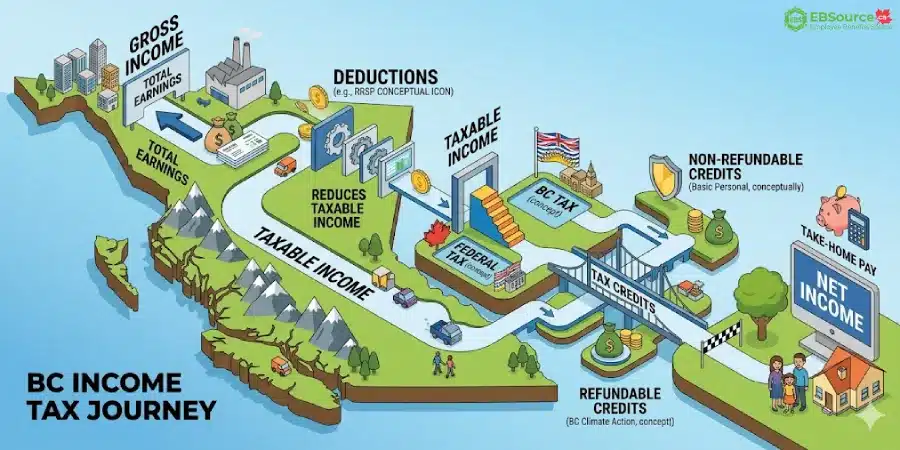
Our British Columbia income tax calculator helps you figure out your gross pay and your actual take-home pay. It first adds up your total income, including vacation pay and bonuses, then subtracts the deductions that reduce taxable income and the deductible portion of your enhanced CPP contribution. Finally, it applies your mandatory CPP and EI contributions and calculates federal and provincial income tax on the result.
To understand how it calculates your net pay, you need to know about four key components: your taxable income, CPP contributions, EI premiums, and the tax credits that lower your total tax owed.
The guide below shows your exact income tax results and walks through each component, so you can see how every deduction and credit shapes your final paycheque.
How to Use our BC Income Tax Calculator
To use our BC income tax calculator, gather your income slips and deduction receipts, choose British Columbia as your province, enter your figures, and review the combined federal and provincial tax breakdown.
Here are 4 steps to use this tool, which takes only a few minutes:
- Choose Your Province: Select “British Columbia” from the dropdown menu as your province of employment.
- Enter Your Income and the Pay Period: Input your gross employment income along with your pay period.
- Add Other Incomes and Deductions: Enter any other income sources, then include your RRSP/FHSA contributions and any other eligible deductions.
- Review and Run Scenarios: Check the results panel for your total tax, applicable rates, and net income, then adjust your salary, bonus, or RRSP contributions to see the effect on your after-tax pay.
The best part is that our BC tax calculator updates results instantly as you adjust your inputs, making it easy to evaluate the impact of a raise or additional contributions on your overall tax situation.
Components Used in the British Columbia Income Tax Calculator
BC income tax calculators use 5 main components: gross annual income and taxable income; CPP and EI contributions; federal and provincial income tax with non-refundable credits; combined marginal tax rates, and final net income.
Here are the details about key calculation factors that determine your net income in BC:
Gross annual income and taxable income
To estimate your net salary in British Columbia, first calculate your gross annual income by multiplying your pay per period by the number of pay periods in a year, then adding any vacation pay and bonuses. From this total, subtract your RRSP/FHSA contributions, any other eligible deductions, and the enhanced portion of your CPP contribution to determine your taxable income.
To simplify, we have the formula to calculate taxable income in British Columbia, which is used to calculate your federal and provincial taxes:
Taxable income = employment income + bonus + vacation pay + other taxable income – deductions
BC edge note: For tax purposes, your province is determined by your residence on December 31, not by where you earned your income. If you move into or out of British Columbia during the year, you will file and be taxed according to the provincial rates based on where you reside on December 31.
CPP and EI contributions
Before BC provincial tax is applied, three mandatory national contributions are deducted, and the base portion of each also becomes a BC non-refundable credit:
- CPP Contributions: 5.95% on earnings over $3,500, up to $74,600, for a maximum of $4,230.45.
- CPP2 (if applicable): 4% on earnings between $74,600 and $85,000, with a maximum of $416.
- EI Premiums: 1.63% of insurable earnings up to the maximum insurable earnings of $68,900, for a maximum of $1,123.07. Earnings above $68,900 are not subject to EI.
Federal and British Columbia provincial income tax with credits
Federal tax is calculated according to the 2026 tax brackets, which range from 14% to 33%. It is reduced by non-refundable tax credits, including the 2026 federal basic personal amount, CPP base contributions, EI premiums, and the Canada Employment Amount. For provincial tax in British Columbia, there are 7 tax brackets ranging from 5.60% to 20.5%. This tax is offset by credits based on BC’s basic personal amount of $13,216.
The CRA has set the federal indexation factor at 2.0% based on the average CPI data from the year ending September 30, 2025.
This 2.0% increase will apply to federal tax brackets and credits as follows:
| 2026 Federal Tax Rates | Annual Federal Taxable Income |
| 14% | Up to $58,523 |
| 20.5% | Over $58,523 to $117,045 |
| 26% | Over $117,045 to $181,440 |
| 29% | Over $181,440 to $258,482 |
| 33% | Over $258,482 |
In addition, British Columbia uses its own CPI data to set a 2.2% increase for the 2026 tax year. This rise exceeds the 2.0% federal adjustment, meaning the province’s tax credits and brackets increase slightly faster than those at the federal level.
The 2026 tax rates in British Columbia for each income bracket are as follows:
| 2026 BC Tax Rates | Annual BC Taxable Income |
| 5.60% | Up to $50,363 |
| 7.7% | Over $50,363 to $100,728 |
| 10.5% | Over $100,728 to $115,648 |
| 12.29% | Over $115,648 to $140,430 |
| 14.7% | Over $140,430 to $190,405 |
| 16.8% | Over $190,405 to $265,545 |
| 20.5% | Over $265,545 |
Combined Marginal Tax Rates on Raises, Bonuses, and Overtime
In British Columbia, your marginal tax rate is the rate applied to each additional dollar of taxable income. As a result, raises, bonuses, or overtime in this province may appear to be taxed at a higher rate than your regular pay.
Note that the income range of $181,440 to $258,482 has a low extra tax rate of about 0.29% on top of the nominal marginal rate. This is because the enhanced portion of the federal BPA is gradually phased out as income rises within this range, resulting in a $227.22 loss of credit spread over $77,042 of income.
The table below outlines the combined federal and BC provincial marginal tax rates for regular employment income by income bracket in 2026:
| 2026 BC taxable income threshold | Combined federal and BC marginal tax rate on regular income |
| Up to $50,363 | 19.60% |
| $50,363 to $58,523 | 21.70% |
| $58,523 to $100,728 | 28.20% |
| $100,728 to $115,648 | 31% |
| $115,648 to $117,045 | 32.79% |
| $117,045 to $140,430 | 38.29% |
| $140,430 to $181,440 | 40.70% |
| $181,440 to $190,405 | 43.99% |
| $190,405 to $258,482 | 46.09% |
| $258,482 to $265,545 | 49.80% |
| Over $265,545 | 53.50% |
For instance, if you earn $65,000 and receive a $5,000 bonus, that bonus will fall into the income bracket of $58,523 to $100,728, which is effectively taxed at a combined marginal rate of 28.20%. That means roughly $1,410 of the bonus would go to combined federal and provincial taxes.
This is important to keep in mind because your average tax rate on your total salary is significantly lower. Understanding this difference will help you set realistic expectations for how bonuses, overtime, and raises will be reflected on your pay stub.
Final net income
Finally, subtract federal tax, provincial tax, CPP contributions, and EI premiums to get your total annual deductions. This gives you your annual net income, which is then divided by the number of pay periods to find your per-period take-home pay.
Example of Net Pay in British Columbia at Different Income Levels
Consider examples across seven salary levels to illustrate how higher incomes lead to increased taxes and mandatory contributions, ultimately reducing the percentage of your pay you take home.
Keep in mind that estimates provided below are based on the federal tax brackets for 2026, British Columbia’s 2026 annual rates, as well as the CPP, CPP2, EI, the federal BPA, the BC BPA, the CEA, and the BC tax reduction credit where applicable. These calculations assume no RRSP contributions, no taxable benefits, no bonuses, and full-year employment in British Columbia.
Here is a quick reference for the estimated net pay at each salary level:
| Gross salary | Estimated annual net pay | Why this example matters |
| $45,000 | $36,858.50 | Low/mid-income |
| $65,000 | $51,044.16 | Enters second federal and BC brackets |
| $75,000 | $57,711 | EI maxed at $68,900; CPP2 begins above YMPE |
| $85,000 | $64,603 | CPP2 reaches its annual maximum |
| $130,000 | $95,238 | Common professional salary benchmark |
| $170,000 | $119,237 | Shows higher federal and BC bracket effects |
| $200,000 | $136,274 | Shows high-income combined tax impact |
To better understand the importance of income tax calculations in British Columbia, consider examples using salary figures: $45,000 and $65,000. These illustrate how higher incomes lead to higher taxes and mandatory contributions, ultimately reducing the percentage of money you take home.
Let’s compare the examples below to see how your estimated gross-to-net pay in British Columbia is calculated at different income levels:
Example 1: How much is $45,000 after tax in BC?
In British Columbia, a gross yearly income of $45,000 results in a net pay of about $36,858.50 before the BC tax reduction credit. At a gross annual salary of $45,000, the entire taxable income falls within the lowest federal tax bracket and the lowest British Columbia provincial tax bracket, resulting in a relatively modest overall tax burden.
After deducting CPP contributions and EI premiums, the BC income tax calculator incorporates non-refundable tax credits. These include the federal basic personal amount of $16,452, the CEA of $1,501, and the provincial basic personal amount of $13,216. Because the worker’s net income of $44,585 is just below the $44,952 cut-off, a small BC tax reduction credit also applies.
As a result, the net federal tax amounts to $3,338.20, while the net provincial tax totals about $1,587.48. This results in an estimated annual net income of roughly $36,871.57, meaning about 82% of the gross salary is retained after deductions.
This table will divide the process into smaller steps:
| Description | Amount |
| Gross Annual Salary | $45,000 |
| CPP contributions (employee) | ($45,000 – $3,500) x 5.95% = $2,469.25 [base 4.95% credit‑eligible: $2,054.25; enhanced 1% deductible: $415] |
| Taxable income | $45,000 – $415 = $44,585 |
| EI premiums (employee) | $45,000 x 1.63% = $733.50 |
| Federal basic personal amount | $16,452 |
| Canada employment amount | $1,501 |
| Federal tax | Total federal tax credits: Base ($16,452) + CEA ($1,501) + CPP Base ($2,054.25) + EI ($733.50) = $20,740.75; Fed Tax Reduction: $20,740.75 x 14% = $2,903.70; Gross Fed Tax: $44,585 x 14% = $6,241.90; Net federal tax: $6,241.90 – $2,903.70 = $3,338.20 |
| Provincial basic personal amount | $13,216 |
| Provincial tax | Total provincial tax credits: Base ($13,216) + CPP Base ($2,054.25) + EI ($733.50) = $16,003.75; BC non-refundable credit value: $16,003.75 x 5.60% = $896.21; Gross BC Tax: $44,585 x 5.60% = $2,496.76; Net provincial tax: $2,496.76 – $896.21 = $1,600.55 |
| Total Deductions | $2,469.25 + $733.50 + $3,338.2 + $1,600.55 = $8,141.50 |
| Net Annual Pay in British Columbia | $45,000 – $8,141.50 = $36,858.50 |
Example 2: How much is $65,000 after tax in BC?
With a $65,000 annual gross salary, your estimated take-home pay in British Columbia would be $51,044.16. Calculating income tax on a yearly salary of $65,000 before taxes is more complicated because income falls into a higher tax bracket at both the federal and provincial levels.
After accounting for the enhanced CPP deduction, your taxable income is $64,385. This amount is split between the federal tax rates of 14% and 20.5%, and the BC tax rates of 5.60% and 7.70%. As a result, the total tax amounts are clearly higher. At this income, your net income exceeds $44,952, so the BC tax reduction credit no longer applies.
CPP contributions increase to $3,659.25, and EI premiums total $1,059.50. Even though non-refundable tax credits are bigger in total, they reduce a smaller part of the total taxes owed. The final federal tax is $6,306.98, and the final provincial tax is $2,930.11. Together, these add up to the total yearly deductions. This results in an estimated yearly net pay of $51,044.16, about 78% of the income.
Here’s how you can calculate it, step by step:
| Description | Amount |
| Gross Annual Salary | $65,000 |
| CPP contributions (employee) | ($65,000 – $3,500) x 5.95% = $3,659.25 [base 4.95% credit‑eligible: $3,044.25; enhanced 1% deductible: $615] |
| Taxable income | $65,000 – $615 = $64,385 |
| EI premiums (employee) | $65,000 x 1.63% = $1,059.50 |
| Federal basic personal amount | $16,452 |
| Canada employment amount | $1,501 |
| Federal tax | Taxable income = $65,000 – $615 (enhanced CPP) = $64,385; Gross Fed Tax: (14% x $58,523) + [20.5% x ($64,385 – $58,523 = $5,862)] = $8,193.22 + $1,201.71 = $9,394.93; Federal non‑refundable credits: [BPA $16,452 x 14% = $2,303.28] + [CEA $1,501 x 14% = $210.14] + [base CPP $3,044.25 x 14% = $426.20] + [EI $1,059.50 x 14% = $148.33] = $3,087.95; Net federal tax: $9,394.93 – $3,087.95 = $6,306.98 |
| Provincial basic personal amount | $13,216 |
| Provincial tax | Taxable income = $64,385; Gross BC Tax: [5.60% x $50,363] + [7.70% x ($64,385 – $50,363 = $14,022)] = $2,820.33 + $1,079.69 = $3,900.02; BC non‑refundable credits: Base ($13,216) + CPP ($3,044.25) + EI ($1,059.50) = $17,319.75; BC non-refundable credit value: $17,319.75 x 5.60% = $969.91; Net provincial tax: $3,900.02 – $969.91 = $2,930.11 |
| Total Deductions | $3,659.25 + $1,059.50 + $6,306.98 + $2,930.11 = $13,955.84 |
| Net Annual Pay in British Columbia | $65,000 – $13,955.84 = $51,044.16 |
Mini Case Study: $85,000 Salary With an RRSP Contribution and a Bonus
To understand how a deduction and a one-time payment affect your income, look at a BC employee earning $85,000 per year. This salary falls in the federal-BC tax bracket, where any additional income is taxed at 28.20%.
Starting with a net pay of $64,603 (with no RRSP or bonus), we can analyze two changes:
First, consider a $4,000 RRSP contribution. At the combined marginal rate of 28.20%, your income tax decreases by $4,000 x 28.20% = $1,128. The $4,000 contribution remains invested in your RRSP, so the actual cost to you is $4,000 – $1,128 = $2,872.
Next, look at a $5,000 bonus instead of the RRSP contribution. Since you are earning $85,000, you have already reached the annual maximums for CPP, CPP2, and EI. Therefore, the bonus will not incur any additional CPP or EI contributions; it will only be taxed at the 28.20% marginal rate. This results in a tax of $5,000 x 28.20% = $1,410, leaving you with $5,000 -$1,410 = $3,590 from the bonus.
In summary, an RRSP contribution reduces your taxable income and provides tax savings, while a bonus gives you a smaller amount after paying taxes.
The table below summarizes the two scenarios:
| Scenario | How to calculate | Effect on take-home |
| Base case ($85,000, no RRSP, no bonus) | Starting point: $85,000 gross – CPP, CPP2, and EI (all at annual maximum) – federal and BC tax = $64,603; no RRSP deduction or bonus applied | $64,603 take-home |
| With a $4,000 RRSP contribution | Tax saved: $4,000 x 28.20% = $1,128; cash take-home: $64,603 + $1,128 – $4,000 = $61,731; plus $4,000 in RRSP | $61,731 cash + $4,000 in RRSP = $65,731 total |
| With a $5,000 bonus (no RRSP) | Extra tax: $5,000 x 28.20% = $1,410 (no extra CPP/EI already maxed); net bonus: $5,000 – $1,410 = $3,590; take-home: $64,603 + $3,590 | $68,193 take-home |
The key takeaway is that the same 28.20% marginal tax rate applies in both scenarios: it dictates the tax impact of a raise or bonus and indicates how much you save with an RRSP contribution. If you invest the entire bonus directly into your RRSP, you can avoid paying $1,410 in taxes and keep the full $5,000 working for your retirement.
Which BC Tax Credits and Benefits Can Affect Your Final Return?
In British Columbia, different credits and benefits affect your final tax amount or possible refund when you file your yearly T1 tax return. These include the BC Renter’s Tax Credit for eligible renters, the BC Sales Tax Credit designed for low- and middle-income people, and the BC Family Benefit for families with children under 18. Although the BC Climate Action Tax Credit has ended, the BC Tax Reduction Credit remains important and is already deducted from paycheques for eligible lower-income workers.
The table below outlines the differences between these components:
| British Columbia item | Included in the payroll estimate or not | What to know |
| BC renter’s tax credit | No | Up to $400 per year for eligible low- and moderate-income renters. For the 2026 tax year, the adjusted income threshold will be increased to $66,189, and the credit will be reduced to zero at $86,189. Claimed on form BC479. |
| BC sales tax credit | No | Up to $75 for an individual and $75 for a spouse/common-law partner. Reduced by 2% of net income exceeding $15,000 (single) or $18,000 (couple). |
| BC family benefit | No | The BC family benefit provides a tax-free monthly payment to families with children under 18. The CRA administers it on behalf of the Province. |
| BC climate action tax credit | No longer current | The B.C. climate action tax credit program has ended. The climate action tax credit payment for April 2025 was the final payment. |
| BC tax reduction credit | Yes (built into payroll tables) | Up to $690 for lower-income individuals; phases out at 3.56% of net income above $25,570 and is reduced to zero at $44,952 net income. |
Keep in mind that most of them are claimed when you file your taxes, not taken out of your paycheques. Because of this, your final year-end tax amount might be different from the estimate shown by a BC regular paycheque calculator.
Taxpayers often confuse a “BC take-home pay calculator” with a “BC tax refund calculator.” Within the British Columbia tax system, while these credits and benefits affect your overall return when filing, they are generally not reflected in your regular payroll withholding.
FAQs about the British Columbia income tax calculator
What is the British Columbia Minimum Tax Credit?
If you qualify to claim a minimum tax credit under the federal Income Tax Act, you can also claim a minimum tax credit in British Columbia. The BC minimum tax credit is calculated as a percentage of your federal minimum tax credit. For the year 2026, this percentage is set at 40% of your federal alternative minimum tax.
What is the British Columbia Sales Tax Credit?
You can claim the BC Sales Tax Credit for a tax year if you were a resident of British Columbia on December 31 of that tax year. The credit allows you to receive up to $75 for yourself and an additional $75 for your cohabiting spouse or common-law partner.
If you are single, the credit is reduced by 2% of the portion of your net income that exceeds $15,000. If you have a cohabiting spouse or common-law partner, the credit is reduced by 2% of your family’s net income that exceeds $18,000.
Why did my 2026 paycheque change after July?
The federal government cut its lowest income tax bracket from 15% to 14% under Bill C-4, but the change took effect on July 1, 2025, rather than at the start of that tax year. As a result, the legislated full-year rate for 2025 is a blended 14.5%, while the full 14% rate applies to the 2026 tax year and every year after. This explains any small difference between what was withheld from your 2025 paycheques and what your 2025 T1 ultimately calculates.
What does the BC indexation pause from 2027 to 2030 mean for me?
The pause from 2027 to 2030 means that tax brackets and most non-refundable credits will remain at their 2026 levels for four years. The BC tax reduction credit will remain at $690 and is not affected by this pause. As a result, if your salary increases with inflation, you may pay more taxes because more of your income will fall into higher tax brackets. Indexation is set to resume in 2031.
