


Following the CRA calculation guidance and the rate references for July 2026, this Northwest Territories calculator was last modified on July 9, 2026.
When you use our Northwest Territories income tax calculator, it breaks down your finances into several key figures, including your Canada Pension Plan and Employment Insurance premiums, income tax, Northwest Territories payroll tax, after-tax income, marginal tax rate, and average tax rate.
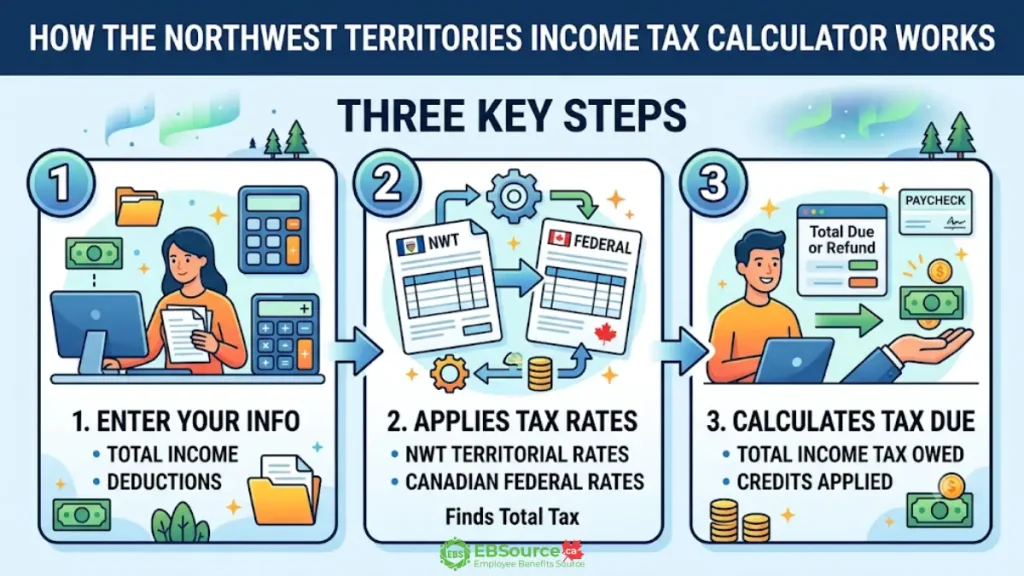
The calculator produces those figures by following a structured process. It begins with your total yearly income, subtracts different deductions, calculates your taxable income, and then applies the current federal and Northwest Territories tax rates to find out how much tax you need to pay.
However, your final tax return may differ because it may include items that are not normally included in each paycheque, such as the Northern Residents Deduction, medical expenses, tuition amounts, disability credits, refundable benefits, CGEB, and family-based benefits.
How to Interpret Your Results in Our NWT Income Tax Calculator
Our NWT income tax calculator takes your total income and deductions, applies the current federal and territorial tax rates, and provides an approximate estimate of your tax liability. Once you submit your required and optional inputs, the calculator will display several output lines, including total tax, CPP and EI premiums, after-tax income, marginal tax rate, and average tax rate.
Here’s what each term means:
- Total Income: This is your total employment income before any taxes or payroll deductions are taken out.
- CPP and EI Premiums: These are required deductions that are listed separately from your income tax.
- Marginal Tax Rate: This is the tax rate you pay on your next dollar of taxable income.
- Average Tax Rate: This is calculated by dividing your total tax by your total income and expressing the result as a percentage.
- After-tax Income: This represents your gross income minus all taxes and premiums.
Calculator Note: Our provided figures are approximate because your actual tax amount may change depending on additional credits, deductions, or your personal situation. Our calculator does not fully account for separate Northwest Territories benefits or refundable measures that may affect a household’s after-tax income beyond the regular paycheque.
Important Note on NWT Payroll Tax: This calculator provides estimates of your federal income tax, Northwest Territories income tax, Northwest Territories payroll tax, CPP contributions, and EI premiums.

For NWT employees, income tax and payroll tax are different. NWT personal income tax is based on tax residence rules, while NWT payroll tax is based on employment income earned from work performed in the Northwest Territories. Check your pay stub, ask your employer's payroll department, or contact the Government of the Northwest Territories to learn more about your payroll tax.
The calculator is best used for regular employment income. It may be less accurate if you are self-employed, paid irregular bonuses, receive taxable northern travel benefits, work for more than one employer, move into or out of the NWT during the year, or qualify for deductions that are normally claimed only when filing your return.
How This Calculator Finds Your Income Tax in the Northwest Territories
Our NWT income tax calculation runs in 4 steps: start with your gross income, subtract your deductions, determine your taxable income, and apply the federal and NWT territorial tax brackets to calculate your income tax. It then uses this information to estimate your annual after-tax income.
Here is a step-by-step guide for checking income tax in your paycheque:
Step 1: Determine the annual income
To calculate your after-tax salary in the Northwest Territories, start with your gross annual income. This is done by multiplying your per-period employment income by the number of pay periods in a year.
Here are the standard pay frequencies and the corresponding number of pay periods per year:
| Pay frequency | Number of pay periods per year |
|---|---|
| Weekly | 52 or 53 |
| Biweekly | 26 or 27 |
| Semi-monthly | 24 |
| Monthly | 12 or 10 or 13 |
| Annual | 1 |
If you receive bonuses, vacation pay, commissions, or other taxable employment earnings, those amounts should be added to your annual income where applicable.
Step 2: Determine CPP and EI
Next, you need to consider your mandatory payroll deductions, which lower the amount of money you take home, but they are not the same as federal or territorial taxes. For 2026, EI premiums are 1.63% of insurable earnings, up to a limit of $68,900, which means the most you can pay is $1,123.07. CPP contributions are 5.95% on earnings between $3,500 and $74,600, with a maximum of $4,230.45. Also, if you earn between $74,600 and $85,000, you will pay an extra CPP2 contribution of 4% on that amount, up to $416.
Step 3: Determine taxable income
To figure out your taxable income, begin with your total income before taxes. Include any extra income like vacation pay, bonuses, and other earnings shown on your T4 slip. Then, subtract any deductions you can claim. Note that extra CPP contributions are deducted from your income, while the basic CPP and EI premiums are claimed later as non-refundable tax credits.
Step 4: Determine income tax
Calculate your income tax by determining both the federal and territorial tax rates in the NWT.
To calculate your federal income tax for 2026, use these brackets for your taxable income:
- 14% on the first $58,523
- 20.5% from over $58,523 to $117,045
- 26% from over $117,045 to $181,440
- 29% from over $181,440 to $258,482
- 33% on income above $258,482
To compute your federal tax liability, reduce the basic federal tax by credits derived from the federal basic personal amount, ranging from $14,829 to $16,452, your CPP contributions, your EI premiums, and the Canada Employment Amount.
For the NWT territorial tax, use these rates:
- 5.9% on the first $53,003
- 8.6% from over $53,003 to $106,009
- 12.2% from over $106,009 to $172,346
- 14.05% on income above $172,346
For 2026, the Northwest Territories’ basic personal amount is $18,198. It creates a non-refundable territorial credit equal to $18,198 multiplied by the lowest NWT tax rate of 5.9%, rather than reducing taxable income dollar-for-dollar.
What Are the Combined Federal and NWT Marginal Tax Rates?
Your combined marginal tax rate shows how much income tax applies to your next dollar of taxable income. In the Northwest Territories, this rate ranges from 19.90% to 47.05%. Knowing your marginal tax rate can help you estimate how things like a raise, overtime, a bonus, RRSP contributions, or northern deductions might change your taxes.
The combined federal and NWT brackets for regular taxable income in 2026 are:
| 2026 taxable income band | Combined federal + NWT marginal rate |
|---|---|
| Up to $53,003 | 19.90% |
| Over $53,003 to $58,523 | 22.60% |
| Over $58,523 to $106,009 | 29.10% |
| Over $106,009 to $117,045 | 32.70% |
| Over $117,045 to $172,346 | 38.20% |
| Over $172,346 to $181,440 | 40.05% |
| Over $181,440 to $258,482 | About 43.34% |
| Over $258,482 | 47.05% |
The “about 43.34%” reflects the gradual reduction in the federal basic personal amount. In this income range, some taxpayers lose part of this extra amount, slightly increasing their tax rate on the extra income.
Example of How Combined Marginal Tax Rates are Calculated
For example, if you earn $95,000 and get a $5,000 taxable bonus, that bonus is taxed at a combined rate of 29.10%, not including any CPP or EI deductions.
Here is what that bonus looks like in dollars:
| Item | Amount |
|---|---|
| Taxable bonus | $5,000 |
| Combined marginal tax rate | 29.10% |
| Estimated income tax on the bonus | $1,455 |
| Approximate after-tax bonus | $3,545 |
The same logic works in reverse for RRSP contributions and other deductions. If your income is in the 29.10% marginal band, a $5,000 RRSP deduction may reduce your income tax by about $1,455, assuming the deduction falls fully within that band:
| Item | Amount |
|---|---|
| RRSP contribution | $5,000 |
| Combined marginal tax rate | 29.10% |
| Estimated tax reduction | $1,455 |
If a deduction crosses more than one tax bracket, the tax savings will be calculated partly at one marginal rate and partly at another.
Which NWT Tax Credits, Deductions, and Benefits Affect Your Final Return?
Six NWT-related and federal tax items can affect your final household income, even if they do not appear directly in a payroll calculator. They can be the Northern Residents Deduction, the NWT Child Benefit, the Canada Groceries and Essentials Benefit, the Medical Expense Credit, Disability Amount, and the Tuition and Education-Related Credits.
Here is a list of the main NWT-related credits and benefits, notes on whether a regular payroll estimate and explanations of how each one works:
| Item | Included in regular payroll estimate? | What to know |
|---|---|---|
| Northern Residents Deduction | Usually no | Claimed on the tax return to reduce taxable income if residency rules are met |
| NWT Child Benefit | No | A non-taxable payment for eligible families with children |
| Canada Groceries and Essentials Benefit | No | A federal CRA-administered, tax-free quarterly benefit for eligible low- and modest-income individuals and families (CGEB replaces GST/HST credit in July 2026) |
| Medical expense credit | No | Claim when filing if eligible expenses exceed the required threshold |
| Disability amount | No | May reduce tax payable if eligibility is certified |
| Tuition and education-related credits | No | May reduce tax owing or be carried forward depending on the credit rules |
How the Northern Residents Deduction Changes Your After-tax Income in the NWT
Because these items are often calculated after the year ends, they may explain why your tax refund or final tax balance differs from a paycheque calculator’s estimate.
The Northern Residents Deduction is a key factor in why your actual after-tax income in the Northwest Territories may differ from a typical payroll estimate, which is claimed on your tax return rather than being automatically applied to your paycheque.
The deduction has two parts: one for living in the North and another for eligible travel, both calculated on Form T2222.
For residents of a prescribed northern zone, the basic residency amount is calculated on a per-day basis. Based on CRA’s current Line 25500 guidance for the 2025 return, for Zone A, the basic amount is $11 per day, which equals about $4,015 for a full 365-day year. An additional residency amount may also be available, potentially bringing the total to $22 per day, or about $8,030 for a full year.
Understanding who qualifies for the deduction, why all NWT communities fall within the higher-benefit zone, the two components of the deduction, and the most common mistakes people make can help clarify why the Northern Residents Deduction often represents the largest difference between a generic calculator’s estimate and the actual amount you retain after filing your taxes.
Here is a detailed explanation of how it affects after-tax income in the NWT:
| Item | What to know |
|---|---|
| Eligibility | You must live in a prescribed zone continuously for at least six consecutive months. |
| Zone status | All NWT communities are in Zone A, the higher-benefit prescribed northern zone. |
| Two deduction types | A residency deduction and a travel deduction. |
| Paycheque vs tax return | It generally will not appear in a payroll calculator unless entered manually as a deduction. |
| Common mistake | Treating it as a monthly benefit cheque. It’s a deduction claimed at tax time. |
How the Northwest Territories’ After-tax Income Compares to Other Provinces and Territories
The Northwest Territories often has a relatively favourable income tax position compared with many provinces and territories because its territorial tax brackets start at a low rate. Therefore, many workers may see a lower income tax burden than they would in higher-tax provinces. Yet, a lower income tax rate does not always mean that all payroll deductions will be lower. In the Northwest Territories, there is an extra 2% Payroll Tax on earnings from work.
One advantage for NWT residents is that the territory does not charge a territorial sales tax. They only pay the 5% federal Goods and Services Tax (GST) on goods and services. In comparison, provinces with combined sales tax rates of 13% to 15% impose much higher taxes on everyday purchases, thereby increasing the total tax burden.
However, after-tax income is not only about income tax. To understand how much money you actually keep and spend, it helps to look at three separate factors: personal income tax, cost of living, and payroll deductions.
Lower sales tax does not always mean lower living costs. Many employees in NWT face higher prices for food, fuel, freight, rent, home heating, insurance, and travel, especially outside larger service centres.
The Northern Residents Deduction can also change the comparison as it can reduce taxable income and improve a person’s final after-tax result.
In short, the NWT can be attractive from a tax perspective, but a realistic after-tax income comparison should include both taxes and living costs.
FAQs about the Northwest Territories income tax calculator
Does the NWT offer a child benefit that lowers a family’s taxes?
Yes. The Northwest Territories offers the Northwest Territories Child Benefit, which is a non-taxable monthly payment. However, it is not a typical payroll tax reduction that our calculator includes. While it can increase a family’s overall after-tax income, it does not function as a direct deduction from each paycheck.
How does a non-resident earning income from the NWT calculate their territorial tax?
Non-residents of Canada who earned employment income solely in the Northwest Territories, or who received income from a business with a permanent establishment only in the NWT, must also complete Form NT428 to calculate their territorial taxes.
Does the EBSource Northwest Territories income tax calculator work for the self-employed?
The calculator is primarily intended for people with regular jobs (T4) income, so it might not give accurate results for self-employed people. Self-employed workers usually do not pay EI premiums unless they decide to join the program. However, they have to pay both the employee and employer parts of the CPP, which means paying twice as much. Also, self-employed people usually pay taxes in installments throughout the year rather than having them deducted from their paychecks, so a salary-based estimate will not reflect their true financial situation.
Disclaimer: Our NWT income tax calculator is intended for general informational purposes only and provides estimates of payroll deductions based on employment income. It is not a substitute for the CRA payroll tools or a complete personal income tax return calculation.