


Modified July 8, 2026, this MB tax calculator uses CRA-aligned payroll logic and the latest 2026 federal and provincial rates in effect as of July 2026.
Our Manitoba income tax calculator helps you estimate your federal income tax, provincial income tax, CPP, EI premiums, and after-tax pay all at once. You just need to enter details such as your employment income, other earnings, bonuses, and tax deductions to get a clearer picture of your after-tax income.
The following sections explain each stage of this computation and clarify whether taxes are high or low in your final salary.
What Does Our Manitoba Income Tax Calculator Estimate?
Our MB income tax calculator provides an approximate breakdown of federal tax, provincial tax, CPP/EI premiums, total tax, and after-tax income for the 2026 tax year.
It accepts a standard set of inputs, which includes:
- Employment Income: Your gross earnings from employers.
- Pay frequency: Let our tool know how often you are paid, since the calculator annualizes each pay period to apply the correct rates and contribution caps.
- Other income: Other taxable income not subject to payroll deductions.
- Bonus, tips, and commissions: Enter these where prompted, as they can be withheld differently from regular salary.
- RRSP contributions: Registered deductions that lower your taxable income.
- Vacation pay: Additional income that many companies offer.
- Other deductions: Eligible amounts that reduce taxable income before federal and Manitoba tax rates are applied.
Once everything is entered, the calculator estimates your federal tax, provincial tax, CPP/CPP2, EI, total tax, and after-tax pay for each period and for the year. The calculator applies the federal Basic Personal Amount of $16,452 and the Manitoba Basic Personal Amount of $15,780 automatically when only basic claims are selected.
What are the Federal and Manitoba Income Tax Brackets?
Canada uses a progressive tax system that taxes higher incomes at higher marginal rates. The federal and Manitoba provincial governments have distinct tax brackets, ranging from 14% to 33% federally and 10.8% to 17.4% provincially, which determine the rates individuals pay.
The detailed federal tax brackets are determined as follows:
| 2026 Federal Taxable Income | 2026 Federal Tax Rate |
|---|---|
| Up to $58,523 | 14% |
| Over $58,523 to $117,045 | 20.5% |
| Over $117,045 to $181,440 | 26% |
| Over $181,440 to $258,482 | 29% |
| Over $258,482 | 33% |
According to the CRA, the Manitoba provincial income tax rates for 2026 are:
| 2026 Manitoba Taxable Income | 2026 Manitoba Tax Rate |
|---|---|
| Up to $47,564 | 10.8% |
| Over $47,564 to $101,200 | 12.75% |
| Over $101,200 | 17.4% |
Your specific tax rate depends on which bracket your taxable income falls into, with progressively higher rates applied to income above each threshold.
Important Note for the 2026 Manitoba Tax Bracket: Manitoba has announced that its basic personal amount and income tax bracket limits frozen at the levels set in 2024, effective for the 2025 tax year. According to Manitoba’s official tax page and the Budget 2025 bulletin, these fixed limits are $47,000 for the income tax bracket and $100,000 for the upper limit, with a basic personal amount of $15,780. However, the CRA currently shows the Manitoba limits for 2026 as $47,564 and $101,200 on its tax-rate page.

Our calculator is using the most updated figures from the CRA. However, because these official sources do not match, you should check the final 2026 Manitoba limits on the CRA's tax-rate page, the CRA’s Manitoba payroll tables, and the Manitoba Finance website before filing taxes or handling payroll.
What are the Combined Manitoba Marginal Tax Rates?
The combined marginal tax rate in Manitoba refers to the total percentage you pay on each extra dollar earned from regular income when both federal and Manitoba tax rates are combined. It helps estimate how much of a raise, bonus, side income payment, or RRSP deduction may be affected by taxes. However, note that it does not include CPP/EI effects on payroll withholding.
In 2026, this rate ranges from 24.80% at the bottom to a peak of 51.25% in the $258,482-$400,000 band, then settles at 50.40% for income above $400,000.
Here’s a table of the marginal tax bands in Manitoba, allowing you to easily identify your top rate without needing to calculate the two systems separately:
| 2026 Manitoba Taxable Income Threshold | Combined Marginal Rate on Regular Income |
|---|---|
| Up to $47,564 | 24.80% |
| $47,564 to $58,523 | 26.75% |
| $58,523 to $101,200 | 33.25% |
| $101,200 to $117,045 | 37.90% |
| $117,045 to $181,440 | 43.40% |
| $181,440 to $200,000 | 46.69% |
| $200,000 to $258,482 | 47.55% |
| $258,482 to $400,000 | 51.25% |
| Over $400,000 | 50.40% |
Expert note: The tax rate for the income band between $258,482 and $400,000 is the highest in the table due to the Manitoba BPA clawback. Therefore, if you are considering making a large RRSP contribution and your income falls within this range, each dollar you contribute effectively saves you 51.25 cents in combined tax. This makes it the most tax-efficient band for RRSP deductions.
How Manitoba Calculates Your After-Tax Income
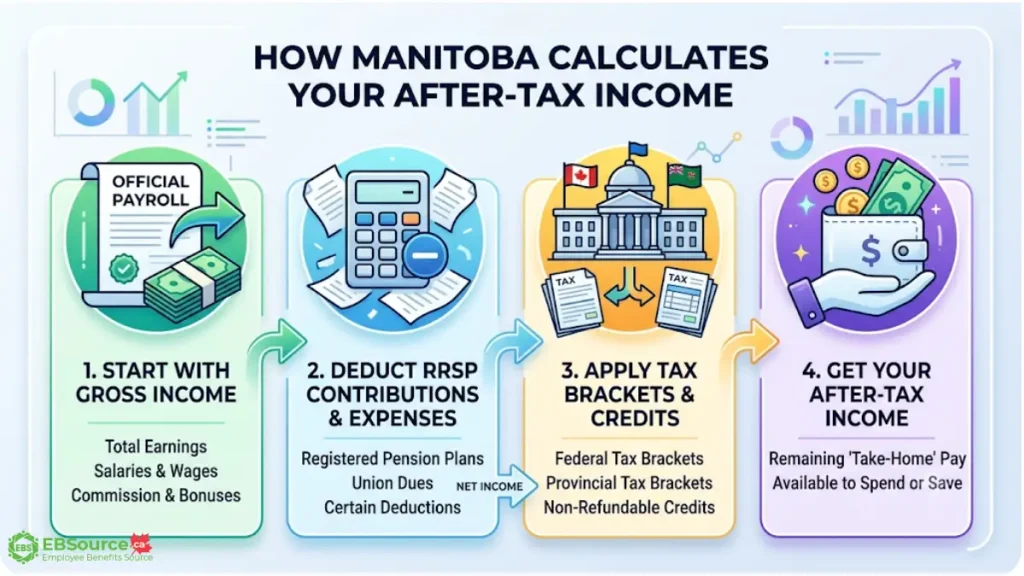
Your Manitoba after-tax income is calculated based on your taxable income after mandatory deductions are taken from your gross pay. Our calculator simplifies this process in three steps: calculate gross income and payroll deductions, determine taxable income, and find your after-tax pay.
Here is the process of estimating your income tax in Manitoba:
Step 1: Determine your gross income and payroll deductions
First, to find the gross annual income, multiply the employee’s income for each pay period by the number of pay periods in a year. After that, mandatory payroll deductions in Manitoba are applied as follows:
| Deduction | Rate | Applies To | 2026 Annual Maximum |
|---|---|---|---|
| EI premiums | 1.63% | Insurable earnings up to $68,900 | $1,123.07 |
| CPP | 5.95% | Earnings above the $3,500 exemption, up to the $74,600 ceiling (YMPE) | $4,230.45 |
| CPP2 | 4% | Earnings between $74,600 and $85,000 | $416 |
If you want to deduct employment expenses on your tax return, your employer needs to complete a T2200 form to certify those expenses. Additionally, if you are looking to reduce the amount of tax withheld on your paycheques for regular deductions, like RRSP contributions, you can apply to the CRA using a T1213 form.
Step 2: Calculate your taxable income
Taxable income is calculated by adding other income, then deducting RRSP contributions, other eligible deductions, and the first additional CPP contribution to find the amount that is taxed federally and provincially.
Step 3: Find your take-home pay
After calculating federal and provincial taxes, along with CPP, CPP2 where applicable, and EI deductions, these amounts are subtracted from your gross income to get your annual take-home pay. Once you have your MB annual take-home pay, divide it by the number of pay periods to find your take-home pay for each period.
Note: Manitoba’s Health and Post-Secondary Education Tax Levy is a payroll tax for employers. It is not taken from an employee’s earnings and should not be considered as a personal withholding in this Manitoba income tax calculator.
Examples of Gross-to-Net Salary in Manitoba
If you want a quick estimate of Manitoba take-home pay, the examples below show approximate after-tax pay for common salary levels. The examples assume basic claim amounts, no RRSP contributions, no taxable benefits, no bonuses, and full-year employment in Manitoba.
Here is the table displaying seven salary levels ranging from $45,000 to $250,000:
| Gross Salary | Est. Annual After-tax Pay | Why This Example Matters |
|---|---|---|
| $45,000 | $35,649 | Income below Manitoba’s second bracket |
| $60,000 | $45,783 | Crosses the federal first bracket and the Manitoba second bracket |
| $75,000 | $55,035 | $75,000 | EI is maxed; CPP2 applies only to the small slice of pensionable earnings above $74,600 |
| $85,000 | $61,443 | CPP2 reaches the annual cap |
| $100,000 | $71,456 | Near Manitoba’s top provincial bracket threshold |
| $150,000 | $100,863 | Shows higher federal and Manitoba marginal effects |
| $250,000 | $154,825 | Shows federal BPA and Manitoba BPA phaseout effects |
This example shows that Manitoba’s tax structure significantly reduces the benefits of salary increases:
For example, when someone’s income rises from $45,000 to $60,000, they only get about $10,134 more in their paycheque after taxes and deductions from a $15,000 raise, meaning about 32.4% of that raise is taken in taxes.
The $75,000 to $100,000 income range is where workers feel the biggest tax effect. A $25,000 salary increase leads to about $16,420 more in take-home pay, meaning about 34.32% of that extra money goes to taxes. Also, in this range, employees finish their EI payments and begin and end CPP2 contributions, which can cause paycheques to vary from one pay period to the next.
However, if you earn $150,000 in Manitoba, the tax on your last dollar is 43.4%. On average, about 32.8% of your income is taken out for income tax, CPP, CPP2, and EI. This means you keep about 56.6 cents of every extra dollar before putting money into an RRSP.
The tax situation in Manitoba begins to change once take-home income exceeds $200,000, with the Manitoba BPA of $15,780 gradually reducing and disappearing entirely at $400,000. At the same time, the federal enhanced BPA is $16,452 up to $181,440, begins to decline above $181,440, and reaches its minimum of $14,829 at $258,482. This means there is an overlap in the reduction of both BPAs between $200,000 and $258,482.
For someone earning $250,000, the tax rate on the last dollar earned is about 47.54%. This rate peaks at 51.25% for incomes between $258,482 and $400,000 due to the top federal tax rate of 33%, combined with Manitoba’s top rate of 17.4%, along with the BPA reduction.
After passing $400,000, the BPA reduction is fully eliminated, and the effective tax rate drops to 50.40%. Therefore, the income range of $258,482 to $400,000 is the least favourable for high earners in Manitoba.
A Mixed-Income Example: $72,000 Salary Plus Extra Earnings
Let’s look at a more detailed example: Consider someone who earns $6,000 a month, totalling $72,000 a year from their job. Additionally, they earn $8,000 from other sources throughout the year, receive $2,000 in vacation pay, and get a $3,000 bonus. They contribute $5,000 to an RRSP and claim a $1,000 deduction. This brings their total income before taxes for the year to $85,000.
| Income item | Amount |
|---|---|
| Employment income | $72,000 salary + $2,000 vacation + $3,000 bonus = $77,000 |
| Other income | $8,000 |
| Gross income (employment, vacation, bonus, other) | $85,000 |
| RRSP + other deductions | $6,000 |
| First additional CPP | $711 |
| Taxable income | $85,000 − $6,000 − $711 − $96 = $78,193 |
| Income tax (federal + provincial) | -$15,899 |
| CPP contributions (including CPP2) | -$4,326 |
| EI premiums | -$1,123 |
| After-tax income | $63,652 |
How Do RRSP and Other Deductions Change Your Manitoba Take-home Pay?
A few factors impact the final result. Contributing $5,000 to an RRSP and deducting $1,000 lowers taxable income, reducing the tax bill compared to a straight $85,000 salary. Vacation pay and bonuses count as regular job earnings and contribute to CPP and EI, along with salary. With total employment earnings at $77,000, CPP2 applies to the income over the $74,600 limit, adding $96 to the maximum base CPP amount.
The additional $8,000 in income increases taxable income but does not contribute to CPP or EI, since the calculation is based on employee payroll rather than self-employment. Overall, about 25.1% of gross income goes to income tax, CPP, CPP2, and EI, resulting in approximately $5,304 in take-home pay each month.
What Common Mistakes Affect the Manitoba Income Tax Estimate?
Two common errors can distort the output of the MB tax calculator: confusing different tax rate types and incorrectly treating non-employment income as salary. Each of these mistakes is straightforward to fix once identified.
The following 2 mistakes can lead to inaccurate results when using the MB income tax calculator:
Mixing Marginal and Average Tax Rates
The marginal tax rate applies only to your next dollar earned, while the average rate is your total tax divided by your total income. Treating the marginal rate as if it applied to your whole income badly overstates the burden.
For example, a Manitoban earning $100,000 has a combined marginal tax rate of approximately 33.25%, but an average income-tax rate closer to 22.8%. If you mistakenly applied the marginal rate of 33.25% to the entire $100,000, you would expect to owe around $33,250 in income tax. In reality, the total federal and provincial income tax is about $22,775, or about 22.8% of income.
However, in a progressive tax system, different parts of your income are taxed at different rates. In fact, the total federal and provincial tax on $100,000, after claiming only basic personal amounts, is about $22,775, which is an average income-tax rate of nearly 22.8%. This means you pay about $10,475 less than if you used the marginal rate for everything, which can make a big difference when planning for big expenses or RRSP contributions.
Misclassifying Non-Employment Income
Business or freelance income may have different CPP, EI, and withholding requirements compared to employee salaries. Unless indicated otherwise, this calculator is intended for employee payroll estimates rather than for self-employment tax calculations. Treating it as regular salary can cause excessive payroll deductions and inaccurate take-home pay calculations.
For instance, if a self-employed Manitoban with $80,000 in net business income enters that amount as employment income, the calculator deducts the employee-only CPP of $4,230.45, CPP2 of $216 and EI of $1,123.07. In practice, a self-employed individual owes both the employee and employer shares of CPP, totalling $8,460.90, CPP2 of $432, and EI is not deducted at all unless you have voluntarily opted in for special benefits. That means the calculator would understate CPP by about $4,230.45, CPP2 by about $216, and overstate EI by $1,123.07, resulting in an estimated after-tax pay of more than $3,323.38 ($4,230.45 + $216 – $1,123.07).
Note: The line-item differences total $5,569.52 in absolute terms, but the atter-tax contribution difference before income-tax effects is about $3,323 because EI would not normally apply to self-employment income.
Manitoba vs Other Provinces at the Same Salary
Each province and territory in Canada has its own tax rates, credits, and fees, resulting in take-home pay that can differ by thousands of dollars, even for people with the same salary. Manitoba’s income tax rates are not the highest in Canada but are high for middle- and upper-income earners.
The results of provincial and territorial income taxes in Canada can vary, even for people with the same total income, due to additional tax rules, how tax brackets are set (how quickly tax rates rise), and the basic personal amount in each province or territory.
The table below compares the total federal and provincial tax rate on $100,000 of employment income across all 13 provinces and territories for 2026:
| Province / Territory | Provincial Rate at $100,000 | Combined Marginal Rate at $100,000 | Top Combined Marginal Rate |
|---|---|---|---|
| Nunavut | 7% | 27.50% | 44.50% |
| Northwest Territories | 8.60% | 29.10% | 47.05% |
| Yukon | 9% | 29.50% | 48% |
| Ontario | 9.15% | 29.65%* | 53.53%* |
| Alberta | 10% | 30.50%*** | 48% |
| British Columbia | 7.70% | 28.20% | 53.50% |
| Saskatchewan | 12.50% | 33% | 47.50% |
| Manitoba | 12.75% | 33.25% | 51.25% if using true peak marginal rate; 50.40% only after BPA phaseout ends |
| Quebec | 19% | ~36.12%** | ~53.31%** |
| Newfoundland & Labrador | 15.80% | 36.30% | 54.80% |
| New Brunswick | 14% | 34.50% | 52.50% |
| Prince Edward Island | 16.60% | 37.10% | 53% |
| Nova Scotia | 17.50% | 38% | 54% |
FAQs about the Manitoba income tax calculator
What replaced the Manitoba Education Property Tax Credit for homeowners?
The Education Property Tax Credit and the School Tax Rebate were replaced in 2025 by the new Homeowners Affordability Tax Credit (HATC). For the 2026 tax year, the Manitoba Homeowners Affordability Tax Credit is the lesser of $1,600 and the gross school taxes on an eligible principal residence. It does not apply to rental properties, cottages, secondary residences, or commercial properties. This credit can be applied as an advance on your property tax bill or claimed on your income tax return using Form MB479.
Remember, only one principal residence per taxpayer qualifies, and vacation properties, such as cottages, are not eligible. Looking ahead, the maximum HATC amount is scheduled to increase to $1,700 for the 2027 tax year, and the credit will begin to be reduced for properties with an assessed value exceeding $1,000,000.
How does the Manitoba tax on split income work?
If you report federal tax on split income on line 40424 of your tax return, you also need to calculate a Manitoba Tax on Split Income using Part 3 of Form T1206. The Manitoba TOSI amount is entered on line 59 of Form MB428 and included on line 42800 of your return. This split income is taxed at a high rate of 17.4%, and you generally cannot use regular credits, such as the basic personal amount, to reduce this tax. TOSI applies to specific income from related businesses, including dividends, shareholder benefits, and certain partnership income.
Does Manitoba have a provincial surtax on personal income?
No. Manitoba does not have a provincial surtax on personal income tax. Before 2001, it used a “tax on tax” system, but since then, it has switched to a “tax on income” system with three progressive tax rates: 10.8%, 12.75%, and 17.4%. There is an additional tax calculation on Form MB428 for minimum tax purposes: 50% of the federal minimum tax, but this is not considered a surtax.
Is Income Tax Higher in Manitoba?
In Manitoba, income tax rates are not the highest in Canada, but they are relatively high, especially for middle- and upper-income earners. The provincial tax is structured into three tax brackets at rates of 10.8%, 12.75%, and 17.4%. Additionally, you can claim Manitoba’s basic personal amount as a tax credit.
For federal taxes, the 2026 brackets range from 14% to 33%. You can reduce your federal tax liability with non-refundable credits like the federal basic personal amount, CPP contributions, EI premiums, and the Canada Employment Amount.