
Employee Benefits Plan Design: A Practical Framework for Canadian Employers


Designing an employee benefits plan means deciding who qualifies, which benefits to offer, how you and your employees share the cost, and how the plan works in practice. A good plan supports employees without placing an unsustainable burden on the business.
This eight-step guide helps Canadian employers build or improve a plan that meets employee needs, fits the budget, and remains manageable. By the end, you will have a clearer view of your budget, initial coverage, eligibility decisions, and a plan design brief to share with a benefits advisor or insurer.
Where Should You Start?
- If you are starting a plan: Start with Step 1 to define your goals, workforce needs, and budget.
- If you are improving an existing plan: Review current coverage, costs, claims experience, employee feedback, and administrative issues. Then use the eight steps to identify what should change.
This guide focuses on employer-sponsored group insurance and health spending arrangements. It does not cover statutory benefits or standalone workplace retirement plans in detail.
On this page
The Eight-Step Plan Design Roadmap
Use this map to find the step that covers each decision.
| Step | Decision | Key question | Output |
|---|---|---|---|
| 1 | People and goals | Who does the plan protect, and what goals should it achieve? | Target workforce and ranked goals |
| 2 | Budget | What can the business afford? | Budget limits and approach to cost sharing |
| 3 | Plan structure | How do coverage, funding, pooling and choice fit together? | Preferred structure and alternatives |
| 4 | Core coverage | Which risks should the plan cover first? | Core, optional, deferred benefits |
| 5 | Eligibility | Who qualifies, and when does coverage start? | Classes, eligibility, enrolment rules |
| 6 | Cost sharing | How are premiums and claim costs split? | Contribution and reimbursement rules |
| 7 | Testing | Is the plan affordable, accessible, and manageable? | Test results, accepted trade-offs, open questions |
| 8 | Quote readiness | What is fixed and what is negotiable? | A plan design brief |
Every plan decision affects the others. Adding benefits can increase costs, while offering more choices can create extra administrative work. Changing eligibility rules can also affect payroll and employee participation. Consider the entire plan before making changes.
Step 1: Define the Business Goals and Workforce Needs
Start by identifying the business problem the plan must solve and the people it serves. These decisions will guide the rest of the design.
Choose Your Main Goal
Pick one main goal and a few secondary ones. Ranking your priorities helps you make decisions when you cannot meet every goal at once.
Common goals are:
- Protecting employees from significant health costs or lost income
- Attracting new hires
- Reducing employee turnover
- Improving cost predictability
- Improving access to frequently used care
- Giving employees more choice
- Supporting business growth
- Closing gaps in an existing plan
Also identify the limits the design must respect. For example, you want benefits that help you compete for talent but cannot absorb large increases in annual premiums. In that case, recruiting is the goal while budget stability is a firm constraint. If an option pushes costs beyond the limit, you will need to adjust it or rule it out.
Choose one or two measures to help you review whether the plan is working. These could include offer acceptance rates, voluntary turnover, employee feedback, or changes in plan costs at renewal.
Assess Your Workforce
Consider workforce factors that may affect coverage, cost, eligibility, or administration.
- Workforce profile: Consider the mix of full-time, part-time, seasonal, and different job groups.
- Location: Staff in more than one province may have different provincial plans, tax, and contract requirements.
- Workforce changes: Consider expected hiring, turnover, and business growth when planning for future needs.
- Administrative capacity: Consider how easily your team can manage employee changes, payroll deductions, and ongoing enrolment.
Decide Who to Involve in the Design
Benefits design usually requires input from several people:
- Business leadership: Set priorities and approve spending.
- HR or benefits administrators: Manage eligibility, enrolment, and communications.
- Payroll and finance: Handle deductions, costs, and reporting.
- Employees or representatives: Provide feedback on needs and usability.
- Benefits advisor or insurer: Explain available coverage, pricing, contract terms, and underwriting requirements.
Output from Step 1: A written list of your main objectives, workforce needs, constraints, and the people responsible for key decisions.
Before moving on to the budget and plan options, consider common mistakes employers make when choosing employee benefits and how to avoid them.
Step 2: Set the Benefits Budget
Set a budget before comparing plan options. A clear spending limit helps you judge whether a proposal is realistic.
Write down three figures:
- Target budget: What you would like the plan to cost.
- Maximum commitment: The most the business can afford. If a proposal exceeds this amount, the design must change.
- Renewal tolerance: The increase you could reasonably afford at renewal. For example, an employer might decide in advance that an increase above 10% would trigger a review of coverage, plan design, or insurer options.
The cheapest plan is not always the best. It may leave employees exposed to substantial out-of-pocket expenses, while paying for benefits employees rarely value wastes money you could spend better elsewhere.
For detailed calculations, see our guide to the employee benefits budgeting process and employee benefits costs.
Output from Step 2: A target budget, a maximum spending limit, and an approach to handling renewal increases.
Step 3: Choose the Benefits Plan Structure
With goals and budget established, decide how different parts of the plan work together. Common options include insured benefits, spending accounts, pooled options, and different levels of employee choice.
These options do not necessarily compete with one another. A business could offer core insured coverage alongside a flexible health spending account.
Use your main priority to guide which structures you explore:
| If your priority is… | Consider… | How it works |
|---|---|---|
| Protecting employees against major health or income shocks | Relevant insured coverage | An insurer provides coverage under a group insurance contract. |
| Limiting costs from routine claims | Health spending account (HSA) | Employees receive a set amount for eligible healthcare expenses. |
| Reducing swings from certain claims | Pooling arrangement | Certain claims or pricing risks are shared across a larger group. |
| Meeting different employee needs | Modular/flex plan | Employees choose from predefined packages or coverage options. |
Insured Benefits
A traditional group plan can include:
- prescription drugs
- extended health care
- dental
- life insurance
- accidental death and dismemberment (AD&D)
- short-term or long-term disability
Choose coverage that best supports your priorities and protects employees against risks they may struggle to afford on their own. See our guide to group insurance in Canada for an overview of these benefits.
Health Spending Accounts
A health spending account (HSA) gives each employee a fixed amount to spend on eligible medical expenses. It may supplement insured coverage or help pay for eligible expenses that exceed standard plan limits.
An HSA does not provide the same protection as insurance against every major or unexpected health cost. Consider how it will work alongside insured benefits rather than treating it as a complete replacement.
Whether your HSA qualifies as a Private Health Services Plan (PHSP) for tax purposes is a separate check. Before assuming the arrangement receives favourable tax treatment, see our guide to Health Spending Accounts to confirm the applicable requirements.
Risk Pooling
Risk pooling allows claims or pricing risks to be shared across many employers, rather than being priced only on one employer’s experience. Smaller businesses may encounter pooling when comparing group benefits options.
Pooling is about how risk is shared and priced; it is not a type of coverage. Learn how a pooled benefits plan handles pricing, renewals and plan changes before you compare options.
Modular and Flex Plans
If employees have different needs, you may consider:
- Modular plan: Employees choose from predefined packages.
- Flexible plan: Let employees pick coverage levels or spending options.
However, more choice also increases payroll, enrolment, communication, and administrative work. Choose a structure that your employees can understand and your organization can manage.
See our guide to modular and flex benefits plans.
Output from Step 3: Preferred structure, alternatives to compare, and questions for your advisor.
Step 4: Prioritize the Coverage the Plan Needs
With the overall structure in place, decide which benefits are worth including in your budget. You do not have to include every benefit at launch.
Sort each benefit into one of three groups:
- Core: Essential to the plan’s main purpose.
- Optional or flexible: Valuable, but potentially suitable for employee choice or a spending account.
- Deferred: Not a current priority, but worth reconsidering later.
A useful starting point is to protect employees against major risks they may struggle to afford on their own. Then use the remaining budget for smaller or personal-preference expenses.
For example:
- Disability coverage may be a core benefit because losing income can have serious financial consequences.
- High-cost prescription drugs and major healthcare expenses may also deserve priority because one event can create a substantial financial burden.
- Vision or certain paramedical expenses may be suitable for flexible coverage, depending on employee needs, the plan’s objectives, and the available budget.
- Benefits with limited relevance to the workforce may be deferred until a later review.
Different employers may prioritize the same benefit differently. What matters is being able to explain each decision using employee needs, financial impact, and available alternatives. You do not need to settle every reimbursement percentage yet; first decide which benefits matter most.
Smaller employers can also compare small business employee benefits packages to understand common approaches.
Output from Step 4: A prioritized list of core, optional, and deferred benefits, with a reason for each choice.
Step 5: Define Eligibility, Benefits Classes and Enrolment Rules
This step turns your coverage decisions into clear rules about who can join the plan, when coverage begins, and what happens when an employee’s circumstances change.
Who Qualifies for Coverage?
Confirm:
- which employee groups can join
- whether dependants are included
- whether you need more than one class
If different classes receive different benefits, ensure the distinctions are intentional, applied consistently, and permitted under the contract and applicable requirements.
When Does Coverage Begin?
Decide how long an eligible employee must wait before coverage begins. This is known as the waiting period. It affects employee access and recruitment, not just when premiums start, so consider how it fits your hiring practices and administration needs.
Confirm that the insurer allows it and that it meets applicable obligations. Also establish how eligibility dates will be recorded and communicated so employees know when their coverage takes effect.
What If An Employee Misses Enrolment?
An employee who does not enrol in time may be treated as a late applicant under the group contract. Depending on the contract, they may need to provide additional medical evidence or face restrictions on certain benefits.
Before launch, establish a process for:
- tracking enrolment deadlines.
- following up on incomplete applications.
- explaining enrolment requirements to employees.
- escalating missed deadlines and confirming the insurer’s requirements.
Clear responsibilities help reduce avoidable delays.
What Happens During Leaves and Status Changes?
Eligibility rules must also address protected leaves and changes in employment status, such as a move from full-time to part-time work.
Document how coverage and contributions will be handled in each situation. Provincial employment standards may require certain benefits to continue during protected leaves.
For example, the Employment Standards Act, 2000, section 51 generally requires employees to remain enrolled in specified benefit plans during most ESA-protected leaves (except for reservist leave) unless they elect otherwise in writing. The employer must also keep paying its share of contributions unless the employee gives written notice that they will not pay their share.
Rules differ by province, so verify the requirements for every jurisdiction where your employees work.
Which Coverage Amounts Need Insurer Approval?
Life and disability insurance may have a non-evidence maximum (NEM), the maximum coverage an insurer will provide without requiring additional medical information, subject to the plan’s terms.
If an employee applies for coverage above this limit, the insurer may request medical evidence before approving the additional amount.
This matters when setting salary-based coverage formulas: higher earners may calculate to an amount above the NEM. Do not promise that every calculated amount will automatically be approved.
Output from Step 5: Eligibility classes, waiting periods, enrolment responsibilities, leave rules, and outstanding approvals.
Step 6: Decide How the Employer and Employees Share the Cost
Cost sharing determines what the business pays and what employees contribute through premiums and out-of-pocket expenses.
The plan should make these costs clear before employees enrol or use their coverage.
Decide Who Pays the Premiums
For each benefit, decide:
- The percentage paid by the employer and the employee.
- Whether single and family coverage have different contribution arrangements.
- Whether any benefits use a different payment approach.
- How payroll will process deductions.
- How premium increases at renewal will be shared.
Important tax consideration: Employer-paid premiums do not receive the same tax treatment for every benefit. For example, under the CRA’s guidance, employer-paid group term life premiums are generally a taxable benefit to the employee. Employer-paid disability (wage-loss) premiums are generally not taxable when paid, but they can make disability benefits taxable when received. Quebec has different rules (see Step 7).
Before finalizing premium arrangements, confirm the intended tax treatment with an appropriate professional and current government guidance.
Decide What Employees Pay When They Use Their Benefits
Even when a benefit is included in a plan, employees may need to pay part of the cost themselves. Three common mechanisms are:
- Deductible: The employee pays a set amount before the plan starts paying. Example: Employees pay the first $100 of eligible expenses.
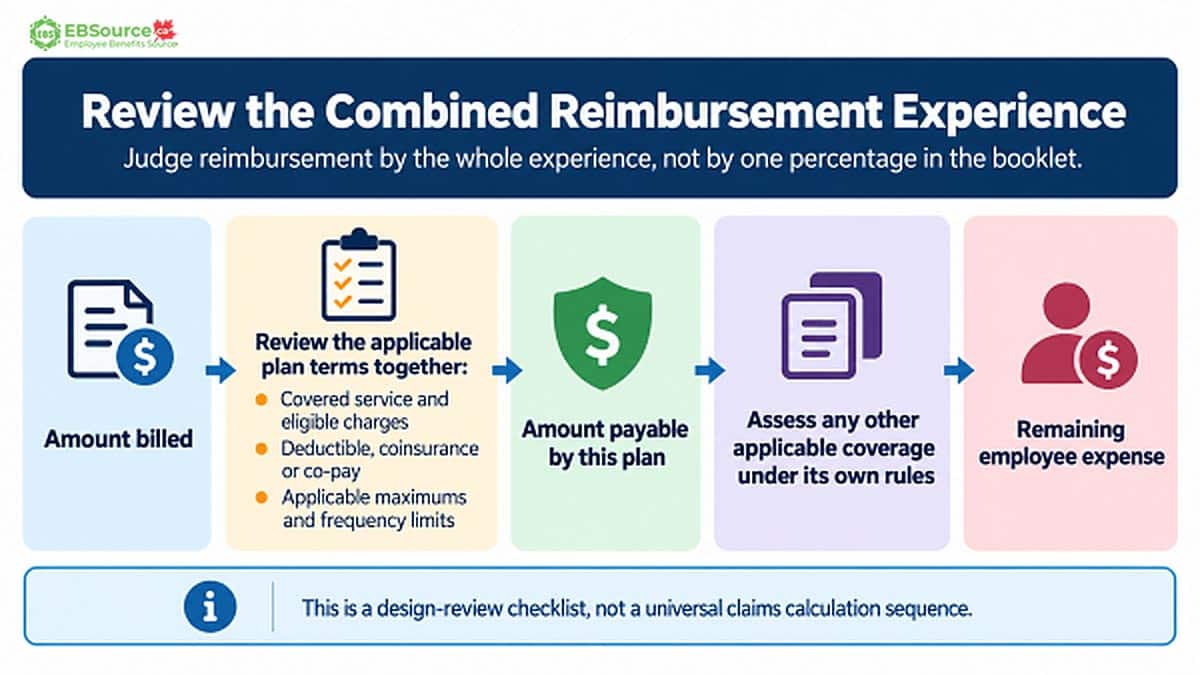
- Coinsurance: The plan pays a percentage, and the employee pays the rest. Example: If a plan reimburses 80% of an eligible $100 expense, the plan pays $80, and the employee pays the remaining $20, subject to plan limits and deductibles.
- Co-payment: The employee pays a fixed amount per claim or service. Example: Employees pay $10 per prescription.
These mechanisms affect employee expenses differently, so don’t treat them as interchangeable. See our comparison of coinsurance and co-pay structures.
Check the Limits on Reimbursement
The percentage shown in a benefits plan does not always determine the final amount an employee receives. Other limits can reduce what a plan pays:
- Reasonable and customary limits: The insurer may only recognize what it considers a normal charge for a service or area. If the provider charges more, the employee may have to pay the difference.
- Annual maximums: The plan will not pay further claims under that limit during the applicable period.
If employees also have coverage through a spouse’s plan, review how coordination of benefits affects reimbursement and employee communications.
Explain these limits before enrolment so employees are not surprised when a claim pays less than expected.
Output from Step 6: A documented premium-sharing approach, claim cost-sharing rules, reimbursement limits, and a list of tax and payroll questions requiring confirmation.
Step 7: Test Affordability, Employee Access, and Administration
Before finalizing the plan, check whether it still works under realistic changes in staffing, employee needs, or renewal costs.
Run Four Practical Tests
| Test | Ask yourself | Example scenario |
|---|---|---|
| Employer affordability | Can the business sustain the cost? | Workforce growth, a shift toward family coverage, or a substantial renewal increase |
| Employee access | Can intended employees qualify and enrol? | A new hire, a change in employment status, or dependant enrolment |
| Financial protection | Could employees still face high uncovered costs? | Repeated treatment, high-cost healthcare, or loss of income |
| Administrative capacity | Can the organization apply the rules consistently? | Salary changes, missed enrolments, class changes, or flexible benefit elections |
These tests help identify problems before the plan is finalized.
What If a Test Fails?
If a test reveals a problem, choose an appropriate response.
| If you find… | Then… | Revisit |
|---|---|---|
| Cost exceeds the approved ceiling | Rethink benefits, funding or the contribution split | Steps 2, 3, 4, 6 |
| Intended employees cannot qualify | Revise classes or eligibility, or find another option for that group | Steps 3, 5 |
| A major protection gap remains | Fix core insured coverage before adding routine benefits | Step 4 |
| Admin cannot support the rules | Simplify elections or classes, or change who provides support | Steps 3, 5 |
You may also decide to accept a trade-off, provided it is understood and communicated appropriately. Where the solution depends on contract terms, insurer approval, or specialist advice, confirm it before proceeding.
If growth materially changes the result, employers can use our guide to scalable group benefits plans, which covers the triggers and adjustments that apply as headcount and workforce structure change.
Confirm Legal, Tax, and Contract Requirements
Once the design passes the practical tests, confirm it can be implemented under the applicable rules and contract terms.
- Provincial rules: Confirm employment standards and other jurisdiction-specific obligations.
- Tax treatment: Check the treatment of premiums, contributions, and benefits.
- Health spending arrangements: Confirm that any proposed arrangement meets the applicable requirements to receive favourable tax treatment.
- Eligibility and leaves: Ensure coverage rules are consistent with applicable obligations and contract terms.
- Insurer approval: Confirm that requested coverage, limits, classes, and exceptions are available under the proposed contract.
- Quebec prescription drug coverage: Review RAMQ’s mandatory prescription drug insurance requirements separately from optional supplemental benefits. Quebec also has specific provincial tax treatment for employer-paid group insurance contributions. Confirm the current requirements with Revenu Québec.
These checks are particularly important where employees work in multiple provinces. Verify current government guidance and seek professional advice as needed.
Output from Step 7: A record of the design tests, accepted trade-offs, changes required, and unresolved implementation questions
Step 8: Prepare the Plan Design Brief for Quoting
A plan design brief brings your decisions together in one document. It helps your benefits advisor and insurers understand what you want, which requirements are essential, and where you are open to alternatives.
The brief is not a final contract and does not replace the workforce information needed to obtain quotes. Its purpose is to make proposals easier to compare.
What to include in the brief
| Brief section | What to record |
|---|---|
| Business goals | Primary problem, desired outcome, target effective date |
| Budget | Target spending, maximum commitment, and approach to employee contributions |
| Workforce | Eligible groups, locations, dependant coverage, expected changes |
| Eligibility | Benefit classes, waiting periods, enrolment responsibilities, and leave arrangements |
| Plan structure | Funding approach, risk pooling, employee choice, and spending account preferences |
| Coverage | Core, optional, and deferred benefits, plus preferred coverage levels |
| Cost sharing | Employer and employee premium contributions, deductibles, and reimbursement preferences |
| Limits and approvals | Coverage limits, identified gaps, NEM questions, and required insurer approvals |
| Administration | Responsible staff, payroll requirements, employee communications, and support needs |
| Review | Measures of success, review dates, and conditions that could trigger a redesign |
Label what is fixed and what can change
Label each decision, so insurers and advisors know where they can suggest alternatives:
- Must-have: an essential condition of the design
- Preferred: wanted, but open to adjustment
- Needs confirmation: not enough information yet to decide
Keep the brief focused on decisions and open questions. You do not need every contract detail finalized before requesting quotes. Use your plan design brief to guide the group benefits quoting process.
Output from Step 8: A clear plan design brief that insurers can use to prepare proposals based on comparable assumptions.
Next Step for Canadian Employers
Once your plan design brief is ready, the next stage is to confirm available terms and obtain insurer proposals.
- For a new plan: confirm the preferred design, check which terms are available, request quotes, compare proposals using the same assumptions, and refine the design where needed.
- For an existing plan: compare the current and proposed designs side by side, pin down exactly what’s changing, and check first whether your current insurer can accommodate those changes.
A full redesign may be appropriate when:
- The plan no longer supports your business objectives.
- Employees you want to cover cannot qualify under the existing rules.
- Important gaps remain after smaller fixes
- The plan has become too difficult to administer.
If the main problem is price or a single benefit, a targeted change or a market review may be enough.
Build a Plan That Balances the Right Priorities
The best employee benefits plan is not necessarily the most generous or the cheapest. It balances employee needs, business objectives, financial capacity, and administrative resources.
By working through these eight steps, Canadian employers can make informed decisions and give benefits advisors and insurers clearer instructions when preparing proposals.