


If you work in Alberta, you might need time off for illness, family care, or personal reasons. The province allows unpaid, job-protected leave for certain situations. The length of leave and notice requirements vary. Choosing the right leave is just one part of planning time off. You should also check which income sources you may qualify for and whether their payment dates leave a gap during your absence. Changes in your situation can affect your income and return date.
As part of our Leave of Absence in Canada series, this guide explains these provincial leave-of-absence types and where to find income support.
On this page
Are You Entitled to Job-Protected Leave in Alberta?
You may qualify for job-protected leave under Alberta’s Employment Standards Code if it covers your job, you meet the service requirement for the leave, and your circumstances meet that leave’s specific conditions.
Federal vs. Provincial Rules
Alberta’s leave rules apply to employees covered by the province’s Employment Standards Code. If you work in a federally regulated industry, such as banking, telecommunications or interprovincial transportation, check the applicable federal leave rules instead.
If you are unsure which rules cover your job, confirm this with your employer or the relevant employment standards authority before relying on Alberta’s leave provisions.
The Service Requirement
Most Alberta job-protected leaves require at least 90 days of employment with the same employer. Reservist leave requires at least 12 consecutive weeks.
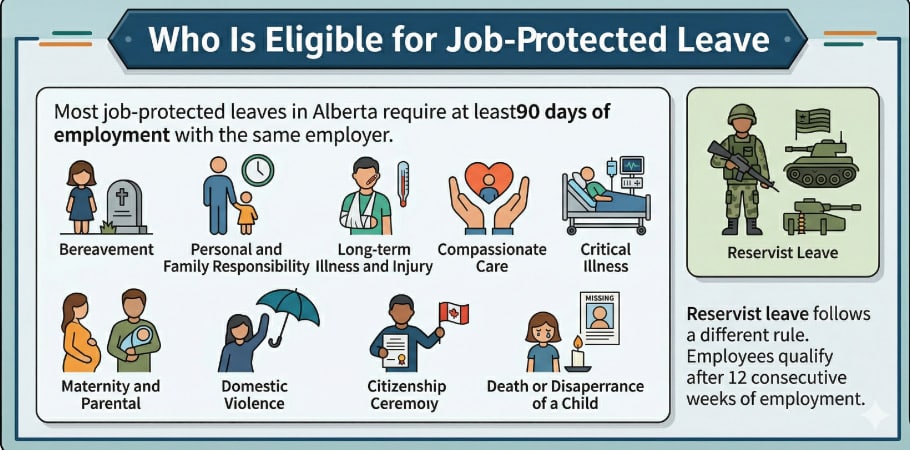
Meeting the service requirement does not, by itself, qualify you for leave: you must also meet the conditions for the particular reason you need time off. The next section helps you identify which leave to check.
What If You Have Fewer Than 90 Days of Service?
If you have not met the service requirement for the relevant leave, your employer may still agree to time off. Other rights, including disability-related accommodation, may still apply. Before taking time off, ask your employer to confirm in writing:
- how long the absence will last,
- whether it will be paid,
- what happens to your benefits, and
- what position you will return to.
When Your Reason Does Not Fit A Statutory Category
Statutory leaves cover specific situations defined in law. If you want time off for personal travel, for example, Alberta’s job-protected leave categories do not cover that reason. You can request unpaid time off or use accrued vacation, but job protection doesn’t apply unless the employer agrees in writing.
Which Alberta Leave of Absence Fits Your Situation?
The applicable Alberta leave depends on why you need time off. For your own illness or injury, check personal and family responsibility leave or long-term illness and injury leave. If you need to care for someone, check compassionate care or critical illness leave. Birth, bereavement, domestic violence and other qualifying events have separate leave categories.
The table shows the maximum time available under each.
| Reason for time off | Relevant leave | Maximum time |
|---|---|---|
| Your own illness, injury, or quarantine | Long-term illness and injury leave | 27 weeks per calendar year |
| Brief personal health issue or family need | Personal and family responsibility leave | 5 days per year |
| Caring for a gravely ill family member at risk of dying | Compassionate care leave | 27 weeks |
| Caring for a critically ill child under 18 | Critical illness leave | 36 weeks |
| Caring for a critically ill adult family member | Critical illness leave | 16 weeks |
| Birth or adoption of a child | Maternity and parental leave | Maternity: 16 weeks (birth mother only); Parental: 62 weeks |
| Death of a family member or pregnancy loss | Bereavement leave | 3 days per calendar year |
| Death or disappearance of a child under 18 | Death or disappearance of child leave | 104 weeks after a death; 52 weeks after a disappearance; (Statutory crime-related conditions are met) |
| Effects of domestic violence | Domestic violence leave | 10 days |
| Military deployment or annual training | Reservist leave | Length of operation or training |
| Attending your own citizenship ceremony | Citizenship ceremony leave | Up to half a day |
These are statutory maximums. Your leave may end earlier when the medical certificate expires, care or support ends, or the family member dies, depending on the leave.
Your Own Health: Short Absences vs. Extended Leave
For an absence related to your own health, check which leave’s conditions fit your situation. Alberta provides personal health and family responsibility leave for necessary health matters and long-term illness and injury leave when illness, injury or quarantine prevents you from working.
- Personal health and family responsibility leave provides up to five unpaid days per calendar year, shared between personal health and family responsibilities.
- Long-term illness and injury leave provides up to 27 unpaid weeks per calendar year, effective January 1, 2026. It requires a certificate from a physician or nurse practitioner stating the estimated leave duration.

For long-term illness and injury leave, provide the certificate before your leave begins. If that is not possible, provide it as soon as is reasonable.
Caring For Someone: Compassionate Care vs. Critical Illness Leave
The applicable leave depends on the family member’s medical condition. Both require a medical certificate. Here is the key distinction:
- Compassionate care leave: Up to 27 weeks to care for or support a gravely ill family member who faces a significant risk of dying within 26 weeks.
- Critical illness leave: Up to 36 weeks to care for a critically ill child under 18, or up to 16 weeks for a critically ill adult family member.
You can take either leave in separate periods, but each period must be at least one week long.
What Income Can You Receive During Leave of Absence in Alberta?
Alberta’s statutory job-protected leaves are unpaid. Depending on your circumstances, you may receive income support under a workplace policy, Employment Insurance (EI), disability insurance or WCB-Alberta benefits.
Each source has its own eligibility and application rules. Check when any payment could begin and end, since the period you can take off may differ from the period you receive income.
Your Last Paycheque
Your regular pay for work completed before the leave remains payable. Check with your employer about the payment date and any overtime you might be owed. After that, your leave is unpaid unless your contract states otherwise, so review those documents before assuming you’ll get paid.
Employer Pay During Your Leave
Your workplace may offer paid sick or personal days, salary continuation, or an EI top-up. Check your employment contract, workplace policies or collective agreement, and ask HR or payroll which payments apply to your leave, how long they last and whether you need to apply.
If you plan to use vacation or banked time, confirm the arrangements with your employer. Record the confirmed payment dates in the income worksheet below.
Federal Employment Insurance benefits
Depending on the type of leave, you may be eligible for federal Employment Insurance (EI) benefits. EI is a federal program, separate from Alberta’s leave rules, that provides partial income replacement in specific situations. It includes:
- Sickness benefits for your own illness or injury
- Caregiving benefits for critically ill or end-of-life family care
- Maternity and parental benefits after a birth or adoption
For new EI claims starting between March 30, 2025, and October 9, 2027, the usual one-week waiting period is waived. A claimant may serve it if doing so is advantageous because of a SUB top-up.
Check the current measure when your EI claim starts; the waiver does not guarantee immediate payment: Temporary Employment Insurance measures to respond to major changes in economic conditions – Canada.ca
WCB Benefits For Work-Related Injuries
If the illness or injury is work-related, you may be eligible for wage-replacement benefits through the Workers’ Compensation Board of Alberta (WCB-Alberta).
If WCB-Alberta accepts your claim, available support may include:
- Wage-replacement benefits for lost earnings;
- Medical treatment;
- Rehabilitation and return-to-work assistance.
The payment amount and duration depend on the accepted claim, your earnings and your ability to work; they do not follow the maximum period of an Alberta job-protected leave.
Source: About WCB – WCB Alberta
Disability Coverage Through Your Benefits Plan
If your workplace plan includes short-term or long-term disability benefits, ask the plan administrator about eligibility, the waiting period, required evidence and application deadlines. Check when payments could begin and end before relying on them.

Alberta’s long-term illness and injury leave provides eligible employees with up to 27 weeks of job-protected leave per calendar year. Disability payments follow the policy’s separate rules: approval does not establish your leave entitlement, and payments may end before or continue beyond the statutory leave period.
How Do You Request Leave of Absence in Alberta?
To request job-protected leave in Alberta, check the rules for the leave that fits your situation, give your employer the required notice, and provide any supporting documents that leave requires. Apply separately for income benefits. The notice deadline, information required, and process for an unexpected absence depend on the leave.

The examples below show why the same notice period does not apply to every leave.
| Leave | Notice before starting |
|---|---|
| Long-term illness and injury | Give written notice as soon as is reasonable, including your estimated return date. |
| Compassionate care | Give at least two weeks’ written notice, including your estimated return date. If two weeks is not possible, give notice as soon as is reasonable. |
| Maternity or parental | Generally, give at least six weeks’ written notice. Special rules apply if medical reasons or circumstances related to the birth or adoption prevent advance notice. |
| Reservist | Give at least four weeks’ written notice. For an urgent deployment that prevents this, give written notice as soon as is reasonable. |
These are selected examples. Check the official Alberta guidance for your leave, including any exceptions.
Provide the Required Supporting Information
The documents depend on the leave:
- Long-term illness and injury: Provide a certificate from a physician or nurse practitioner stating the estimated leave duration. Submit it before leave begins or, if that is not possible, as soon as is reasonable.
- Compassionate care: The certificate must address the family member’s serious medical condition, significant risk of death within 26 weeks, and need for family care or support.
- Maternity: Your employer may require a certificate confirming the pregnancy and estimated delivery date.
- Reservist: If your employer requests proof, provide the required document from your commanding officer.
Keep your notice, supporting documents and employer responses. Apply separately for any EI, disability or WCB benefits; notifying your employer does not submit those claims.
Example of a Written Leave Notice
Adapt the example below to your leave’s rules: some leaves require different dates, documents or wording, and an unexpected absence may require a follow-up notice.
"I am writing to advise you that I require leave beginning [date] under [leave type]. I estimate returning to work on or around [date]. I will provide [the required documentation] [before the leave begins / as soon as possible]. Please let me know if you need any additional information under the applicable leave rules."
Don’t forget to check the exact requirements for your specific leave before sending anything.
What Should You Do If Your Circumstances Change?
If your return date, care needs or income changes, review the affected leave and payment rules promptly. The table below outlines the most common shifts and what to do when they happen.
| If… | Check | Act |
|---|---|---|
| Your return date moves later | Notice rules; need for updated medical evidence | Tell your employer in writing as soon as you know. |
| Care needs continue | More time under this leave or eligibility for another | Give any required notice and new documentation. |
| Income ends before your leave | The payer’s extension and eligibility rules | Contact the payer about continued or other support. |
| You can return with restrictions | Duties you can perform; need for accommodation | Discuss your return with your employer in advance. |
| Your leave is nearly exhausted | End date; other leave or accommodation options | Start the discussion before the leave ends. |
Example: Your Medical Leave Needs to Last Longer
You begin Alberta long-term illness and injury leave expecting to return after four weeks. In week three, your physician advises that you need another three months to recover.
At that point, update your employer in writing with the revised estimated return date, and check whether an updated certificate is needed to cover the longer absence. Alberta requires employees on this leave to report changes to their estimated return date.
Check the revised absence against the 27-week calendar-year limit and review your income arrangements separately. A longer absence does not automatically extend EI or disability payments. If you may need time beyond the statutory limit, discuss accommodation or another applicable arrangement before the leave ends.

Can You Take Two Job-Protected Leaves Back to Back in Alberta?
Yes, if you qualify for each leave and have the relevant entitlement available. Each leave has its own notice and documentation requirements.
Example: Moving from Critical Illness Leave to Compassionate Care Leave
You are caring for a parent on critical illness leave. Their condition changes, and a medical practitioner determines that they have a significant risk of dying within 26 weeks.
Check whether you qualify for compassionate care leave. Obtain the certificate required for that leave and give your employer written notice, including your estimated return date. Alberta generally requires two weeks’ notice; if that is not possible, give notice as soon as is reasonable.
Do not assume the earlier certificate establishes eligibility for the new leave. Check separately with Service Canada whether your EI caregiving claim needs to change.
What Happens When Your Leave of Absence Ends?
When an Alberta job-protected leave ends, an eligible employee is generally entitled to return to the same or an equivalent job. Before returning, you must follow the notice rule for your specific leave. If your health affects the work you can do, raise that with your employer before your return date.
When Must You Tell Your Employer You Are Returning?
Check the return deadline for your leave, even if you gave an estimated return date when the leave began. For example,
- Long-term illness and injury leave requires at least one week’s written return notice, unless you and your employer agree otherwise.
- Maternity and parental leave require at least four weeks’ written notice.
State the date you intend to return and keep a copy of the notice. If that date changes, tell your employer promptly. Do not rely on an earlier estimate as your return notice: failing to give the required notice or report to work when the leave ends can affect your right to reinstatement, subject to exceptions for unforeseeable or unpreventable circumstances.
What Job Must Your Employer Provide?
Your employer must generally reinstate you to your same or an equivalent job when your protected leave ends. A job with a different title is not necessarily a problem; what matters is whether the role offered is genuinely equivalent.
A genuine suspension or discontinuation of the business is a limited exception. Alberta’s rules require reinstatement if the business resumes within 52 weeks after the leave ends.
What If You Can Work With Restrictions?
Contact your employer before your return date if you can work but cannot yet perform all your usual duties. Explain the restrictions relevant to your work and how long they are expected to last. Medical documentation may help identify suitable duties, adjusted hours or a gradual return; you generally do not need to disclose your diagnosis to request accommodation.
Both you and your employer should participate in finding a reasonable arrangement, subject to the employer’s duty to accommodate to the point of undue hardship.
Source: Requesting accommodation | Alberta Human Rights Commission
What If Your Return Is Refused?
Ask your employer to explain its decision in writing. Keep your leave notices, proof of delivery, required certificates, return notice, and any messages about changes to your job or pay. That record will help establish whether the dispute concerns reinstatement, disability accommodation or both.
You can make an Alberta Employment Standards complaint about a possible breach of leave rules while still employed or within six months after your last day of employment. For a concern involving disability discrimination or accommodation, contact the Alberta Human Rights Commission. The two processes have different requirements, so do not assume that contacting one preserves your deadline with the other.
Source: Make an employment standards complaint | Alberta.ca
Frequently Asked Questions about Leave of Absence in Alberta
Does vacation entitlement continue during job-protected leave?
Yes, time on a protected leave counts toward years of employment used to determine vacation entitlement.
Can part-time or casual employees take job-protected leave?
Yes. Part-time and casual employees may qualify if the Employment Standards Code covers their employment and they meet the service and other conditions of the specific leave.
Is stress leave a separate statutory leave in Alberta?
No. Alberta does not have a leave category called “stress leave.” A short absence for your own health may qualify for up to five days of personal and family responsibility leave per year. A longer absence may qualify for long-term illness and injury leave if you meet its requirements and provide the required medical certificate. Mental health conditions may also engage workplace accommodation duties.
Should I quit or request a leave of absence?
If you expect to return and qualify for job-protected leave, confirm your entitlement before resigning: taking leave preserves your employment relationship, while resignation ends it. If you cannot yet predict when you can return, ask about the applicable leave and any accommodation before deciding.
How often can I call in sick?
Alberta does not set a universal number of sick calls that is “too often.” Eligible employees may use up to five days of personal and family responsibility leave per year for qualifying health needs; longer absences may fall under a different leave. Report each absence under your workplace’s reasonable procedures. If recurring absences relate to a disability, your employer may have a duty to consider accommodation rather than treating the number of absences alone as decisive.
Will my workplace benefits continue during unpaid leave?
Not necessarily. Alberta’s job-protected leave rules do not generally require an employer to continue paying benefits during leave unless an employment contract or collective agreement provides otherwise. Ask your employer or plan administrator whether coverage continues, who pays the premiums, and when coverage ends or resumes. Confirm the answer for each benefit, including health, dental and disability coverage.
Can you receive more than one income source during the same period?
More than one income source may apply to your absence, but the amounts may not simply add together. Before combining employer pay, EI, disability or WCB payments, ask each payer whether another payment could reduce the amount payable or create a repayment obligation. Report other income as required and keep written confirmations, especially when a claim is approved retroactively.
Your main goal is to find the right leave for your situation and know what could end it. For income, check all potentially applicable sources promptly. Ask the employer, insurer and Service Canada how their application and coordination rules apply. Also, confirm how each benefit considers other income before relying on the totals.
For those seeking information on leaves of absence across Canada, our guides are available: