



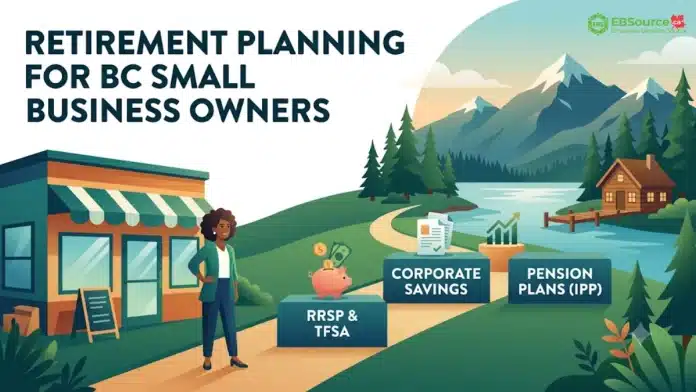
British Columbia (BC) small business owners usually fund their own retirement through a mix of an RRSP, a TFSA, savings kept in a corporation and, for some incorporated owners, an individual pension plan (IPP). The right mix depends on how your business is structured, how you pay yourself, how steady its cash flow is and how you expect to exit.
Retirement planning for small business owners in British Columbia may lean on the business in three ways. The business pays you, it funds your savings, and its eventual sale may finance part of your retirement. A plan that ignores any one of these can look sound on paper and still fall short.
Most RRSP, TFSA and federal IPP tax rules are the same across Canada. What changes for a BC owner is the provincial tax layer and, for an employer-sponsored pension, the pension standards rules that apply in British Columbia. This guide separates those BC-specific checks from the federal rules that apply nationwide.
Which Retirement Plan Options are Ideal for BC Small Business Owners?
British Columbia small business owners can compare four main options: a Registered Retirement Savings Plan (RRSP), a Tax-Free Savings Account (TFSA), an Individual Pension Plan (IPP) sponsored by their corporation, and savings kept inside the corporation. Which of them are open to you depends first on whether you are incorporated and how you pay yourself.
No retirement plan option is best for British Columbia small business owners in every situation. RRSPs and TFSAs are registered personal savings arrangements, an IPP is a registered pension plan sponsored by an employer, and savings kept in the corporation are corporate assets that use no registered contribution room.
The table below compares the four options on what an owner usually weighs first:
| Option | Tax treatment | What to check first |
|---|---|---|
| RRSP | Deductible personally; withdrawals taxed as income | Your current RRSP deduction limit, including carry-forward |
| TFSA | Not deductible; qualifying withdrawals generally not taxed | Available room, including amounts withdrawn last year |
| IPP | Employer contributions set by the plan’s actuarial funding; pension paid out is taxable | Actuarial projection and the company’s ongoing funding commitment |
| Savings kept in the corporation | Investment income is taxed inside the corporation, and high passive income can reduce the corporation’s access to the small business rate | Cash the business needs, and how funds will come out later |
Your business structure and compensation mix decide which of these are actually available, so find your starting point before looking at each option in detail.
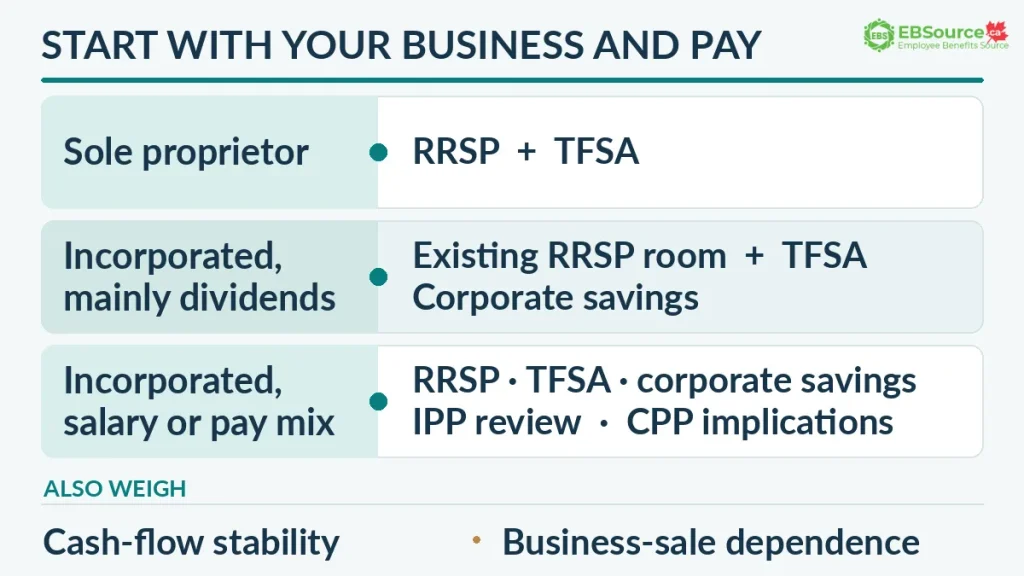
Below is a starting point for your discussion with an advisor; please note that this is not a recommendation. It outlines where each type of owner typically begins and who should be involved in the conversation.
| Your situation | What to investigate first | Specialist to involve |
|---|---|---|
| Sole proprietor | RRSP room from net self-employment income, plus a TFSA | Accountant |
| Incorporated, paid mainly in dividends | Existing RRSP room, a TFSA and savings kept in the corporation | Accountant |
| Incorporated, paid a salary or a salary-dividend mix | RRSP room, a TFSA, savings kept in the corporation, CPP implications and whether an IPP comparison is warranted | Accountant, plus an actuary for any IPP |
This table shows where to begin, but it does not dictate which option to select. Your actual RRSP room, income, and business plans may lead you to a different row. Two key factors matter, whichever row you are in:
- how steady your business’s cash flow is, and
- how much your retirement depends on selling the business.
Both are covered later below. If you also want to offer retirement benefits to your employees, explore small business retirement plans in Canada. Employer-sponsored plans for your workforce involve different eligibility, contribution and administration decisions than planning your own retirement.
How Do Your Business Structure and Your Earnings Affect Your Retirement Options?
How you set up your business and how you pay yourself decide how much Registered Retirement Savings Plan room you build, whether you contribute to the Canada Pension Plan, and whether a corporate pension is realistic.
Salary and qualifying net income from self-employment can count as earned income and create RRSP room, while dividends from your corporation do not.
The rule that connects all three is earned income. Your RRSP deduction limit generally reflects 18% of your previous year’s earned income, subject to the annual maximum, unused room and applicable pension adjustments. Use the deduction limit shown in your latest CRA assessment rather than relying on the 18% calculation alone. Salary and net self-employment income count as earned income, while dividends from your corporation do not.
The table below shows how each way of paying yourself affects the three outcomes:
| How you are paid | New RRSP room | CPP contributions | IPP |
|---|---|---|---|
| Sole proprietor (net self-employment income) | Yes, based on net income after expenses | Yes, on net self-employment earnings | Generally not available |
| Incorporated, paid a salary | Yes, reduced by any pension adjustment | Yes, shared between you and the corporation | Possible through the corporation |
| Incorporated, paid only dividends | No new room, but existing room can still be used | No | Generally not, because an IPP is usually built around salary |
Many owners use a mix of salary and dividends, so the effects above often combine. Choosing how to pay yourself is also a retirement decision, because it shapes your RRSP room, your future CPP pension and whether an IPP is an option. Tax, CPP and cash-flow effects vary from owner to owner, so ask your accountant to model the options using your own numbers rather than relying on a general rule.
How Can You Set Aside Retirement Savings Without Impacting Business Cash Flow?
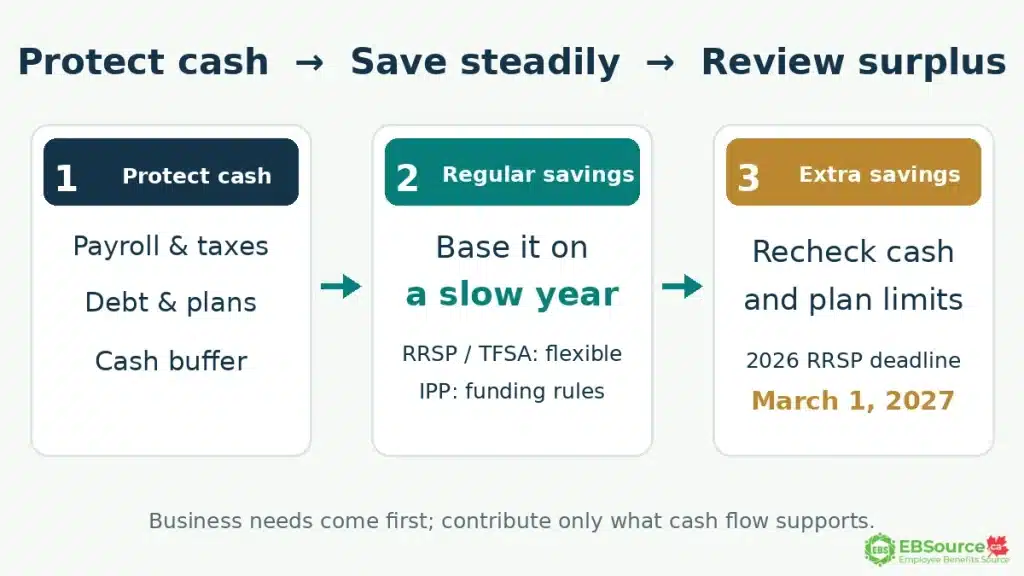
BC small business owners often struggle with retirement saving because business income rises and falls, while bills keep arriving on schedule. So, only after your year-end figures confirm a strong year, work out how much cash the business does not need, set a regular contribution the business could still afford in a slow year, and decide on any extra contributions. This keeps your retirement savings steady without putting the business at risk.
The three steps below help you save in a way the business can actually sustain.
Step 1: Find the Cash the Business Does Not Need
A healthy bank balance does not mean all of that money is free to save. Before choosing a retirement amount, subtract what the business has already committed to pay:
- Payroll and remittances: wages, source deductions and other amounts due on a fixed schedule.
- Tax payments: sales tax, corporate tax instalments and any balance owing at year-end.
- Debt payments: loan and lease payments, including any large payments or renewals coming up.
- Planned spending: equipment, hiring or expansion you have already decided to fund.
- A cash buffer: a reserve sized to how much your own revenue tends to swing.
What is left is the money you can realistically use for retirement savings. If that amount is small or hard to predict, flexible options such as an RRSP or a TFSA usually fit better than a plan that requires fixed annual funding.
If your business is still growing and you are considering retirement benefits for new hires, startup retirement benefits can help you evaluate those commitments alongside hiring costs and business cash flow.
Step 2: Establish a Sustainable Regular Contribution
You should base your regular contribution on what the business could afford if revenue dropped, not on your best year. That way, a weak year does not force you to choose between the business and your savings.
How much flexibility you have depends on the type of plan:
- RRSP and TFSA: You decide how much to contribute each year. Unused RRSP room carries forward to later years, so contributing less in a slow year does not mean losing that room.
- IPP: The plan’s actuarial valuation sets the contributions your corporation is expected to make, so the amount is not fully in your control. Before starting an IPP, ask your actuary how much the company must contribute each year under your plan terms and the pension rules that apply, and what happens if the business has a bad year.
If your cash flow is irregular, stick with flexible contributions until you are confident the business can carry a formal pension commitment.
For example, Ellie runs a catering company in Nanaimo that is busy in summer and quiet in winter. For 2026, she sets her regular RRSP contribution at a level her winter months could still support. She leaves any larger contribution until after year-end, when she can see how the full year turned out.
Step 3: Determine Additional Year-End Contributions
BC small business owners should review additional RRSP contributions before the applicable contribution deadline. For the 2026 tax year, that deadline is March 1, 2027. Do not wait for completed corporate financial statements if doing so would cause you to miss the deadline.
Book a yearly review with your accountant or planner and work through these points in order:
- Business needs: how much cash the business needs for the coming year.
- RRSP room: your available deduction limit, including room carried forward.
- TFSA room: your available room, including amounts you withdrew in earlier years.
- IPP limits: whether your plan’s funding rules allow any extra contribution at all.
- Money left in the corporation: how much surplus to keep invested in the company, given the investment income it earns.
Confirm your RRSP room before making any large contribution. Contributions more than $2,000 above your RRSP deduction limit are taxed at 1% per month on the excess.
A strong year does not mean the business should pay out everything it earned. Keep what the business needs first, then decide how to use the rest with your adviser.
Which BC Tax and Pension Rules Should You Check Before Choosing a Retirement Strategy?
Every BC owner should check one thing: how federal and BC taxes together affect what you actually keep under each option. If you are considering an Individual Pension Plan, check a second thing: which pension rules govern the plan, because BC changed its rules on April 30, 2026, for plans whose members are all specified individuals.
The two checks below are where being in British Columbia can change your result:
Check 1: Compare Options Based on Your British Columbia After-Tax Value
BC retirement options are taxed at different stages, so comparing them by a single tax rate can be misleading. You need to look at the after-tax result from the moment the business earns the money to the moment you spend it in retirement:
- Money kept in the corporation: It is taxed inside the corporation first, then taxed again personally when it is paid out to you as salary or dividends.
- RRSP contributions: They reduce your personal tax now, and the tax is paid later when you withdraw the money in retirement.
BC’s corporate rates are one part of that calculation. BC’s provincial corporate income tax rate is:
- 2% on qualifying active business income eligible for the small business rate, up to the $500,000 business limit.
- 12% at the general rate, which applies to income above that limit and to income that does not qualify, such as investment income.
In addition, federal rules add further tax layers for investment income held in a corporation, so the BC rate alone does not show the full cost. On the personal side, BC’s personal income tax rates and brackets change each year, so make sure you are using the rates for the year you are modelling.
For example, Jennie is the sole shareholder of a bookkeeping firm in Surrey. For 2026, she asks her accountant to compare two paths using the same income, the same retirement date and combined federal and BC rates for that year. In the first path, she pays herself a salary and contributes to an RRSP. In the second, she leaves the money in the corporation. To estimate the personal tax side, you can use the EBSource BC income tax calculator.
Check 2: Confirm Applicable Pension Rules When Considering an IPP
This check matters only if your corporation sponsors, or plans to sponsor, an IPP or another pension plan for you. The answer affects what the plan must comply with and how it is supervised.
Does BC Pension Law Apply To Your Retirement Plan?
Usually, yes. Pension plans for BC employees generally fall under BC’s Pension Benefits Standards Act (PBSA) and its regulation, supervised by the BC Financial Services Authority (BCFSA).
The main exception is federally regulated work. The PBSA does not apply to employees whose pensions fall under federal jurisdiction, such as those in banking, airlines, broadcasting and telecommunications. If your business is in a federally regulated industry, different pension rules may apply.
Does Your IPP Qualify For BC’s New Exemption?
It may, if every plan member is a specified individual under the federal Income Tax Regulations. For many owner-only IPPs, since April 30, 2026, qualifying plans are exempt from most of the PBSA and its regulation, except the provisions preserved by section 12 of the Regulation. Federal registration and tax rules still apply.
Do not assume your IPP qualifies automatically. Have your actuary or plan administrator check and document it. If your plan is already registered with BCFSA and appears to qualify, BCFSA asks administrators to contact it.
Before you commit to an IPP, ask your actuary or plan administrator to confirm in writing:
- Governing law: whether BC or federal pension rules apply to your plan.
- Exemption status: whether the plan qualifies for BC’s specified individual plan exemption.
- Remaining obligations: which section 12 provisions and federal requirements the plan must still meet.
How Will You Draw Income During Retirement from Your BC Business?
Your savings will support you best if you plan your income in stages as you step back, make sure the plan still works if the business sells for less or later than you hope, and sort out any company pension before the business is sold or closed. Most BC owners do not stop working on a single date, and much of their retirement money is tied to the business.
The three sections below follow that path in order: the income you will draw as you reduce your role, the business sale, and what happens to your pension when the company ends.
Plan Retirement Income in Stages Rather Than a Fixed Date
Some business owners in British Columbia step back gradually, cutting their hours first, then perhaps staying on in an advisory role before retiring fully. Your income changes at each stage, so plan each one separately. For every stage, estimate what you expect to spend and decide which sources of income will cover it.
A typical path looks like this:
- Reduced hours: a lower salary or dividends from the business, topped up from personal savings if needed.
- Advisory role: a smaller and possibly irregular income from the company, or none if it has been sold.
- Full retirement: registered savings, any IPP pension, corporate savings, sale proceeds and public pensions.
Remember that each source is taxed differently, which affects how much you actually have to spend. RRSP withdrawals and pension payments are taxable income, while TFSA withdrawals generally are not.
Public pensions belong on the same timeline. Place the Canada Pension Plan and Old Age Security at the age you expect each one to start, since your income in the years before they begin will need to come from other sources. Treat them as one part of your retirement income rather than the base it is built on, because for most owners they will cover only part of what you spend.
For example, Daniel owns a trucking company in Prince George. He plans to work three days a week from 2030, then retire fully when he sells. His timeline shows several years in which his business income drops, but neither his public pensions nor his sale proceeds have started yet. He builds up TFSA savings to cover that gap.
Ensure the Plan Remains Effective if the Business Sale Falls Short
If your retirement depends on selling the business, do not plan around only the price you hope for. Ask your adviser to run three versions:
- Expected sale: the price and timing you are planning for.
- Later sale: the same sale, two or three years later.
- Lower sale: a sale at a reduced price.
Remember that the sale price is not the amount you will have to spend. Business debt, tax, transaction costs and payments spread over several years can all reduce what you receive. The tax depends on how the sale is structured, so ask your tax adviser:
- whether you expect a share sale or an asset sale, and
- whether your shares may meet the tests for qualified small business corporation shares, which may qualify for the lifetime capital gains deduction.
If your plan only works in the best-case sale, start building more savings outside the business now. That way the sale adds to your retirement instead of deciding it.
Settle Your Company Pension Before Selling or Closing the Business
If your corporation sponsors an IPP or another pension for you, deal with it early in the sale or wind-up process, not after. Who will sponsor the plan, whether it continues and how your benefits are paid out all depend on the plan terms and the pension rules that apply. Ask your actuary and plan administrator to confirm your options and timing before the deal moves forward.
Do not assume you can move the full value into your RRSP tax-free:
- Lump-sum transfers: When a lump sum is transferred out of a defined benefit plan such as an IPP, only the amount up to a prescribed limit can be moved tax-deferred. Any amount above that limit is generally taxable income in the year you receive it.
- Underfunded plans: Special rules can apply to transfers from an underfunded IPP.
Have your actuary calculate your figures before you sign anything.
Which Technical Rules Can Affect a BC Small Business Owner’s Retirement Plan?
Four additional rules can affect incorporated owners who hold investments in their company or participate in an IPP. They are how specified individual status shapes an IPP, how corporate investment income can shrink the small business limit, when IPP minimum payments begin, and which further BC pension amendments are scheduled for October 30, 2026.
You do not need to apply these rules yourself, but knowing them helps you ask your accountant or actuary the right questions.
The table below shows who each rule affects:
| Rule | Who it affects | Who to ask |
|---|---|---|
| Specified individual status | Owners who have, or are considering, an IPP | Actuary |
| October 30, 2026 BC pension amendments | Pension plans under BC’s PBSA, including some that may qualify for the exemption | Actuary or plan administrator |
| IPP minimum payments after 71 | IPP members who plan to keep working or defer income past 71 | Actuary |
| Passive investment income rule | Corporations that keep savings invested | Accountant |
How Specified Individual Status Influences IPP Structure
You are a specified individual if you are connected to the employer that sponsors the plan, or if you earn more than 2.5 times the year’s maximum pensionable earnings (YMPE) from participating employers. With a 2026 YMPE of $74,600, that income threshold is $186,500 for 2026.
This status affects your IPP in two ways:
- Federal designated plan rules: A defined benefit plan in which specified individuals hold more than half of the pension credits becomes a designated plan. CRA applies extra conditions to these plans and to IPPs, including funding restrictions.
- BC’s exemption: BC’s specified individual plan exemption applies only when every plan member is a specified individual under the federal Income Tax Regulations. Even then, BC’s pension regulation sets out provisions that still apply to exempt plans.
What you should do is ask your actuary to confirm your status before the retirement plan for small business owners in BC is designed, not after.
Upcoming BC Pension Amendments Effective October 30, 2026
As of October 7, 2026, a further set of amendments to BC’s PBSA and its regulation is scheduled to take effect on October 30, 2026. This follows the April 30 changes for specified individual plans.
The amendments include two changes:
- Automatic contribution increases: Qualifying defined contribution plans with automatic enrolment will be allowed to raise member contributions automatically, subject to notice and opt-out requirements.
- Surviving spouse rights: If a member dies before retirement, the surviving spouse will have the right to choose a pension.
BCFSA notes that these amendments will generally require changes to plan documents. If your IPP qualifies for the specified individual plan exemption, ask your actuary whether either change applies to it.
IPP Minimum Payment Requirements After Age 71
An IPP does not let you delay payments indefinitely. Federal tax rules require an IPP to pay at least a minimum annual amount for each year after the year in which the member turns 71.
Each year, you receive the greater of two amounts: the pension your plan’s benefit formula provides, or the IPP minimum amount. This means your payment can be higher than the formula pension alone, which can add to your taxable income.
If you expect to keep working or to live on other income past 71, ask your actuary how the minimum will interact with your plan and your tax bracket.
Corporate Investment Income and Its Impact on the Small Business Limit
This rule depends on how much investment income the corporation earns, not on the size of its investment balance. The federal passive income rule is based on the adjusted aggregate investment income earned by your Canadian-controlled private corporation (CCPC) and any associated corporations:
- Below $50,000: The business limit is not reduced.
- Between $50,000 and $150,000: The business limit is reduced gradually.
- Above $150,000: None of the business limit remains.
This also affects your BC taxes. In BC, the lower small business rate applies to active business income eligible for the federal small business deduction, so a reduced federal limit can mean less of your income is taxed at BC’s 2% rate.
If your corporation’s investment income is approaching $50,000, have your accountant model the effect before you decide how much to keep invested in the company.
Key Information to Prepare for a Retirement Planning Meeting
In a retirement planning meeting for small business owners in BC, bring records showing how your business is set up, how you have paid yourself, how much registered room you have left, and what your plan depends on. With these, your accountant or planner can compare your options on the same facts and help you leave with clear decisions. Prepare both the financial records your advisers need and the decisions you want to leave the meeting with.
Here are things to gather before the meeting:
- Business structure: incorporation documents, share ownership and any associated companies.
- Tax records: recent personal returns, notices of assessment and corporate financial statements.
- Pay history: salary and dividend amounts for recent years, with your T4 slips.
- Registered plans: RRSP, TFSA and any pension statements, including the pension adjustment in T4 box 52.
- Corporate investments: current balances held in the company and the investment income they earn.
- Business commitments: debts, cash needs, your target retirement timeline and expected sale terms.
Do not leave out the T4 because it seems routine. The pension adjustment in box 52 is the figure your adviser needs to confirm what you can actually contribute next year.
In addition, aim to leave the meeting with decisions, not just information:
- Pay mix: the salary and dividend split for the coming year, and its effect on RRSP room and CPP.
- Contribution plan: a regular amount for each account that the business can fund in a slower year.
- Corporate savings: how much surplus stays invested in the company and how it is expected to come out.
- IPP decision: whether an actuarial comparison is worth ordering, or why it is not.
- Sale scenarios: the expected, later and lower sale versions your plan has been tested against.
- Review date: when you will revisit the plan once year-end figures are final.
Your next step: Bring your recent notices of assessment, T4 slips, corporate financial statements, current RRSP and TFSA room, and your expected retirement and business-sale timeline to the same planning discussion. Ask your accountant or planner to compare the options using one set of assumptions, and involve an actuary before deciding whether an IPP fits.