
Stress Leave in Canada: Job Protection, Pay and How to Apply


Stress leave in Canada may qualify as job-protected sick or medical leave when a stress-related illness prevents you from working, and you meet the applicable requirements. Pay during stress leave depends on your entitlements and coverage. Paid sick days, an employer disability plan or EI sickness benefits may provide income, subject to separate eligibility rules.
To arrange stress leave, inform your employer and meet the notice and evidence requirements. If your health is impacting your work, get a medical assessment. Apply separately for any income benefits you need.
This guide outlines the leave rules to check, the required documentation, and how to evaluate your income options, beginning with the definition of “stress leave.”
On this page
What is stress leave?
Stress leave is a common term for taking a leave of absence from work when stress-related health problems prevent you from working. In Canada, the legal entitlement generally comes through sick or medical leave, or disability-related accommodation, rather than a separate leave category called “stress leave.” Requirements depend on the employment laws that cover your job and the protection you seek.

When Does Stress Become a Reason for Leave?
Feeling overwhelmed alone does not create an entitlement to protected medical leave. The important question is how your health affects your ability to perform your job. For example, symptoms may interfere with concentration, decision-making, sleep or your ability to carry out safety-sensitive duties. These effects can help explain why you need medical assessment, but they are not a checklist that automatically qualifies you for leave. A healthcare professional can assess your condition and whether time away or work adjustments are appropriate.
Does Your Condition Have to Be Caused by Work?
No. You don’t need to show that your condition is work-related to qualify for sick or medical leave. The key is meeting the requirements, including any necessary proof of your illness or inability to work. If you believe your job caused or contributed to your condition, consider applying for workers’ compensation. Coverage for psychological injuries depends on local rules, medical evidence, and the workplace situation.
Note: Feeling stressed or receiving medical advice to take leave doesn’t automatically qualify as a workplace injury for compensation.
How Stress-Leave Rules Differ Across Canada
Because Canada doesn’t recognize ‘stress leave’ as a separate legal category, your rights fall under your jurisdiction’s standard medical and sick leave laws. Therefore, start by confirming which employment standards law covers your job. Your province of residence alone does not determine this; some workplaces are federally regulated.
The table below summarizes statutory sick and medical leave provisions that may apply to a stress-related illness. The federal row applies to workplaces covered by Part III of the Canada Labour Code.
| Stress leave by jurisdiction | Leave that may apply and duration |
| Federal stress leave |
Medical leave: up to 27 unpaid weeks.
Paid medical leave: up to 10 days per year, earned through accrual. |
| British Columbia stress leave |
Illness or injury leave: 5 paid + 3 unpaid days per calendar year.
Serious personal illness or injury leave: up to 27 unpaid weeks in 52 weeks. |
| Alberta stress leave |
Personal and family responsibility leave: up to 5 unpaid days per calendar year, including personal health needs.
Long-term illness and injury leave: up to 27 unpaid weeks per calendar year. |
| Saskatchewan stress leave | Illness or injury absence protection: up to 12 days per calendar year for non-serious illness or injury; up to 27 weeks in 52 weeks for serious illness or injury. No statutory pay requirement. |
| Manitoba stress leave |
Family leave: up to 3 unpaid days per year, including personal health needs.
Long-term leave for serious injury or illness: up to 27 unpaid weeks in 52 weeks. |
| Ontario stress leave |
Sick leave: up to 3 unpaid days per calendar year.
Long-term illness leave: up to 27 unpaid weeks in 52 weeks. |
| Québec stress leave | Absence for non-work-related illness or accident: up to 26 weeks in 12 months. Up to 2 days may be paid, subject to eligibility and the shared annual allowance. |
| New Brunswick stress leave |
Sick leave: up to 5 unpaid days in 12 months.
Long-term illness and injury leave: up to 27 unpaid weeks in 52 weeks. |
| Nova Scotia stress leave |
Sick leave: up to 5 unpaid days per year.
Serious illness or injury leave: up to 27 unpaid weeks in 52 weeks. |
| Prince Edward Island stress leave |
Sick leave: up to 4 unpaid days in 12 months, plus 1–3 paid days depending on service.
Medical leave: up to 27 unpaid weeks in 52 weeks. |
| Newfoundland and Labrador stress leave |
Sick/family responsibility leave: up to 7 unpaid days per year, shared with qualifying family responsibilities.
Long-term illness or injury leave: up to 27 unpaid weeks in 52 weeks. |
| Northwest Territories stress leave | Sick leave: at least 5 unpaid days in each 12-month period. |
| Yukon stress leave | Sick leave: 1 unpaid day per month worked, subject to a 12-day maximum and leave already used. |
| Nunavut stress leave | No general sick or medical leave entitlement is specified in the territorial Act. |
Statutory Medical and Sick Leave Entitlements by Canadian Jurisdiction. Sources: Federal Labour Program and provincial or territorial employment standards authorities.
Important note: These limits are statutory maximums, not medical recovery timelines. You must meet specific service, notice, and medical-evidence requirements, and short and extended leave periods do not automatically stack. If you need further support, your workplace contract or human rights disability accommodations may provide different or greater options.
What Medical Evidence Do You Need for Stress Leave?
The evidence you need depends on the length of your absence (short absences or long absences), the leave or benefit you are applying for, and the law covering your job.
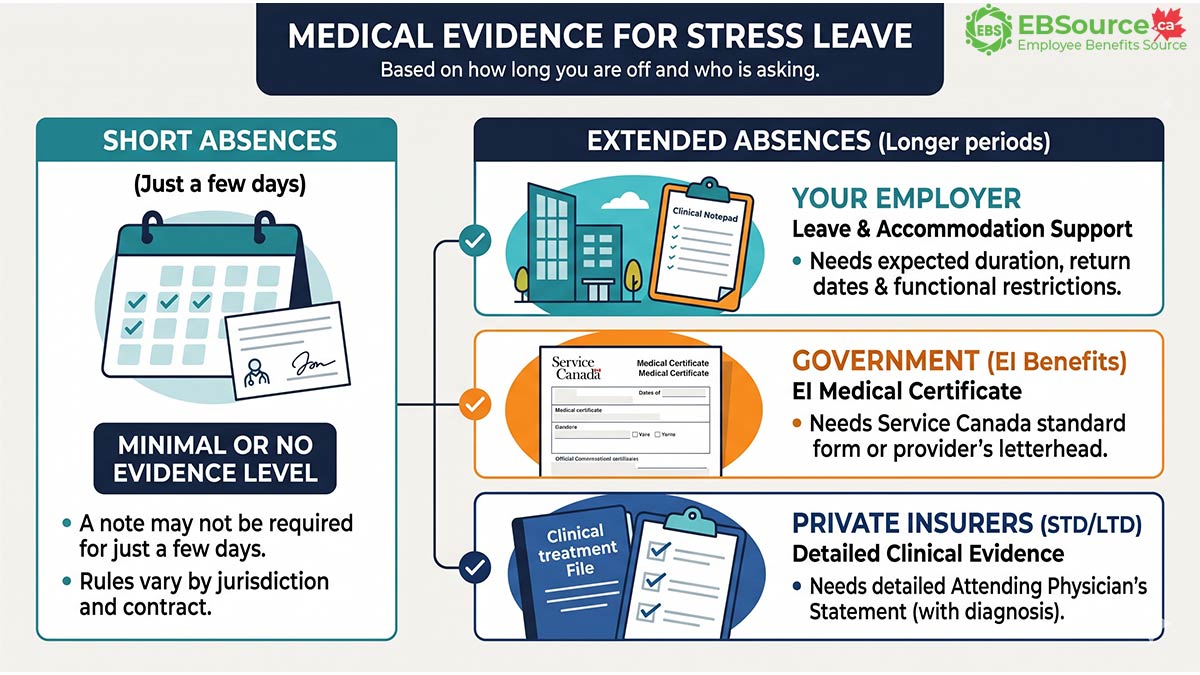
For Short Absences
For an absence of just a few days, you may not need a medical certificate at all. Rules vary by jurisdiction, for example:
- Ontario: Employers cannot require a medical note for the three unpaid sick days available under the Employment Standards Act.
- Quebec: As of January 1, 2025, employers cannot request a certificate for the first three absences of three days or less within 12 months.
- Federally regulated workplaces: Employers can require a medical certificate only if the absence lasts five or more consecutive days.
Before assuming a medical note is (or isn’t) required, always verify the evidence rules directly with your jurisdiction’s official employment standards authority.
For Extended Absences
Employers, government programs, and insurance companies all enforce different rules. How much medical detail you must share depends on who is asking for the documentation:
- For Your Employer: The information required for the specific leave or accommodation process, which may include the relevant medical confirmation, expected duration and functional restrictions.
- For Employment Insurance (EI) Sickness Benefits: You need a medical certificate on Service Canada’s standard form or your provider’s letterhead. It can be signed by a qualified healthcare professional.
- For Private Disability Insurers (STD/LTD): You need detailed medical forms, such as an Attending Physician’s Statement, that include your clinical diagnosis, symptom severity, test results, and treatment plan. Depending on your contract, you may also need a specialist’s evaluation to approve your claim.
How Does Job Protection Work During Stress Leave?
The protection depends on whether you qualify for sick or medical leave under the law that covers your workplace, whether your condition is a disability that requires workplace support, or both. The two protections have different rules and may last for different lengths of time.
The True Meaning of “Job Protection”
- No Penalties: Job protection generally means your employer cannot legally penalize or fire you simply for exercising your right to take an approved leave.
- Reinstatement Rights: Your exact right to return to your previous position (or a comparable one) depends on your local laws.
Protection Under Statutory Sick or Medical Leave
To qualify for job protection under your jurisdiction’s employment laws, your absence must meet specific statutory conditions:
- Basic Requirements: You must meet minimum length-of-service requirements, provide required medical evidence, and follow notice rules (even for unexpected absences).
- Separate Entitlements: Short-term sick leave and extended medical leave are often treated as distinct categories.
- Paid vs. Unpaid: Running out of paid sick days doesn’t mean you lose job protection; you may still be entitled to unpaid statutory leave.
- Medical Notes vs. Legal Limits: A doctor’s note recommending several weeks off does not automatically guarantee you entitlement to that entire period if it exceeds your statutory limit.
Protection Under Disability-Related Accommodations
If your condition qualifies as a disability, human rights legislation provides a separate layer of protection that goes beyond standard employment law:
- Broader Coverage: Employers must accommodate you even if you haven’t worked there long enough to qualify for statutory leave or have already exhausted your standard leave limits.
- Types of Support: Depending on your needs, accommodations can involve additional leave, modified duties, adjusted hours, or a gradual return to work.
- The Limit: Employers are legally required to provide these accommodations up to the point of “undue hardship.”
Is Stress Leave Paid in Canada?
Stress leave is not automatically paid. Depending on your eligibility and coverage, income may come from paid sick days, employer sick pay, disability benefits or EI sickness benefits.
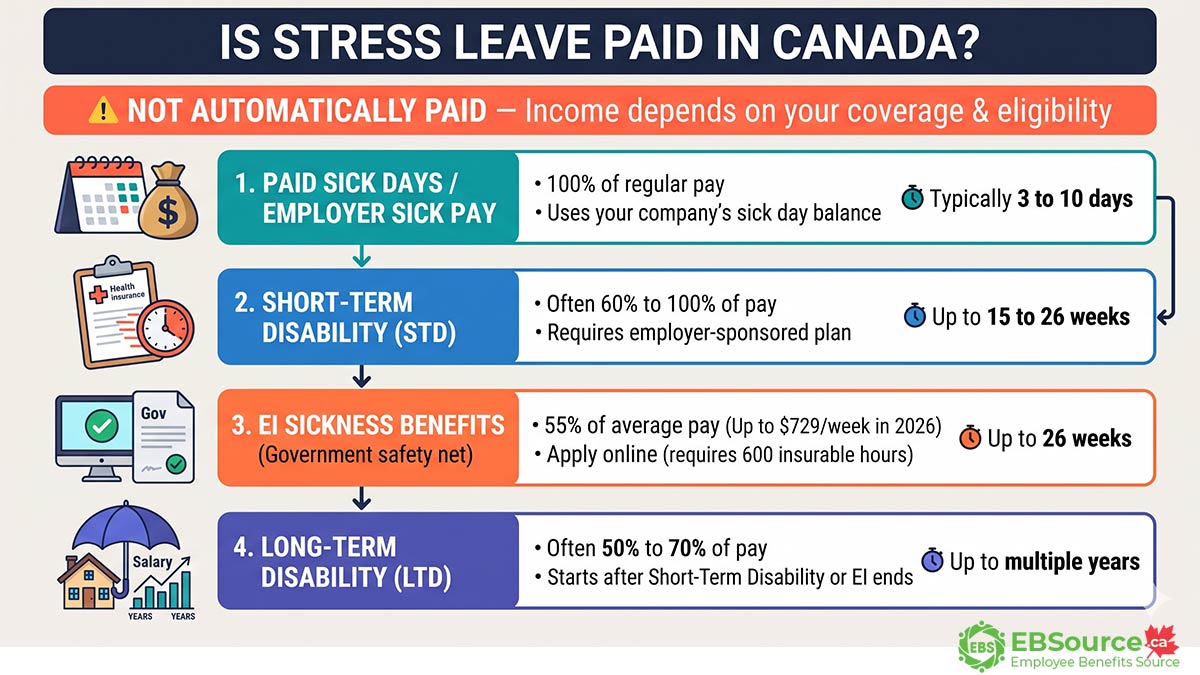
Statutory Paid Sick Days
Only some Canadian jurisdictions require employers to provide paid statutory sick days.
- Federally regulated employees can earn up to 10 paid medical leave days per year. (Source)
- British Columbia provides 5 paid illness or injury days per year after 90 days of employment. (Source)
- Québec provides 2 paid days per year after 3 months of employment. (Source)
- Prince Edward Island also offers paid statutory sick leave, with eligible employees receiving one, two, or three paid days per 12-month period after 12, 24, or 36 months of continuous service, respectively. (Source)
Employer-Paid Sick or Personal Leave
Take a look at your employment contract, sick-pay policy, or any collective agreements you might have. Many employers, especially large companies and union jobs, provide paid sick days beyond the minimum requirements.
Short-Term Disability Benefits
If your workplace offers a group benefits plan, or if you hold a private insurance policy, you may be eligible for short-term disability (STD) benefits. Your STD plan sets the benefit percentage, maximum payment, waiting period, claim deadline and payment duration. Confirm how it coordinates with paid sick leave and EI.
Because every plan is structured differently, always check your employee benefits booklet or contact HR to confirm your specific terms.
Employment Insurance Sickness Benefits
In 2026, EI sickness benefits may pay 55% of average insurable weekly earnings calculated under Service Canada’s best-weeks method, up to $729 a week, for as many as 26 weeks. If your employer does not offer short-term disability (STD) coverage, Employment Insurance (EI) sickness benefits can provide temporary income while you are away. You apply for these benefits directly through Service Canada. The main eligibility requirements include:
- You are medically unable to work;
- Your regular weekly earnings decrease by more than 40% for at least one week; and
- You have accumulated at least 600 insured hours of work during your qualifying period.
(This period is either the 52 weeks before your claim or since the start of your last EI claim, whichever is shorter).
Tell Service Canada about any disability payments you receive. Their effect on EI depends on the type of plan, and your disability policy may also contain offsets. Confirm the rules for both benefits before assuming how much you will receive.
Source: EI sickness benefits: What these benefits offer – Canada.ca; EI sickness benefits: Do you qualify – Canada.ca
Long-Term Disability Benefits
Long-term disability (LTD) insurance provides extended income replacement if a serious condition keeps you off work for a prolonged period, though policy terms and structures vary significantly. Because LTD contracts vary widely in waiting periods, benefit caps, and disability definitions, always consult your benefits booklet or plan administrator to confirm your coverage details.
Which Stress Leave Option Applies to Your Situation?
Decide which stress leave option fits your situation based on how long you need to be away, whether you can work with some changes, and if your issue is due to something that happened at work. The table below shows common situations employees face, along with suitable leave types and possible income sources.
| If this describes you | Main route to check | Possible income source |
| You need only a few days away |
Employer sick days
Short-term statutory sick leave Medical leave |
Statutory paid sick days, if eligible;
Employer sick pay, where available. |
| You are medically unable to work for several weeks or months |
Extended medical leave
Serious illness leave Long-term illness leave |
Employer sick pay
Short-term disability (STD) plan EI sickness benefits |
| You can work, but not under your usual conditions | Disability accommodation under human rights legislation |
Regular wages for hours worked
Partial disability benefits may apply under your employer’s plan |
| You have a diagnosed condition related to workplace harassment, violence, or trauma. |
Workers’ compensation claim
Medical leave Work accommodations |
Wage-loss benefits if the claim is accepted |
Decision matrix matching employee circumstances to Canadian stress leave options and income sources.
Check if your condition meets your provincial or territorial workers’ compensation board’s criteria for a work-related psychological injury. You may still need medical leave and accommodations while your claim is being assessed.
How to Start Stress Leave
Tell your employer as soon as you know you can’t work, and book a medical assessment. You don’t need every form or payment decision in place to get started. But your job protection depends on following the leave rules that apply to you, so the steps below matter.
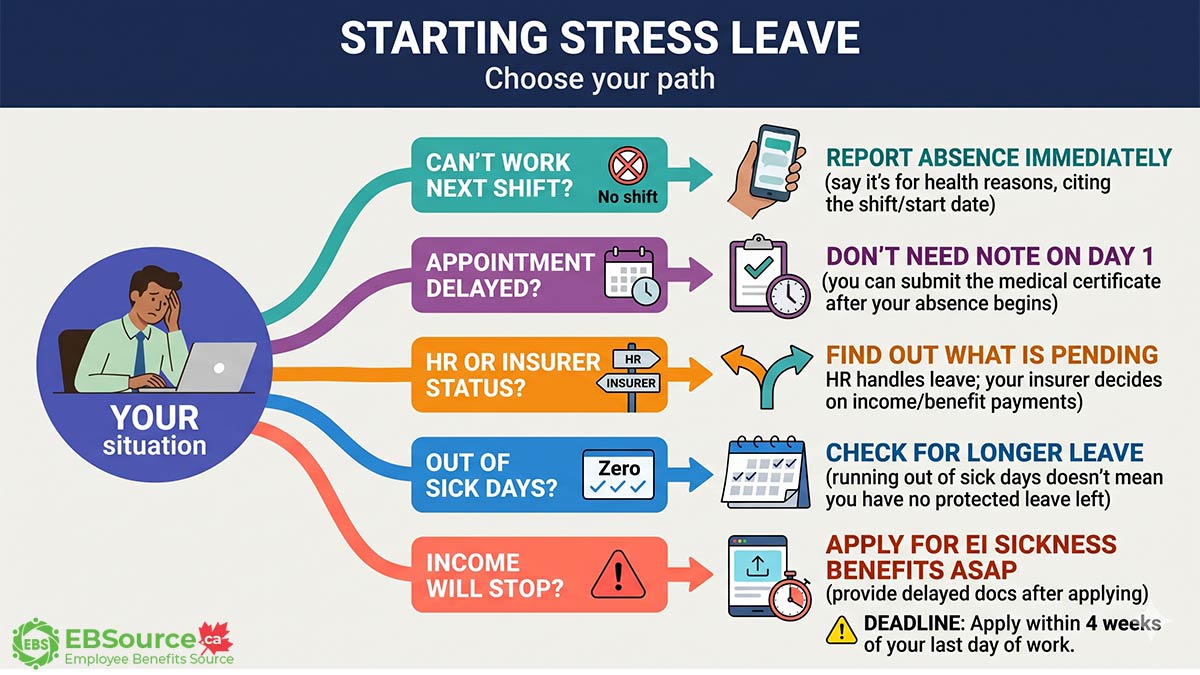
If you can’t work your next shift
Report your absence right away, even if you don’t have a full plan. Say that you can’t attend for a health reason. Name the shift or start date affected, and use your workplace’s usual process for reporting an absence if you can. Notice rules differ depending on whether your absence is sudden or planned:
- Federally regulated employees generally must give four weeks’ written notice of medical leave. If there’s a valid reason you can’t, give notice as soon as possible.
- Ontario employees under the Employment Standards Act (ESA) can also notify their employer as soon as possible after leave starts, when advance notice isn’t realistic.
Keep a record of what you told your employer and when.
If your appointment is after your first day away
You don’t necessarily need a medical certificate in hand the day your leave starts. Short absences may not require a note at all, but extended leave generally does. If your doctor’s appointment is delayed, you can usually submit the paperwork after your absence begins. In addition, be aware that failing to provide requested documentation can eventually void your job protection. Ontario’s long-term illness leave shows how this works:
- You can start the leave before you get the medical certificate.
- A qualifying certificate must be issued later. Without it, you don’t get job protection for that leave.
- You need at least 13 consecutive weeks of employment to qualify.
Alberta handles this differently. It requires the long-term illness certificate before your leave starts. If you can’t get it beforehand, you can provide it as soon as reasonably possible. If you don’t know when you’ll return, say that your assessment is still pending. Share any estimate you have, and update your employer when your medical information changes. Set a date for your next update, but remember that an update date doesn’t replace an expected return date or a certificate when one is required.
If HR or the insurer says to wait
Find out which decision is pending, because HR and your insurer decide different things. HR may be working out which leave applies or reviewing your medical evidence. The insurer decides whether you can receive income payments. Ask HR two questions:
- How is my absence being recorded right now?
- What exactly do I still need to provide to qualify for leave?
A pending payment claim doesn’t decide whether you have job protection. Telling your employer about your absence doesn’t guarantee protection either.
If you’ve used all your sick days
Running out of sick days doesn’t mean you have no protected leave left. You may still have longer leave available. Longer leave isn’t simply an extension of your sick days. In Ontario, short-term sick leave and long-term illness leave have separate eligibility rules, so using up one doesn’t decide the other. You have to meet its own conditions. If you’re outside Ontario, check what your province or territory offers.
If your income will stop before the paperwork is done
Contact your employer or disability insurer promptly to confirm the claim deadline and required forms. For EI sickness benefits, apply as soon as possible after you stop working; you can provide required documents after submitting the application. If you apply more than four weeks after your last day of work, you may lose benefits. You’ll still need to get the required medical evidence. Submitting an application doesn’t mean you’ll be approved.
Frequently Asked Questions About Stress Leave in Canada
What If You Need Stress Leave but Do Not Have a Family Doctor?
A family doctor is not the only professional who can provide medical evidence. For EI sickness benefits, eligible professionals include nurse practitioners and psychologists treating a condition within their expertise.
Do You Need to See a Psychiatrist Before Taking Stress Leave?
A psychiatrist is not a universal requirement. For example, Service Canada accepts EI sickness certificates from several types of treating medical professionals. However, a workers’ compensation claim for a psychological injury may have different diagnostic requirements, depending on the jurisdiction.
Can Your Manager Contact You During Stress Leave?
Some contact may be appropriate to discuss leave administration, updates and your eventual return. Agree on a contact person, communication method and reasonable frequency. If calls or messages worsen your symptoms, explain the difficulty and request an arrangement that supports your recovery while allowing necessary communication.
Can You Travel Outside Canada During Stress Leave?
Travel can affect your income benefits even when you remain on leave from work. EI sickness benefits are generally not payable while you are outside Canada, except in limited circumstances for qualifying medical treatment.
What If You Have Two Jobs and Need Leave From Only One?
Get medical advice that addresses the duties of each job. Different duties may involve different limitations, but continuing another job can affect the assessment of your benefit claim. Tell Service Canada or your insurer about both jobs, and report any work and earnings rather than assuming they are irrelevant.