
Group Disability Insurance in Canada: Coverage Options and Plan Design Decisions


Group disability insurance is an employer-sponsored benefit that replaces a portion of an employee’s income when illness or injury prevents them from working. As part of a broader group insurance, typically offered alongside extended health, dental, and life insurance benefits, group disability insurance has two core coverage types: short-term disability (STD) and long-term disability (LTD).
For planning purposes, Canadian employers can compare five approaches to disability income protection: LTD-only coverage, insured STD and LTD, self-insured short-term benefits with insured LTD, EI sickness benefits with an employer top-up and insured LTD, or no employer-sponsored disability coverage.
Once coverage options are considered, employers need to decide on key plan design features, including the elimination period, disability definition, benefit percentage, and offsets that may reduce payments.
On this page
What is Group Disability Insurance in Canada?
Group disability insurance is an employer-sponsored benefit that replaces a percentage of an employee’s pre-disability income when a covered illness or injury prevents them from working.
When an eligible employee becomes unable to work due to a covered illness or injury, the plan pays a percentage of that employee’s regular pre-disability earnings. Most plans replace between 60% and 85% of pre-disability income, though the actual benefit depends on the policy’s benefit formula, maximum amounts, eligibility criteria, and any offsets that may apply.
While Canadian employment standards do not generally require employers to purchase group disability insurance, many employers choose to offer it as part of a competitive employee benefits package. In some cases, coverage may be required through a collective agreement, employment contract, or employer policy. It’s also important to note that whether or not an employer provides disability insurance, they still have separate obligations under employment and human rights law regarding leave and workplace accommodation.
By offering group disability insurance, employers can attract and retain employees, particularly in industries where skilled workers expect income protection as part of their total compensation.
Types of Group Disability Insurance
Group disability coverage is divided into two types: short-term disability (STD) and long-term disability (LTD).
STD provides income replacement during the initial weeks or months of a disability, while LTD extends coverage for prolonged disabilities that may last for years or until retirement age, depending on the plan.
When both are included in a benefits plan, STD and LTD can work together as consecutive layers of income replacement. STD provides benefits during the initial period of a disability, while LTD is designed to take over when the STD benefit period ends, and the employee meets the LTD plan’s eligibility requirements.
The following table summarizes how the two coverage types compare across the features that matter most to plan design:
| Feature | STD | LTD |
| Typical benefit duration | Up to 6 months | 2 years to age 65, depending on the plan |
| Common elimination period | 7 to 14 days | 90 to 180 days |
| Income replacement | 60% to 85% of pre-disability income | 60% to 70% of pre-disability income |
| Payout frequency | Weekly or biweekly | Monthly |
That said, one of the most important planning decisions for employers is ensuring there is no gap between when STD, sick leave, or EI sickness benefits end and when LTD begins. Aligning these timelines during plan design is a straightforward step that prevents a common and avoidable coverage gap.
Which Group Disability Insurance Coverage Configuration Is Right for Your Business?
Choosing group disability insurance involves more than comparing short-term disability (STD) with long-term disability (LTD). Employers need to decide how to provide income replacement during the initial weeks or months of an absence, how to protect employees against longer-term disabilities, and how much financial and administrative risk they are prepared to take on.
Depending on budget and workforce needs, Canadian employers can consider five illustrative configurations, ranging from LTD-only coverage, insured STD and insured LTD, self-insured STD with insured LTD, EI sickness benefits with an employer top-up and insured LTD, or no employer-sponsored disability coverage.
Configuration 1: LTD Only, Without Employer-Sponsored STD
Under this arrangement, the employer purchases group LTD insurance but does not provide an insured STD plan. Employees may rely on accrued sick days and federal EI sickness benefits to cover the period before LTD benefits begin. The LTD elimination period depends on the contract and should be checked against the duration of sick leave, any STD coverage and other available income support.
This approach eliminates the premium cost for insured STD coverage. However, employers still need to consider the costs of sick leave, the administrative effort of managing absences, and the income gap during short-term disabilities. LTD provides protection against longer-term disabilities that could, otherwise, create a substantial financial burden for employees.
EI sickness benefits can provide temporary income support, but they are not equivalent to an employer-sponsored STD plan.
The key trade-off is that the employer saves on STD premiums but gives up the disability-management support that may come with an insured plan. Without a structured process for monitoring absences, coordinating support, and planning a return to work, a short-term absence may become more difficult to manage.
For employers without a dedicated HR team, this can also mean more responsibility for explaining EI applications, tracking absences, and coordinating workplace arrangements.
When this configuration may work:
- Employers with limited benefits budgets that have assessed employee income gaps.
- Employers with a clear sick-leave policy and a process for helping employees understand EI sickness benefits.
- Employers that accept the limitations of relying on EI and have a plan for managing absences without insurer-led STD support.
When to reconsider it:
- The workforce has frequent or potentially prolonged disability-related absences.
- The employer has limited capacity to coordinate claims and return-to-work arrangements.
- Employees would face a significant income gap if sick leave and EI benefits do not cover the period before LTD begins.
Configuration 2: Insured STD and Insured LTD
The employer purchases both an insured STD plan, also called a weekly indemnity plan, and an insured LTD plan. STD provides income replacement during the initial period of disability, while LTD covers longer-term disabilities once the employee meets the policy’s waiting period and eligibility requirements.
The main advantage is that both short-term and long-term disability risks are transferred to an insurer, subject to the policy terms. The employer also gains access to a more structured claims process and may have access to disability management, rehabilitation, and return-to-work support.
The most important plan-design consideration is coordinating the STD benefit period with the LTD elimination period. The aim is to avoid an unnecessary gap between the end of STD benefits and the start of LTD benefits.
When this configuration may work:
- Employers that want predictable insurance costs and less direct exposure to short-term claims.
- Workforces where disability-related absences could disrupt operations or create replacement-labour costs.
- Employers that want a structured process for managing absences and supporting return to work.
- Employers whose STD plan may qualify for the EI Premium Reduction Program.
When the additional cost needs closer consideration:
- Very small employers with limited budgets and relatively few employees.
- Employers that already provide substantial paid sick leave and need to determine how much additional protection an STD plan would provide.
- Employers that have not compared the additional STD premium with potential EI Premium Reduction savings and the cost of administering absences internally.
Configuration 3: Self-Insured STD (Salary Continuance) and Insured LTD
Instead of purchasing insured STD, the employer continues paying an employee’s salary during a qualifying short-term disability absence. Payments may be made at full salary or at a reduced percentage, depending on the employer’s policy. The employer still purchases insured LTD for longer-term disabilities.
An insurer or third-party administrator (TPA) may help assess claims and coordinate disability management, but the employer retains the financial risk of the salary-continuance payments.
Self-insuring may reduce certain insurance-related costs, but it does not eliminate the cost of disability benefits. The employer must be able to fund claims when employees are absent, including during a year with several overlapping claims. It also needs a reliable process for assessing absences and managing return-to-work arrangements.
When this configuration may work:
- Employers with sufficient cash to handle unexpected spikes in short-term claims.
- Employers with internal HR resources or a TPA to manage claims and coordinate disability leave.
- Employers that have assessed their claims exposure and can accept variable annual costs.
When it may be unsuitable:
- Small employers that would struggle to fund several concurrent absences.
- Employers that need a predictable annual insurance cost.
- Employers without the resources to administer salary continuance or arrange professional claims support.
Configuration 4: EI Sickness + Employer Top-Up + Insured LTD
Under this arrangement, employees receive EI sickness benefits, while the employer provides an additional payment to bring their income to a target replacement level. The employer also purchases LTD insurance for longer-term disabilities.
Instead of funding the entire short-term benefit through an insured STD plan, the employer funds the difference between the EI benefit and the agreed top-up amount. The actual cost depends on the top-up formula, employee eligibility, and the duration of payments.
This structure can be more complex to administer because the employer needs to coordinate its payments with EI benefits.
Key considerations include:
- Confirming each employee’s eligibility for EI sickness benefits.
- Coordinating employer payments with EI application and payment timing.
- Adjusting top-up amounts when EI benefits change.
- Confirming whether a registered Supplemental Unemployment Benefit plan is required and ensuring the arrangement meets Service Canada’s registration and payment conditions before it takes effect. Employers should also note that an EI top-up alone does not qualify for the EI Premium Reduction Program, which requires a separate qualifying short-term disability plan.
When this configuration may work:
- Employers with collectively bargained arrangements that already include EI top-ups.
- Larger employers with dedicated benefits administration staff.
- Employers that have assessed the administrative requirements and confirmed how the arrangement will work in practice.
When it may be unsuitable:
- Small employers that lack dedicated benefits administration.
- Employers looking for a streamlined claims process without the hassle of coordinating different funding sources.
- Employers that have not confirmed whether the arrangement meets the relevant EI program requirements.
Configuration 5: No Employer-Sponsored Disability Coverage
Under this arrangement, the employer provides no insured STD, no insured LTD, and no salary continuance specifically for disability-related absences. Employees may have access to other sources of support, depending on their circumstances. These may include EI sickness benefits, CPP disability benefits, and individual disability insurance. Specifically:
- EI sickness benefits: Temporary income support for eligible employees, subject to program requirements and benefit limits.
- CPP disability benefits: Available only to eligible contributors who meet the program’s strict disability and contribution requirements.
- Individual disability insurance: Available to employees who have purchased their own coverage.
These sources are not substitutes for a coordinated employer-sponsored disability plan. Eligibility requirements, benefit amounts, waiting periods, and coverage duration differ. Employees may therefore face a significant reduction in income or a gap in income support if they cannot work for an extended period.
The employer should also consider its separate workplace accommodation and return-to-work obligations under applicable human rights and employment laws. Those obligations are not removed by the absence of disability insurance.
When this approach may be considered:
- A very early-stage business that has not yet introduced a group benefits program and is reviewing its options as the workforce grows.
What employers should weigh carefully:
- Employees may have limited income protection during an illness or injury.
- The absence of coverage may affect recruitment and retention.
- The employer has no insured LTD plan to help protect employees against prolonged income loss.
The following table summarizes the main differences between the five group disability insurance configurations above. You can use it to narrow the options before comparing actual quotes and plan terms:
| Configuration | STD Source | LTD Source | Financial Risk to Employer | Admin Burden | EI Premium Reduction Eligible? |
| 1. LTD only | EI sickness + sick days | Insured | Employer funds sick days; employees rely on EI and personal resources for short-term income | Low | No (no qualifying STD plan) |
| 2. Insured STD + insured LTD | Insured (weekly indemnity) | Insured | Lower benefit-funding liability transferred to insurer. Employer retains premium costs, administrative duties, accommodation obligations, and operational absence costs | Low | Potentially eligible, subject to Service Canada approval |
| 3. Self-insured STD + insured LTD | Salary continuance (employer-funded) | Insured | Higher for short-term claims. Employer funds all STD claims directly; LTD benefit funding transferred to insurer | Moderate to high | Potentially eligible, if arrangement qualifies as approved plan |
| 4. EI + employer top-up + insured LTD | EI sickness + employer top-up | Insured | Moderate. Employer funds the gap between EI benefits and target income level | High, must coordinate with Service Canada | Depends on structure; top-up may fall under SUB Program, with separate PRP eligibility assessment |
| 5. No coverage | EI sickness only | None | No disability insurance premiums. Employees bear income-loss risk; employer retains employment-law obligations including accommodation and leave | Low (no plan to administer) | No |
However, the five illustrative configurations mentioned are not the only possible arrangements. Employers can also structure coverage through various options, including paid sick leave combined with long-term disability (LTD) benefits, administrative-services-only arrangements, association plans, hybrid salary continuation models, or voluntary employee-paid coverage. The choice of arrangement depends on your employee benefits provider and the size of your group.
What Group Disability Insurance Plan Design Decisions Should Employers Consider?
There are four of the most visible plan design components that directly affect how disability claims are paid and how much a plan costs: the elimination period, disability definition, benefit percentage, and offsets.
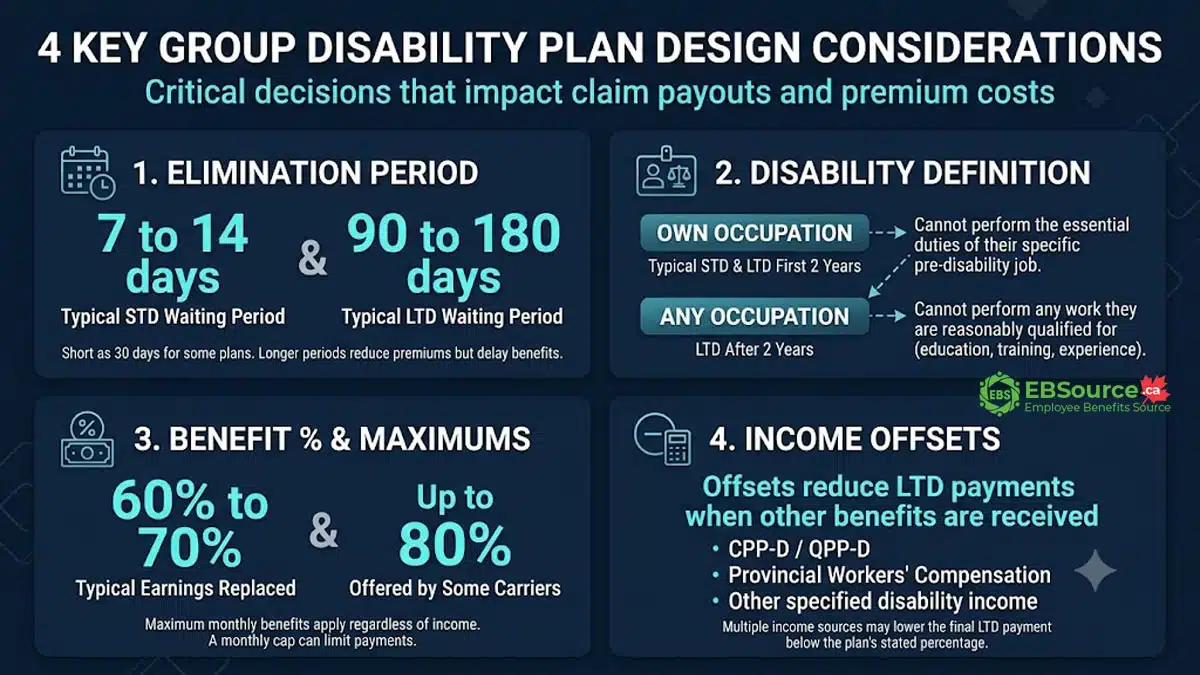
Employers should therefore review each component carefully because these components help employers tailor coverage to their workforce needs and budget while reducing the risk of unexpected gaps in income replacement.
How Long Should the Elimination Period Be?
The elimination period is the number of days between the onset of a disability and the date benefits become payable. It is sometimes called the waiting period. STD elimination periods are commonly 7 to 14 days, while LTD elimination periods typically range from 90 to 180 days, though some plans use periods as short as 30 days. Employers who want to qualify for the EI Premium Reduction Program must ensure their STD plan begins paying benefits no later than the eighth day of disability, as required by Service Canada.
A longer elimination period generally lowers premiums but delays when employees can receive benefits. Employers should coordinate the LTD elimination period with the STD benefit period and any applicable sick leave to reduce the risk of a gap in income replacement before LTD benefits begin.
How Is Disability Defined Under the Plan?
The disability definition sets the standard an employee must meet to qualify for benefits.
STD plans typically use an own-occupation standard, meaning benefits may be paid if the employee cannot perform the essential duties of the specific job they held before becoming disabled.
LTD plans commonly apply the own-occupation standard for the first two years of a claim, then shift to an any-occupation standard depending on the policy terms. Under the any-occupation standard, benefits generally continue only if the employee cannot perform work for which they are reasonably qualified based on their education, training, or experience, as defined by the policy.
Because the definition may change over the course of a claim, an employee who can no longer perform their previous job may not necessarily continue to qualify for LTD benefits. Employers should review the policy’s disability definitions and explain the transition to employees during enrolment so they understand how eligibility may change over time.
What Benefit Percentage and Maximum Should the Plan Provide?
The benefit percentage determines how much of an employee’s pre-disability income the plan will replace. Most LTD plans replace 60% to 70% of pre-disability earnings. Some carriers offer benefit levels up to 80%, and most plans also impose a maximum monthly benefit, regardless of income.
When comparing plans, employers should consider both the replacement percentage and the maximum monthly benefit. A percentage-based benefit may appear sufficient, but the monthly cap can limit payments for higher-earning employees.
The benefit level should provide meaningful income support while taking the plan’s premium cost and the employee’s overall income needs into account. Employers should also review how the plan defines eligible earnings and whether other income sources may reduce the benefit payable.
Which Income Offsets Apply to Disability Benefits?
Offsets are reductions applied to LTD benefits when an employee receives disability income from other sources. Common offset sources include Canada Pension Plan disability benefits (CPP-D), Quebec Pension Plan disability benefits (QPP-D), provincial workers’ compensation payments, and certain other disability income sources specified in the policy.
As a result, an employee who qualifies for more than one source of disability income may receive a lower LTD payment than the plan’s stated benefit percentage suggests. The actual amount depends on the policy’s offset provisions and the other benefits the employee receives.
Employers should review which income sources are offset, how the insurer calculates the reduction, and how offsets interact with the plan’s maximum benefit. Explaining these provisions during enrolment helps employees understand that the stated LTD benefit may not be the final amount they receive.
Beyond the four components above, employers should also consider additional contract terms that shape coverage and cost. These include:
- eligible employee classes and waiting periods
- how the plan defines insurable earnings
- benefit duration limits
- provisions for partial or recurrent disability
- pre-existing condition clauses
- rehabilitation and return-to-work support
- coverage continuation during leave or after termination
- and any conversion or portability options
Reviewing these terms helps ensure the plan meets workforce needs and reduces the risk of coverage gaps.
Source: https://www.canada.ca/en/financial-consumer-agency/services/insurance/disability.html
How Do Premium Arrangements Affect Group Disability Insurance Tax Treatment?
When designing group disability insurance, employers need to decide who pays the long-term disability (LTD) premium because the arrangement affects how benefits are taxed when an employee makes a claim. If the employee pays the entire premium, LTD benefits are generally received tax-free. If the employer pays any portion, the benefits are generally taxable to the employee.
This decision affects the employee’s take-home income during a disability claim, so employers should consider the tax treatment alongside premium costs and their benefits philosophy.
Who Should Pay the LTD Premium?
The Canada Revenue Agency’s guidance on wage-loss replacement plans establishes the following general rule:
| Who Pays the LTD Premium? | Tax Treatment of LTD Benefits |
| Employer pays all or part of the premium | Benefits are generally taxable to the employee. However, employee contributions not previously deducted may reduce the taxable amount. |
| Employee pays 100% of the premium | Benefits are generally received tax-free. |
Note: This is a general summary. The taxable amount can depend on the documented funding history and employee contributions. Employers should confirm the plan structure and payroll reporting with the insurer, payroll provider or qualified tax professional.
When an employer contributes to the LTD premium, disability benefits are generally taxable. However, employee contributions that were not previously deducted for tax purposes may reduce the taxable portion of the benefit.
For tax purposes, employers should distinguish premium funding from benefit payments. Employee-pay-all LTD arrangements generally produce non-taxable disability benefits, while employer-contributed wage-loss replacement plans generally produce taxable benefits, subject to applicable CRA rules. Payroll deductions alone do not establish an employee-pay-all arrangement. Therefore, employers should confirm the actual funding structure and reporting requirements before implementation.
When the employer pays the LTD premium, employees do not have a direct payroll deduction for the coverage. When employees pay the premium through payroll deductions, they bear a visible cost while working but may receive tax-free LTD benefits if they make a claim.
That said, there is no single arrangement that suits every employer. The decision should reflect the employer’s benefits budget, workforce needs and the importance of maximizing employees’ after-tax disability income.
How Does the Premium Arrangement Affect Employees Financially?
To evaluate the options, employers should compare:
- The annual premium employees would pay while working.
- The potential after-tax LTD benefit under an employer-paid arrangement.
- The potential after-tax LTD benefit when employees pay the full premium.
The following example uses an assumed rate of $0.65 per $100 of monthly insured earnings and a 66% LTD benefit. These figures are estimates for illustration purposes only, not insurer quotes or personalized tax calculations. Actual premiums depend on the plan, and the tax impact depends on the employee’s total income, province and applicable tax rules.
| Measure | $50,000 Salary | $75,000 Salary | $120,000 Salary |
| Monthly gross income | $4,167 | $6,250 | $10,000 |
| Illustrative monthly LTD benefit at 66% | $2,750 | $4,125 | $6,600 |
| Estimated monthly employee-paid premium | ~$27 | ~$41 | ~$65 |
| Estimated annual employee-paid premium | ~$325 | ~$488 | ~$780 |
The table above shows the gross benefit and premium amounts. To complete the comparison, employers need to calculate the after-tax LTD income under each arrangement using the employee’s marginal tax rate and any applicable contribution adjustments. The key comparison is the premium paid while working versus the difference in after-tax LTD income during a claim. Employers should use actual plan quotes and employee-specific tax estimates to quantify that difference, rather than treating the full tax on a benefit as an additional cost caused solely by the premium arrangement.
How Does the Group Disability Insurance Claims Process Work?
A group disability claim typically follows seven steps: the employee notifies the employer, the employer and employee submit their statements, the treating physician provides medical information, the insurer assesses the claim and issues a decision, and approved claims move to ongoing management.
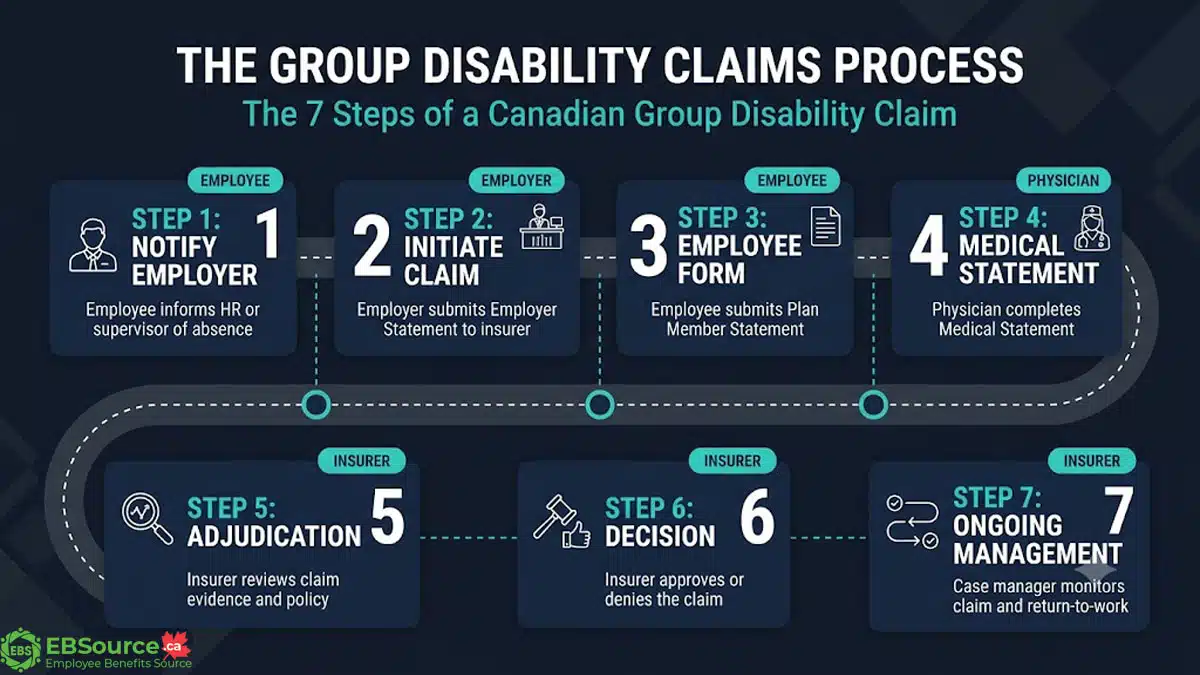
While the process is broadly similar across major Canadian providers, the specific forms and submission methods may vary from provider to provider. The steps below explain how the process works:
Step 1: Employee notifies the employer
This is the trigger for the claims process. The employee informs their supervisor or HR department that they will be absent due to illness or injury and that the absence may extend beyond any available sick leave.
Step 2: Employer initiates the claim with the insurer
The employer completes an Employer Statement form, which provides the insurer with employment details, including the employee’s hire date, salary, job title, job duties, last day worked, available sick leave, and other benefit entitlements.
The employer then submits this form to the insurer through a secure online portal or by email or fax, depending on the insurer’s process.
Step 3: Employee completes their portion
Following, the employee completes a Plan Member Statement (or Employee Statement), which provides details about the nature of the illness or injury, treatment being received, and expected duration of absence. The employee also signs an authorization allowing the insurer to communicate with treating physicians.
Step 4: Attending physician completes the medical statement
A treating health-care professional completes the medical statement or other supporting documentation required by the insurer. The form and accepted provider types depend on the policy and claims process. This typically includes diagnosis, treatment plan, functional limitations, and a prognosis for return to work.
This is a critical form in the process, and missing or incomplete medical information at this stage often delays the insurer’s review and can hold up approval of the claim.
Step 5: Insurer adjudicates the claim
Once all forms are received, the insurer’s disability case manager reviews the medical evidence against the policy’s definition of disability.
Processing times vary by insurer and claim, so these timelines should be treated as insurer-specific guidance, not a guarantee for every claim.
Step 6: Claim decision
The insurer communicates its decision and the applicable next steps. If the claim is approved, the employee receives a letter confirming the benefit start date, the monthly benefit amount, and any applicable offsets. If denied, the employee receives written reasons and information about the insurer’s review or appeal procedures, including any policy-specific deadlines.
Step 7: Ongoing management.
Approved claims are not static. Insurers typically provide ongoing oversight through medical reviews, case management, and return-to-work coordination, though the level of support varies by carrier and plan.
The Employer’s Role During a Group Disability Insurance Claim
Many employers assume their role ends once they submit the Employer Statement. However, they may have ongoing responsibilities under the insurance policy and applicable human rights legislation. These responsibilities can continue throughout the employee’s absence and return-to-work process:
- Maintain contact with the employee. The Canadian federal government’s disability management guidance states that “the manager should make this ongoing throughout the entire recovery and early return-to-work process.” Employers also should keep respectful communication throughout the absence to support return-to-work coordination while protecting the employee’s medical privacy.
- Provide updated employment information. If the employee’s job changes, salary changes, or the employer restructures during the claim, the insurer needs updated information to assess ongoing eligibility and facilitate return-to-work planning.
- Prepare for the return to work. Employers must assess accommodation needs under applicable human rights law and consider reasonable options such as modified duties, graduated schedules, or workplace adjustments. This process is individualized and must account for the specific circumstances and any undue hardship limitations, not simply wait for insurer or physician clearance.
- Do not make employment decisions based on the disability. Terminating an employee because they are on disability leave, or because the employer assumes they will not return, may expose the organization to human rights complaints and wrongful dismissal claims.