



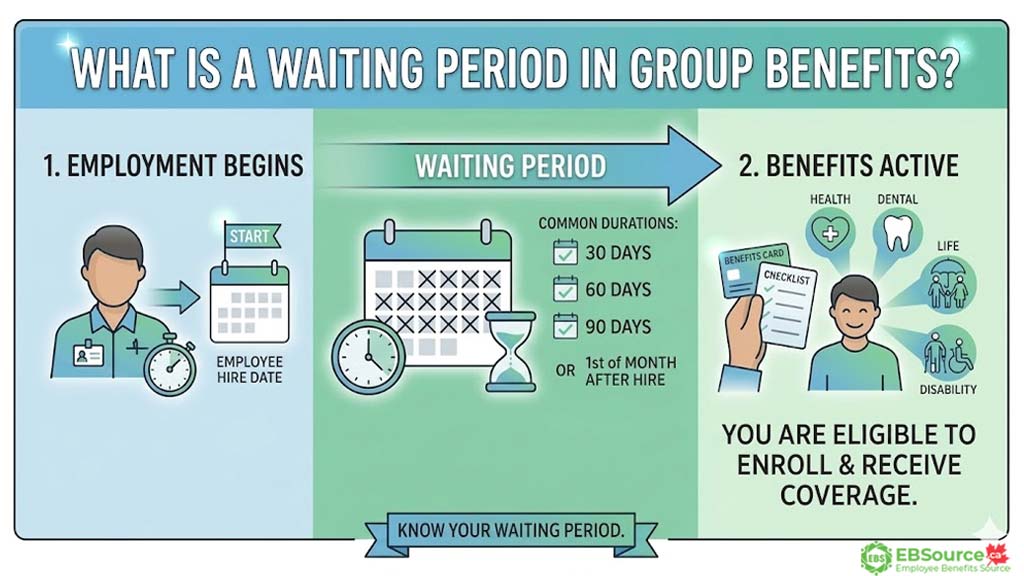
The waiting period in group benefits is the time between an employee’s start date and the date their plan becomes active. Canadian group plans typically offer waiting periods between 0 and 6 months, with 3 months being the most common default.
Setting this period is one of the biggest paradoxes in employee benefits plan design: Employers often implement a strict 3-month or 6-month waiting period to save hundreds of dollars in premium costs, only to lose top-tier candidates to competitors offering immediate coverage. Choosing the right waiting period that keeps your hiring competitive without straining the company budget comes down to balancing four core areas: industry turnover, workforce demographics, market competition, and administrative capacity.
Eligibility rules govern the enrolment window after the waiting period ends and what happens when that window is missed. Employers who understand these rules can negotiate shorter waiting periods or waive them for specific benefit lines to protect employees from coverage gaps.
What is a Waiting Period in Group Benefits?
A waiting period is the time between an employee’s first day of work and the date they become eligible to enrol in the employer’s group benefits plan. During this period, employees generally cannot claim under the group plan unless the employer and insurer have approved a shorter or waived waiting period. A catastrophic illness or serious accident occurring before the plan takes effect may easily leave them exposed to devastating financial risks.
Waiting Period vs Probationary Period vs Elimination Period
Before making any decision, employers must distinguish among the three terms that are routinely confused: waiting period, probationary period, and elimination period.
The probationary period defines the window during which an employer may terminate a new hire without cause or with simplified cause requirements. The length varies by province and employer policy. Meanwhile, the elimination period used in disability insurance is the number of days an employee must be continuously disabled before disability benefits begin.
The table below highlights the core differences between the three types of duration, clarifying what each means, what it applies to, and the common administrative mistakes to avoid:
| Term | Applies to | What it means | Common mistake |
| Benefits waiting period | Plan eligibility | Time before an employee qualifies to enrol in group benefits | Assuming coverage starts on the hire date |
| Employment probation period | Employment relationship | Evaluation window under the employment contract or provincial rules | Assuming it always matches the benefits waiting period |
| Elimination period | Disability claim | Time of continuous disability before STD/LTD begins paying | Confusing it with the eligibility waiting period |
A Decision Framework for Choosing the Right Waiting Periods
Choosing the optimal waiting period requires evaluating four factors: industry turnover rate, workforce demographics, competitive positioning, and administrative capacity.
No single factor should dominate the decision; employers who weigh all factors together generally arrive at a more defensible and sustainable choice.
Industry Turnover Rate
The connection between turnover and waiting period cost is clear. Adding an employee to a group plan involves administrative time, premium payments, and onboarding resources. Industries with historically high turnover rates (such as retail, hospitality or entry-level manufacturing) usually opt for longer waiting periods, often 3 to 6 months.
Turnover heavily impacts a small business’s budget. Waiting until an employee passes probation ensures that the company only pays premiums for retained staff. Meanwhile, large corporations that leverage their size to absorb minor turnover costs use immediate benefits as an effective means of branding and talent retention.
The Action: To remove guesswork, you need to calculate your organization’s specific 90-Day Attrition Rate.
Pull your HR data and look specifically at employees who quit or were terminated in the last 24 months, then divide the number of employees who left within their first 90 days by the total number of new hires within that same timeframe.
Once you have your number, locate your tier in the suggested benchmarks below to determine your strategic plan design:
| Turnover Tier | 90-Day Attrition Rate | What the Data Means | Suggested Action |
| Tier 1: Low | Under 10% | Almost every new hire reaches eligibility anyway. Enforcing a 3-month wait saves virtually zero premium dollars but creates unnecessary recruitment friction for 100% of your candidates. | Shorten or Waive: Move to a 30-day or Day-One waiting period to win top talent. |
| Tier 2: Medium | 10% to 25% | Premium savings are real but moderate. Shifting to Day One won’t break the bank, but it will increase your administrative onboarding workload. | Look at Competitors: If your direct competitors offer Day One coverage, you must match it to protect recruitment. |
| Tier 3: High | Over 25% | You have high early-stage churn. Shortening the wait would expose the plan to massive, unsustainable claim costs from employees who leave before contributing premium tenure. | Maintain a Strict Wait: Keep a 90-day waiting period to help protect your plan’s renewal stability. |
This strategy helps your HR team avoid wasting hours and paying non-refundable premiums when enrolling people who are about to leave.
Workforce Demographics
The age distribution and family composition of your new hires determine how urgently they need coverage and how they perceive a waiting period gap.
- Early-Career Staff: A workforce of single employees in their twenties typically has lower immediate healthcare needs. Thus, a 3-month waiting period rarely causes financial hardship or negative sentiment.
- Mid-Career Staff: A parent with dependents may be managing ongoing orthodontic treatments, regular prescription refills or therapy appointments. A three-month gap forces this family to pay full retail cost for these services, which can easily exceed $1,500 to $3,000.
The Action: Look at the average age of your new hires, the percentage who enrol dependents once eligible, and the percentage who previously held group coverage at another employer over the past two years.
If your typical new hire is 35 or older, has dependents, and is coming from a covered position, your workforce demographics strongly favour a shorter waiting period, ideally one month or day-one eligibility.
Competitive Positioning
In highly competitive sectors (like tech, engineering or executive management), top candidates often expect immediate benefits. Making a highly sought-after professional wait three months for dental or prescription coverage can be a dealbreaker.
The Action: If your hiring is being delayed because of benefits in a tight labour market, conduct a brief competitive scan:
- Ask your benefits advisor what waiting periods are standard in your industry and region.
- Review job postings from competitors that mention benefits timing.
- If you use a recruiter, ask them what candidates report about competing offers.
If the premium increase for immediate or one-month waiting periods is manageable, use this accelerated coverage explicitly as a hook in your recruitment marketing and job postings.
Administrative Capacity
A shortened waiting period only works if your plan administrator can reliably complete enrolment processing within the compressed timeline.
If your company still relies on paper forms and manual entry, reducing this time increases the risk of missing the enrollment window. The employees may need to go through mandatory medical underwriting (Evidence of Insurability) and may be denied coverage for pre-existing conditions. This situation shifts significant financial and legal risks onto the employer.
The action: Assess your current enrolment processing time honestly: How many days typically pass between an employee’s hire date and the date their completed enrolment reaches the insurer?
If this number is routinely 30 days or more, implementing a one-month waiting period without first fixing your administrative workflow will create problems. You would need to either reduce your processing time or maintain a longer waiting period until your systems support faster turnaround.
Can Different Employee Classes Have Different Waiting Periods?
One of the most common mistakes in plan design is applying a one-size-fits-all waiting period across the entire payroll. Insurance carriers allow employers to segment their workforce into distinct classes based on objective criteria in the master contract, for example, employment status, job title, or tenure.
The table below illustrates a practical setup:
| Employee class | Possible waiting period | When it makes sense | Guardrail |
| Class A (Executives/Directors) | Day one | Competitive senior hiring | Must be defined in the master contract |
| Class B (Full-Time Salaried) | 30 – 90 days | Standard stable workforce | Apply consistently |
| Class C (Hourly/retail staff) | 3 – 6 months | Higher turnover | Avoid discriminatory criteria |
| Class D (Part-time eligible) | After the minimum hours threshold | Eligibility depends on hours | Track hours accurately |
| Class E (Unionized) | Contract-defined | Collective agreement controls | Do not override informally |
By structuring a multi-tiered waiting period, you can recruit executive talent while hedging your financial risk against roles with historically high turnover.
The Anti-Selection Guardrail: The classes should be objective, documented in the group contract, and applied consistently. While carriers allow class-based design, you cannot design a class for a single individual just to bypass a rule, nor can you base classes on age, gender or health status. Some carriers may require a minimum number of employees per class to prevent anti-selection – the risk that a class is built solely because an individual has high upcoming medical claims.
Case Study: Securing Executive Coverage When the Carrier Says “No”
Standard policy rules frequently clash with urgent business realities. We recently worked with a tech client who needed to quickly recruit a new CFO. The executive requested immediate benefit coverage upon signing, but the company’s master contract enforced a strict 3-month waiting period for all staff.
While the insurer agreed to waive the waiting period for Health and Dental benefits, they refused to do the same for Long-Term Disability (LTD) and Life Insurance because of underwriting risks.
How we solved the problem: Instead of losing the executive, we restructured a special plan for C-suite executives and negotiated a shorter waiting period for this group. To cover any remaining gap in disability protection, the employer temporarily funded an individual short-term disability policy for the executive’s first 90 days.
This solution allowed the company to onboard their important hire right away, fulfill its promise of “Day One” coverage, and stay aligned with the insurer’s documented rules.
Use this quick diagnostic table to align your business reality with the right plan design:
| Business Model/Industry Profile | Core HR Challenge | Optimal Waiting Period Design | Strategic Rationale |
| High-Growth Tech/Professional Services | Talent scarcity, fierce competition for high-salary specialists. | Class A: Day 1 Class B: First of the month following hire. | Eliminates friction during onboarding; matches market expectations for premium talent. |
| Manufacturing/Logistics/Retail | High early-stage turnover (first 45 days), lower margins. | Class A (Management): 30 days Class B (Hourly): 90 days. | Mitigates premium loss from “churn-and-burn” hiring while protecting management retention. |
| Seasonal/ Project-Based Businesses | Short employment cycles, high volume of contract staff. | All Staff: 90 days (or exclude temporary contracts entirely). | Avoids administrative overhead and continuous mid-month billing reconciliations. |
What are Typical Waiting Period Durations by Benefit Line?
The length of the waiting period varies by type of coverage, including extended health, dental, life, and disability benefits. Employers in the private sector have greater flexibility in designing these periods to fit their business goals, while federal public service plans follow rigid statutory frameworks.
Below is how waiting periods operate across different benefit lines:
Extended Health Care
The common waiting period for extended health benefits is 3 months, which usually aligns with onboarding or internal probation periods. Some employers may shorten it to 1 month to remain competitive, while others extend it to 6 months, especially in high-turnover industries.
For example, under Sun Life’s SunAdvantage plan for small businesses, the standard waiting period is typically set at 3 months (90 days). However, to help recruit top talent or accommodate specific business structures, the carrier offers contract flexibility, allowing employers to choose a waiting period of 0, 1, 2, or 3 months when setting up their master policy.
In the federal public service, the Public Service Health Care Plan (PSHCP) does not impose a mandatory waiting period once the application is approved, but this is an exception driven by the government’s unique position as both the employer and the plan sponsor.
Dental Care
Dental care waiting periods typically range from 3 to 6 months, similar to health plans. However, major services such as crowns, bridges, dentures, and orthodontics may have waiting periods of 6 to 12 months from the date coverage becomes effective. This helps insurers avoid situations where an employee enrolls and quickly submits a claim for a costly service, like a $4,000 crown.
The federal Public Service Dental Care Plan imposes a mandatory 3-month waiting period from the eligibility date. Once you are eligible, you must add a spouse or common-law partner within 60 days of their eligibility date. If you miss this window, a second three-month waiting period is applied before their specific coverage takes effect.
Life and AD&D
Basic life and AD&D coverage is generally subject to a 3-month waiting period, matching the health and dental wait. Coverage amounts are usually set as a multiple of salary (1x or 2x).
Long-Term Disability (LTD)
LTD follows the same 3-month plan membership waiting period as other benefits, but adds its own elimination period.
If a severe illness or injury occurs after they are enrolled, they must then satisfy a separate elimination period (typically 13 weeks) of continuous disability before the first financial payout is issued. Because of the extreme financial risks associated with long-term wage replacement, private insurers almost never permit employers to waive the waiting period for disability lines.
Note: The elimination period is a feature of the claim process, not the plan membership process. An employee who has been enrolled for two years still must satisfy the elimination period when they become disabled.
Source: Life events: public service group insurance benefit plans – canada.ca
Eligibility Rules That Apply Once the Waiting Period Ends
Reaching the end of a waiting period does not guarantee automatic coverage. To ensure entry into the plan, you must meet certain eligibility rules, including the Actively At Work (AAW) rule, the minimum weekly hours requirement, and the enrollment window rule.
Here is how each rule works:
The Actively At Work (AAW) Rule: Many group contracts require the employee to be actively at work on the date coverage becomes effective. If you are absent because of illness, injury, leave, or another approved absence, your coverage may be deferred until the day you return to work.
Minimum Hours Requirement: Most private plans require employees to work a minimum number of hours (often 20-25 hours per week). If you are hired part-time and later increase your hours above this threshold, the waiting period begins on the date your hours increase.
The 31-Day Enrolment Window: Once the waiting period ends, employees generally have 31 days to complete the enrolment. If you want to cover a spouse, common-law partner or children, you must declare them during this window. Enrolling after that means you and your dependents will be subjected to strict medical underwriting and could be denied coverage entirely.
How to Calculate the Eligibility Date After a Waiting Period
Most late applicant problems trace back to miscalculating these dates. Use the table below as a working logic for each new hire:
| Item | What it means | Why it matters |
| Hire date | Start of employment | Not always the same as the benefits start date |
| Waiting period | Time set by the master contract | Determines when eligibility can begin |
| Eligibility date | Date employee qualifies if other rules are met | Starts enrolment/admin workflow |
| Enrolment deadline | Usually 31 days after eligibility/effective date, depending on the contract | Missing it can trigger late applicant rules |
| Coverage effective date | Date coverage actually starts | Depends on the contract wording and form timing |
| Late applicant date | After the enrolment window | May trigger EOI, restrictions or decline |
Calculate the Eligibility Date
If a plan has different waiting periods across benefit lines, the contract will specify which benefit determines the coverage effective date. Confirm this with your carrier rather than assuming.
Example Timeline for a New Hire
A new employee is hired at a small business that has selected a SunAdvantage plan featuring a 7-day sickness waiting period for STD, 17 weeks of STD coverage, and a 120-day elimination period for LTD, with both paying out at a 66.7% benefit formula.
June 1: Starts Work.
The employee starts work.
September 1: Eligibility date.
The employee has satisfied the employer’s standard three-month probationary period.
September 30: Enrolment deadline.
The employee successfully enrolls in the SunAdvantage group benefits plan, including Extended Health Care, Dental Care, Basic Life, STD, and LTD.
November 15: Employee Becomes Totally Disabled.
Employee becomes totally disabled due to a severe non-work-related illness (sickness).
November 15 to November 21 (7 Days): STD Waiting Period.
The employee satisfies the SunAdvantage STD waiting period for sickness. Employers can choose 3, 7, or 14 calendar days; this plan uses 7 days.
November 22: First STD Payment.
The employee begins receiving weekly STD payments. They receive 66.7% of their regular income, capped at the plan’s maximum of $1,750 per week.
November 22 to March 14: STD Duration.
The employee continues to receive weekly STD payments while they recover. Concurrently, this time counts toward their LTD elimination period.
November 15 to March 15 (120 Days): LTD Elimination Period.
The employee is meeting the 120-day LTD elimination period. SunAdvantage allows employers to choose 90, 105, 112, 120, or 180 days.
March 16: Transition to LTD.
The 120-day LTD elimination period is complete. The STD benefit ends, and the employee receives their first Long-Term Disability payment. They will now receive monthly LTD payments (e.g., 66.7% of their monthly income, up to a maximum of $12,000 per month) until they can return to work or reach age 65.
If the employee missed the September 30 enrolment deadline and became disabled before STD or LTD coverage was approved, they may not have been insured for that disability claim at all, depending on the contract, late-applicant rules, and underwriting outcome.
Waiting Period Documentation Checklist for Plan Administrators
A waiting period only functions as intended when the Plan Administrator maintains consistent documentation at every stage. The following table details the key documentation items needed for the full lifecycle of an employee’s waiting period: pre-hire, onboarding, during and after the waiting period.
| Stage | Key Documents | Purpose |
| Pre-hire | Signed offer letter with a waiting period clause Current benefits booklet Insurer policy contract | Establishes employee awareness and confirms accurate representation of terms |
| Onboarding/Day one | Benefits orientation document with eligibility date Signed acknowledgement Enrolment package issued with a deadline | Triggers the waiting period clock and initiates the enrolment process |
| During the waiting period | Reminder communications with timestampsInternal tracking logNotes on employee inquiries | Demonstrates employer diligence and provides an audit trail |
| Eligibility date | Completed enrolment form Proof of insurer submission Insurer confirmation Employee coverage confirmation letter | Confirms timely processing and coverage activation |
| Ongoing | Consolidated benefits record per employee Annual renewal documents Archived plan summaries by year | Supports long-term dispute resolution, audits, and compliance |
Each item exists to protect both the employer and the employee: the employer gains proof that obligations were met and timelines were communicated, and the employee gains a clear record of when coverage begins and what steps they must complete. Missing or incomplete records create disputes, delay coverage, trigger late applicant status, and expose the employer to liability when employees claim they were never informed of the timeline.
Frequently Asked Questions About Group Benefits Waiting Periods
Can an employer waive the waiting period for one employee?
An employer should not waive the waiting period informally for one employee. A waiver should be supported by the group contract, a defined benefit class, or written insurer approval. Informal one-off waivers can create fairness, contract and underwriting problems
What happens to the waiting period if the employee quits and then returns?
It depends on the group contract. Some plans credit the previous waiting period if employees are rehired within a specified period, while others restart the waiting period after a longer break.
Can employees enrol mid-year just because they changed their mind?
Usually, employees cannot simply change their mind and enrol mid-year without a qualifying life event or plan-approved reason. If they waived coverage initially (without a valid spousal coordination reason) and then change their mind, the insurer may treat them as a late applicant and require medical underwriting or apply a restriction.
